Note: If you wish to receive, via e-mail, (1) my weekly newsletter or (2) daily copies of these posts, write to me at rrbates1951@gmail.com. Comments may also be sent to this address. I promise not to share your e-mail with anyone. To unsubscribe, write here as well.
Thursday
Somehow I stumbled across an Outdoor Life article, posted by the author on Bluesky, that brought to mind the 15th century Arthurian romance Sir Gawain and the Green Knight. I use it to take a break from the dispiriting political news that pounds us day after day.
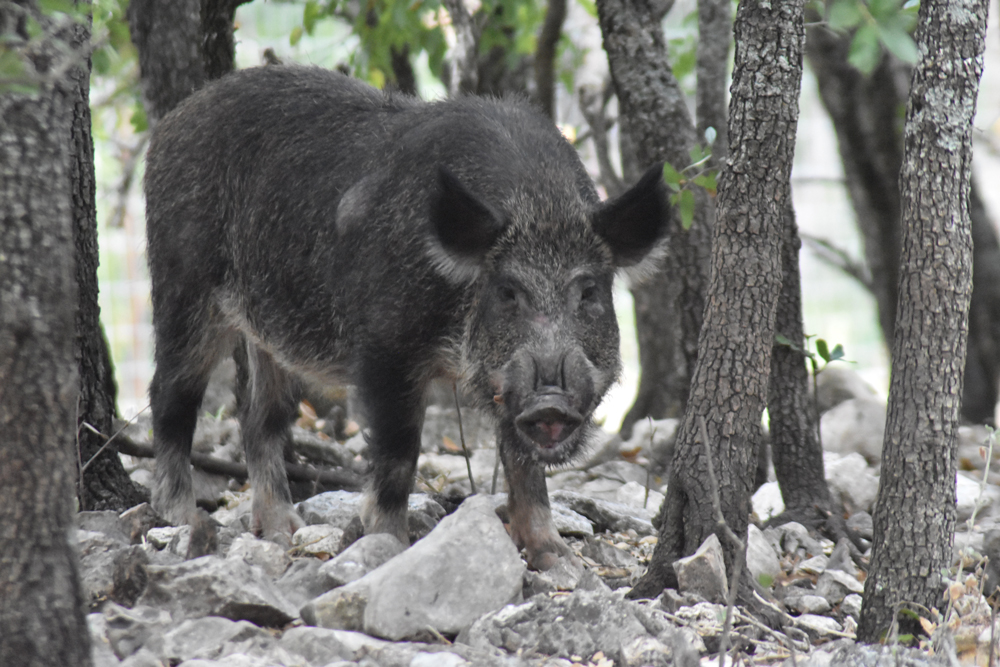
The headline that caught my eye was, “I’ve Been Charged by Bears and Moose. Wild Hogs Are Much, Much Worse.” The subtitle reads, “Over the years I’ve had my fair share of run-ins with big game. The only critters that seem to have no sense of fear are feral pigs.”
Hunter and photographer Charles Elliott elaborates:
Over the years, my contacts with big game have led me to believe that the only tribe that has no sense of fear is the one to which pigs belong. This includes the European wild boar, introduced into our Eastern mountains and Southern coastal islands in the early part of the century, and feral hogs that have escaped civilization and made it on their own in the swamps and mountains. They have noses and ears as sensitive as deer. Most of the time, when a lone hunter approaches, they are wise enough to vanish into the brush or to run before a dog pack. But, cornered or in sudden confrontation, they are most likely to charge or put on a hair-raising demonstration of their ferocity.
The author goes on to report stories of otherwise fearless hunters shimmying up trees to escape the wild boar charges.
Among the many reasons why Green Knight is among my top five favorite works of literature is how, in Part III, the poet crosscuts between men hunting game in the forest and a woman “hunting” Gawain in the castle. The use of this technique, which D. W. Griffith rediscovered in Birth of a Nation 550 years later, serves to heighten both the suspense and the intensity of both chases. Here’s the hunt:
Then they [the hounds] rile the creature with their rowdy ruckus
and suddenly he breaks the barrier of beaters,
–the biggest of wild boards has bolted from his cover–
ancient in years and estranged from the herd,
savage and strong, a most massive swine,
truly grim when he grunted. And the group were aggrieved,
for three were thrown down by the first of his thrusts;
then he fled away fast without further damage.
The Other huntsmen bawled “hi” and “hay, hay,”
blasted on their bugles, blew to regroup,
so the dogs and the men made a merry din,
tracking him noisily, testing him time and time
and
The board would stand at bay
and aim to maul and maim
the thronging dogs, and they
would yelp and yowl in pain.
The next stanza is more of the same, only note the dramatic but also comic shift at the end, where the Lady of the Castle advances on a sleeping Sir Gawain:
Then the archers advanced with their bows and took aim,
shooting arrows at him which were often on target,
but their points could not pierce his impenetrable shoulders
and bounced away from his bristly brow.
The smooth, slender shafts splintered into pieces,
and the heads glanced away from wherever they hit.
Battered and baited by such bombardment,
in frenzied fury he flies at the men,
hurts them horribly as he hurtles past
so that many grew timid and retreated a tad.
But the master of the manor gave chase on his mount,
the boldest of beast hunters, his bugle blaring,
grumpeting the tally-ho and tearing through thickets
till the setting sun slipped from the western sky.
So the day was spent in pursuits of this style,
while our lovable young lord had not left his bed,
and, cosseted in costly quilted covers, there he
remained
The lady, at first light,
did not neglect Gawain,
but went to wake the knight
and meant to change his mind.
We watch the lady relentlessly tempting and teasing Gawain, who is simultaneously working to remain chaste without striving to remain chivalrous and accommodating. (A Groucho Marx line from Duck Soup comes to mind:“We’re fighting for this lady’s honor, which is more than she ever did.”) Then it’s back to the boar.
Then [Gawain] loitered with the ladies the length of the day
while the lord of the land ranged left and right
in pursuit of that pig which stampeded through the uplands,
breaking his best hounds with its back-snapping bit
when it stood embattled…then bowmen would strike
goading it to gallop into open ground
where the air was alive with the huntsman’s arrows.
That boar made the best men flinch and bolt,
till at last his legs were like lead beneath him,
and he hobbled away to hunker in a hole
by a stony rise at the side of a stream.
With the bank at his back he scrapes and burrows,
frothing and foaming foully at the mouth,
whetting his white tusks. The hunters waited,
irked by the effort of aiming from afar
but daunted by the danger of daring to venture
too near.
So many men before
had fallen prey. They feared
that fierce and frenzied boar
whose tusks could slash and tear.
Following much commotion, the hunt finally comes to an end:
Till his lordship hacks up, urging on his horse,
spots the swine at standstill encircled by men,
then handsomely dismounts and unhands his horse,
brandishes a bright sword and goes bounding onwards,
wades through the water to where the beast waits.
Aware that the man was wafting a weapon
the hog’s hairs stood on end, and its howling grunt
made the fellows there fear for their master’s fate.
Then the boar burst forward, bounded at the lord,
so that beast and hunter both went bundling
into white water, and the swine came off worst,
because the moment they clashed the man found his mark
knifing the boar’s neck, nailing his prey,
hammering it to the hilt, bursting the hog’s heart.
Screaming, it was swept downstream, almost slipping
beneath.
At least a hundred hounds
latch on with tearing teeth.
Then, dragged to drier ground,
the dogs complete its death.
As I interpret the poem, it is about humans learning to appreciate and love life in the decades following the great plague, which wiped out half of Europe’s population. Gawain looks with contempt at life, perhaps as a psychological coping mechanism in an age of death (he sees self-denial as a Christian and knightly virtue), and so has to be taught to value it as the gift that it is. This is the lesson the Green Knight has for him. In the hunt we see the creatures fighting for life while in the castle hunt we see the sweetness of sexuality. The Lord of Death and the Lady of Life divide creation between them.
In the end, Gawain is forced to concede that he cares for his life after all. This admission comes reluctantly and with a fair amount of shame attached but it does come. We, meanwhile, can see in the lord’s quarry—the deer, the boar, and the fox—the three ways we respond to death: we deny it (like the deer, who are caught unawares), we fight it (like the boar), or we seek to escape it (like the fox). And just as the Lord of Death always gets its prey, so does the Lady of Life, who persuades Gawain to accept from her a life-saving belt.
But back to boar hunting. Thanks to rifles, hunters now have an unfair advantage. Still, boars themselves haven’t changed.
They still refuse to go gently into that good night.