Friday
My English professor son, who like many in academe is grappling with AI, has found the right book to capture one pressing issue: Dr. Seuss’s Butter Battle Book.
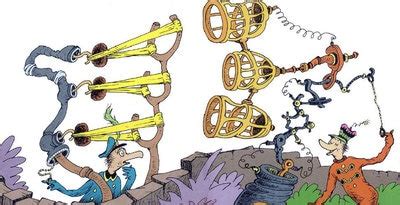
Alongside an illustration from the book, Tobias Wilson-Bates posted on Bluesky,
The solution to AI cheating in the classroom cannot be buying into deeply flawed AI detection tools marketed by the same companies selling the AI being used for cheating in the first place.
The situation reminds me of an even more disturbing one imagined by Margaret Atwood in her dystopia Oryx and Crake. In it giant, unregulated pharmaceutical companies release deadly viruses into the population, which can only be cured by drugs they themselves are selling. Buy the drug or die.
The Seuss illustration provided by Toby is of two weapons of war in an ongoing war between the Yooks and the Zooks. The Yook weapon hurls rocks while the Zook weapon catches them.
The rivalry stems from disagreements over which side of the toast should be buttered. As “Grandpa,” a former member of the Zook-Watching Border Patrol, explains to his grandson,
“But we Yooks, as you know,
when we breakfast or sup,
spread our bread,” Grandpa said,
“with the butter side up.
That’s the right, honest way!”
Grandpa gritted his teeth.
“So you can’t trust a Zook
who spreads bread underneath!
Every Zook must be watched!
He has kinks in his soul!”
Those familiar with Gulliver’s Travels may see an echo here of the Big Endians and Small Endians, who fight endless wars over which is the proper way to break an egg. Swift has in mind the bloody rivalries between Catholics and Protestants. According to Wikipedia, Seuss also drew inspiration from the Pope-related battles in medieval Italy between the Guelphs and Ghibellines, where one side was accustomed to cutting their apples horizontally and the other vertically.
Seuss’s Yook-Zook rivalry is a reference to the decades-long U.S.-Soviet Union arms race, with Reagan’s “Star Wars” defense shield being the latest entry in that contest. I recall a 1960s column by political satirist Art Buchwald about missiles, anti-missiles, anti-anti-missiles, and anti-anti-anti-missiles in which one of these projectiles, becoming confused, shoots itself down.
So the AI that enables students to write papers that are not their own will be countered by AI that detects them doing so. Next we can anticipate programs that will evade detection systems, followed by programs designed to expose the evaders. The developers, meanwhile, make money each step of the way.
My son believes that we can’t look for technological fixes to this technological development and is increasingly having his students do much of their writing in class. For his part, my tennis partner and Sewanee Review editor Adam Ross has his creative writing classes write about work published in the Review, to which AI has been denied access.
Butter Battle imagines a different outcome, with each side developing technology so powerful that it will end all human life, the Bitsy Big-Boy-Boomeroo. As the two escalating forces approach each other, we get this warning in the book’s open conclusion:
“Grandpa! I shouted. “Be careful!
Oh, gee!
Who’s going to drop it?
Will you . . . ? Or will he . . . ?
“Be patient,” said Grandpa. “We’ll see.
We will see . . . “
Will AI end learning as we know it? Will the massive AI centers swallow up all our personal information, even as they empty our aquifers and dramatically increase carbon pollution, thereby hastening climate change? Will AI change what it means to be human? We’ll see, we will see.