Note: If you wish to receive, via e-mail, (1) my weekly newsletter or (2) daily copies of these posts, write to me at rrbates1951@gmail.com. Comments may also be sent to this address. I promise not to share your e-mail with anyone. To unsubscribe, write here as well.
Thursday
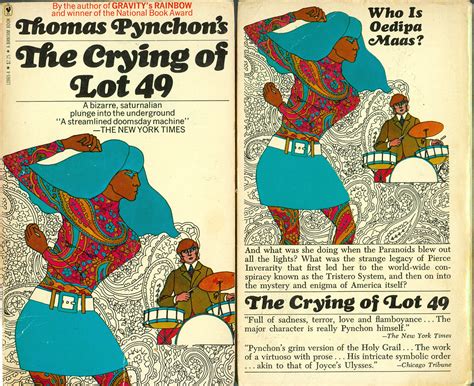
Back when Barack Obama was president and we were first encountering QAnon, Birtherism, Pizzagate, and other unhinged conspiracy theories, there were two literary works I turned to: Jorge Luis Borges’s “Tlön, Uqbar, Orbis Tertius” and Thomas Pynchon’s The Crying of Lot 49. (I’ve provided links to those posts below.) In the Borges short story, a Memphis millionaire makes up a fantasy world that is so compelling that it supplants the actual world, while in Pynchon’s novella heroine Oedipa Maas uncovers a conspiracy so vast and complicated that she wonders whether she’s going crazy. With his open ending, Pynchon never lets us know for sure.
Ace blogger Greg Olear enthused about Pynchon and Lot 49 this past Sunday. Despite its intricate plot, however, Olear says that the novella looks like a children’s book when compared with Trump’s career arc.
Olear lists some of the elements of Pynchon’s plot, but don’t worry if you can’t figure out how they fit together. It’s a challenge even if you’ve read the book. The connecting thread is Oedipa thinking she has uncovered a secret and illegal postal service that is centuries old:
Lot 49 is a paranoid adventure, a sort of Dark Night of the Soul that goes on for weeks and weeks. It involves a dead multi-millionaire, a conspiracy involving rival postal services, a nerdish counterculture, a child actor all grown up, a thought experiment debunking the second law of thermodynamics, rare stamps trollishly defaced, swastika armband manufacturers, Jacobean revenge plays, obscure used books, Nazi psychotherapists, disc jockeys and knockoff Beatles bands with a yen for “beautiful women…many of them on the younger side,” gay bars, a symbol of a muted postal horn, physics, engineering—and those are just the highlights.
Got that? Okay, now hang on for Olear’s description of what we have been seeing with our own eyes:
If I tried to describe the full plot [of Lot 49], in all of its kooky details, you would say, “That makes no sense! Why would anyone write a book about that?” But then we recall another plot, this one of a terrible show now in its ninth season: a New York real estate mogul, a creature of organized crime, after running afoul of the Russians, is co-opted by the Kremlin; sold to the American people as a successful businessman because of a reality show that portrays him as such; is installed in the White House by dint of an insidious social media campaign that demonizes his opponent; meets his Russian overlord in Helsinki, where he cowers before him despite being much taller; denies being a puppet; maintains the support of the American people because of “fake news;” botches the response to the first bona fide plague we’re had in 100 years; is voted out; leads an attack on the Capitol to remain in place, fails, and reluctantly leaves; is indicted four times in four jurisdictions only to have three of the cases get tossed, because the state prosecutor hired her sidepiece, and the special counsel brought the cases in Florida, where they are kiboshed by a corrupt judge no one bothers to investigate; is found guilty in the fourth, but serves no prison time; loses several cases in civil court so owes hundreds of millions of dollars, doesn’t pay; pretends to be injured in an assassination attempt; sells merch based on the images from the assassination attempt; wins election soon after, because his original opponent had a senior moment on national TV and America is racist and sexist; immediately forms a secret state police to deport residents and eventually dissidents (we all assume); sabotages our relationship with our allies and resets our foreign policy to align with Moscow’s; plunders from the U.S. taxpayer, issues fake money, accepts lavish gifts from foreign entities including a jumbo jet; invites conspiracy theorists to advise him and maybe even perform fellatio upon him; gins up a fight with Venezuela for some reason; says bat-shit stuff on TV on the regular; shits his pants; uses the full power of the presidency and the DOJ and the FBI to conceal his intimacy with one of the two most notorious child sex traffickers of all time, wishes the other one well and contemplates pardoning her; pardons drug dealers and swindlers and thugs who give him money; fails to properly flip a coin at a football game—and that’s just off the top of my head. Worst of all, we don’t know how this ends. No outcome is off the table. Like, none. Consider: a leaked sex trafficker email suggested that one president had sucked off another—and we didn’t immediately dismiss that as crazy.
Each one of these plot twists features rabbit holes into which one can disappear. Take the notorious child sex traffickers. Olear says that Lot 49 presages the Epstein situation in that the two contain a number of common elements. These include
a conspiracy that keeps getting bigger and bigger, and more and more perplexing, the more I dig into it. Lot 49 may well describe the murky confusion of the offshore finance system (“assets numerous and tangled”). Or the Epstein sex trafficking network itself—there are, in the book, a few references to pedophilia, and many parallels to the here and now: Nazis, perverts, secret societies, mad real estate developers, science, tech, big money, obscure law firms, conspiracy—even proto-memes…in the form of the defaced stamps.
Olear acknowledges to feeling like Pynchon’s protagonist as he tries to sort it all out:
I am Oedipa, my brain is full, I doubt my own sanity at times, I have a cocktail or two on Friday nights to calm my jangled nerves, I crank out piece after piece after piece about the Epstein madness, about the evil men at the heart of our darkness, and for all my relentless detective work, I am no closer to the truth.
One can sympathize. After all, this is what he is seeing:
The emails, the photographs, the survivor accounts, the civil suits, the foreign intelligence services, the shell companies, the banks, the lawyers, the models, the scientists, the trafficked girls, the massage tables, the creepy masks on the wall, the bad artwork, the money, the power, the influence: the enduring mystery. Names we know, IRL characters we’ve met—we look at them differently once they know that we know. But do we know, really? What do we know? What is there to know? And: do we even want to know? After all, the whole point of Oedipus Rex, to which titular king the name of Lot 49’s protagonist clearly alludes, is that there are some secrets we’re better off not discovering.
Another parallel Olear draws between Pynchon and the Trump administration had me laughing out loud. One of the joys of Pynchon is his character and place names, including (in Lot 49) “Genghis Cohen, Mike Fallopian, Emory Bortz, Randolph Driblette, Dr. Hilarius; a law firm called Warpe, Wistfull, Kubitschek and McMingus; a town called St. Narcisso; a gay bar in San Francisco called The Greek Way.” Olear could have added Oedipa’s disc jockey husband Mucho Maas and Gravity’s Rainbow protagonist Tyrone Slothrop.
But even Pynchon can’t compete with the reality of the two Trump administrations. “How many names in the MAGA-verse,” Olear asks,
would feel right at home in the universe of Lot 49? Elon Musk, Rex Tillerson, Steve Mnuchin, Lee Zeldin, Peter Thiel, Laura Loomer, even good guy Reality Winner. And none of Pynchon’s nine novels contain a single moniker more Pynchonesque than Reince Priebus.
In one past post on “Tlön, Uqbar” and Lot 49, I turned to Yale Professor Peter Brooks’s Seduced by Story: The Use and Abuse of Narrative, who warns about the dangers of unbridled fiction. Brooks even opens his book with a cynical line from Game of Thrones: “There’s nothing in the world more powerful than a good story. Nothing can stop it. No enemy can defeat it.” The observation is delivered by the dwarf Tyrion as he elevates Bran the Broken to the throne. As I noted then, we Americans, to our sorrow, have seen how far an unscrupulous man can go by relying upon nothing more than the fictions he tells.
While I admire Brooks’s book, I expressed skepticism about his solution, which is that students should be taught how fiction works. In other words, English teachers should focus on narratology. While I can’t entirely argue since I myself offer such instruction daily on this blog, a more powerful response is exciting students about good books. As I’ve written in the past,
Once students, through great literature, develop an expansive vision of human possibility, they will not be satisfied with shallow and manipulative fictions. Deep people don’t settle for trashy stories, whether from authors or politicians. Their very contact with sublime art enables them to see through bullshit.
Fiction is not the enemy. The enemy is bad fiction and the scoundrels who wield it.
Previous posts on “Tlön, Uqbar” and Lot 49
The Elaborate Plots of Conspiracy Nuts (April 22, 2104)
Lit vs. Fabricated Reality (Sept. 25, 2014)
The Postal Service under Attack (Again) (April 15, 2020)
The U.S. Postal Service and Conspiracy Theories (Aug. 26, 2020)
Fiction as Authoritarian Weapon (Dec. 21, 2022)