Note: If you wish to receive, via e-mail, (1) my weekly newsletter or (2) daily copies of these posts, write to me at rrbates1951@gmail.com. Comments may also be sent to this addss. I promise not to share your e-mail with anyone. To unsubscribe, write here as well.
Friday
An English graduate program is, by definition, literature-intense, which means that recounting how this stage of my life intersected with poetry and fiction risks overshadowing everything else in my life. This “everything else” included my developing marriage with Julia, then in its third year, and the birth of our first child four years later. For simplicity’s sake I will separate the academic out from the personal, starting with the academic.
In tracking my intellectual development in those years, I use as a model a book I read in a Carleton class on “The 20th century French Novel.” Roger Martin du Gard’s Jean Barois is the life story of a man who is raised Catholic, breaks with the church and his devout wife over his scientific interests, becomes an activist intellectual in response to the Dreyfus affair, and finally circles back to his Catholicism and his wife at the end of his life. Given that I was going through my own intense intellectual exploration, Jean Barois read to me less like a novel and more like, well, life.
I mention the novel here because I think it has helped shape how I am writing this memoir and how I see my life. Like Barois’s life arc, mine has progressed through various intellectual, political, literary, and religious movements.
[As an aside, I find myself amazed at all the novels that Don Scheer assigned in that class. In ten weeks we read, in French, Jean Barois, André Malraux’s La Condition Humaine, Jean Paul Sartre’s Nausea, Albert Camus’s The Plague, and Michel Butor’s La Modification. And Scheer had also been planning to have us read Simone de Beauvoir’s Les Mandarins but dropped it.]
So what were my movements? The year was 1975, which meant that the political tumult caused by the Vietnam War and the Black power movement was subsiding. I came from Carleton carrying my intellectual Marxism although, if truth be told, it was a fairly benign Marxism since I was also committed to Martin Luther King’s principles of non-violence. At Emory I encountered New Criticism, which still had a strong hold on English Departments, and I felt out of my depth when I saw my fellow students ferreting out image patterns running through works. They appeared to me as magicians pulling rabbits out of hats, which led me to believe that literary criticism was an arcane discipline where one, like Talmudic rabbis, read between the lines to discover the work’s deep secrets. I desperately wanted to acquire this ability, even if I wasn’t sure where it was supposed to lead.
New Criticism is a formalist approach to literature, which is to say it focuses above all on the text while giving short shrift to author, reader, and historical context. Its successors—structuralism and deconstruction—did the same. As I would break with formalism once I discovered its limited scope, I’d like to say a few words in its defense. If scholars focused exclusively on the text for several decades, it was because they were so enthralled by literature’s dazzling complexity that it seemed enough to devote all their energies to that purpose. Why study such secondary topics as authors’ lives and time periods, not to mention what readers carry away from a work, when the works themselves are so thrilling.
Although I developed my own close reading skills, I was fortunate that not everyone at Emory was a dyed-in-the-wood New Critic. Victorianist Jerome Beaty introduced me to reception theory in a departmental presentation he gave on Jane Eyre. The novel, he pointed out, played with and ultimately overturned the expectations that readers brought to it, especially gothic expectations. In other words, the work is engaged in an active dialogue with the reader. In his talk Beaty recommended the German reception theorist Hans Robert Jauss, and when I read Jauss’s major article I discovered there was a place for me in literary scholarship after all.
Jauss argues that great literature widens a reader’s “horizon of expectations” whereas lesser literature just confirms what the reader already knows. While Jauss is somewhat modest in his claims—he’s just talking about how literary history evolves—I immediately took the next step: great literature, I wanted to believe, radically changes readers and (because readers are part of society) history itself. In my college senior thesis I had argued that the French Enlightenment brought about the French Revolution, and now I had someone explaining how such momentous change could happen.
I immediately put the theory to work in Beaty’s “Early Novels of Charles Dickens,” arguing that, in Martin Chuzzlewit, the author springs a trap on the reader. Because Dickens had already established the family hearth as the most holy place in British society—he was beloved for warm family scenes in The Pickwick Papers, Oliver Twist, and The Old Curiosity Shop—readers were shocked when the author placed a hypocritical villain spouting Dickensian platitudes smack dab in the middle of this hearth. Dickens was concerned that people were only paying lip service to these values, embracing them on Sunday before returning on Monday to ruthless laissez faire capitalism. Dickens wanted to shake his audience up and shake them up he did: Martin Chuzzlewit would be his first commercial failure and only years later did they come around to praising it. Jauss would say their horizon had to be widened before that could appreciate the novel’s vision.
I felt like I shouldn’t apply reader response theory to every work I studied—I wouldn’t learn anything new if I did the same thing over and over-—so I branched out and experimented with other approaches in other classes. Some resulted in essays that felt inauthentic (see my post on inauthenticity here), others moved me forward. Of the latter, I took a class in Carl Jung and saw how literature could function as a kind of therapy, changing lives in the process. In a Chaucer class I wrote about how the Wife of Bath wants to be one of the guys, with her prologue and tale expressing longing and frustration.
I brought all my interests together in my dissertation, contending that the Scottish novelist Tobias Smollett used his novels to understand the economic, political, and cultural shifts underway in his society. Literature, I contended, could work as a social barometer.
During my time at Emory I developed a deep friendship with Norman Finkelstein—the noted poet and literary scholar, not the outspoken critic of Israel—and together we explored various form of literary Marxism. For a brief moment we flirted with the ideas of Lyndon LaRouche, who saw philosophers and artists playing a major role in world history. In LaRouche’s view, Aristotle and his intellectual and artistic heirs have had a deleterious effect on history whereas Plato and those who followed in his wake (Renaissance artists and the Romantics among them) offer a vision of the true and the good. Norman and I quickly learned that Larouchites were narrowly doctrinaire—LaRouche had his origins in Trotskyism but swung hard to the right in his later years—but the idea that literature could play a significant role in history was heady stuff.
We were also drawn to the Marxist criticism of such figures as Terry Eagleton and Frederic Jameson. Both warned against literature that towed a party line (they called this “vulgar Marxism”) and argued that great literature opened the mind to progressive possibilities, even when the authors were themselves conservative. (I remember applying these ideas in a Jane Austen essay, arguing that the author is seeking wholeness in a world that she feels is falling apart.) Ultimately our scholarship would go in different directions, with Norman pursuing a more esoteric path, I a more utilitarian one. The friendship, however, was one of the high points of my graduate experience, and it has continued to this day.
I mention one other development although it is only peripherally connected to literature. Film historian David Cook had begun teaching film classes in the English Department and I became enthralled with cinema. Movies had an immediacy that balanced out my focus on 18th century studies: I could examine how they change contemporary lives as authors like Fielding, Smollett and Austen had once changed past lives. An essay I wrote for Cook on the Czech New Wave—I argued that the films produced in 1967 and 1968 redefined socialism in ways that galvanized the Czech populace but threatened Soviet control—would become my first scholarly publication. I would subsequently introduce film classes to St. Mary’s College of Maryland and travel to Yugoslavia to study its cinema. My major scholarly publications are in film rather than in literature, even though my deepest love has always been literature.
As I look back, I realize my scholarly life could have taken a different direction—a road not taken—had I chosen a different dissertation topic. I thought I wanted to study how literature could change history and, since satire seemed the form of literature most concerned with changing lives, I mentioned this to Paul Hunter. He suggested I write about Smollett, the ship surgeon turned novelist, and I dutifully went along, even though I didn’t really like him. (Smollett is grumpy all the time, so much so that fellow author Laurence Sterne once referred to him as Dr. Smellfungus). It’s hard to pursue scholarship where there’s distaste. In retrospect, I wish I had chosen a topic related to a presentation Hunter once delivered to the department.
In “The Loneliness of the Long Distance Reader,” Hunter talked about the radical experience of immersing oneself in the new (or novel) genre that had burst upon the public in the 18th century. People became acquainted with a new kind of solitude, and their engagement with novels was sometimes so intense that some wives would disappear for days in works like Samuel Richardson’s Clarissa, which is over a million words long. Domestic duties were abandoned, servants slacked off, and husbands became upset, all because of a new literary form. No wonder so many critics attacked or satirized the novel in that century, leading to Jane Austen’s mixed defense in Northanger Abbey.
If, in discussing possible dissertation topics with Hunter, I had said, “I want to do something along these lines,” I would have delved into accounts of reading rather than focuses on an author about whom I was indifferent. This in turn would have linked me up with scholars who were beginning to focus on the reader, and I would have written articles and books on the subject. Instead, I wrote articles about Citizen Kane, Jean Renoir’s Rules of the Game, and other films.
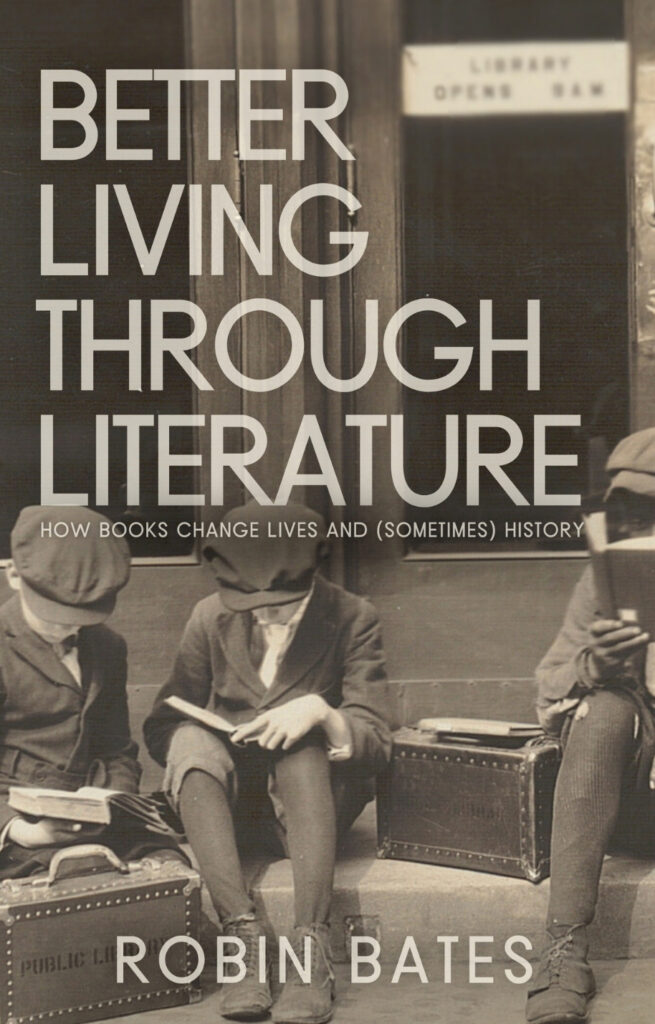
Am I (to borrow from Robert Frost’s “The Road Not Taken”) saying this with a sigh? A little. Then again, my incursion into film studies led me down such interesting paths—an article co-written with my father, a lifelong relationship with Slovenia—that I can’t complain. And, in the end, I have returned to my early interest in how literature changes lives and (sometimes) history.
In the short story “The Garden of Forking Paths,” Jorge Luis Borges has a different take on Frost’s poem, noting that sometimes paths that diverge go on to reconverge at a later time. The landscapes through which one travels may be different, but the end point can still be the same, or at least can rhyme. A question first formulated in college, it so happens, has been there guiding me all along.