Monday
This is the second post I’ve written on the use of poetry in Ted Lasso, the delicious Apple TV show about an American coaching British soccer. Julia and I just finished watching season four and were struck by how it concludes with a Mary Oliver lyric.
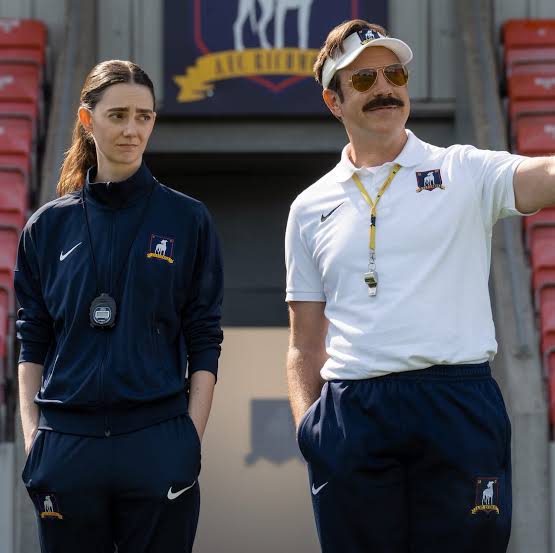
Having coached a premier league men’s team in the first three seasons, Ted coaches a women’s team in season four. His folksiness, quirky sense of humor, humanity, empathy, and balanced perspective win over pretty much everyone.
In my previous post, I examined why an episode would turn to Phil Larkin’s “This Be the Verse,” along with its well-known line, “They fuck you up, your mum and dad.”
The issue raised by that poem—whether Ted has been good father to his son after having had a bad father himself—comes around again in the season four finale (spoiler alert). Because his job has forced him to miss all his son’s soccer games, Ted demotes himself from the head coach position. Instead, he elevates his assistant, a prickly woman who expected the job initially but who now, under his mentorship, has become an excellent coach.
That’s not the only farewell in this finale. The Richmond women are also mourning the death of Mae, the old lady who runs the local tavern and has been the team’s most ardent fan.
Along with these endings, however, are also beginnings—a marriage in one case, a baby in another, and (for the coach of the Richmond men’s team) an offer to coach the legendary team Chelsea. (Like his pregnant girlfriend, upon his getting the offer Roy throws up.) A reading of Oliver’s “When Death Comes” accompanies the final montage.
I shared the poem (as did others) when Oliver died. Here it is:
When Death Comes
By Mary Oliver
When death comes
like the hungry bear in autumn;
when death comes and takes all the bright coins from his purse
to buy me, and snaps the purse shut;
when death comes
like the measle-pox
when death comes
like an iceberg between the shoulder blades,
I want to step through the door full of curiosity,
wondering:
What is it going to be like, that cottage of darkness?
And therefore I look upon everything
as a brotherhood and a sisterhood,
and I look upon time as no more than an idea,
and I consider eternity as another possibility,
and I think of each life as a flower, as common
as a field daisy, and as singular,
and each name a comfortable music in the mouth,
tending, as all music does, toward silenceand each body a lion of courage, and something
precious to the earth.
When it’s over, I want to say all my life
I was a bride married to amazement.
I was the bridegroom, taking the world into my arms.
When it’s over, I don’t want to wonder
if I have made of my life something particular, and real.
I don’t want to find myself sighing and frightened,
or full of argument.
I don’t want to end up simply having visited this world
The use of the poem suggests the series too has come to an end. What we see, in the last episode, is people taking the world into their arms. Mae’s death plays a role in this, focusing people’s attention on what is important. Rather than sighing or arguing or playing it safe—rather than simply visiting the world—various characters decide to be lions of courage and “something precious to the earth.”
Thanks largely to Ted, who has shown them how to move beyond ego and “look upon everything as a brotherhood and a sisterhood,” they have become brides of amazement.