A.A. Milne and a Squeaking Tank

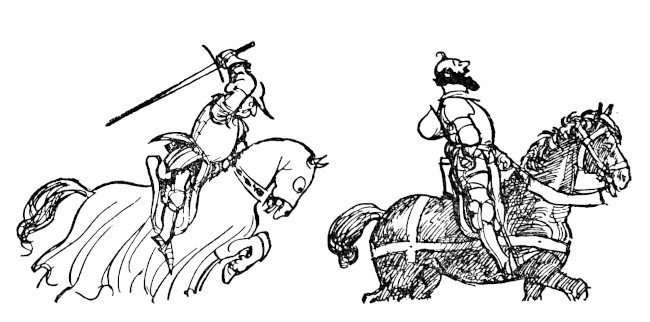
E.H. Shepard, illus. of “The Knight Whose Armor Didn’t Squeak”

Note: If you wish to receive, via e-mail, (1) my weekly newsletter or (2) daily copies of these posts, write to me at rrbates1951@gmail.com. Comments may also be sent to this address. I promise not to share your e-mail with anyone. To unsubscribe, write here as well.

Monday

As somewhere between four and six million Americans gathered around the country to protest Donald Trump’s attempted fascist takeover—despite threats of rain we drew 200+ to a rally in ruby red Winchester TN—the president got the military parade he’s been salivating over ever since his first term. Everyone knew that parade was for himself, not for the army’s 250th birthday or for Flag Day, and a hot mic moment made this clear. Asked off stage whether he would be inviting North Korea’s Kim Jong Un to the White House, Trump responded admiringly, “He speaks and his people sit up in attention. I want my people to do the same.”

There were relatively few sitting up and paying attention upon this occasion. As the New York Times’ Shawn McCreesh reported at one point,

The energy level at the military parade here is a bit desultory. The crowds are calm and light, a bit sapped after waiting in the oppressive D.C. humidity for hours to make it to this point, and it’s now spitting rain. The announcer stopped with the neat history lesson just now and an instrumental version of Heart’s “Barracuda” is being blasted over the loudspeakers.

A tiny but revealing detail brings me to today’s poem. At one point a commentator who goes by the name “Tennessee Holler” observed on Bluesky, “Our military deserves better than this empty charade. Yikes. The tank squeaking over silence is incredible.” Another advised us to “watch the clip of that tank squeaking slowly and painfully along in silence, past empty stands, like a cartoon of abject sadness.” All of which put me in mind of the A.A. Milne poem, “The Knight Whose Armor Didn’t Squeak.”

Squeaking tank

I haven’t read the poem since my kids were young. When I revisited it, I saw a knight so averse to fighting and so puffed up with his view of himself (he thinks he’s smart because he can subtract 9 from 20) that he is affronted whenever anyone challenges him. Like our president, he finds ways to slither out of confrontation, not to mention actual fighting. As the poem informs us, Sir Thomas Tom

     felt that it was hardly fair
To risk, by frequent injuries,
A brain as delicate as his.

When he does respond to challenges from other knights, he always makes sure to be ensconced safely in his moated castle:

His castle (Castle Tom) was set
Conveniently on a hill;
And daily, when it wasn’t wet,
He paced the battlements until
Some smaller Knight who couldn’t swim
Should reach the moat and challenge him.

Call him TACO, as in Thomas-Tom Always Chickens Out.

To his credit, Trump braved the rain for the event Saturday, unlike the time in 2018 when he passed up visiting the graves of Americans who died in France during World War I for fear it would mess with his hair.

What most elevates Sir Thomas Tom in his own eyes is military spectacle. Just as Trump doesn’t want to be around military personnel who are fat or have disabilities, so Sir Thomas Tom wants armor that doesn’t squeak:

No other Knight in all the land
Could do the things which he could do.
Not only did he understand
The way to polish swords, but knew
What remedy a Knight should seek
Whose armor had begun to squeak.

The only time that Sir Thomas Tom ventures into combat is when he encounters another knight whose armor doesn’t squeak—which is to say, who has the same vanities as he has—and he thinks he has won a battle when he humiliates his foe. Yet even here his attack is underhanded and from behind. Who knows whether he would have engaged with the unfortunate Sir Hugh in full frontal assault.

In short, reading Milne’s poem as a parable of Saturday’s march, we can say that it’s about a man with no substance who loves military show. All hat and no cattle, as they say in Texas.

The Knight Whose Armor Didn’t Squeak
By A.A. Milne

Of all the Knights in Appledore
The wisest was Sir Thomas Tom.
He multiplied as far as four,
And knew what nine was taken from
To make eleven. He could write
A letter to another Knight.

No other Knight in all the land
Could do the things which he could do.
Not only did he understand
The way to polish swords, but knew
What remedy a Knight should seek
Whose armor had begun to squeak.

And, if he didn’t fight too much,
It wasn’t that he didn’t care
For blips and buffetings and such,
But felt that it was hardly fair
To risk, by frequent injuries,
A brain as delicate as his.

His castle (Castle Tom) was set
Conveniently on a hill;
And daily, when it wasn’t wet,
He paced the battlements until
Some smaller Knight who couldn’t swim
Should reach the moat and challenge him.

Or sometimes, feeling full of fight,
He hurried out to scour the plain,
And, seeing some approaching Knight,
He either hurried home again,
Or hid; and, when the foe was past,
Blew a triumphant trumpet-blast.

One day when good Sir Thomas Tom
Was resting in a handy ditch,
The noises he was hiding from,
Though very much the noises which
He’d always hidden from before,
Seemed somehow less….Or was it more?

The trotting horse, the trumpet’s blast,
The whistling sword, the armor’s squeak,
These, and especially the last,
Had clattered by him all the week.
Was this the same, or was it not?
Something was different. But what?

Sir Thomas raised a cautious ear
And listened as Sir Hugh went by,
And suddenly he seemed to hear
(Or not to hear) the reason why
This stranger made a nicer sound
Than other Knights who lived around.

Sir Thomas watched the way he went –
His rage was such he couldn’t speak,
For years they’d called him down in Kent
The Knight Whose Armour Didn’t Squeak!
Yet here and now he looked upon
Another Knight whose squeak had gone.

He rushed to where his horse was tied;
He spurred it to a rapid trot.
The only fear he felt inside
About his enemy was not
“How sharp his sword?” “How stout his heart?”
But “Has he got too long a start?”

Sir Hugh was singing, hand on hip,
When something sudden came along,
And caught him a terrific blip
Right in the middle of his song.
“A thunderstorm!” he thought. “Of course!”
And toppled gently off his horse.

Then said the good Sir Thomas Tom,
Dismounting with a friendly air,
“Allow me to extract you from
The heavy armor that you wear.
At times like these the bravest Knight
May find his armor much too tight.”

A hundred yards or so beyond
The scene of brave Sir Hugh’s defeat
Sir Thomas found a useful pond,
And, careful not to wet his feet,
He brought the armor to the brink,
And flung it in…and watched it sink.

So ever after, more and more,
The men of Kent would proudly speak
Of Thomas Tom of Appledore,
“The Knight Whose Armor Didn’t Squeak.”
Whilst Hugh, the Knight who gave him best,
Squeaks just as badly as the rest.

I know there are some who proudly speak of Donald Trump. Their claims on his behalf, however, generally wander into fantasy land.

Further thought: Upon reflection, I’m thinking that Milne’s poem may have been inspired by the Duke of Plaza-Toro in Gilbert and Sullivan’s The Gondoliers. Think of Trump as you read the description:

When, to evade Destruction’s hand,
To hide they all proceeded,
No soldier in that gallant band
Hid half as well as he did.
He lay concealed throughout the war,
And so preserved his gore, O!
That unaffected,
Undetected,
Well connected
Warrior,
The Duke of Plaza-Toro!

I think of how, following the 2018 mass shooting at Marjory Stoneman High School that claimed 17 lives, Trump stated, “I really believe I’d run in there even if I didn’t have a weapon.” (This after calling the officer on duty “disgusting” for not having done so.) And then how he hid out in a bunker under the White House when demonstrators in nearby Lafayette Park protested the George Floyd murder.
Posted in Uncategorized | Tagged , , , , , , | Comments closed

God the Father as Loving Protector

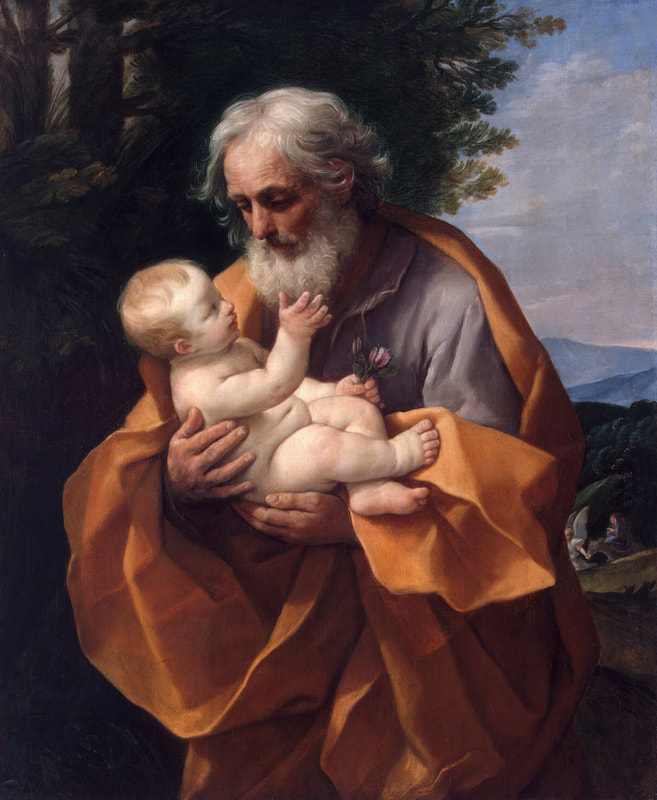
Guido Reni, St. Joseph with Infant Jesus

Note: If you wish to receive, via e-mail, (1) my weekly newsletter or (2) daily copies of these posts, write to me at rrbates1951@gmail.com. Comments may also be sent to this address. I promise not to share your e-mail with anyone. To unsubscribe, write here as well.

Sunday

When I was thinking of a poem for today’s post—a religious lyric that would also celebrate Father’s Day–I initially thought of John Donne’s “Hymn to God the Father,” in which the speaker pleads with God to forgive him for his sins. These sins include sins that he continues to commit:

Wilt thou forgive that sin, through which I run,
         And do run still, though still I do deplore?

The final sin is doubting Jesus’s promise of life after death:

I have a sin of fear, that when I have spun
         My last thread, I shall perish on the shore…

And always there is the refrain, with the poet punning on his name:

When thou hast done [forgiving], thou hast not done,
                        For I have more.

As the speaker piles up all the different ways that he’s sinned, growing more desperate with each item on the list, the image of God as an angry parent becomes more entrenched. Even though Donne all but grabs God by the coat lapels and demands assurance—”swear by thyself, that at my death thy Son/ Shall shine as he shines now, and heretofore”—I emerge from the poem exhausted. Is Christianity, at its core, a drama of anger, punishment, and scapegoat sacrifice, with Jesus offering himself up to placate an angry daddy. “Die he or Justice must; unless for him/ Some other able, and as willing, pay/ The rigid satisfaction, death for death,” thunders Milton’s God in Paradise Lost.

“Sinners in the hands of an angry god,” as Calvinist Jonathan Edwards would have it.

This is not my god. When I think of divinity as a father—which I occasionally do but just as often think of Her as mother—I imagine Him more as the father in Naomi Shihab Nye ‘s wonderful poem “Shoulders.” Such a god is one who loves us despite our faults, who doesn’t insist on punishment and blood sacrifice. We are the child that God, like Nye’s father, holds lovingly and protectively in his arms.

I remember holding my son Toby in my arms for three hours right after he was born as Julia went off to have a follow-up operation. Apparently the nurses told her later that they couldn’t get him away from me. I don’t remember them trying but I vividly remember the touch.

Shoulders
By Naomi Shihab Nye

A man crosses the street in rain,
stepping gently, looking two times north and south,
because his son is asleep on his shoulder.

No car must splash him.
No car drive too near to his shadow.

This man carries the world’s most sensitive cargo
but he’s not marked.
Nowhere does his jacket say FRAGILE,
HANDLE WITH CARE.

His ear fills up with breathing.
He hears the hum of a boy’s dream
deep inside him.

We’re not going to be able
to live in this world
if we’re not willing to do what he’s doing
with one another.

The road will only be wide.
The rain will never stop falling.

Though the road is indeed wide and the rain is falling, God hears the hum of our dreams, deep inside Him. “As I have loved you, so you must love one another,” Jesus told his disciples (John 13:34), and Nye gives us a powerful image of such love.

Happy Fathers Day.

Posted in Uncategorized | Tagged , , , , | Comments closed

A.I. and the Tech Bro Accelerationists

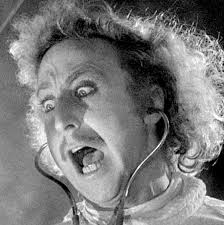
Gene Wilder in Young Frankenstein

Note: If you wish to receive, via e-mail, (1) my weekly newsletter or (2) daily copies of these posts, write to me at rrbates1951@gmail.com. Comments may also be sent to this address. I promise not to share your e-mail with anyone. To unsubscribe, write here as well.

Friday

As if we didn’t have enough to worry about, the Silicon Valley tech bros who support Donald Trump have more surprises for us. The other day the New York Times breathlessly reported,

Meta is said to be preparing to unveil an A.I. lab dedicated to a hypothetical system that exceeds the powers of the human brain

To which Tobias Wilson-Bates, my English professor son who studies A.I., replied with a literary passage you’re probably can identify:

Life and death appeared to me ideal bounds, which I should first break through, and pour a torrent of light into our dark world. A new species would bless me as its creator and source; many happy and excellent natures would owe their being to me.

Not too much blessing—in fact, mostly undiluted cursing—occurs in Victor Frankenstein’s subsequent account of his technological breakthrough. For instance, here’s what his creation has to say:

“Hateful day when I received life!” I exclaimed in agony. “Accursed creator! Why did you form a monster so hideous that even you turned from me in disgust?”

There’s no sign that Mark Zuckerberg has any qualms about what he’s attempting, and thanks to Greg Olear at the substack blog Prevail, I now have a word for what he’s up to—accelerationism—which Olear succinctly sums up as, “All gas, no brakes.”

Andy Beckett, British historian and Guardian journalist, describes the accelerationist philosophy:

Accelerationists argue that technology, particularly computer technology, and capitalism, particularly the most aggressive, global variety, should be massively sped up and intensified—either because this is the best way forward for humanity, or because there is no alternative. Accelerationists favor automation. They favor the further merging of the digital and the human. They often favor the deregulation of business, and drastically scaled-back government. They believe that people should stop deluding themselves that economic and technological progress can be controlled. They often believe that social and political upheaval has a value in itself.

 Beckett observes that the accelerationists run afoul of

conservatism, traditional socialism, social democracy, environmentalism, protectionism, populism, nationalism, localism and all the other ideologies that have sought to moderate or reverse the already hugely disruptive, seemingly runaway pace of change in the modern world.

They also don’t appear interested in Mary Shelley’s warning.

Speaking for the environment, Olear quotes Lady Macbeth, employing sarcasm to reveal accelerationism’s consequences:

What is the accelerationist attitude toward climate change? In the words of Lady Macbeth, “If it were done when ‘tis done, then ‘twere well it were done quickly.” Since humans are going to eventually destroy the earth’s habitability regardless, we might as well get a move on. Only when we’ve extracted all the fossil fuels from the ground, and all the “raw earth” minerals we need for our technological devices, will we understand what to do next. Therefore, accelerate the melting of the icecaps so we can drill baby drill in the Arctic Ocean! (To understand why Trump and Vance are so fixated on Greenland, just look at a map.) And if a lot of peasants and serfs and hoi polloi bite the dust in the process, so be it; we can always make more.

Olear points out that the Italian Futurists in the first decade of the 20th century embraced an early version of accelerationism and finds it no surprise that some of them would go on to embrace Mussolini fascism. In the famous 1909 Futurist manifesto, written by the Italian poet Filippo Tommaso Marinetti, Olear notes,

we find the seeds of the “manosphere” movement and the war on “wokeness,” inchoate accelerationism, and the inherent cruelty of a cult that values technology more than individual human life.

Marinetti’s manifesto called for poets to “sing the love of danger, the habit of energy, and the strength of daring,” and said that “the essential elements of our poetry will be courage, audacity, and revolution.” He embraced the beauty of the automobile, asserting that it is our version of ancient Greek statuary:

We declare that the splendor of the world has been enriched by a new form of beauty: the beauty of speed. A racecar adorned with great tail-pipes like serpents with explosive breath, a roaring sports car which seems to run on machine-gun fire, is more beautiful than the Winged Victory of Samothrace.

While some of Mainetti’s points don’t sound too bad–for instance, that the poet “must spend himself with warmth, glamour, and prodigality to enhance the fervent urgency of the primordial elements”–the manifesto gets darker as it goes along. Article #9 declares, “We glorify war—the only true antidote for the world—and with it, militarism, patriotism, the destructive gesture of the anarchist, the beautiful ideas which kill, and the scorn of woman.” In article #10 we read, “We want to demolish museums and libraries, and oppose morality, feminism, and all opportunistic and utilitarian cowardice.”

Recall that World War I is only five years in the future, followed immediately by Mussolini’s rise. Olear notes that Marinetti, “like his friend Ezra Pound, wound up being an apologist for autocracy and a tool of the totalitarian state.”

“Small wonder, he concludes, “the titans of Silicon Valley lined up behind Trump at the inauguration.”

Olear is careful to note that he is not against technological innovation and that science and religion don’t have to be yolked to an authoritarian agenda. For that matter, there can be anti-technocratic authoritarianism, as we see in Robert Kennedy’s war against vaccines, one of science’s greatest gifts to humanity. There were also Nazi environmentalists dreaming of pure nature. No less than accelerationism, extremist ideology, whether right or left, strips human beings of their humanity.

Novels like Frankenstein, by contrast, honor our humanity. Mary Shelley has given us a powerful forum to explore the moral, social, and political dimensions of our choices. In the light of such understanding, we stand a better chance of making wise decisions.

All gas and no braking, on the other hand, allows no room for reflection.

Posted in Uncategorized | Tagged , , , , , , , , , , , , | Comments closed

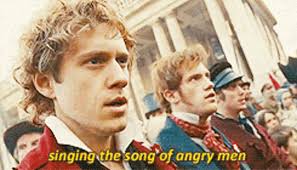
The Song of Angry Americans

Still from Les Misérables

Note: If you wish to receive, via e-mail, (1) my weekly newsletter or (2) daily copies of these posts, write to me at rrbates1951@gmail.com. Comments may also be sent to this address. I promise not to share your e-mail with anyone. To unsubscribe, write here as well.

Thursday

Kudos to Reuters News Service for its strategic juxtaposition, delivered deadpan, in an article on Trump’s plan to attend Les Misérables last night:

Trump’s appearance at Les Misérables, a show about citizens rising up against their government, comes just days after he sent U.S. Marines and the National Guard to quell protests against his administration’s immigration raids in Los Angeles. First lady Melania Trump and Vice President JD Vance will also attend.

Will the president connect “the songs of angry men” who vow to “not be slaves again” with the thousands of protesters who are expected to participate in the “No Kings” demonstrations this Saturday? Even in our rural and very red Tennessee county we will be assembling. In April we drew between 200-300 in our “Hands Off” protest (as in “Hands off our Social Security, Medicare, and Medicaid”) as we assembled across from the federal office building in Winchester, Tennessee, and I can imagine similar numbers this time around. I’ll report back on Monday.

“No Kings Day” organizers are very clear that the protests, in the spirit of Martin Luther King, must be peaceful—Trump is salivating over the prospect of military confrontation—so the passages from Victor Hugo’s novel don’t entirely fit. The Paris Revolution of 1832, which Hugo witnessed directly, was violent and was violently put down, with revolutionaries lined up and summarily shot when captured (as occurs in the novel). Still, the vision of insurrection leader Enjolras is one that Saturday’s protesters will be embracing as he speaks for democracies everywhere.

I’ve applied these passages in the past to the Ukrainians resisting Vladimir Putin and to freedom movements in Hong Kong, Myanmar, and elsewhere. (I’ve repurposed those posts here.) Little did I know that I would one day be applying them to an attempted fascist takeover in my own country. Here’s Enjolras:

Citizens, do you picture the future to yourselves? The streets of cities inundated with light, green branches on the thresholds, nations sisters, men just, old men blessing children, the past loving the present, thinkers entirely at liberty, believers on terms of full equality, for religion heaven, God the direct priest, human conscience become an altar, no more hatreds, the fraternity of the workshop and the school, for sole penalty and recompense fame, work for all, right for all, peace over all, no more bloodshed, no more wars, happy mothers!

Enjolras declares that the meaning of the struggle is self-determination or “sovereignty of myself over myself”:

Citizens, whatever happens to-day, through our defeat as well as through our victory, it is a revolution that we are about to create. As conflagrations light up a whole city, so revolutions illuminate the whole human race. And what is the revolution that we shall cause? I have just told you, the Revolution of the True. From a political point of view, there is but a single principle; the sovereignty of man over himself. This sovereignty of myself over myself is called Liberty.

Following a mini lecture on the social contract, Enjolras sets forth a Jeffersonian vision of the importance of education. Think of such education as a guard against the mendacity and brainwashing that the Trump White House and Fox News engage in daily:

[L]egally speaking, [equality] is all aptitudes possessed of the same opportunity; politically, it is all votes possessed of the same weight; religiously, it is all consciences possessed of the same right. Equality has an organ: gratuitous and obligatory instruction. The right to the alphabet, that is where the beginning must be made. The primary school imposed on all, the secondary school offered to all, that is the law. From an identical school, an identical society will spring. Yes, instruction! light! light! everything comes from light, and to it everything returns.

Yes, light! light! everything comes from light!

To our sorrow, we know Enjolras’s next prediction will not occur. The 20th century, rather than being happy, will be one of the bloodiest in history. Nevertheless, the ideal he voices is one that activists have never ceased striving for. And to give Enjolras credit, from World War II up until now, the European Union and NATO have accomplished some of what he envisions while various minority rights movements have changed the landscape of civilized society (which of course is what so infuriates Trump and his supporters). Here’s Enjolras:

Citizens, the nineteenth century is great, but the twentieth century will be happy. Then, there will be nothing more like the history of old, we shall no longer, as today, have to fear a conquest, an invasion, a usurpation, a rivalry of nations, arms in hand, an interruption of civilization depending on a marriage of kings, on a birth in hereditary tyrannies, a partition of peoples by a congress, a dismemberment because of the failure of a dynasty, a combat of two religions meeting face to face, like two bucks in the dark, on the bridge of the infinite; we shall no longer have to fear famine, farming out, prostitution arising from distress, misery from the failure of work and the scaffold and the sword, and battles and the ruffianism of chance in the forest of events. One might almost say: There will be no more events. We shall be happy. The human race will accomplish its law, as the terrestrial globe accomplishes its law; harmony will be re-established between the soul and the star; the soul will gravitate around the truth, as the planet around the light.

Another thing that Enjolras couldn’t foresee is that some people would become bored with freedom, choosing a leader who delights in taking it away once fears of invasion and famine had abated. Complacency set in as we forgot how precious and how fragile, democracy can be.

Enjolras’s address concludes with assurances that we need to hear. Whatever we sacrifice to protect freedom, he tells us, will not be in vain:

Friends, the present hour in which I am addressing you, is a gloomy hour; but these are terrible purchases of the future. A revolution is a toll. Oh! the human race will be delivered, raised up, consoled! We affirm it on this barrier. Whence should proceed that cry of love, if not from the heights of sacrifice? Oh my brothers, this is the point of junction, of those who think and of those who suffer; this barricade is not made of paving-stones, nor of joists, nor of bits of iron; it is made of two heaps, a heap of Ideas, and a heap of woes. Here misery meets the Ideal. The day embraces the night, and says to it: ‘I am about to die, and thou shalt be born again with me.’ From the embrace of all desolations faith leaps forth. Sufferings bring hither their agony and ideas their immortality. This agony and this immortality are about to join and constitute our death. Brothers, he who dies here dies in the radiance of the future, and we are entering a tomb all flooded with the dawn.

Americans have it lucky: on Saturday, people will not need to die to affirm our belief in our constitutional republic. The more of us who turn out, the more chance we have of saving the one we’ve got.

Posted in Uncategorized | Tagged , , , | Comments closed

Without Literature, No Freedom

Gustave Doré, Ezra Reads the Law to the People

Note: If you wish to receive, via e-mail, (1) my weekly newsletter or (2) daily copies of these posts, write to me at rrbates1951@gmail.com. I’ll subscribe you via Mailchimp for the weekly or email you directly for the daily (your choice). Comments may also be sent to this address. I promise not to share your e-mail with anyone.

Wednesday

My friend Dennis Johnson recently alerted me to a powerful commencement address, delivered by the accomplished novelist Nicole Krauss and published in the Washington Post. Author of The History of Love and The Great House, both of which I highly recommend, Krauss argues that literature is essential if humans are to step into freedom and live up to our potential.

Krauss grounds her case in a powerful historical moment. When the Jews were captives in Babylon, they had turned to writing and transcribing the Torah because they had no access to their land or their Temple. Upon their return to Jerusalem, the question was whether they were going to be a people of the Temple or a people of the Torah. Krauss describes what happened next:

[I]t is in Nehemiah that we read of something truly extraordinary: the first record of the Torah being read in public. Ezra brought the scroll out and read from it, “facing the square before the Water Gate, from the first light until midday, to the men and the women and those who could understand; the ears of all the people were given to the scroll of the Torah. … They read from [it], translating it and giving the sense; so they understood the reading.”

Krauss says that “it is impossible to exaggerate how momentous this moment was”:

 At perhaps the greatest juncture the Jews have ever faced, the Temple was replaced by Torah. Sacrifice was replaced by reading, teaching and study. And Judaism was made independent of place and became portable, ensuring its survival to this day.

Not only did Judaism become portable but the first steps towards democratization had been taken. As Krauss explains it,

In those few lines of Nehemiah, we find a rejection of a hierarchical system based on hereditary power in the hands of the few, toward the town square, where all men and women are offered the chance to participate, to listen, learn and understand the teachings for themselves. It might be argued that from that day on, all that is required to live as a Jew are words. No more, and no less.

This is where the importance of writing comes in. Krauss says that she writes, just as she reads, because she believes that

in the realm of literature we are, each of us, free. Free to imagine, to invent, to change our minds, to travel through time, across space, to feel and experience the full breadth of ourselves, and to do what I don’t believe can be done in any other realm, medium or dimension: to step into the mind of another. Feel what it is to live inside another and, in the process, enlarge ourselves beyond the borders of selfhood, into the vaster fields of mutual understanding and empathy.

To intrude into Krauss’s argument for a moment, in my book Better Living through Literature I make the case that the 19th century Romantic Imagination expanded the franchise in a similar way. When a poet like Wordsworth began to make shepherds, leech gatherers, and wheat gatherers the subjects of his verse, he opened the door for poets and writers

to use the Imagination to step beyond their own narrow class boundaries in ways that would have been, well, unimaginable in earlier times. Through literature authors have entered the lives of the marginalized (Walt Whitman), the urban poor (Charles Dickens), American slaves (Harriet Beecher Stowe), Dorset dairy maids (Thomas Hardy), French coalminers (Emile Zola), Nebraska pioneers (Willa Cather), Harlem residents (Langston Hughes), African American sharecroppers (Jean Toomer), African American homosexuals (James Baldwin), bankrupted Oklahoma farmers (John Steinbeck), Laguna Pueblo war veterans (Leslie Marmon Silko), transplanted Pakistanis (Hanif Kureishi), West Indian immigrants (Zadie Smith), American lesbians (Alison Bechdel), and on and on….[T]he Romantic Imagination elevated lower-class figures to new levels of importance. In the process, it inspired generations of social and political idealists and changed conversations about public policy.

Krauss, however, adds one major caveat to her argument that literature is “fundamentally democratic.” “To access its freedoms,” she writes, “we must be taught to read, value and engage with literature.” She sees us standing at a crossroads where the future of reading, writing, and literature is at stake, along with “all of the expansive freedom they have afforded us.”

Concerned about AI and “the demolition of the capacity to read and engage with a book,” she worries that we

have lost not just our ability to concentrate on deciphering long passages of written language; we have, I believe, begun to lose our attachments to the meaning of words and sentences, which we once trusted to carry the precious freight of communicating who we are — to ourselves and to each other. The blatantly, proudly senseless speech of our current leaders is not the cause, it is merely the most extravagant example of what happens when an entire culture — increasingly, the monoculture of the world — gives up on, and ceases to be capable of, the struggle to funnel meaning into language — to translate themselves, their thoughts, and their ideas into words that others can read and share.

Writing and reading take effort, she points out, and without that effort “we will slide deeper and deeper into inchoateness, darkness, violence, diminished freedom for all and a diminished state of human being.”

She takes heart, however, from all the professors who make it their life work to ensure that their students “have access to the freedom that comes with becoming a reader, being able to write for oneself, and partake in a culture of literature and ideas.” (Remember, this is a commencement address.) She also takes the long view, noting that, after all, we have been finding words for ourselves and have been writing our own story for thousands of years. In the process, we “have done something far more radical than expressed ourselves: We have invented ourselves. We have asked the essential question: Who are we, and what kind of people do we want to be?”

“Where there is destruction,” she concludes, “there is also the potential for tikkun, for repair.” To rise to the occasion, however, we must be educated “in the bonding of language and meaning.”

Authors, teachers, librarians, parents, bloggers, social workers, therapists, friends, and others are critical to making this educational bonding happen.

Posted in Uncategorized | Tagged , , | Comments closed

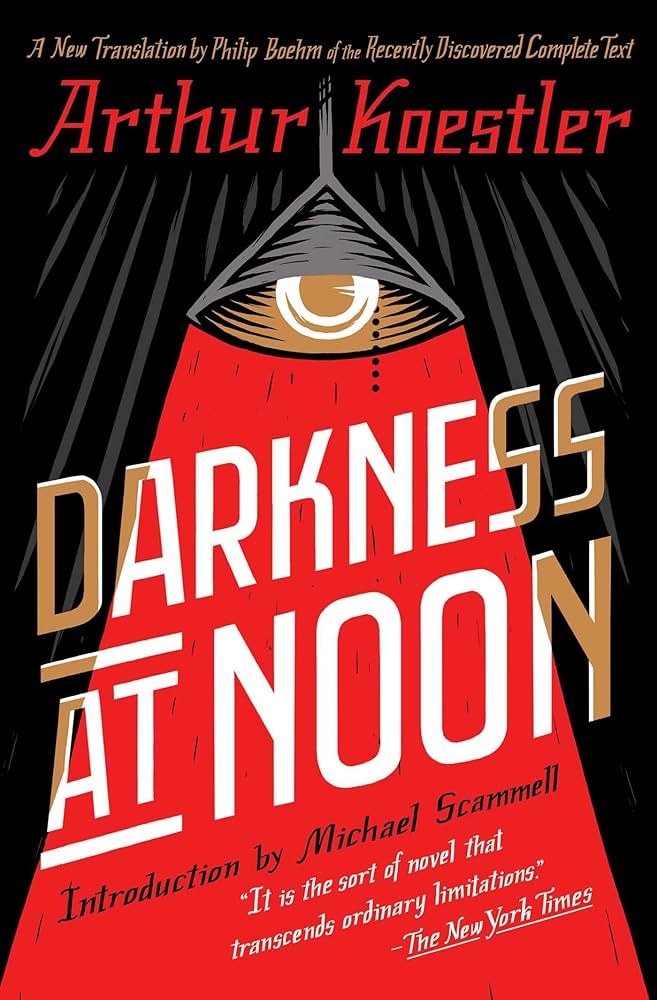
Darkness at Noon in Trump’s America

ypNote: If you wish to receive, via e-mail, (1) my weekly newsletter or (2) daily copies of these posts, write to me at rrbates1951@gmail.com. I’ll subscribe you via Mailchimp for the weekly or email you directly for the daily (your choice). Comments may also be sent to this address. I promise not to share your e-mail with anyone.

Tuesday

In Trumpism’s assault on democracy, the name Curtis Yarvin keeps appearing. Ava Kovman’s recent New Yorker profile identifies him as the guru of rightwing Silicon Valley oligarchs, especially former PayPal CEO Peter Thiel, and Yarvin appears to have shaped the thinking of Vice President J.D. Vance. Essentially Yarvin believes that autocracy is preferable to democracy, and he would like to see the world (including the United States) divided into fiefdoms run by billionaires.

Normally people with Yarvin’s views would be shrugged off, but with rightwing billionaires playing an ever-increasing role in American politics, it’s important to know the ideology they espouse.

As I read the Yarvin profile, I thought of Arthur Koestler’s novel Darkness at Noon (1940), which focuses on Stalin’s purge of Bolshevik intellectuals (although Stalin is never named, referred to only as No. 1). And that book came to mind because of a perfect putdown of Yarvin by author Joyce Carol Oates, who tweeted,

over-all takeaway from the Curtis Yarvin profile is that there must be millions of smart-aleck show-offy kids who annoy their teachers & go on to annoy other adults through their lives with their “contrarian” pose that hardens to a carapace over their faces; until, as adults, they still harbor a delusion that, if there is a king, or a fűhrer, he’d be impressed with the guy’s motor mouth & appoint him to his cabinet rather than deleting him with a negligent swipe of his wrist as Stalin did routinely.

Oates’s slam reminds me of blogger John Rogers’s well-known depiction of Ayn Rand fans (who include a number of Silicon Valley oligarchs):

There are two novels that can change a bookish fourteen-year old’s life: The Lord of the Rings and Atlas Shrugged. One is a childish fantasy that often engenders a lifelong obsession with its unbelievable heroes, leading to an emotionally stunted, socially crippled adulthood, unable to deal with the real world. The other, of course, involves orcs.

To show what Oates is responding to, here’s Yarvin’s opinion on authoritarian regimes:

Picking at a plate of fried calamari, Yarvin praised China and Rwanda (neither of which he has visited) for having strong governments that insured both public safety and personal liberty. In China, he told me, “you can think and pretty much say whatever you want.” He may have sensed my skepticism, given the country’s record of imprisoning critics and detaining ethnic minorities in concentration camps. “If you want to organize against the government, you’re gonna have problems,” he admitted. Then he returned to his airbrush: “Not Stalin problems. You’ll just, like, be cancelled.”

I suppose there’s some comfort that Yarvin can’t bring himself to openly endorse mass killing or genocide, but he comes close:

Whatever the exact solution, he has written, it is crucial to find “a humane alternative to genocide,” an outcome that “achieves the same result as mass murder (the removal of undesirable elements from society) but without any of the moral stigma.”

So the problem with genocide is not that it’s immoral, inhumane, and abhorrent but that there’s a “moral stigma” attached. In other words, it’s got a public relations problem. It’s worth remembering that the Nazis originally defended concentration camps as a humane way of segregating out people they regarded as undesirable (Roma, homosexuals, the neurodiverse, Jews, socialists, and communists). Unfortunately, dehumanizing a certain population—as we are seeing–can lead to suspension of habeas corpus, illegal deportation to concentration camps abroad, and military intervention to quash protests. It’s not hard to see the logical end as mass murder. Or, to use Yarvin’s weasel word, cancellation.

Darkness at Noon is about a former Bolshevik revolutionary that is imprisoned and tried for treason by the government he helped set up. In Oates’s phrasing, he is deleted with a negligent swipe of Stalin’s wrist. However, whereas Yarvin is essentially a troll and bullshit artist—one whom unfortunately various powerful men take seriously—Rubashov is an introspective revolutionary who is now tormented by various ethical choices he made in the past. The supposedly necessary violence meant to usher in a just and prosperous society has instead led to unimaginable misery:

So consequent, that in the interests of a just distribution of land we deliberately let die of starvation about five million farmers and their families in one year. So consequent were we in the liberation of human beings from the shackles of industrial exploitation that we sent about ten million people to do forced labor in the Arctic regions and the jungles of the East, under conditions similar to those of antique galley slaves. So consequent that, to settle a difference of opinion, we know only one argument: death, whether it is a matter of submarines, manure, or the Party line to be followed in Indochina.

His interrogator and former comrade Ivanov, by contrast, tells him that the ends justify the means and only weak-minded humanists think one can avoid tough choices:

There are only two conceptions of human ethics, and they are at opposite poles. One of them is Christian and humane, declares the individual to be sacrosanct, and asserts that the rules of arithmetic are not to be applied to human units. The other starts from the basic principle that a collective aim justifies all means, and not only allows, but demands, that the individual should in every way be subordinated and sacrificed to the community–which may dispose of it as an experimentation rabbit or a sacrificial lamb. The first conception could be called anti-vivisection morality, the second, vivisection morality. Humbugs and dilettantes have always tried to mix the two conceptions; in practice, it is impossible.

The difference between Rubashov and Yarvin—what makes the literary character more interesting than the actual man—is that he reflects. “The fact is: I no longer believe in my own infallibility. That is why I am lost,” he writes in his journal. Yarvin, who talks incessantly, appears to ascribe to the Trumpian imperative, “Never admit you’re wrong. Never apologize.”

Trumpism has declared war on science, on critical thinking, and on empathy, ad figures like Yarvin are providing an intellectual-sounding justification, however bogus, for its attacks. Literature helps keep us grounded in the true and the good as we resist.

Posted in Uncategorized | Tagged , , , , , , , , | Comments closed

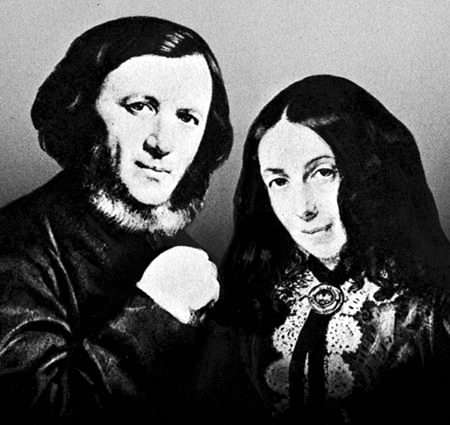
The Brownings’ Marriage–and My Own

Robert and Elizabeth Barrett Browning

Note: If you wish to receive, via e-mail, (1) my weekly newsletter or (2) daily copies of these posts, write to me at rrbates1951@gmail.com. I’ll subscribe you via Mailchimp for the weekly or email you directly for the daily (your choice). Comments may also be sent to this address. I promise not to share your e-mail with anyone.

Monday

My faculty reading group has been discussing the poetry of Robert Browning, and as yesterday was Julia’s and my 52nd wedding anniversary, I share today a marriage love poem written to him by his spouse. Elizabeth Barrett Browning’s “How do I love you, let me count the ways” is one of the best-known love poems—is there anyone who hasn’t encountered its opening line?—but it takes on special meaning when you think of it as arising out of a marriage.

Robert and Elizabeth married over the strenuous objection of her father—he disinherited her—and Robert persuaded her to publish Sonnets of the Portuguese, which she feared were too personal. One of his pet names for her was “my little Portuguese,” which explains the title.

Speaking from my own experience, there are times in marriage when one experiences oceanic feelings of love and times when one experiences moments of quiet tenderness. Barrett Browning touches on both. She knows that her love for her husband has stretched her soul beyond physical parameters—beyond depth and breadth and height—but also that this love dwells in “every day’s most quiet need, by sun and candle-light.” Any number of domestic moments could behind her declaration that “I love thee with the breath,/ Smiles, tears, of all my life.” This love she associates with humankind’s noblest ends—“I love thee freely, as men strive for right”—and knows that it transcends the egotistical self: she love purely, not transactionally, not for praise.

It sounds as though she may once have lost her childhood religious faith—she mentions “lost saints”—but she remembers the passionate immersion of that time, and now regards marital love and divine love as indistinguishable. Love, after all, is the foundation—”the love that moves the sun and the other stars,” as Dante puts it—and this love is at once domestic and divine.

And because it is, she can imagine it transcending death itself. “If God choose, I shall but love thee better after death,” she writes.

How do I love thee? Let me count the ways.
I love thee to the depth and breadth and height
My soul can reach, when feeling out of sight
For the ends of being and ideal grace.
I love thee to the level of every day’s
Most quiet need, by sun and candle-light.
I love thee freely, as men strive for right.
I love thee purely, as they turn from praise.
I love thee with the passion put to use
In my old griefs, and with my childhood’s faith.
I love thee with a love I seemed to lose
With my lost saints. I love thee with the breath,
Smiles, tears, of all my life; and, if God choose,
I shall but love thee better after death.

The poem has traveled quite a distance from the poet’s initial claim that she will be enumerating love’s aspects. The matter-of-fact opening contrasts with, and therefore serves to accentuate, the way that love refuses to be confined by time, space, or life itself.

So happy anniversary, my dear. My love for you over these 52 years—53 actually—has deepened and expanded in ways I could never have imagined.

Posted in Uncategorized | Tagged , , , , | Comments closed

Something Green in a Dry, Barren Heart

Note: If you wish to receive, via e-mail, (1) my weekly newsletter or (2) daily copies of these posts, write to me at rrbates1951@gmail.com. I’ll subscribe you via Mailchimp for the weekly or email you directly for the daily (your choice). Comments may also be sent to this address. I promise not to share your e-mail with anyone.

Pentecost Sunday

Franciscan priest Murray Bodo has written the following lyric for Pentecost Sunday. Pentecost was the moment when the disciples understood, in a visceral way, that the God of love dwells in us as He/She dwelt in Jesus. Like John Donne, the Bodo plays with the pun “sun/son,” capturing the miraculous reversal of life and death as we understand them (“the sun rising at sunset”). Searching for “a horizon to free my mind from prison,” the speaker experiences “a crack of light happening.”

The final line reminds me of Mary Oliver’s conclusion in “Crossing the Swamp,” amongst my  favorites of her poems. After wading through “pathless, seamless, peerless mud”—her own road to calvary, one could say–she describes herself as a “poor dry stick

           given
one more chance by the whims
                   of swamp water— a bough
                           that still, after all these years,
could take root,
           sprout, branch out, bud–
                  make of its life a breathing
                            palace of leaves.

Bodo, meanwhile, detects, “out of the dry, barren heart/ the shoot of something green.”

Still Movement (Motets I-V for Pentecost Sunday)
By Murray Bodo

You have gone the way you came
burning in and out of the dark.

My eye searches for a horizon
to free my mind from prison.

The day, gray with backward growing,
the sun rising at sunset.

And you return the way you left,
a crack of light happening:

Out of the dry, barren heart
the shoot of something green.

Posted in Uncategorized | Tagged , , , | Comments closed

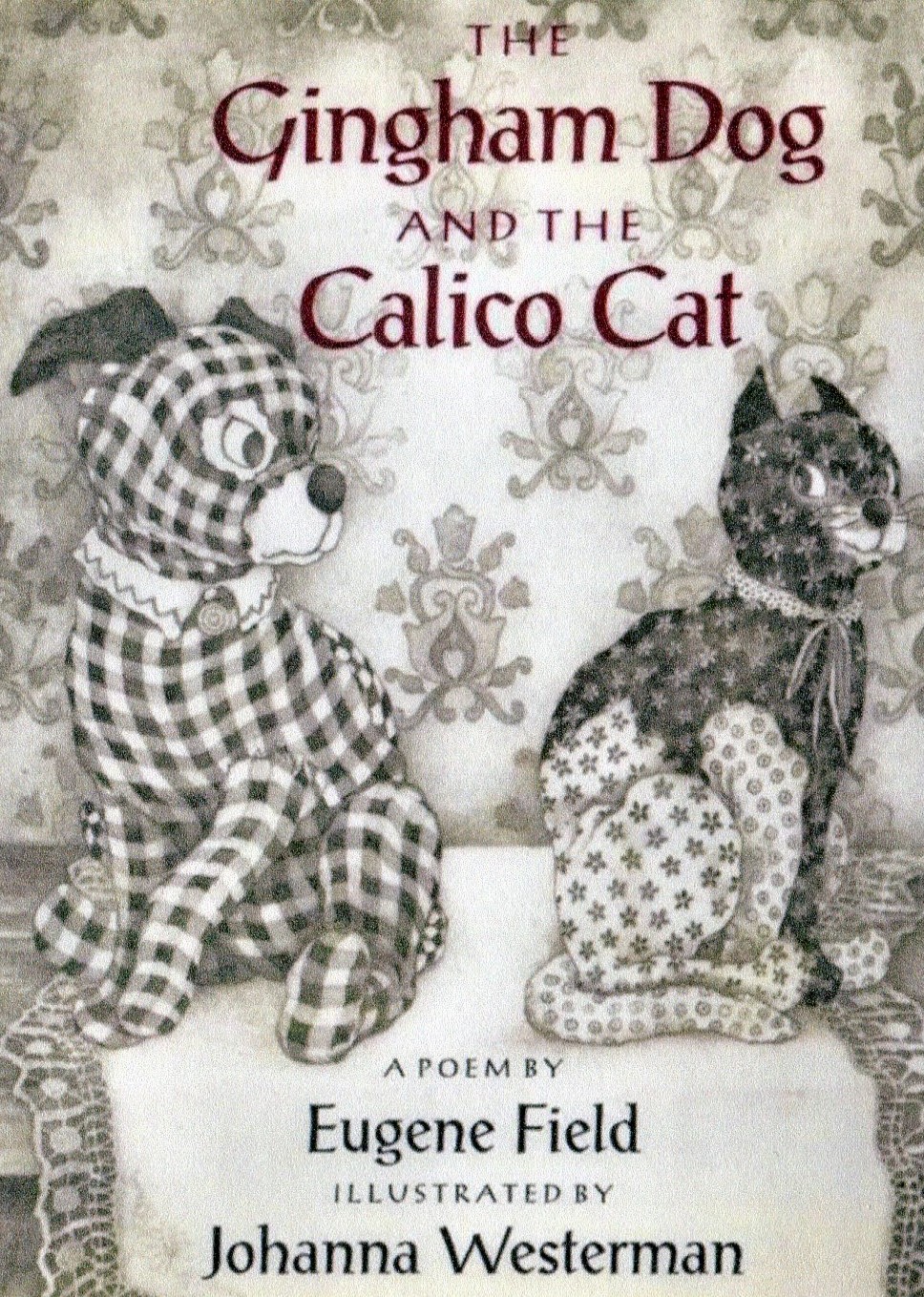
Trump=Gingham Dog, Musk=Calico Cat

Note: If you wish to receive, via e-mail, (1) my weekly newsletter or (2) daily copies of these posts, write to me at rrbates1951@gmail.com. I’ll subscribe you via Mailchimp for the weekly or email you directly for the daily (your choice). Comments may also be sent to this address. I promise not to share your e-mail with anyone.

Saturday

Because I don’t want to pay too much attention to Trump-Musk spat—“A plague on both your houses,” I hear Mercutio saying—but also because I don’t want to waste a perfect poem for the feud, I’m writing a rare Saturday post. The featured poem is Eugene Field’s “The Gingham Dog and the Calico Cat,” a gem that I remember from my childhood:

The gingham dog and the calico cat
Side by side on the table sat;
‘T was half-past twelve, and (what do you think!)
Nor one nor t’ other had slept a wink!
      The old Dutch clock and the Chinese plate
      Appeared to know as sure as fate
There was going to be a terrible spat.
            (I wasn’t there; I simply state
            What was told to me by the Chinese plate!)

The gingham dog went “Bow-wow-wow!”
And the calico cat replied “Mee-ow!”
The air was littered, an hour or so,
With bits of gingham and calico,
      While the old Dutch clock in the chimney-place
      Up with its hands before its face,
For it always dreaded a family row!
            (Now mind: I’m only telling you
            What the old Dutch clock declares is true!)

The Chinese plate looked very blue,
And wailed, “Oh, dear! what shall we do!”
But the gingham dog and the calico cat
Wallowed this way and tumbled that,
      Employing every tooth and claw
      In the awfullest way you ever saw—
And, oh! how the gingham and calico flew!
            (Don’t fancy I exaggerate—
            I got my news from the Chinese plate!)

Next morning, where the two had sat
They found no trace of dog or cat;
And some folks think unto this day
That burglars stole that pair away!
      But the truth about the cat and pup
      Is this: they ate each other up!
Now what do you really think of that!
            (The old Dutch clock it told me so,
            And that is how I came to know.)

To borrow from MSNBC’s Chris Hayes, our own gingham dog has the nuclear codes while our own calico cat has access to all our personal data. Good riddance if they were to eath each other up.

Sadly, I don’t think this is the outcome we can expect. Rather, as has been the case with Vladimir Putin and his former oligarch buddies, most of the power lies with the head of government. Trump is already threatening to cancel Musk’s government contracts, and while such a personalized threat is blatantly corrupt—just as his major campaign contributor getting special favors was blatantly corrupt—that won’t stop the president. Nor will the GOP Congress intervene. Odds are that Musk will either come groveling back or he will be crushed while Trump emerges more powerful than ever.

Entertaining though it may be to watch the air be littered with bits of gingham and calico, therefore, I expect that, by maybe as early as next week, we can expect at least one and possibly both figures to be sitting in their customary positions on the table.

Posted in Uncategorized | Tagged , , , | Comments closed

  • Sign up for my weekly newsletter