Note: If you wish to receive, via e-mail, (1) my weekly newsletter or (2) daily copies of these posts, write to me at rrbates1951@gmail.com. Comments may also be sent to this address. I promise not to share your e-mail with anyone. To unsubscribe, write here as well.
Friday
With Mother’s Day coming up, here’s a May Sarton homage to her own mother. It’s fairly direct reminder that, when we look back, it’s important to dwell upon the good times.
For My Mother By May Sarton
Once more I summon you Out of the past With poignant love, You who nourished the poet And the lover. I see your gray eyes Looking out to sea In those Rockport summers, Keeping a distance Within the closeness Which was never intrusive Opening out Into the world. And what I remember Is how we laughed Till we cried Swept into merriment Especially when times were hard. And what I remember Is how you never stopped creating And how people sent me Dresses you had designed With rich embroidery In brilliant colors Because they could not bear To give them away Or cast them aside. I summon you now Not to think of The ceaseless battle With pain and ill health, The frailty and the anguish. No, today I remember The creator, The lion-hearted.
Note: If you wish to receive, via e-mail, (1) my weekly newsletter or (2) daily copies of these posts, write to me at rrbates1951@gmail.com. Comments may also be sent to this address. I promise not to share your e-mail with anyone. To unsubscribe, write here as well.
Thursday
This being Teacher Appreciation Week, I share the classroom experiences of one of literature’s great teacher characters. In Jane Eyre we see a true professional at work.
Commenting on the Lilliputian system of education, Jonathan Swift observes “that parents are the last of all others to be trusted with the education of their own children.” Why certain parents think they can do a better job than skilled professionals says more about them than about our education system. These parents remind me of Blanche Ingram and her sisters who, right in front of Jane, show how badly they treated the governesses who taught them. We are fortunate that, even when suffering similar disrespect, our underpaid and overworked teachers demonstrate the same commitment to their students that Jane does.
I’ll admit that bad teachers exist, and in Bronte’s novel we get an instance of one in Lowood School’s Miss Scatcherd, who publicly humiliates the angelic Helen Burns and condemns her “to a dinner of bread and water on the morrow because she had blotted an exercise in copying it out.” Scatcherd, by failing to appreciate Helen’s beautiful mind, prompts Jane to reflect, “Such is the imperfect nature of man! such spots are there on the disc of the clearest planet; and eyes like Miss Scatcherd’s can only see those minute defects, and are blind to the full brightness of the orb.”
So yes, there are those who focus on defects rather than seeing the full student.
But there are more Jane Eyres and Miss Temples than Scatcherds in our school systems. Temple, the principle of Lowood, knows how to be teacher that both Jane and Helen need in their hours of extremity. Fair, kind, empathetic and just, Temple becomes a model for Jane. We go on to see Jane in three teaching situations: at Lowood when she grows up, at Thornfield Hall as governess to Adele, and in a country school as sole teacher.
While Jane has some nationalist prejudices when it comes to Adele (she regards her as a French coquette), she nevertheless takes her teaching duties seriously and the results are good. We know this from an interchange with Rochester regarding Adele’s progress. He has brought his ward a gift (“un cadeau”) and wonders if Jane expects one as well:
“I have examined Adèle, and find you have taken great pains with her: she is not bright, she has no talents; yet in a short time she has made much improvement.”
“Sir, you have now given me my ‘cadeau;’ I am obliged to you: it is the mead teachers most covet—praise of their pupils’ progress.”
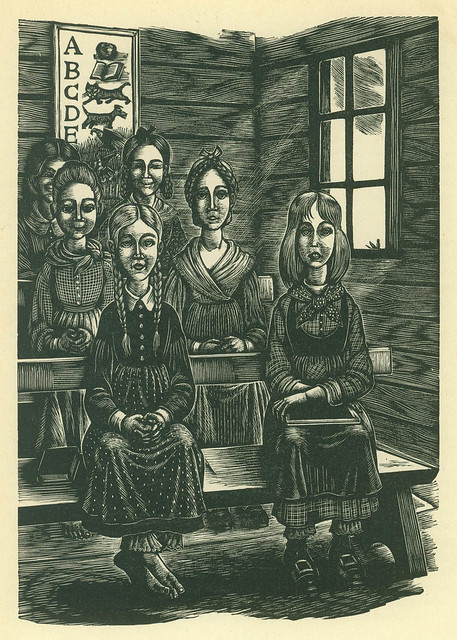
When Jane is put in charge of a country schoolroom, she shines yet brighter, even though her task is a daunting one. She describes her situation:
This morning, the village school opened. I had twenty scholars. But three of the number can read: none write or cipher. Several knit, and a few sew a little. They speak with the broadest accent of the district. At present, they and I have a difficulty in understanding each other’s language. Some of them are unmannered, rough, intractable, as well as ignorant…
She adds that others, however, “are docile, have a wish to learn, and evince a disposition that pleases me.” And she reminds herself of a truth that every good teacher knows:
I must not forget that these coarsely clad little peasants are of flesh and blood as good as the scions of gentlest genealogy; and that the germs of native excellence, refinement, intelligence, kind feeling, are as likely to exist in their hearts as in those of the best-born. My duty will be to develop these germs: surely I shall find some happiness in discharging that office.
Jane doesn’t pretend that this is her first choice of occupation. “Much enjoyment I do not expect in the life opening before me,” she admits. After all, she was on the verge of marrying the master of Thornfield Hall. But she resolves to soldier on, reassuring herself that “if I regulate my mind, and exert my powers as I ought, [this will] yield me enough to live on from day to day.”
The teaching episodes, often skipped over in film and television adaptations of Jane Eyre, are critical to her developing a full sense of self. After all, when she was first on the verge of becoming Mrs. Rochester, she all but gave away her power, allowing Rochester to shape her. As she puts it at one point,
My future husband was becoming to me my whole world; and more than the world: almost my hope of heaven. He stood between me and every thought of religion, as an eclipse intervenes between man and the broad sun. I could not, in those days, see God for His creature: of whom I had made an idol.
She leaves because “I care for myself,” and this care involves escaping his influence. Her teaching stint helps her step into her powers, all the more so because challenges her to the max. Sounding like many first-year teachers, the task ahead of her at first seems hopeless:
I continued the labors of the village-school as actively and faithfully as I could. It was truly hard work at first. Some time elapsed before, with all my efforts, I could comprehend my scholars and their nature. Wholly untaught, with faculties quite torpid, they seemed to me hopelessly dull; and, at first sight, all dull alike…
Once education begins to work its wonders, however, she discovers she has underestimated her students. There’s more in them than she first realized:
There was a difference amongst them as amongst the educated; and when I got to know them, and they me, this difference rapidly developed itself. Their amazement at me, my language, my rules, and ways, once subsided, I found some of these heavy-looking, gaping rustics wake up into sharp-witted girls enough. Many showed themselves obliging, and amiable too; and I discovered amongst them not a few examples of natural politeness, and innate self-respect, as well as of excellent capacity, that won both my goodwill and my admiration.
The students respond to her appreciation:
These soon took a pleasure in doing their work well, in keeping their persons neat, in learning their tasks regularly, in acquiring quiet and orderly manners. The rapidity of their progress, in some instances, was even surprising; and an honest and happy pride I took in it: besides, I began personally to like some of the best girls; and they liked me. I had amongst my scholars several farmers’ daughters: young women grown, almost. These could already read, write, and sew; and to them I taught the elements of grammar, geography, history, and the finer kinds of needlework. I found estimable characters amongst them—characters desirous of information and disposed for improvement—with whom I passed many a pleasant evening hour in their own homes.
To be sure, Jane’s teaching career proves to be of short duration, and eventually she returns to Thornfield to nurse Rochester back to health and become his wife (“Reader, I married him”). Some find this ending dissatisfying.
For instance, in her study of the marriage plot, feminist Rachel Blau DuPlessis complains how, in the 19th century, women were not allowed their own growth novels: they either ended up married or dead. Even in Jane Eyre, she says, whatever growth occurs in the middle of the novel is held of no account by the end as the “hero” dwindles to a married heroine.
To her credit, Bronte changes this in her next novel (spoiler alert). In what looks, until the last pages, like a romance, Villette concludes with Paul Emanuel dying at sea and Lucy Snowe running her own school. Readers, including Bronte’s own father, complained vociferously, causing Bronte to alter the ending—but instead of giving them what they wanted, she shrouded the ending in ambiguity, telling them that it was up to them, not to her, to imagine a “Reader I married him.” Or as she puts it, ”Let them picture union and a happy succeeding life.”
Note: If you wish to receive, via e-mail, (1) my weekly newsletter or (2) daily copies of these posts, write to me at rrbates1951@gmail.com. Comments may also be sent to this address. I promise not to share your e-mail with anyone. To unsubscribe, write here as well.
Wednesday
Ronald Reagan famously asked the question, “Are you better off than you were four years ago?” and if the upcoming election were really to be determined by that answer, there would be no question about the winner. After all, four years ago thousands of people were dying and unemployment was soaring as Donald Trump mismanaged the pandemic in multiple ways. But instead of recalling those uncomfortable facts, many just recall that gas prices were low while Democratic governors were requiring that people wear masks and stay away from others.
The blaming continued the following year. Although, in 2021, the new Biden administration brought an end to the dying through the vigorous promotion of vaccines along with continued masking, Republicans have managed to convince many to focus on the measures taken to address the catastrophe rather than the catastrophe itself.
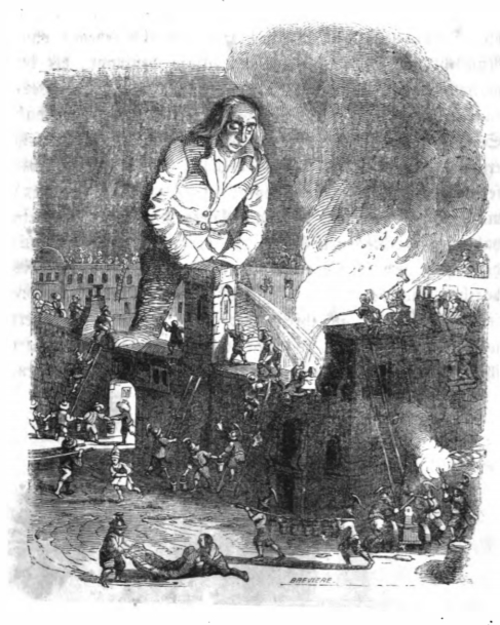
There’s a comparable situation in Gulliver’s Travels, which my faculty book group is currently discussing (at my suggestion). The palace of Lilliput has caught on fire and, having left his leather jerkin elsewhere (so that he can’t use it to smother the flames), Swift must find an alternative solution. First, the situation:
I was alarmed at midnight with the cries of many hundred people at my door; by which, being suddenly awaked, I was in some kind of terror. I heard the word Burglum repeated incessantly: several of the emperor’s court, making their way through the crowd, entreated me to come immediately to the palace, where her imperial majesty’s apartment was on fire. The case seemed wholly desperate and deplorable; and this magnificent palace would have infallibly been burnt down to the ground, if, by a presence of mind unusual to me, I had not suddenly thought of an expedient.
Now for the expedient:
I had, the evening before, drunk plentifully of a most delicious wine called glimigrim, (the Blefuscudians call it flunec, but ours is esteemed the better sort,) which is very diuretic. By the luckiest chance in the world, I had not discharged myself of any part of it. The heat I had contracted by coming very near the flames, and by laboring to quench them, made the wine begin to operate by urine; which I voided in such a quantity, and applied so well to the proper places, that in three minutes the fire was wholly extinguished, and the rest of that noble pile, which had cost so many ages in erecting, preserved from destruction.
Gulliver expects to be thanked for this service but quickly learns that no good deed goes unpunished. First, he is informed that it is a capital crime to urinate within the palace. While the emperor grants him a formal pardon, the empress is less forgiving. Feeling “the greatest abhorrence” for what Gulliver has done, she “removed to the most distant side of the court, firmly resolved that those buildings should never be repaired for her use: and, in the presence of her chief confidants could not forbear vowing revenge.”
Eventually, Gulliver learns from one of the court ministers, she tries to have him put to death, “having borne perpetual malice against you, on account of that infamous and illegal method you took to extinguish the fire in her apartment.”
Biden’s competent management of the pandemic, which contrasts so markedly with Trump’s, should have helped pave the way for an easy reelection. Unfortunately, the polls remain close as far too many Americans are proving to be small-minded and vindictive Lilliputians
Further thought: The lack of appreciation for Biden’s efforts puts me in mind of how Lilliput deals with ingratitude—or at least how it did so in its golden past before it became a degenerate nation. For the ancient Lilliputians, ingratitude was a capital crime:
[T]hey reason thus; that whoever makes ill returns to his benefactor, must needs be a common enemy to the rest of mankind, from whom he has received no obligation, and therefore such a man is not fit to live.
I’m obviously not advocating this for the GOP. Nor would Swift, for that matter, who has just found a dramatic way to emphasize the ugliness of ingratitude. He provides another instance of Lilliputian ingratitude later after Gulliver brings peace between Lilliput and its rival Blefescu (France) by stealing Blefescu’s fleet. Rather than thank him, the emperor declares him a traitor for not going futher, using his size to wipe Blefescu off the map. For his disobedience, Gulliver is to have his eyes shot out, which would result in him becoming an unresisting tool of the emperor’s imperial agenda.
And yet more thoughts: Since Gulliver’s Travels is a satiric allegory as well as an adventure story, both the palace and fleet incidents have real life antecedents. Apparently Queen Anne was so put off by Swift’s early satire Tale of a Tub (1704), a buoyant, profane and controversial exploration of religious excess, that she quashed all promotion hopes. Swiftian acerbic satire, one might say, is like pissing on a fire to put it out: critics only smell the stench while failing to acknowledge the necessity.
Something comparable happened in the early years while Swift was in the Tory administration. Through secret talks, the Tories paved the way for the Peace of Utrecht, which ended the bloody War of Spanish Succession. Those talks were illegal and therefore problematic, leading to Whig accusations of treason and selling out to the French, but much bloodshed was averted as a result. A comparable situation in our own time could be Biden messily pulling the United States out of Afghanistan, the longest standing war in our history–while arguably necessary, the action was roundly criticized.
Finney and Cilento as Tom and Molly in Tom Jones (1963)
Note: If you wish to receive, via e-mail, (1) my weekly newsletter or (2) daily copies of these posts, write to me at rrbates1951@gmail.com. Comments may also be sent to this address. I promise not to share your e-mail with anyone. To unsubscribe, write here as well.
Tuesday
A recent column by the Washington Post’s Brian Broome about comedian Jerry Seinfeld has me revisiting one of my all-time favorite works, Henry Fielding’s Tom Jones. I should add that this column has more to say about the 18th century novel and the nature of comedy than about Seinfeld’s complaints about woke audiences but I promise you that it’s all connected.
Apparently Seinfeld has been complaining that our “woke” culture doesn’t have a sense of humor because they aren’t laughing at him anymore. Broome begins his column by informing us that he was never laughing:
I have never found Jerry Seinfeld funny. Even in the ’90s when his show was all the rage, I didn’t get why people thought it was hilarious. It always seemed to me to be about immigrants being odd or unhygienic or making fun of women’s faces or body parts. The show always seemed mean-spirited to me, and that’s just not my kind of humor.
Rather than taking shots at Seinfeld, however, Broome’s major point is that comedy has to change with the times. He provides two examples, the second of which puts me in mind of Tom Jones:
Blackface, for example, was considered funny at one time, and I’m positive that, when it fell out of fashion, there was some old White guy complaining about how nothing is funny anymore and people have lost their sense of humor and it’s a shame he can’t say the n-word like he used to. “Punch and Judy,” a violent puppet show for children in which one of the puppets (Punch) would lay into his wife (Judy) and others with a stick, sometimes beating the daylights out of them. Punch was popular in its time. When it was called out for being problematic, I’m sure there were people who complained about that, too.
Now, I suspect that Seinfeld might make the same critique of Broome that Tom Jones makes of a puppet-master who decides to censor his own Punch and Judy Show. The entertainer does so in order to please the moral censors of his day, and at first he is applauded. Instead of Punch and Judy, he offers his public a morally correct comedy about a “provoked husband” chastising his philandering wife:
The puppet-show was performed with great regularity and decency. It was called the fine and serious part of the Provoked Husband; and it was indeed a very grave and solemn entertainment, without any low wit or humor, or jests; or, to do it no more than justice, without anything which could provoke a laugh. The audience were all highly pleased. A grave matron told the master she would bring her two daughters the next night, as he did not show any stuff; and an attorney’s clerk and an exciseman both declared, that the characters of Lord and Lady Townley were well preserved, and highly in nature.
The applause leads the puppet-master to discourse on how the age has progressed:
The master was so highly elated with these encomiums, that he could not refrain from adding some more of his own. He said, “The present age was not improved in anything so much as in their puppet-shows; which, by throwing out Punch and his wife Joan, and such idle trumpery, were at last brought to be a rational entertainment. I remember,” said he, “when I first took to the business, there was a great deal of low stuff that did very well to make folks laugh; but was never calculated to improve the morals of young people, which certainly ought to be principally aimed at in every puppet-show…
Tom, sounding like Seinfeld, is unimpressed, “I would by no means degrade the ingenuity of your profession,” he replies, “but I should have been glad to have seen my old acquaintance master Punch, for all that; and so far from improving, I think, by leaving out him and his merry wife Joan, you have spoiled your puppet-show.”
Tom’s complaint elicits the puppet-master’s contempt:
[W]ith much disdain in his countenance, he replied, “Very probably, sir, that may be your opinion; but I have the satisfaction to know the best judges differ from you, and it is impossible to please every taste. I confess, indeed, some of the quality at Bath, two or three years ago, wanted mightily to bring Punch again upon the stage. I believe I lost some money for not agreeing to it; but let others do as they will; a little matter shall never bribe me to degrade my own profession, nor will I ever willingly consent to the spoiling the decency and regularity of my stage, by introducing any such low stuff upon it.”
As is his wont, however, Fielding immediately upsets these high moral declarations by introducing some low comedy of his own:
A violent uproar now arose in the entry, where my landlady was well cuffing her maid both with her fist and tongue. She had indeed missed the wench from her employment, and, after a little search, had found her on the puppet-show stage in company with the Merry Andrew, and in a situation not very proper to be described.
The “wench” proceeds to blame the puppet-master’s seemingly moral production for her behavior:
Though Grace (for that was her name) had forfeited all title to modesty; yet had she not impudence enough to deny a fact in which she was actually surprized; she, therefore, took another turn, and attempted to mitigate the offence. “Why do you beat me in this manner, mistress?” cries the wench. “If you don’t like my doings, you may turn me away. If I am a w—e” (for the other had liberally bestowed that appellation on her), “my betters are so as well as I. What was the fine lady in the puppet-show just now? I suppose she did not lie all night out from her husband for nothing.”
This prompts the landlady, who had before been praising The Provoked Husband for its high sentiment, to turn her fire on it, calling the puppeteers “lousy vermin” who have turned her inn into a bawdy-house. Modern-day puppet shows, she says, “teach our servants idleness and nonsense,” and she longs for puppet-shows from the past:
I remember when puppet-shows were made of good scripture stories, as Jephthah’s Rash Vow, and such good things, and when wicked people were carried away by the devil. There was some sense in those matters; but as the parson told us last Sunday, nobody believes in the devil now-a-days; and here you bring about a parcel of puppets drest up like lords and ladies, only to turn the heads of poor country wenches; and when their heads are once turned topsy-turvy, no wonder everything else is so.
Fielding revels in recounting how the self-censoring puppet-master has been hoisted with his own petard, as the saying goes. The point to be made here is that there is no placating self-righteous guardians of morality, as anyone encountering purists will quickly discover, whether they come from the left or the right. Give them an inch and they’ll take it a mile. Therefore, it’s satisfying to see the man effectively silenced:
Nothing indeed could have happened so very inopportune as this accident; the most wanton malice of fortune could not have contrived such another stratagem to confound the poor fellow, while he was so triumphantly descanting on the good morals inculcated by his exhibitions. His mouth was now as effectually stopt, as that of quack must be, if, in the midst of a declamation on the great virtues of his pills and powders, the corpse of one of his martyrs should be brought forth, and deposited before the stage, as a testimony of his skill.
It should be noted that, in arguing for Punch and Judy, Fielding has his own art in mind. His comic novel elevates an indecorous hero of unknown parentage and sends him boozing and womanizing through the countryside and on into London (although we love him for his good heart and strong sense of honor). In fact, barbs similar to those directed by the puppet-master against Punch were directed against Tom Jones by multiple critics. Among these were Samuel Johnson, who feared that the novel would corrupt young people. As the great moralist argued,
These books are written chiefly to the young, the ignorant, and the idle, to whom they serve as lectures of conduct, and introductions into life. They are the entertainment of minds unfurnished with ideas, and therefore easily susceptible of impressions; not fixed by principles, and therefore easily following the current of fancy; not informed by experience, and consequently open to every false suggestion and partial account.
So should we use Fielding to defend Seinfield against so-called woke culture? Possibly. But much as I admire Fielding’s comedy—Tom Jones is the reason I focused on 18th century British literature in grad school—he is not exempt from Broome’s criticism. There are parts of Fielding’s comedy that haven’t aged well, starting with his incessant old maid jokes. Sometimes I find myself wincing in ways I didn’t in 1973, when I first read the novel.
I don’t think it’s because I’m a humorless moralist. It’s just that certain jokes now seem somewhat cheap, flaws in what is otherwise a brilliant comic diamond. Which brings me back to the conclusion of Broome’s article:
So, yes, if you make ham-fisted jokes about women, or the LGBTQ+ community or people living with disabilities or the French, someone will come for you. And I don’t think it’s because they “don’t have a sense of humor.” I think it might just be because you’ve been living in a bubble and they are tired of playing Judy to your Punch.
There’s plenty to laugh at in our world without hitting down. Seinfeld just sounds like a curmudgeon whose act has worn thin and who can’t keep up with the times.
Further thought: The same thing happened to Henry Fielding. In Tom Jones, he pulls off an amazing comic balance between the traditions of the landed gentry and a rapidly changing England that is characterized by a new acquisitive spirit and urban chaos. In the end, the old values prevail as Tom returns to the country to become gentry himself, uniting two country estates through his marriage to Sophia. But Fielding needs a certain ironic detachment to pull this off, which he achieves through a framing narrative where he comments on the novelistic devices required to pull off a happy ending. In other words, even as he gives us the romantic fantasy we desire, he does so with a sly wink, comparable to what occurs in the novel and movie The Princess Bride. In his later Journal of a Voyage to Lisbon, by contrast, Fielding sounds increasingly petulant and out of control. The world is changing in ways that challenge his brand of comedy and he doesn’t like it.
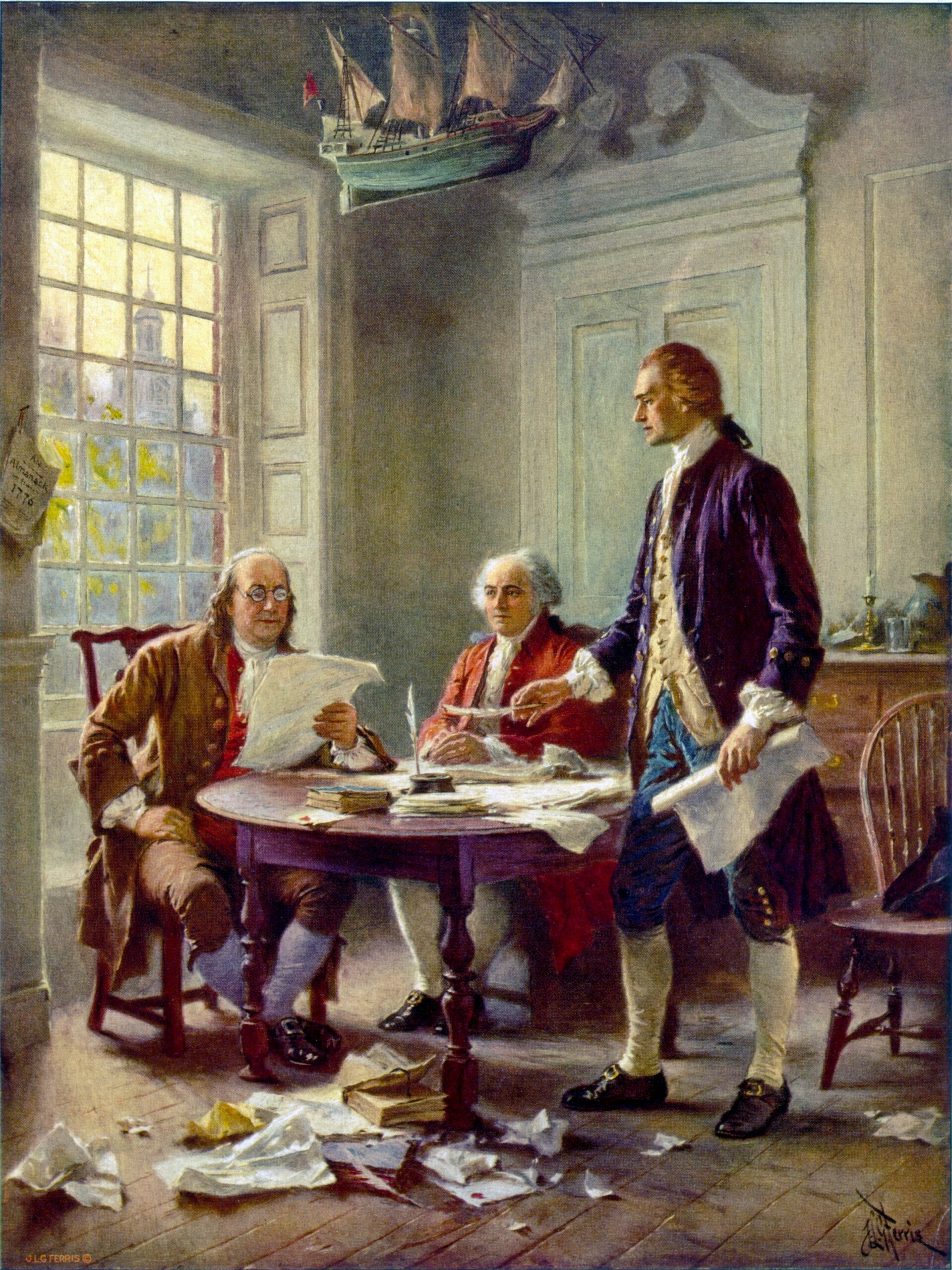
Ferris, Writing the Declaration of Independence, 1776
Note: If you wish to receive, via e-mail, (1) my weekly newsletter or (2) daily copies of these posts, write to me at rrbates1951@gmail.com. Comments may also be sent to this address. I promise not to share your e-mail with anyone. To unsubscribe, write here as well.
Monday
A superb Washington Post article by Robert Kagan (gifted here) has put Donald Trump within the broader context of American history in a way I find very illuminating. When I sent it to my brothers, Jonathan said it put him in mind of Erich Fromm’s Escape from Freedom, which in turn got me thinking about the Grand Inquisitor episode is Dostoevsky’s Brother’s Karamazov. Hang on while I explain.
According to Kagan’s article, which is adapted from his recent book Rebellion: How Antiliberalism Is Tearing America Apart—Again (Penguin Random House), America’s Founders based the new republic “on a radical set of principles and assertions about government.” These principles and assertions were
that all human beings were created equal in their possession of certain “natural rights” that government was bound to respect and to safeguard. These rights did not derive from religious belief but were “self-evident.” They were not granted by the Christian God, by the crown or even by the Constitution. They were inherent in what it meant to be human.
Because they recognized how radical their ideas were, they also knew that “a new way of thinking and acting” was required. This new way set up inevitable conflicts from the very beginning since most people of the time thought and behaved differently. The Founders, Kagan says, were well aware of this, knowing
that their own practices and those of 18th-century American society did not conform to their new revolutionary doctrines. They knew that slavery was contrary to the Declaration’s principles, though they permitted slavery to continue, hoping it would die a natural death. They knew that established churches were contrary to those principles because they impinged on that most important of rights, “freedom of conscience,” which was vital to the preservation of liberty, yet a number of states in the 18th and 19th centuries retained all kinds of religious tests for office.
Because the Declaration of Independence was so radical, a significant number of Americans kicked back against it and have been doing so ever since. Believing that America should be governed by White Protestants, they felt and have continued to feel “under siege” by the Founders’ liberalism, which Abraham Lincoln later endorsed and backed up by force.
In Lincoln’s vision, the Declaration of Independence was the nation’s “standard maxim,” with a goal of “constantly spreading and deepening its influence, and augmenting the happiness and value of life to all people of colors everywhere”—and it is this vision that some rightwing political scientists today call “liberal totalitarianism.” They claim they are being deprived of their “freedom” to “live a life according to Christian teachings” and that the government favors various minority groups (especially Black people) at their expense. Kagan observes,
Anti-liberals these days complain about wokeness, … but it is the liberal system of government bequeathed by the Founders, and the accompanying egalitarian spirit, that they are really objecting to, just as anti-liberals have since the founding of the nation. Many of Trump’s core supporters insist they are patriots, but whether they realize it or not, their allegiance is not to the Founders’ America but to an ethnoreligious definition of the nation that the Founders explicitly rejected.
Kagan turns to various rightwing intellectuals to flesh out this counter vision, including Claremont Institute’s Glenn Ellmers, Notre Dame’s Patrick Deneen, and Harvard Law School’s Adrian Vermeule. He reports,
The smartest and most honest of [rightwing intellectuals] know that if people truly want a “Christian America,” it can only come through “regime change,” by which they mean the “regime” created by the Founders. The Founders’ legacy is a “dead end,” writes Glenn Ellmers, a scholar at the Claremont Institute. The Constitution is a “Potemkin village.” According to Deneen and Harvard Law School’s Adrian Vermeule, the system established by the Founders to protect individual rights needs to be replaced with an alternative form of government.
What they have in mind, Katan says, is a Christian commonwealth—which is to say (here he quotes Vermeule),
a “culture that preserves and encourages order and continuity, and support for religious belief and institutions,” with legislation to “promote public morality, and forbid its intentional corruption,” a “forthright acknowledgment and renewal of the Christian roots of our civilization,” “public opportunities for prayers,” and a “revitalization of our public spaces to reflect a deeper belief that we are called to erect imitations of the beauty that awaits us in another Kingdom.”
Since most Americans are not White Protestants—or even White Christians—these rightwing intellectuals believe that democracy must be overthrown. Kagan elaborates on their view:
The Christian commonwealth would not and could not be a democracy because the majority of people can’t be trusted to choose correctly. According to the Claremont Institute’s Ellmers, “most people living in the United States today — certainly more than half — are not Americans in any meaningful sense of the term.” They are a “zombie” or “human rodent” who lives “a shadow-life of timid conformity.” Only “the 75 million people who voted in the last election” for Trump are true Americans. Instead of trying to compete with Democrats in elections that don’t reflect the will of the people, Ellmers writes, “Why not just cut to the chase and skip the empty, meaningless process?” The “only road forward” is “overturning the existing post-American order.”
In this view, Trump has been an essential albeit imperfect vehicle for counterrevolution. Kagan turns to Deneen to elaborate:
If Trump failed to accomplish the desired overthrow in his first term, Deneen argues, it was because he lacked “a capable leadership class.” Things will be different in his next term. What is needed, according to Deneen, is a “self-conscious aristoi,” a class of thinkers who understand “both the disease afflicting the nation, and the revolutionary medicine required for the cure,” who know how to turn populist “resentments into sustained policy.” Members of Deneen’s would-be new elite will, like Vladimir Lenin, place themselves at the vanguard of a populist revolution, acting “on behalf of the broad working class” while raising the consciousness of the “untutored” masses. Indeed, according to Harvard’s Vermeule, it will be necessary to impose the common good even against the people’s “own perceptions of what is best for them.”
Kagan adds that this is “a most Leninist concept indeed.”
Now to The Brothers Karamazov although, interestingly enough, the Grand Inquisitor’s diatribe is directed against Christianity, not democracy. But there is a democratic strain within Christianity, and it is this to which he is objecting. In other words, parallels between the Grand Inquisitor and today’s Christian authoritarians hold up.
In Dostoevsky’s novel, the rational brother (Ivan) is debating with the spiritual brother (Alyosha) about the latter’s vision of God as loving and benevolent. Setting up a thought experiment where Jesus is arrested by the Inquisition when he returns to the world, Ivan argues that he makes inhuman demands on people. When Jesus rejects Satan’s temptations in the desert—bread, safety, and earthly power—and when he tells his followers that they must rely on faith rather than miracles—he is putting impossible and therefore cruel demands upon them. Only saints are capable of rising to the occasion, the Inquisitor contends:
Thou hast burdened man’s soul with anxieties hitherto unknown to him. Thirsting for human love freely given, seeking to enable man, seduced and charmed by Thee, to follow Thy path of his own free-will, instead of the old and wise law which held him in subjection, Thou hast given him the right henceforth to choose and freely decide what is good and bad for him, guided but by Thine image in his heart. But hast Thou never dreamt of the probability, nay, of the certainty, of that same man one day rejected finally, and controverting even Thine image and Thy truth, once he would find himself laden with such a terrible burden as freedom of choice? That a time would surely come when men would exclaim that Truth and Light cannot be in Thee, for no one could have left them in a greater perplexity and mental suffering than Thou has done, lading them with so many cares and insoluble problems.
In Escape from Freedom (1941), the book mentioned by my brother, Erich Fromm uses a similar idea to explain why certain Germans embraced fascism over democracy. Individual freedom, he argued, causes fear, anxiety, and alienation whereas authoritarianism provides them with a kind of relief. The Grand Inquisitor makes the same argument against Christ’s challenge, asserting, “Thou has suffered for mankind and its freedom, the present fate of men may be summed up in three words: Unrest, Confusion, Misery!”
By contrast, the Inquisitor contends, the authoritarian church offers happiness:
We will prove to them their own weakness and make them humble again, whilst with Thee they have learnt but pride, for Thou hast made more of them than they ever were worth. We will give them that quiet, humble happiness, which alone benefits such weak, foolish creatures as they are, and having once had proved to them their weakness, they will become timid and obedient, and gather around us as chickens around their hen. They will wonder at and feel a superstitious admiration for us, and feel proud to be led by men so powerful and wise that a handful of them can subject a flock a thousand millions strong. Gradually men will begin to fear us. They will nervously dread our slightest anger, their intellects will weaken, their eyes become as easily accessible to tears as those of children and women; but we will teach them an easy transition from grief and tears to laughter, childish joy and mirthful song.
The Grand Inquisitor goes on for a while longer but you get the point. Christ’s vision that every individual is beloved by God—it doesn’t matter whether you are high or low, slave or free, man or woman—was as radical in Roman times as the Declaration of Independence was in the 18th century. In fact, Christ’s radical ideas helped make the democratic revolutions possible. So it is not only Founder liberalism that America’s contemporary rightwing intellectuals are objecting to but people finding their own individual ways to God.
These intellectuals, in their arguments for a new elite, don’t mention the potential for abuse and corruption, which we witness in every authoritarian regime. They appear to see themselves exempt from the truism that power corrupts and that absolute power corrupts absolutely. Similarly, the Grand Inquisitor speaks as though the authoritarian church actually cares about the common people rather than, first and foremost, about its own concerns. One need only do a quick glance at the history of humankind to realize that “benevolent dictator” is an oxymoron.
Americans are beginning to get glimpses of what a Christian Commonwealth would look like as librarians, teachers, and doctors are threatened with prison, women are forced to bring non-viable fetuses to term, asylum seekers are shot, and threats of violence against political opponents are regarded as an acceptable means of maintaining order. If we are to judge by the questions asked at Trump’s immunity hearing last week, some rightwing members of the Supreme Court see presidents as above the law (at least Republican presidents). In their questions, they didn’t laugh Trump’s lawyers out of court when they argued that a president should be free to assassinate opponents or stage a coup.
I imagine Clarence Thomas, Samuel Alito, Neil Gorsuch, and Brett Kavanaugh reading the Grand Inquisitor’s words and applauding.
Note: If you wish to receive, via e-mail, (1) my weekly newsletter or (2) daily copies of these posts, write to me at rrbates1951@gmail.com. Comments may also be sent to this address. I promise not to share your e-mail with anyone. To unsubscribe, write here as well.
Sunday
As we are still in the Easter season, here’s Christina Rossetti’s lovely “Easter Carol.” Feel the pure joy as the poet makes full use of springtime imagery.
Easter Carol By Christina Rossetti
Spring bursts today, For Christ is risen and all the earth’s at play.
Flash forth, thou Sun, The rain is over and gone, its work is done.
Winter is past, Sweet Spring is come at last, is come at last.
Bud, Fig and Vine, Bud, Olive, fat with fruit and oil and wine.
Break forth this morn In roses, thou but yesterday a Thorn.
Uplift thy head, O pure white Lily through the Winter dead.
Beside your dams Leap and rejoice, you merry-making Lambs.
All Herds and Flocks Rejoice, all Beasts of thickets and of rocks.
Sing, Creatures, sing, Angels and Men and Birds and everything.
All notes of Doves Fill all our world: this is the time of loves.
Note: If you wish to receive, via e-mail, (1) my weekly newsletter or (2) daily copies of these posts, write to me at rrbates1951@gmail.com. Comments may also be sent to this address. I promise not to share your e-mail with anyone. To unsubscribe, write here as well.
Friday
The presence of anti-Semitic campus leftists who lionize Hamas terrorism while arguing for the elimination of the state of Israel is taking me back to my college days, when both the Civil Rights movement and the anti-war movement had their share of extremists. I remember hearing Martin Luther King (this in Charleston in 1967) when he responded to Black militants with, “It’s not burn, baby, burn but build, baby, build.” Meanwhile, peaceful Vietnam War protesters were derided by the Underground Weathermen, who said they/we weren’t going far enough.
While leftwing militancy today doesn’t pose the same dangers as rightwing militancy—occupying college campuses isn’t the same existential threat to the country as seizing the Capitol, and we haven’t seen leftists implicated in mass shootings—it still must be called out. Gaza supporters directing hate speech against Jews are no less disturbing than Islamophobes and Palestinian haters. Few poets have better credentials for such calling out than William Blake, who does so in his poem “The Grey Monk.” More on this in a moment.
First, a little on my own activist background. Speaking as one who was arrested during a peaceful protest following the Kent State shootings—we blocked the Hennepin County draft induction center in Minneapolis for two hours before police came and, with no resistance from us, took us to Hennepin County jail—I remember thinking of Trotskyist, Maoist, anarchist, and Black militants as mostly bullshitters. But they also revealed a disturbing authoritarian streak that mirrored the very forces that they were opposing.
In fact, that authoritarian streak would reveal itself in time. Just as a number of 1950s Troskyists would become hardened reactionaries in the 1960s, so it was not surprising to see figures like the New Left’s David Horowitz and Black Power’s Eldridge Cleaver embrace the intolerant right.
Unlike them, Blake maintained a balanced perspective.
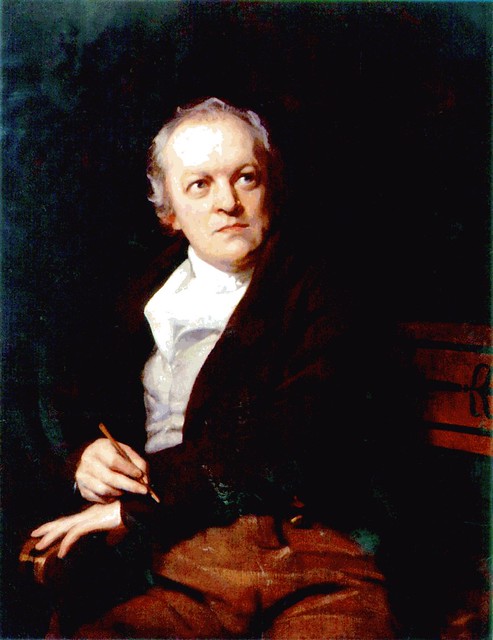
Blake’s activist credentials are beyond question. Here’s a summation:
In 1780, Blake was among the crowd that stormed Newgate Prison and freed its inmates. (The assault was the culmination of the Gordon Riots, a set of events that started as an anti-Catholic protest and turned into a fundamental challenge to inequality, the king, and an unrepresentative parliament.) In 1791, he wrote a long poem about the French Revolution. It was too admiring for even his left-wing publisher, John Johnson, to present to the public. Two years later, he wrote and illustrated a book, America a Prophecy, celebrated the American Revolution and endorsed abolitionism. In another book he published that year, Visions of the Daughters of Albion, he examined, through metaphor and personification, what is today called “rape culture” and argued for women’s sexual and creative emancipation. In 1804, Blake was charged with sedition for punching a soldier and allegedly saying, “Damn the king.”(It’s unclear if he actually uttered the phrase, though he wrote, in private literary notations, “Every Body hates a King.”
Blake’s activism put him at far greater risk than American activists in the 1960s and early 1970s. For his so-called sedition, which occurred when fears of a French invasion were high, he could have been executed. Only a good lawyer was able to get him off.
“Grey Monk” begins with a cry of suffering, one which those Palestinian and Israeli parents of dead children can relate to:
I die I die the Mother said My Children die for lack of Bread What more has the merciless Tyrant said The Monk sat down on the Stony Bed
The Grey Monk, an avatar for Blake himself, is a Christ-like witness to the suffering:
The blood red ran from the Grey Monks side His hands & feet were wounded wide His Body bent his arms & knees Like to the roots of ancient trees
His eye was dry no tear could flow A hollow groan first spoke his woe He trembled & shudderd upon the Bed At length with a feeble cry he said
While God, Blake writes, has commanded him to write to protest injustice, he acknowledges that his writing could elicit an opposite response than that which he desires. That’s the reason for his feeble, almost defeated, cry. He embraces love but is seeing his protest lead to hatred and violence, which are “the Bane of all that on Earth I lovd”:
When God commanded this hand to write In the studious hours of deep midnight He told me the writing I wrote should prove The Bane of all that on Earth I lovd
Before explaining how, he returns to his theme of suffering and of his own willingness to endure torture to say truth to power:
My Brother starvd between two Walls His Childrens Cry my Soul appalls I mockd at the wrack & griding chain My bent body mocks their torturing pain
Then, however, comes the response he fears. He probably is thinking foremost of the Reign of Terror that followed the French Revolution:
Thy Father drew his sword in the North With his thousands strong he marched forth Thy Brother has armd himself in Steel To avenge the wrongs thy Children feel
And now the caution. Only love, not force, can “free the World from fear.” His declaration that “a tear in an Intellectual Thing”—an apparently contradictory statement since tears are of the heart rather than of the head—is (I think) a response to how people regarded the French Revolution as an outgrowth of the Age of Reason. While a revolutionary himself, Blake believes that the heart rather than the head must take the lead:
But vain the Sword & vain the Bow They never can work Wars overthrow The Hermits Prayer & the Widows tear Alone can free the World from fear
For a Tear is an Intellectual Thing And a Sigh is the Sword of an Angel King And the bitter groan of the Martyrs woe Is an Arrow from the Almighties Bow
And then Blake’s grand finale, which is a warning that every activist should memorize and hold close:
The hand of Vengeance found the Bed To which the Purple Tyrant fled The iron hand crushd the Tyrants head And became a Tyrant in his stead”
From long history we know this truth only too well. Since the founding of Israel, the Middle East has been witnessing non-stop tit-for-tat vengeance. In practically every instance, tyranny has proved the victor.
Yes, we must speak out against suffering, Blake’s Grey Monk tells us. But we must do so with humility and care, knowing that even well-intentioned protesters can have their own inner tyrant.
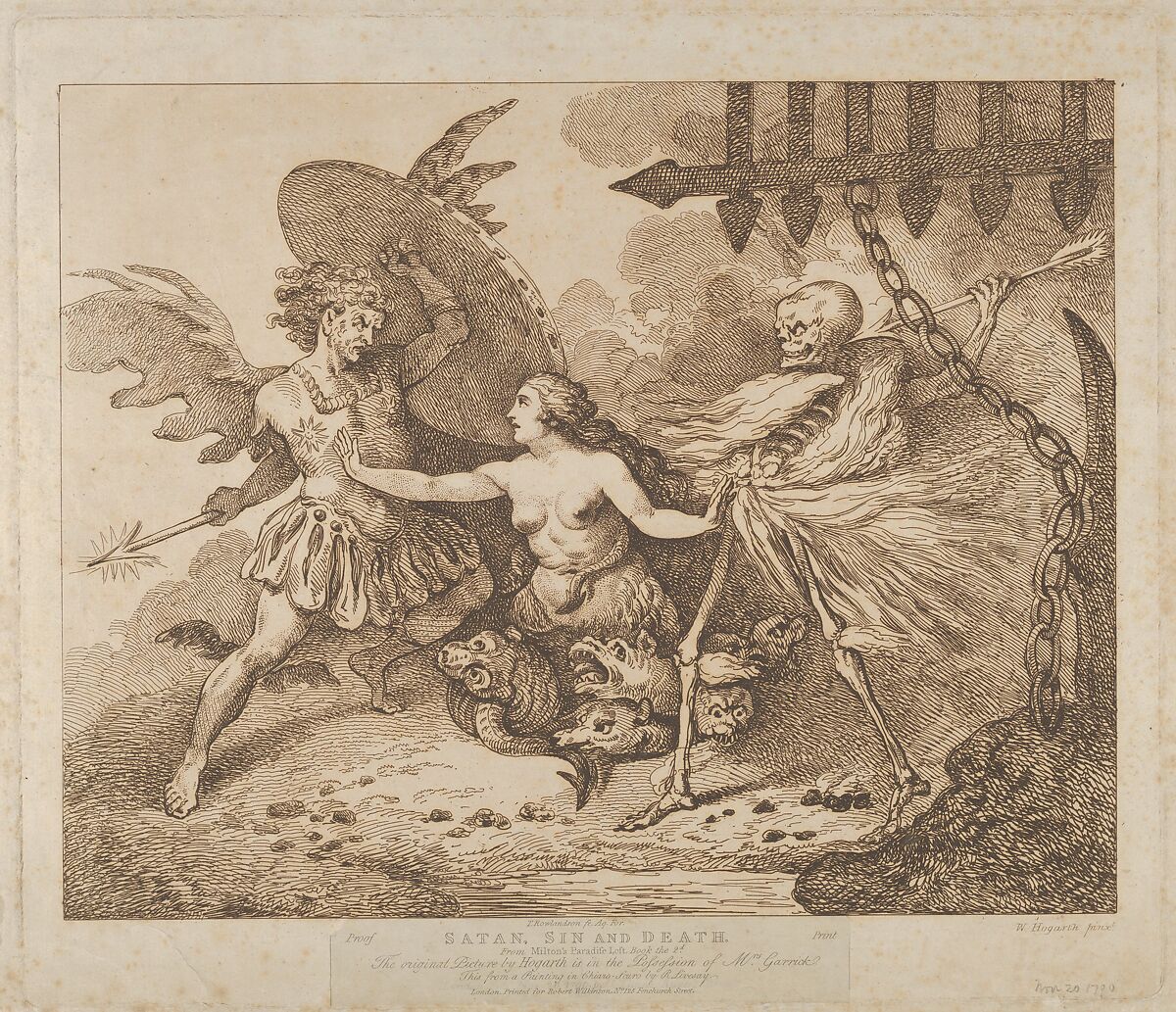
Rowlandson, Sin makes peace between Satan and Death in Paradise Lost
Note: If you wish to receive, via e-mail, (1) my weekly newsletter or (2) daily copies of these posts, write to me at rrbates1951@gmail.com. Comments may also be sent to this address. I promise not to share your e-mail with anyone. To unsubscribe, write here as well.
Thursday
It’s not every day that I see a political commentator casually citing a phrase from Paradise Lost, but NeverTrumper Charlie Sykes makes nice use of one. In an Atlantic article about partisanship and how Alexander Hamilton of the Federalists crossed party lines to support Thomas Jefferson, thereby preventing the “cunning, ambitious, and unprincipled” Aaron Burr from becoming president, Sykes writes,
Like Hamilton, we live in an age of fierce loyalties that make crossing party lines extraordinarily difficult. If anything, it is even harder now, especially for Republicans living with social pressures, media echo chambers, and a cult-like party culture compassed round, in the words of John Milton.
The phrase “compassed round” is used by Sin in Book II of Paradise Lost and it packs even more of a punch when one sees what she is referring to. Here’s the passage:
Here in perpetual agony and pain, With terrors and with clamors compassed round Of mine own brood, that on my bowels feed…
That’s right, she’s being compassed round by bowel-devouring hellhounds. Sykes has even internalized the Miltonic practice of suspending the verb until after a long prepositional phrase. Here’s the backstory:
Sin, who has sprung like Athena from Satan’s head and, after being raped by him, given birth to Death, has subsequently been set by God to watch over the gates of Hell. Her job is to make sure the rebel angels do not escape. While there, however, she is the victim of a second incestuous rape, this time by her son Death, after which she gives birth to hellhounds. These in turn start interbreeding while sheltering in her womb and feeding on her bowels. Here’s Milton’s grotesque description:
About her middle round A cry of Hell-hounds never-ceasing barked With wide Cerberean mouths full loud, and rung A hideous peal; yet, when they list, would creep, If aught disturbed their noise, into her womb, And kennel there; yet there still barked and howled Within unseen.
And here’s her account of the incestuous rape that has brought it about:
I fled; but he [Death] pursued (though more, it seems, Inflamed with lust than rage), and, swifter far, Me overtook, his mother, all dismayed, And, in embraces forcible and foul Engendering with me, of that rape begot These yelling monsters, that with ceaseless cry Surround me, as thou saw’st—hourly conceived And hourly born, with sorrow infinite To me; for, when they list, into the womb That bred them they return, and howl, and gnaw My bowels, their repast…
Through his allegory, which has been influenced by Dante’s Inferno and Edmund Spenser’s Faerie Queene, Milton makes the point that sin traps us, ravages our being, and breeds ever more sin. When Sykes says that the current GOP is “compassed round” with “social pressures, media echo chambers, and a cult-like party culture,” he captures how it has been caught in a never-ending downward spiral. The image of hell-hounds ceaselessly barking “with wide Cerberean mouths full loud” captures well the rightwing echo chamber. (Cerberus, as you probably know, is the three-headed hound who guards the mouth of Hades.)
Two examples Sykes mentions of people caught up in this hellish spiral are New Hampshire governor Chris Sununu and former Trump Attorney General Bill Bar. Even though they have both criticized Trump, have acknowledged that he attempted to overthrow the government, and admit that he committed multiple felonies, they now are prepared to vote for him in November. In thinking they can steer what they regard as a middle course, they fail to realize that one either breaks altogether with Trump or becomes tarred by him. As long-time Republican consultant and now NeverTrumper Rick Wilson puts it, “Everything Trump touches dies.”
There are a few former Republicans—like Sykes and Wilson—who are actively trying to reestablish a moral compass within the GOP. Since he is familiar with Paradise Lost, I wonder if Sykes finds comfort in its ending, where the Archangel Michael assures Adam that evil will, in the end, be defeated. As Adam puts it after their conversation,
Henceforth I learn, that to obey is best, And love with fear the only God, to walk As in his presence, ever to observe His providence, and on him sole depend, Merciful over all his works, with good Still overcoming evil, and by small Accomplishing great things, by things deemed weak Subverting worldly strong, and worldly wise By simply meek; that suffering for Truth’s sake Is fortitude to highest victory…
To which Michael replies, “This having learnt, thou hast attained the sum of wisdom,” and then,
[O]nly add Deeds to thy knowledge answerable, add Faith, Add virtue, Patience, Temperance, add Love, By name to come call’d Charity, the soul Of all the rest: then wilt thou not be loath To leave this Paradise, but shalt possess A Paradise within thee, happier far…
Think how much better off our country would be if the GOP started putting Truth first. Think how conditions would improve if its leaders made good deeds, faith, virtue, patience, temperance, and charity their guiding watchwords. That’s how one breaks free of the horrors that compass us round.
Note: If you wish to receive, via e-mail, (1) my weekly newsletter or (2) daily copies of these posts, write to me at rrbates1951@gmail.com. Comments may also be sent to this address. I promise not to share your e-mail with anyone. To unsubscribe, write here as well.
Wednesday
The Atlantic’s Adam Serwer, writing about Trump policies separating migrant children from their parents and putting them in cages, once noted that “the cruelty is the point.” The observation has become a powerful way to understand the MAGA movement: many are not attracted to Trump in spite of his sadism but because of it.
This in turn helps explain why South Dakota governor Kristi Noem, who wants to be Trump’s vice-president, boasted in her bio about shooting her puppy Cricket. Perhaps Noem figured this would endear herself to the former president, who has a well-known dislike of dogs.
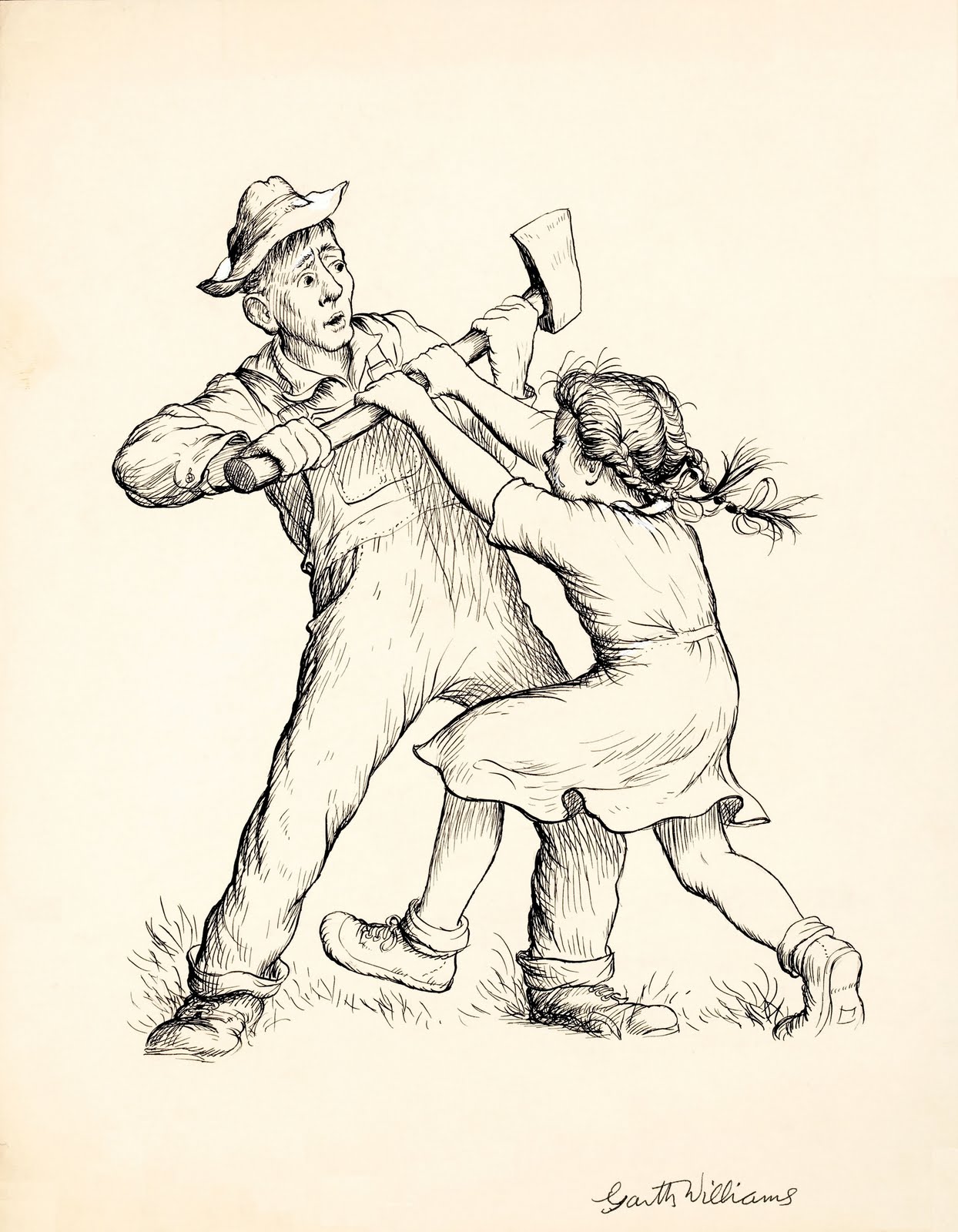
Noem grew up on a farm, where killing animals is sometimes necessary. Not that this makes such tasks necessarily easier. My wife talks about the challenge of killing chickens when she was growing up on a small southeastern Iowa farm. I’m also sure that I’m not the only child who was traumatized by the Garth Williams illustration in Charlotte’s Webb of Fern holding off her axe-wielding father as he goes after Wilbur, the runt of the litter.
E.B. White’s book is powerful in part because it acknowledges the stark reality at play in rural America. It’s a fact of life that farm-raised pigs do not have a spider advocate to save them from their destined end. Charlotte’s Web is noteworthy as a children’s book because it has the courage to grapple with life and death issues.
Sometimes dogs too must be put down, such as Old Yeller in Fred Gipson’s novel, who saves the family from a rabid wolf but contracts the illness in the process. There’s also the rabid dog in To Kill a Mockingbird, a foreshadowing of the “rabid” Bob Ewell, who assaults his daughter and blames an innocent Black man for it.
Perhaps most powerfully, there’s the tragic story of the sheepdog-in-training, young George, in Far from the Madding Crowd. Instead of rounding up the flock, George stampedes them over a cliff, rendering the kindly Gabriel Oak an instant pauper:
With a sensation of bodily faintness [Gabriel] advanced: at one point the rails were broken through, and there he saw the footprints of his ewes. The dog came up, licked his hand, and made signs implying that he expected some great reward for signal services rendered. Oak looked over the precipice. The ewes lay dead and dying at its foot—a heap of two hundred mangled carcasses, representing in their condition just now at least two hundred more.
Gabriel, we learn, is so humane that he feels “an arrant traitor to his defenseless sheep” when he has to turn one into mutton. After first feeling a deep pity for his decimated flock, he is then faced with the enormity of his loss:
It was a second to remember another phase of the matter. The sheep were not insured. All the savings of a frugal life had been dispersed at a blow; his hopes of being an independent farmer were laid low—possibly forever. Gabriel’s energies, patience, and industry had been so severely taxed during the years of his life between eighteen and eight-and-twenty, to reach his present stage of progress that no more seemed to be left in him. He leant down upon a rail, and covered his face with his hands.
In spite of his loss, however, he still feels for young George, who only thought he was doing his job:
As far as could be learnt it appeared that the poor young dog, still under the impression that since he was kept for running after sheep, the more he ran after them the better, …collected all the ewes into a corner, driven the timid creatures through the hedge, across the upper field, and by main force of worrying had given them momentum enough to break down a portion of the rotten railing, and so hurled them over the edge.
Hardy doesn’t hold back on the injustice of it all:
George’s son had done his work so thoroughly that he was considered too good a workman to live, and was, in fact, taken and tragically shot at twelve o’clock that same day—another instance of the untoward fate which so often attends dogs and other philosophers who follow out a train of reasoning to its logical conclusion, and attempt perfectly consistent conduct in a world made up so largely of compromise.
“I hated that dog,” Noem writes, adding that Cricket tried to bite her, proving herself “untrainable”, “dangerous to anyone she came in contact with” and “less than worthless … as a hunting dog.”
Then, to further prove her ruthlessness, she writes about shooting an unruly goat immediately afterwards.
It’s not as though she didn’t have other options. One animal rights group laid them out.
“There’s no rational and plausible excuse for Noem shooting a juvenile dog for normal puppy-like behavior,” said a statement from Wayne Pacelle, president of Animal Wellness Action and the Center for a Humane Economy. “If she is unable to handle an animal, ask a family member or a neighbor to help. If training and socializing the dog doesn’t work, then give the dog to a more caring family or to a shelter for adoption.
Sometimes animals have to be put down, although even in seemingly clear instances there can be moral complications, as George Orwell makes clear in his essay “Shooting an Elephant.” But Noem, in a book designed as a campaign advertisement, is uninterested in nuance. She wants to show the MAGA faithful, and to show Donald Trump, that she is one mean motherf***er.