Sunday – Day of Pentecost
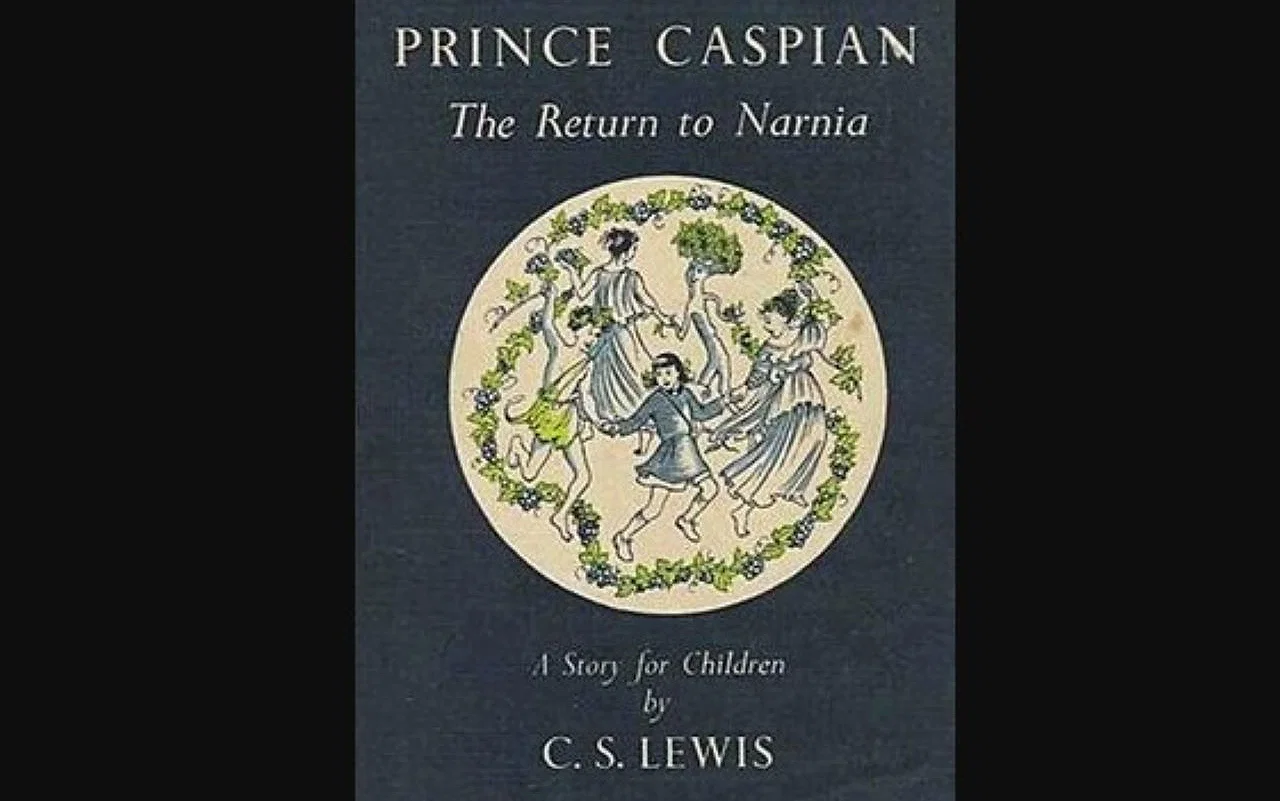
John Gatta’s Green Worlds of C.S. Lewis: The Ecology of Aslan’s Realm has just been released, and while I will examine it in a future post, it has me thinking about images of Pentecost as they show up in the Narnia books. Two years ago I wrote about a Pentecostal moment in The Lion, the Witch, and the Wardrobe, and now, thanks to a blog essay by an Anglican curate, I realize there is also one in Prince Caspian.
In Wardrobe, the moment occurs when Aslan breathes on the stone statues in the White Queen’s Palace and they become living, vibrant selves. As the old spiritual puts it, “Dem bones, dem bones gonna walk around.” Here’s the passage I particularly like:
I expect you’ve seen someone put a lighted match to a bit of newspaper which is propped up in a grate against an unlit fire. And for a second nothing seems to have happened; and then you notice a tiny streak of flame creeping along the edge of the newspaper. It was like that now. For a second after Aslan had breathed upon him the stone lion looked just the same. Then a tiny streak of gold began to run along his white marble back—then it spread—then the color seemed to lick all over him as the flame licks all over a bit of paper—then, while his hindquarters were still obviously stone the lion shook his mane and all the heavy, stony folds rippled into living hair. Then he opened a great red mouth, warm and living, and gave a prodigious yawn. And now his hind legs had come to life. He lifted one of them and scratched himself.
In my post, I drew a parallel between the cacophony of languages that breaks out as the Pentecostal spirit descends—so much so that some skeptical witnesses conclude that the worshippers are drunk—and the response of the Witch’s former victims:
And instead of the deadly silence the whole place rang with the sound of happy roarings, brayings, yelpings, barkings, squealings, cooings, neighings, stampings, shouts, hurrahs, songs and laughter.
The Rev’d Dr. Hannah J. Swithinbank identifies a similar awakening in Caspian. In this instance, the “rush of a violent wind” described by Luke is a lion’s roar:
The light was changing… Aslan, who seemed larger than before, lifted his head, shook his mane, and roared. The sound, deep and throbbing at first like an organ beginning on a low note, rose and became louder, and then far louder again, till the earth and air were shaking with it. It rose up from that hill and floated across all Narnia. Down below that in the Great River, now at its coldest hour, the heads and shoulders of the nymphs, and the great weedy-bearded head of the river-god, rose from the water. Beyond it, in every field and wood, the alert ears of rabbits rose from their holes, the sleepy heads of birds came out from under wings, owls hooted, vixens barked, hedgehogs grunted, the trees stirred.
Ecstatic dancing follows as all creation awakens:
What Lucy and Susan saw was a dark something coming to them from almost every direction across the hills. It looked first like a black mist creeping on the ground, then like the stormy waves of a black sea rising higher and higher as it came on, and then, at last, like what it was, woods on the move. All the trees of the world appeared to be rushing toward Aslan. But as they drew nearer, they looked less like trees, and when the whole crowd, bowing and curtseying and waving thin long arms to Aslan, were all around Lucy, she saw that it was a crowd of human shapes. Pale birch-girls were tossing their heads, willow-women pushed back their hair from their brooding faces to gaze on Aslan, the queenly beeches stood still and adored him, shaggy oak-men, lean and melancholy elms, shock-headed hollies (dark themselves, but their wives all bright with berries) and gay rowans, all bowed and rose again, shouting “Aslan, Aslan!” in their various husky or creaking or wave-like voices.
The crowd and the dance round Aslan (for it had become a dance once more) grew so thick and rapid that Lucy was confused. She never saw where certain other people came from who were soon capering about the trees.
These other figures include the Greek fertility deities Silenus and Dionysus (a.k.a. Pan, Bromios, Bassareus), along with the Bacchantes and possibly also an Egyptian ram god. Given Luke’s mention of “new wine” in his Gospel account, it’s striking that Lucy and the others soon find grape vines and grape clusters entwined in their hair. Lewis appears to borrow some of his imagery from Euripides’s The Bacchae.
In The Magician’s Book, journalist Laura Miller talks about how, as a child, she became disillusioned with Narnia after concluding that it is Christian propaganda. The pagan figures, however, suggest that Lewis doesn’t find Christian symbolism sufficient for capturing the ecstasy of spiritual awakening. Perhaps it’s because Luke’s account of Pentecost doesn’t include images from nature (other than the wind and the tongues of fire that hover over the worshippers). Lewis wants to include all of creation in his vision, not just people.
As a result, his vision is like that which Gatta puts forth in his books The Transfiguration of Christ and Creation, Green Gospel: Foundations of Ecotheology, and now Green Worlds of C.S. Lewis. As Gatta writes in Green Gospel,
Faith must encompass everything—all things seen and unseen, human and nonhuman beings of every stripe, throughout the whole of creation. For us living today, a Jesus capable of rescuing just ourselves, or our kind alone, from sin and death can no longer be recognized as God’s savior of the world. Only a cosmic Christ, as Saint Paul first envisioned, could possibly fulfill that role.
I’ve shared multiple times the contention of Dr. Rob MacSwain, editor of The Cambridge Companion to C.S. Lewis, that Anglicans conduct their theology through literature rather than systematic philosophy, and these scenes from Prince Caspian make his point. One can either say that that the Cosmic Christ came to earth to redeem not only humans but all of creation…or one can tell a story featuring a lion, dancing trees, celebrating animals, rivers liberated from bridges, and students freed from indoctrinating history classes.
“What is the use of a book,” I hear Lewis Carroll’s Alice asking, “without pictures or conversations?”