Wednesday
For its September book, our church group has been discussing Green Worlds of C.S. Lewis: The Ecology of Aslan’s Realm, by member John Gatta. At John’s request, yesterday I led the session on Prince Caspian.
Upon revisiting it, I was struck by how it can offer us hope in the midst of our despair over Trumpian depredation.
Set hundreds of years after The Lion, the Witch, and the Wardrobe, Prince Caspian features a tyrant who, after ascending to the throne by killing his brother (think Claudius from Hamlet), then targets his nephew after his queen gives birth to a son. Like Trump, Miraz cares only about his own ethnicity, the conquering Telmarines, and feels no responsibility for the rest of the land. Indeed, he seeks to rewrite history, denying that Narnia was ever home to talking animals and nature spirits.
Caspian’s nurse is therefore banished for telling him stories about ancient Narnia, and his tutor—a mixed race dwarf-human who passes as a Telmarine—can only secretly reveal to him Caspian’s own family history. At one point Lewis tells us that “the sort of ‘History’ that was taught in Narnia under Miraz’s rule was duller than the truest history you ever read and less true than the most exciting adventure story.”
The Telmarines also fear nature, especially forests and open water.
Unlike his uncle and DJT, Prince Caspian believes he has a responsibility to the entire country, not just Telmarines, and longs to reconnect with ancient Narnia. Escaping from Miraz, he chances upon remnants of the old world, and together they fight back. At a critical moment, he blows Susan’s magic horn (see The Lion, the Witch, and the Wardrobe), calling forth both Aslan and the king and queens from Narnia’s Golden Age (Peter, Susan, Edmund, and Lucy). Lewis here is tapping into that deepest of British myths, the return of the king.
The task of these former monarchs is to set Caspian on the throne. This they do with the help of Aslan, who unleashes an ecological uprising. The trees awaken and play a pivotal role in a key battle, just as Tolkien’s Ents do in the Battle at Helm’s Deep. I’ve mentioned in the past that Lewis here may be borrowing from a chapter in Kipling’s Jungle Books (“Letting in the Jungle”), although a more direct influence is Euripides’s The Bacchae.
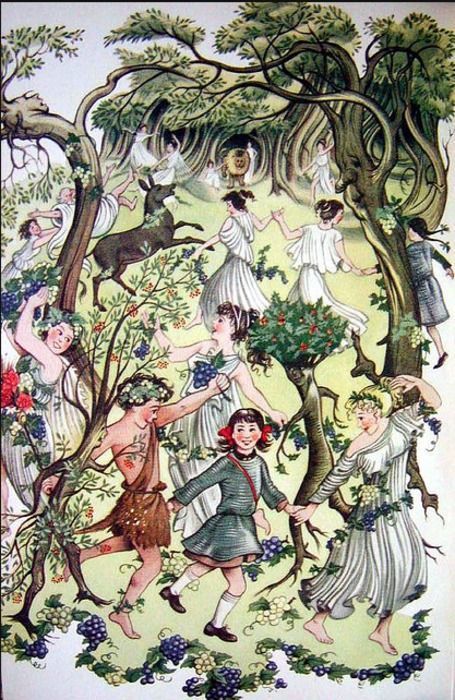
Bacchus (a.k.a. Dionysus and Bromios) and his female followers make a direct appearance as Lewis seeks to give full expression to fertility unbounded. With the Greek fertility god Silenus also in attendance, we see grape vines sprouting everywhere:
And all the time there were more and more vine leaves everywhere. And soon not only leaves but vines. They were climbing up everything. They were running up the legs of the tree people and circling round their necks. Lucy put up her hands to push back her hair and found she was pushing back vine branches. The donkey was a mass of them. His tail was completely entangled and something dark was nodding between his ears. Lucy looked again and saw it was a bunch of grapes. After that it was mostly grapes overhead and underfoot and all around. “Refreshments! Refreshments,” roared the old man [Silenus].
Just as Euripides’s Dionysus will pull down the prison in which tyrant Pentheus seeks to confine him, so Lewis’s Bacchus unleashes vines that pull down a bridge imprisoning a river god. Vines also pull down an oppressive school teaching Telmarine history, and there are the following moments, the last of which may be inspired by Ovid’s Metamorphoses:
They swept on across the level fields on the north bank, or left bank, of the river. At every farm animals came out to join them. Sad old donkeys who had never known joy grew suddenly young again; chained dogs broke their chains; horses kicked their carts to pieces and came trotting along with them — clop-clop — kicking up the mud and whinnying.
At a well in a yard they met a man who was beating a boy. The stick burst into flower in the man’s hand. He tried to drop it, but it stuck to his hand. His arm became a branch, his body the trunk of a tree, his feet took root. The boy, who had been crying a moment before, burst out laughing and joined them.
Reading Prince Caspian as DJT assaults America’s national parks, along with its air and water, helps us imagine a leader who cares about all America, not just himself, and who seeks a connection with both our Enlightenment and our natural heritage. We can also take a page from Trufflehunter the badger, who never loses his faith in a restored Narnia:
Peter leaned forward, put his arms round the beast and kissed the furry head: it wasn’t a girlish thing for him to do, because he was the High King.
“Best of badgers,” he said. “You never doubted us all through.”
“No credit to me, your Majesty,” said Trufflehunter. “1’m a beast and we don’t change. I’m a badger, what’s more, and we hold on.”
For an updated version of Lewis’s vision, I leave you with this poem by Wendell Berry, who passed away last month. (I’ve written about it here https://betterlivingthroughbeowulf.com/berrys-vision-to-save-the-planet/) It too calls for patience:
A Vision
By Wendell BerryIf we will have the wisdom to survive,
to stand like slow-growing trees
on a ruined place, renewing, enriching it,
if we make our seasons welcome here,
asking not too much of earth or heaven,
then a long time after we are dead
the lives our lives prepare will live
here, their houses strongly placed
upon the valley sides, fields and gardens
rich in the windows. The river will run
clear, as we will never know it,
and over it, birdsong like a canopy.
On the levels of the hills will be
green meadows, stock bells in noon shade.
On the steeps where greed and ignorance cut down
the old forest, an old forest will stand,
its rich leaf-fall drifting its roots.
The veins of forgotten springs will have opened.
Families will be singing in their fields.
In the voices they will hear a music
risen out of the ground. They will take
nothing from the ground they will not return,
whatever the grief at parting. Memory,
native to this valley, will spread over it
like a grove, and memory will grow
into a legend, legend into song, song
into sacrament. The abundance of this place,
the songs of its people and its birds,
will be health and wisdom and indwelling
light. This is no paradisal dream.
Its hardship is its possibility.