Wednesday
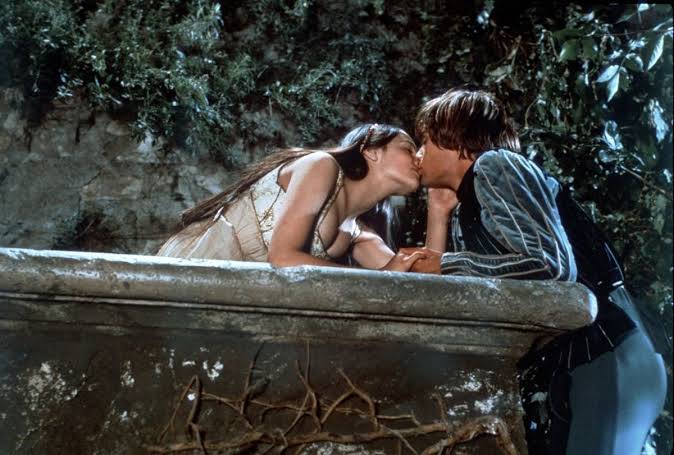
A question that has nagged at me for years suddenly came into focus yesterday as I was teaching Midsummer Night’s Dream and Romeo and Juliet. I had paired the two, figuring that a comedy and a tragedy addressing the same topic (explosive sexual desire) provided a good way of understanding how the two genres work. Pairing them did that and more.
My question was which of the two plays, both written between 1594-96, came first. The play-within-a-play that we encounter in Midsummer is a botched rendering of Ovid’s story Pyramus and Thisbe, the evident model for Romeo and Juliet. If Shakespeare wrote Romeo and Juliet first, was he spoofing his tragic love story in Midsummer? Or (to venture upon a more elaborate theory), was he making Theseus’s point that the inept play in Midsummer is to R&J what Shakespeare’s R&J on stage was to the R&J in Shakespeare’s mind?
This requires some explanation so here goes. In Midsummer, Queen Hippolyta says of the disastrous performance, “This is the silliest stuff that ever I heard,” to which Theseus replies,
The best in this kind are but shadows; and the worst are no worse, if imagination amend them.
When Hippolyta reasonably says, “It must be your imagination then, and not theirs,” Theseus counters, “If we imagine no worse of them than they of themselves, they may pass for excellent men.”
I love the interchange because I imagine that Shakespeare is talking about his own plays. If even the best plays “are but shadows”—and in my opinion Shakespeare wrote the best plays the world has ever seen—then perhaps he’s expressing his disappointment that R&J didn’t live up to his internal vision of it. Thus the spoof.
Or maybe (to float a third theory under option #1), he was following in the tradition of the Ancient Greek tragedians, who would follow a trilogy of tragedies with a lighthearted satire. It was a way of letting their audiences down gently after running them through an emotional wringer.
After teaching yesterday’s class, however, I have come to the opposite conclusion. I now think that, in exploring the explosive workings of human desire, Shakespeare was unsatisfied with just laughing at humans. Puck may say, “What fools these mortals be,” but Shakespeare wanted to explore further. “Long shot for comedy, close-up for tragedy,” Charlie Chaplin once said, and Shakespeare went for close-up. In the process, he produced one of the world’s greatest love stories.
If you imagine that the Oscar-winning film Shakespeare in Love actually happened, he proved to Queen Elizabeth that England was indeed capable of besting the Italians in the love story business.
I came down on the side of option #2—that R&J was written second—in part because of insights gained from pairing Taming of the Shrew and Much Ado about Nothing the week before. As I wrote last Wednesday and Thursday, I sensed potential in a Katharina-Petruchio pairing—what if they are actually collaborating at the end?—and then saw Shakespeare embodying that potential in the Beatrice-Benedick relationship. Isn’t a marriage where sparks fly endlessly more satisfying to both partners than one in which one ,submits utterly. I think of the lines by the 17th century libertine John Wilmot, “But did you love your pleasure less,/ You were no match for me.”
If Shakespeare could see potential for a more expansive relationship after writing Taming, perhaps he saw the same after writing Midsummer.
With Shakespeare, I admire above all the way he acknowledges our full humanity. As Harold Bloom contends, Shakespeare invented personality, changing our ideas “as to what makes the self authentically human.” While comedy gets us part of the way there, tragedy is where we see humanity at its most complex. (As I told the class, comedy focuses more on the social, tragedy on the individual.)
All of which is to say, I imagine Shakespeare thinking that he’d like to become better acquainted with Pyramus and Thisbe and creating Romeo and Juliet as a result. It has been said of the Bard that he was incapable of creating a two-dimensional character—this is true also of Tolstoy—and in R&J he created three-dimensional characters in spades, everyone from the leads to Mercutio to the nurse to Friar Laurence to the Montague and Capulet parents and on and on.
Shakespeare does justice to our full selves, capturing like no one before or since our virtues, our vices, and our situations. To apply to him a line delivered by perhaps his most deeply realized character (Hamlet), he held his “mirror up to nature: to show virtue her own feature, scorn her own image, and the very age and body of the time his form and pressure.”
All that being said, I’m open to other arguments. The virtue of the debate is that it plunges us more deeply into the plays.