Note: If you wish to receive, via e-mail, (1) my weekly newsletter or (2) daily copies of these posts, write to me at rrbates1951@gmail.com. Comments may also be sent to this address. I promise not to share your e-mail with anyone. To unsubscribe, write here as well.
Tuesday
The news has been so bad recently that I figured readers would appreciate Bill McKibben’s positive report about the world’s conversion to solar energy. To add to the uplift, I also include a Philip Larkin poem about the glories of the sun.
In a recent New Yorker article the noted climate activist says that, over the past two years and with surprisingly little notice, renewable energy “has suddenly become the obvious, mainstream, cost-efficient choice around the world.” He notes that despite the efforts of the GOP’s Big Beautiful Bill to kneecap solar and wind energy, the U.S. and other countries continue to surpass even our most ambitious goals. “Globally, roughly a third more power is being generated from the sun this spring than last,” McKibben writes.
One reason we in America may not be noticing this is because some of the biggest strides are happening elsewhere. China, which in 2020 set a goal of producing twelve hundred gigawatts of clean power by 2030, hit that target early last year. Africa and South Asia, meanwhile, are importing China’s mass-produced solar panels, which are changing the fortunes of farmers and business owners. According to McKibben, the International Energy Agency is currently predicting that, by 2026,
solar will generate more electricity than all the world’s nuclear plants combined. By 2029, it will generate more than all the hydro dams. By 2031, it will have outstripped gas and, by 2032, coal. According to the I.E.A., solar is likely to become the world’s primary source of all energy, not just electricity, by 2035.
We’re by no means out of the woods yet, unfortunately. McKibben says that, if we are to achieve the 2015 Paris agreement’s goals of a net-zero carbon world by 2050, we must increase the pace at which we’re installing renewables by about twenty per cent. Donald Trump and the fossil fuel companies are doing all they can to stop that from happening.
Interestingly, however, this is spurring a backlash from other countries, which are looking for ways to break free of their dependance on American natural gas and oil and as a result are accelerating their own renewable efforts. Even in America, solar power remains the most popular source of electricity in America, with almost 90% of the public favoring the clean energy tax credits passed during the Biden administration. As Bob Dylan would say, “Please get out of the new [road] if you can’t lend a hand/ For the times they are a changin’.”
I can report that Julia and I have made our own small contribution, installing solar panels on our Maryland home in 2016. (We’re currently living in Appalachian Tennessee and so can’t do the same here.) Someday, when they wear out, they will provide minerals for future solar panels, which are becoming increasingly efficient. McKibben quotes an Oxford researcher reporting that “the silver used in one solar panel built in 2010 would be enough for around five panels today.” McKibben says that, by 2035, that number will increase to ten new panels.
After our 20-year-old Prius died, Julia and I also purchased an all-electric Hyundai Ioniq 6, which we plug into our house every night and love more than any other car we’ve ever owned. As McKibben notes, “it takes two to three times more energy to run a standard car than to run an E.V., which is why even an E.V. charged with power from a coal-fired plant is still far more efficient than a vehicle run on an internal-combustion engine.” He’s even more enthusiastic about e-bikes.
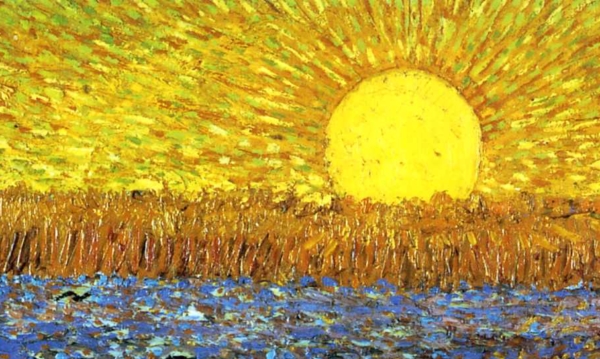
So with gratitude toward the sun, here’s Larkin’s “Solar,” which praises the heavenly body for pouring its bounty down upon us “unrecompensed.” The sun is both a “suspended lion face” in the “unfurnished sky” and a “single stalkless flower,” sending out heat that is “the echo of [its] gold.”
For good measure, Larkin throws in a reference to Jacob’s ladder. In a dream Jacob saw angels ascending and descending a stairway to heaven, and so go our own prayers to the sun. It awaits with open hands as “our needs hourly climb and return like angels.”
“You give forever,” the poet concludes gratefully.
Solar
By Philip Larkin
Suspended lion face
Spilling at the center
Of an unfurnished sky
How still you stand,
And how unaided
Single stalkless flower
You pour unrecompensed.
The eye sees you
Simplified by distance
Into an origin,
Your petalled head of flames
Continuously exploding.
Heat is the echo of your
Gold.
Coined there among
Lonely horizontals
You exist openly.
Our needs hourly
Climb and return like angels.
Unclosing like a hand,
You give forever.
When I think of how Trump hates solar power—and before Trump, Ronald Reagan, who removed the solar panels that Jimmy Carter installed on the White House—I think of Satan in Milton’s Paradise Lost. “O Sun, [I] tell thee how I hate thy beams/ That bring to my remembrance from what state/ I fell.”
Better to say to praise the sun as Milton’s Adam does in his morning hymn. The sun here is the eye and soul of our world, belonging not only to the dawn but functioning as the “sure pledge of day”:
Fairest of stars, last in the train of night,
If better thou belong not to the dawn,
Sure pledge of day, that crownst the smiling morn
With thy bright circlet, praise him in thy sphere
While day arises, that sweet hour of prime.
Thou sun, of this great world both eye and soul,
Acknowledge him thy greater, sound his praise
In thy eternal course, both when thou climb’st,
And when high noon has gained, and when thou fall’st.
Further thought: A song about the sun that I learned as a child is a far cry from Larkin and Milton, but I have a special fondness for it and can still sing it. Looking back at it now, I realize it gave us a chance to express gratitude at an early age:
The sun is a mass of incandescent gas
A gigantic nuclear furnace
Where hydrogen is turned into helium
At a temperature of millions of degreesYo-ho, it’s hot, the sun is not
A place where we could live
But here on Earth, there’d be no life
Without the light it gives
We need its light, we need its heat
We need its energy
Without the sun, without a doubt
There’d be no you and me