Tuesday
People have long praised the power of literature to foster empathy, and in my book I explore the radical ways that novels expanded the franchise in the 19th century (see footnote). If one wants a single example, think of the role that Uncle Tom’s Cabin played in the American Civil War. For this reason, perhaps we shouldn’t be surprised to learn that certain forces on the right are now attacking empathy itself.
At one point I thought that Elon Musk was a sociopathic outlier when he said, “The fundamental weakness of Western civilization is empathy, the empathy exploit.” I didn’t realize that several rightwing books have recently been claiming this, including Paul Bloom’s Against Empathy, Allie Beth Stuckey’s Toxic Empathy, Joe Rigney’s The Sin of Empathy, and Gail Saad’s Suicidal Empathy. In a review of Saad (gift copy) that mentions the other works, Atlantic’s Elizabeth Bruenig says that suicidal empathy
is when otherwise positive impulses are “hijacked and used to make policy decisions that are best tackled via a sober analysis”—a phenomenon that will lead to nothing less than “the collective suicide of the West.”
An influential Catholic bishop in Minnesota has embraced Saad’s book, contrasting suicidal empathy with Christian charity. He argues that “love, far from mandating kindness, can and often should be harsh.” While this may sound acceptable in the abstract, Bruenig says the actual agenda is to make conservatives “resolve their internal conflicts and ignore their consciences.”
“Arguments about the harms of empathy,” she writes, “help justify personal and political behavior that might otherwise seem wrong or feel bad, such as cutting food-stamp benefits for poor people or tearing immigrant mothers away from their children.”
For instance, Stuckey’s Toxic Empathy
is at pains to reassure her readers that any dissonance they might feel between their religious duties and political interests is a treacherous mirage generated by the left. The goal of “toxic empathy,” she says, is “to get us to suppress our opposition to a particular issue or point of view by playing upon our desire to be a good person.” By this account, liberals are emotionally exploiting feelings of guilt or shame in conservatives to persuade them to support left-wing goals.
For the anti-empathy folk, Western culture is always under dire threat from liberals and immigrants, “through either the great replacement of white Christians or a grand shift in public opinion.” In actuality, the choice of targets in such books boils down to a laundry list of rightwing grievances. What Saad’s ideas mean in practice, Bruenig writes, “is that every time you pay your taxes, sit through a diversity-training session at work, or interact with a disabled employee at the post office, you are witnessing the collapse of the West.”
Rather than an argument for Christian love, Bruenig concludes that Saad and others are providing conservatives with a guidebook for ignoring human suffering. “Love they neighbor” is getting replaced with “might makes right.”
Which is pretty much how Ayn Rand sees the world, which is why her novels resonate so much with people on the right. As I reported in my recent post on end times fascism, it makes sense to me that Howard Roark in The Fountainhead was based on a murderer who was so lacking in empathy that he could cut up a victim and stick her head on her torso to fool her father at the ransom drop-off.
But Rand at least didn’t claim to be a Christian: she was a staunch atheist when she celebrated self-centered behavior. Rightwing Christians, on the other hand, must tie themselves into moral knots to justify children being torn away from their parents in ICE deportation raids or families being priced out of healthcare.
I promised, in my end times fascism essay, to show how great literature pushes back against the shallow novels that promote Christo-fascism, technofascism, and ethnonationalism, novels that I described as delivering a sugar high. Since all these groups are caught up in their own grandiosity, cutting themselves off from the rest of humanity, I figure that Shakespeare’s King Lear offers a profound antidote.
Lear, whose similarity to Trump I have noted many times (for instance, here), is a narcissist who thinks the world revolves around him. He’s not entirely wrong since, for as long he holds executive power, it does. But because humans can’t do without other people—that’s what empathy is all about—he reaches out for love, subjecting his daughters to a love test.
That, of course, is not how love works. He learns the hard way that you can’t have love on your own terms.
In the course of the story, we watch his spectacular meltdown as he arrives at this realization. His breakthrough comes when he discovers that real love—opening oneself fully and unconditionally to another—fills his formerly empty existence with real meaning. Everything else fades into insignificance when he and Cordelia are together in prison:
Come, let’s away to prison:
We two alone will sing like birds i’ the cage:
When thou dost ask me blessing, I’ll kneel down,
And ask of thee forgiveness: so we’ll live,
And pray, and sing, and tell old tales, and laugh
At gilded butterflies, and hear poor rogues
Talk of court news; and we’ll talk with them too,
Who loses and who wins; who’s in, who’s out;
And take upon’s the mystery of things,
As if we were God’s spies: and we’ll wear out,
In a wall’d prison, packs and sects of great ones,
That ebb and flow by the moon.
The last few hours that he spends with Cordelia mean more to him than all the wealth and power he possessed as king.
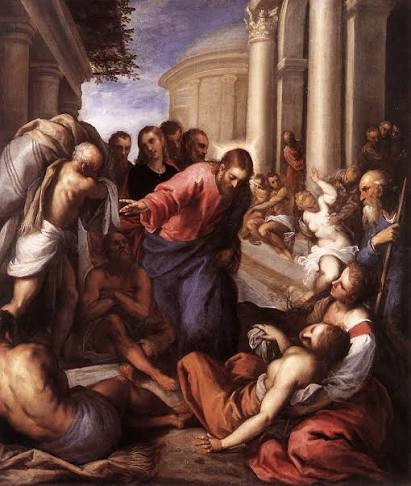
This, I would add, is the “kingdom on earth” that Jesus preached. Those rightwing Christians obsessed with people getting benefits they don’t deserve have to ignore any number of Jesus’s parables, including those about the prodigal son and the laborers in the vineyard.
If one starts with empathy, reasonable social policy can be worked out. Without it, Ayn Rand’s self-absorption will rule the day.
The radical power of literary empathy: “[With Wordsworth] the door had been opened for poets and writers to use the Imagination to step beyond their own narrow class boundaries in ways that would have been, well, unimaginable in earlier times. Through literature authors have entered the lives of the marginalized (Walt Whitman), the urban poor (Charles Dickens), American slaves (Harriet Beecher Stowe), Dorset dairy maids (Thomas Hardy), French coalminers (Emile Zola), Nebraska pioneers (Willa Cather), Harlem residents (Langston Hughes), African American sharecroppers (Jean Toomer), African American homosexuals (James Baldwin), bankrupted Oklahoma farmers (John Steinbeck), Laguna Pueblo war veterans (Leslie Marmon Silko), transplanted Pakistanis (Hanif Kureishi), West Indian immigrants (Zadie Smith), American lesbians (Alison Bechdel), and on and on.”—Robin Bates, Better Living through Literature