Thursday
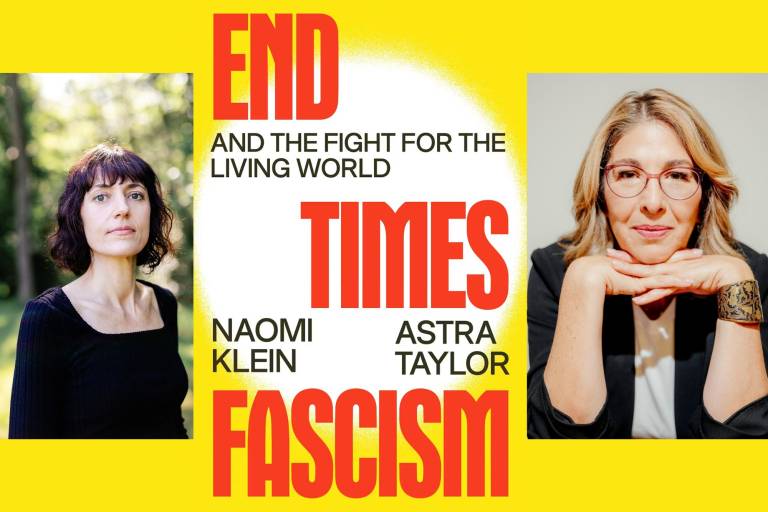
Recently I listened to Chris Hayes interview Naomi Klein and Astra Taylor about their book End Times Fascism and the Fight for the Living World, where they contend that three groups have joined forces in their efforts to end the world as we know it: Christian extremists, technofascists, and ethnonationalists. These factions, as an NPR review put it “have come together around their shared conviction that they are part of an elite destined to survive the coming apocalypse.”
I write about the work here because novels—bad novels but novels nonetheless—have played a role in each of these movements. But let’s first look at the phenomenon.
While Messianic movements predicting the end of the world have been with us forever, Klein and Taylor argue that it’s different this time. That’s because “our world is more dangerous than their world: its weapons deadlier, its technologies vastly more potent, its media more connected, its climate more unstable, its concentrated wealth more global in reach than at any point in human history.”
Christo-fascists, known as dispensationalists, endorse Israel taking over the entire Holy Land as a precondition for the Rapture. As an article in Christianity Today explained it,
Until Messiah’s coming God’s earthly people must suffer Gentile domination, prophesied by Daniel. This Gentile hegemony would end at the coming of Messiah, 70 weeks after one of the Gentile rulers issues a decree allowing the Jews to return to Jerusalem to repair its broken walls. But when the Jews rejected Jesus as their Messiah, God suspended the prophetic timetable at the end of Daniel’s sixty-ninth week and began building a new and heavenly people—the church.
Dispensationalists were overjoyed when Donald Trump moved the American embassy from Tel Aviv to Jerusalem, which he may in fact have done to curry favor with them.
For their part, technofascists believe they can build bunkers on Earth or flee to Mars or the moon. Better yet, once liberal democracy bites the dust, they can step in and pick up the pieces. For them, AI destroying us all is a consummation devoutly to be wished since coding is a world they understand.
Finally, ethnonationalists see the white race as doomed unless it stops mass migration, which indeed becomes more of an issue every day as climate change leads to ever more extreme weather events.
I haven’t read End Times Fascism yet and so don’t know if the authors talk about overlap. For instance, Palantir’s Peter Thiel talks like a Christo-fascist when it comes to the Antichrist like a Christo-fascist while Tesla and Starlink’s Elon Musk is a white nationalist in addition to being a tech bro. It appears that Musk saw the millions of African deaths caused by DOGE terminating USAID and (temporarily) the Ebola program as a desired result. Nevertheless, identifying the three strands is useful given that each plays a distinctive role in the modern GOP.
The novels I’ve identified all view their protagonists as misunderstood victims who triumph over their tormentors in satisfying ways (or, in Camp of Saints, die as proud, self-righteous martyrs). In the Left Behind novels of Tim LaHaye and Jerry B. Jenkins (I draw here from a previous post), the victims are potential born-again Christians who have been left behind when the Rapture begins. A group calling itself “the Tribulation Force” grapples with the Antichrist, who runs the United Nations, in preparation for the time when the Messiah will return and separate the sheep from the goats. Here’s a member of the Force encountering Jesus:
“Again, Rayford slid to the ground, raising his arms. “My Lord and my God, I am so unworthy.”
“And you, Rayford, who once were alienated and an enemy in your mind by wicked works, yet now I have reconciled the body of My flesh through death to present you holy, and blameless, and above reproach in God’s sight.”
“Unworthy! Unworthy!” Rayford cried.
“Justified by faith,” Jesus said, “Justified.”
The Left Behind plot is similar to many of the conspiracy theories in which MAGA believes, complete with fiendish liberal conspiracies to brainwash and murder the populace. Perhaps this explains why they have sold over 65 million copies and have been read by many more. According to Wikipedia,
multiple books in the series have been on the New York Times best-seller list. Starting in 2000, Books 7 and 8 reached number one on the list followed by book 10, which debuted at number one…. Seven titles in the adult series have reached #1 on the bestseller lists for the New York Times, USA Today and Publishers Weekly.
Failing to distinguish fact from fiction is a theme in several noteworthy novels, including Don Quixote, Northanger Abbey, and Angela Carter’s The Infernal Desire Machines of Doctor Hoffman. And these were all written before AI’s unnerving ability to mimic reality.
The Bible of the tech bros has long been Ayn Rand’s Atlas Shrugged, with Rand’s Fountainhead as runner-up. The title of the first gives away the fantasy: if the billionaires, who are supposedly holding up the world, ever shrugged off their responsibility, our comfortable lives would end and we would be sorry. That’s what happens when various corporation heads, including multi-millionaire John Galt, go to war with the regulatory state. Without their entrepreneurial spirit, society collapses, at which point they return to build a new world on the ruins. It will not, of course, be a republic but a society in which they call the shots.
The novel is an exercise in libertarian thinking that indulges various infantile fantasies, including that people can make it on their own without help from anyone and that entrepreneurs are not properly appreciated.
I hadn’t fully realized the role that Fountainhead has played in rightwing thinking until reading a fascinating essay by Thom Hartmann. Howard Roark is a visionary architect, one who walks to the beat of his own drummer and who dynamites one of his own buildings rather than allow people to change it. According to Hartmann, Rand based Roark on kidnapper/murderer William Edward Hickman, who perpetrated “the crime of the century” in 1927. The man kidnapped a millionaire’s daughter, strangled her, cut her into pieces, and then “set what was left of her stump torso with the head sitting atop it in the passenger seat of his car, and drove to meet her father to collect the ransom money.”
While the country was horrified, Ayn Rand was inspired by the “unfeeling, unpitying selfishness.” The unrepentant Hickman, Hartmann writes, would go on to inspire Fountainhead, Rand’s philosophy, and her life’s work:
In Hickman, Ayn Rand wrote that she had finally found the new model of the Superman (her phrase, likely borrowed from Friedrich Nietzsche). Only a worldview held by a man like Hickman, she believed, could ever prevent an all-powerful state from traumatizing another generation of small businesspeople and their children as the Bolsheviks had her family.
And:
Hickman’s words, as recounted by Rand in her Journals, “I am like the state: what is good for me is right,” resonated deeply with her. It was the perfect articulation of her belief that if people pursued their own interests above all else—even above friends, family, or nation—the result would be utopian.
She wrote in her diary that those words of Hickman’s were, “the best and strongest expression of a real man’s psychology I ever heard.”
About Roark, meanwhile, Rand wrote, “One puts oneself above all and crushes everything in one’s way to get the best for oneself. Fine!” And also that her protagonist
has learned long ago, with his first consciousness, two things which dominate his entire attitude toward life: his own superiority and the utter worthlessness of the world. He knows what he wants and what he thinks. He needs no other reasons, standards or considerations. His complete selfishness is as natural to him as breathing.”
To contrast Fountainhead with a great novel, one in which the protagonist also channels Nietzsche’s Übermensch, look at Dostoevsky’s Crime and Punishment. Raskolnikov also thinks he can rise above good and evil, only to learn that his conscience and his heart have other plans for him. Contrasting him with Roark makes instantly clear just how much of a cardboard figure the architect is.
That, however, didn’t keep Rand from becoming the darling of conservative libertarianism. In 2017 the Guardian listed many of the public figures identifying themselves as Rand acolytes, including Federal Reserve Chair Alan Greenspan, Ronald Reagan, Speaker of the House Paul Ryan (who used to give copies of Atlas Shrugged to his staff members), Trump’s Secretary of State Rex Tillerson, libertarian Congressman Ron Paul, and Trump’s CIA director Mike Pompeo. Apple’s Steve Jobs, meanwhile, saw Atlas Shrugged as one of his “guides in life,” and Thiel and Musk include it amongst their favorite novels. Oh, and Fountainhead is the only novel on Shark Tank Mark Cuban’s list of his ten favorite books.
Given this, we shouldn’t be surprised at what Thiel and Musk have had to say about ethics. Here’s Thiel, perhaps himself channeling Nietzsche’s Beyond Good and Evil as he muses,
If you’re evil, you’re at least competent. And if you’re evil, you’re not bad. And therefore, maybe you’re actually kind of good because you’re at least getting something done.
Here’s Elon Musk on empathy:
The fundamental weakness of Western civilization is empathy, the empathy exploit.
So yes, they find a kindred spirit in Rand.
I’ve written about Camp of Saints (1973) before (here) so I’ll just cite Huffington Post’s summary, starting with the response to the third world hoards streaming towards the West:
The French government eventually gives the order to repel the armada by force, but by then the military has lost the will to fight. Troops battle among themselves as the Indians stream on shore, trampling to death the left-wing radicals who came to welcome them. Poor black and brown people literally overrun Western civilization. Chinese people pour into Russia; the queen of England is forced to marry her son to a Pakistani woman; the mayor of New York must house an African-American family at Gracie Mansion. Raspail’s rogue heroes, the defenders of white Christian supremacy, attempt to defend their civilization with guns blazing but are killed in the process.
And now, sure enough, there’s a Muslim in Gracie Mansion. And before him, there was an African American.
Camp of Saint “terribly impressed” Ronald Reagan when as president he was given a copy by the head of France’s Intelligence Services. Trump advisor Steve Bannon and Stephen Miller, chief architect of Trump’s draconian deportation policies, are fans.
I’ll write a post next week on how great literature pushes back against such shallow narratives. Many of our finest works affirm life and the dignity of humanity, not one-dimensional, suicidal fascism. Klein and Taylor point to one of these messages in their book’s conclusion: “We mortals are one another’s salvation.”
In the meantime, however, we can appreciate just how powerful fiction can be, even (or perhaps especially) bad fiction. Vegetables may make for better health but sugar gives us an instant dopamine high.