Sunday
Last week I wrote about End Times Fascism, a recent book examining three rightwing groups rooting for world-ending cataclysm. I was also in a church group discussing apocalyptic scenarios as we looked at C.S. Lewis’s The Last Battle, where Aslan replays the Book of Revelation as he separates the sheep from the goats. And then there was a grim-face DJT announcing that we are approaching “the final battle” as he strides toward the camera in an ad illegally paid for by the government and shown during Thursday night football. End of the world dramas have always been a way to capture our attention.
Today I focus on Lewis as I believe he is less interested in end times and more on what happens to us after we die. Novelists create narratives to grapple with life’s big questions, and in Last Battle Lewis has everyone die—and I mean everyone—so as to focus on what’s next.
This is what makes Last Battle the most disagreeable of the Narnia Chronicles. We get a taste of what is to come when we watch a tree spirit die. Then we see Narnian horses slaughtered by nihilistic dwafs, followed by the deaths of Jill, Eustace, King Tirian, and Jewel the unicorn (although Lewis softens the blow for young audiences by euphemistically having them thrown into a shed). Lewis follows this up with killing off the entire Narnia universe, Narnians and Calormenes alike, as flood waters rise, the stars plummet, and the sun swallows the moon and goes dark.
Meanwhile, back in our world, a train crash kills Peter, Edmund, Lucy, and their parents.
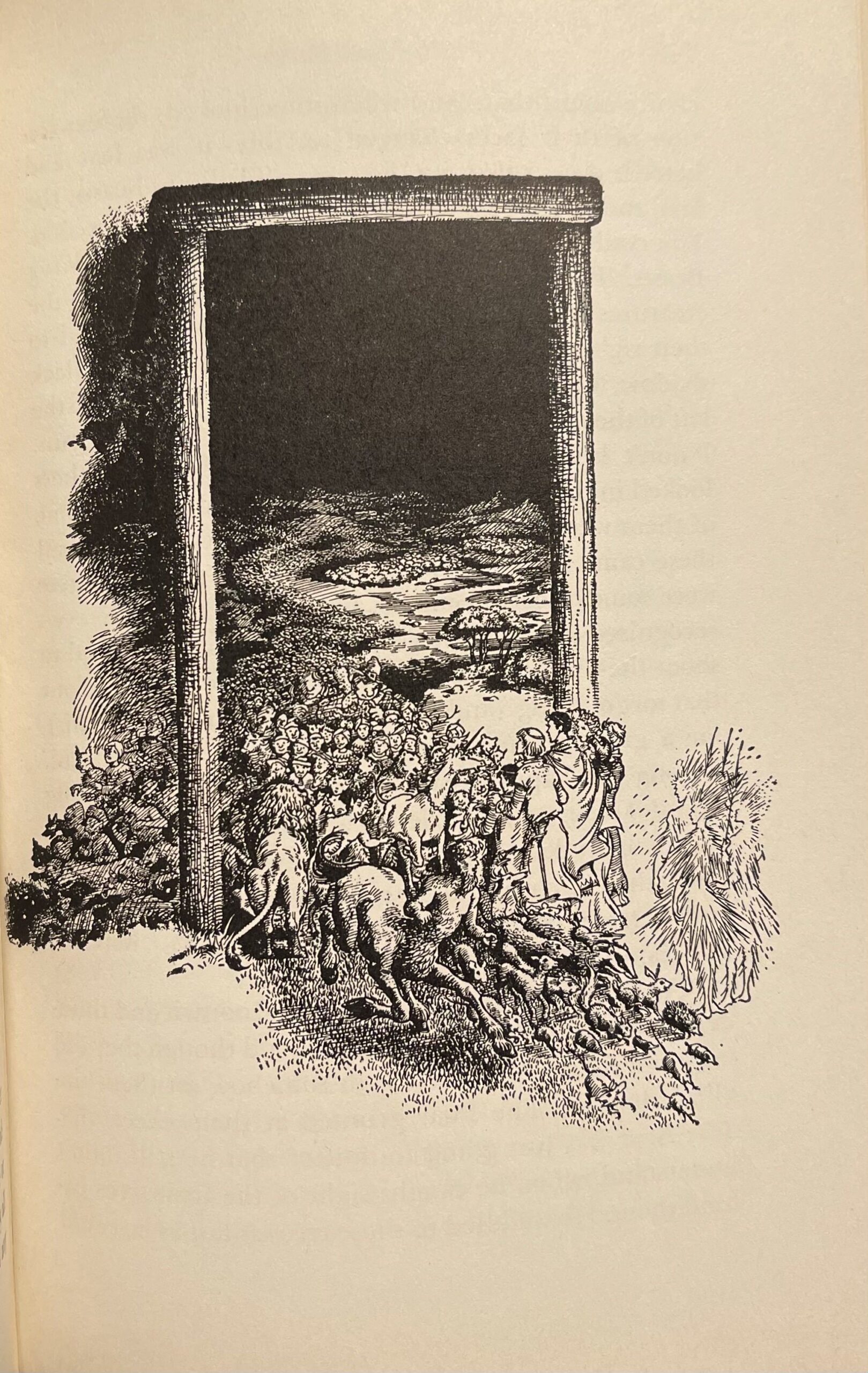
Since we move quickly to New Narnia, we don’t have to see any dead bodies. The book seems mainly an exercise in imagining the afterlife, with Lewis drawing largely on Plato and Dante while mixing in his own fantasizing. To convey the difference between the old Narnia and the New Narnia, he invokes Plato’s cave dwellers, who think that the shadows they are seeing on the wall are reality. Lewis changes the allegory by bringing in the imagination:
It is as hard to explain how this sunlit land was different from the old Narnia, as it would be to tell you how the fruits of that country taste. Perhaps you will get some idea of it, if you think like this. You may have been in a room in which there was a window that looked out on a lovely bay of the sea or a green valley that wound away among mountains. And in the wall of that room opposite to the window there may have been a looking glass. And as you turned away from the window you suddenly caught sight of that sea or that valley, all over again, in the looking glass. And the sea in the mirror, or the valley in the mirror, were in one sense just the same as the real ones: yet at the same time they were somehow different—deeper, more wonderful, more like places in a story: in a story you have never heard but very much want to know. The difference between the old Narnia and the new Narnia was like that. The new one was a deeper country: every rock and flower and blade of grass looked as if it meant more.
Tennyson fans may recognize images from “The Lady of Shalott” here:
And moving thro’ a mirror clear
That hangs before her all the year,
Shadows of the world appear.
Whereas the Lady, somewhat like Plato, becomes “half-sick of shadows” and wants to see the deeper country directly, for Lewis one can better glimpse this country through the imagination. His mirror, which Plato would consider shadows, is imaginative storytelling. Just as Paradiso is Dante’s attempt to see God’s own country, so Last Battle is Lewis’s.
In Green Worlds of C.S. Lewis, John Gatta stresses that Lewis’s New Narnia is “an intensely material and nature-encompassed realm” and not merely “a state of spiritualized, mental abstraction.” No “disembodied spirits hovering on clouds (and playing harps)” in this afterlife. All of God’s creation, not just humans, figure in Lewis’s vision as his New Narnia abounds “in real mountains, waters, skies, animals, orchards, grass, and flowers.”
Gatta acknowledges that “the transformed materiality in question cannot be equated with our current notions or experience of material substances—just as the body of the resurrected Christ must be distinguished from the body with which he previously walked the Earth.” Every rock and flower and blade of grass look as if they mean more. As Jewel says, “This is the land I have been looking for all my life, though I never knew it till now.” Then he cries, “Further up and further in” as he goes charging forward.
For Lewis, Gatta writes, the idea of a “sanctified materiality” was grounded in Christianity’s doctrine of the incarnation. And he notes,
In recent years theologians have reflected further on the ways in which God’s taking flesh as a flesh-and-blood temporal creature, described now as “deep incarnation,” has expansive implication not just for humankind but for the whole of God’s creation.
The most compelling image of the afterlife that I have encountered appears not in Lewis but in an author heavily influenced by him. In The Amber Spyglass, Philip Pullman has an extended reflection on what happens to us after we die, which I lay out in considerable detail here.
Although Pullman is critical of Lewis, they share an environmental focus. In Spyglass, those who die, after spending time in the arid world of the dead, finally find heaven by mingling with nature. Will and Lyra, reenacting a version of Jesus’s harrowing of hell, free the dead cut by cutting a window to release them. Rather than a window to an ethereal heaven, however, the window is into our material world.
And yet, the world is the way into heaven because it is a stepping fully into God’s creation. When the window opens up, Will, Lyra, and the dead experience our world as “the sweetest thing they had ever seen”:
The night air filled their lungs, fresh and clean and cool; their eyes took in a canopy of dazzling stars, and the shine of water somewhere below, and here and there groves of great trees, as high as castles, dotting the wide savanna.
The dead souls experience heaven on earth:
The first ghosts trembled with hope, and their excitement passed back like a ripple over the long line behind them, young children and aged parents alike looking up and ahead with delight and wonder as the first stars they had seen for centuries shone through into their poor starved eyes.
The first ghost to leave the world of the dead was Roger. He took a step forward, and turned to look back at Lyra, and laughed in surprise as he found himself turning into the night, the starlight, the air…and then he was gone, leaving behind such a vivid little burst of happiness that Will was reminded of the bubbles in a glass of champagne.
The other ghosts followed Rober, and Will and Lyra fell exhausted on the dew-laden grass, every nerve in their bodies blessing the sweetness of the good soil, the night air, the stars.
At the end of the novel, when Will and Lyra discover that they must be parted forever, they draw on what they have witnessed in the harrowing to find a future for themselves. Will promises,
I will love you forever; whatever happens. Till I die and after I die, and when I find my way out of the land of the dead, I’ll drift about forever, all my atoms, till I find you again… I’ll be looking for you, every moment, every single moment. And when we do find each other again, we’ll cling together so tight that nothing and no one’ll ever tear us apart. Every atom of me and every atom of you… We’ll live in birds and flowers and dragonflies and pine trees and in clouds and in those little specks of light you see floating in sunbeams… And when they use our atoms to make new lives, they won’t just be able to take one, they’ll have to take two, one of you and one of me, we’ll be joined so tight…
In my extended post on Pullman, I discuss how not all his souls choose this heaven, preferring instead to remain in the sterile void that is their version of heaven. Lewis does something similar as he too taps into Dante’s Inferno. Those people who think only in terms of the punishing Calormene god Tash rather than the loving lion Aslan get Tash when they die. For their part, the nihilistic dwarves who believe in nothing end up in what seems to them a black hole, even though they are surrounded by New Narnia. As Aslan puts it,
You see, they will not let us help them. They have chosen cunning instead of belief. Their prison is only in their own minds, yet they are in that prison; and so afraid of being taken in that they cannot be taken out.
In Lewis’s heaven, there is a place for all faiths, including Muslims Tashites. When the Calormene Emeth meets Aslan in the New Narnia, he expects to be killed but learns that all are God’s children:
But the Glorious One bent down his golden head and touched my forehead with his tongue and said, Son, thou art welcome. But I said, Alas, Lord, I am no son of Thine but the servant of Tash. He answered, Child, all the service thou hast done to Tash, I account as service done to me.
As their conversation continues, we realize that Tash is Lewis’s stand-in for Satan:
Then by reason of my great desire for wisdom and understanding, I overcame my fear and questioned the Glorious One and said, Lord, is it then true, as the Ape said, that thou and Tash are one? The Lion growled so that the earth shook (but his wrath was not against me) and said, It is false. Not because he and I are one, but because we are opposites, I take to me the services which thou hast done to him, for I and he are of such different kinds that no service which is vile can be done to me, and none which is not vile can be done to him. Therefore if any man swear by Tash and keep his oath for the oath’s sake, it is by me that he has truly sworn, though he know it not, and it is I who reward him. And if any man do a cruelty in my name, then, though he says the name Aslan, it is Tash whom he serves and by Tash his deed is accepted.
When Emeth protests, “Yet I have been seeking Tash all my days,” Aslan replies, “Beloved, unless thy desire had been for me thou wouldst not have sought so long and so truly. For all find what they truly seek.
I find Pullman’s vision of the afterlife more compelling than Lewis’s, where everyone is in their twenties or thirties and dressed in beautiful clothes. (In George Bernard Shaw’s Don Juan in Hell, everyone in the afterlife gets to choose their age, with the devil cautioning Ana against choosing 17: “Occasionally we have a rage for 17; but it does not last long. Just at present the fashionable age is 40—or say 37; but there are signs of a change. If you were at all good-looking at 27, I should suggest your trying that, and setting a new fashion.”) Joyously mingling with the elements strikes me as more plausible than remaining more or less our outer, earthly selves.
Lewis partially agrees when he admits that imagining the afterlife cannot help but hit a roadblock. Like Dante, who says that his poetry cannot adequately describe Paradiso, Lewis qualifies his vision even as he makes it. The afterlife, he says, is beyond all imagining. Previously you have dwelt in the Shadowlands, Aslan tells the new arrivals, but now “the term is over: the holidays have begun. The dream is ended: this is the morning”:
And as He spoke He no longer looked to them like a lion; but the things that began to happen after that were so great and beautiful that I cannot write them. And for us this is the end of all the stories, and we can most truly say that they all lived happily ever after. But for them it was only the beginning of the real story. All their life in this world and all their adventures in Narnia had only been the cover and the title page: now at last they were beginning Chapter One of the Great Story, which no one on earth has read: which goes on for ever: in which every chapter is better than the one before.
Religious studies professor Robin Collins, whose article on “the greatest story argument” I wrote about last Sunday, includes Lewis in his understanding of the Resurrection. If each of us is a unique expression of God’s infinite being within the constraints of our finite life, Collins writes, then that relationship will not end with our bodily demise. Nor will the afterlife be “a static continuation of early existence.” Rather, we will continue to grow, both in relationship with others and with God. We will experience “an eternal deepening of divine participation”:
Each person, reflecting an inexhaustible aspect of God, will continue to manifest and experience divine beauty in ever-greater ways. This view aligns with C. S. Lewis’s conception of the heavenly state, in which each person will eternally know and praise God, communicating some infinite aspect of divine beauty that no other creature can fully express. Since divine beauty is infinite, this process of knowing, praising, and participating in God’s life will never be exhausted.
And not only each person, Gatta would add, but each aspect of creation. “Yet not a sparrow will fall to the ground outside your Father’s care,” Matthew tells us, while Pullman includes birds, flowers, dragonflies, pine trees, clouds and “those little specks of light you see floating in sunbeams.” And then there’s Gerard Manley Hopkins adding dappled things to the list:
Glory be to God for dappled things—
For skies of couple-color as a brinded cow;
For rose-moles all in stipple upon trout that swim;
Fresh-firecoal chestnut-falls; finches’ wings…
Elsewhere Hopkins writes that “the world is charged with the grandeur of God.” In the final chapters of The Last Battle, Lewis seeks to capture the experience of being so caught up in that world that, to borrow from Dylan Thomas, death shall have no dominion.