Tuesday
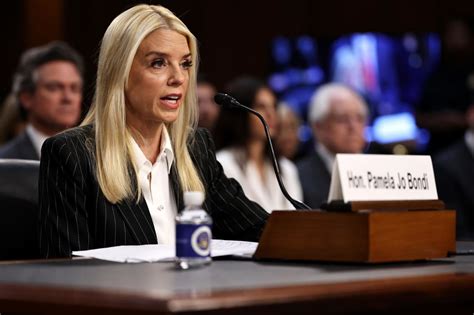
If there was ever any doubt that the Department of Justice is working as Donald Trump’s private law firm, with Attorney General Pam Bondi as his consigliere, that was put to rest with Bondi’s recent appearance before the House Judiciary Committee.
Queried about unexplained redactions in the Epstein files, along with why millions of pages have still not been released, Bondi responded with evasions and name calling. At one point she said, “The Dow is over fifty thousand right now, the S. & P. at almost seven thousand, and the Nasdaq smashing records, Americans’ 401(k)s and retirement savings are booming. That’s what we should be talking about. The non-response triggered a storm of comic responses, my favorite being: “Landlord: “You’re a week late on rent.” Me: “The DOW just hit 50,000!”
Bondi also attacked her interrogators, declaring to Democratic Congressman Jamie Raskin, “You don’t tell me anything, you washed-up loser lawyer. Not even a lawyer,” and accusing Republican Tom Massie of suffering from Trump Derangement Syndrome. At one point she said, “You all should be apologizing. You sit here, and you attack the President, and I am not going to have it.”
For his part, Raskin pointed out how slavishly she follows Trump’s wishes. “Trump orders up prosecutions like pizza and you deliver every time,” he observed. “Nothing in American history comes close to this complete corruption of the justice function and contamination of federal law enforcement.”
Thinking of Bondi as a consigliere invokes the image of Tom Hagen in Mario Puzo’s The Godfather, brilliantly played by Robert Duvall in Francis Ford Coppola’s movie. (Note: I see that Duvall just died at 95.) When discussing with a movie studio head about a role for the godfather’s godson Johnny Fontane, Hagen makes clear that there is only one man that he works for:
[The studio head] studied Hagen’s card. “I never heard of you,” he said. “I know most of the big lawyers in New York, but just who the hell are you?’
“I have one of those dignified corporate practices,” Hagen said dryly. “I just handle this one account.”
While she may resemble Hagen in fealty to her boss, however, Bondi would have done well to follow his negotiation strategies. When the studio head begins slinging insults, Hagen doesn’t pull a Bondi, choosing instead to remain calm:
The abuse itself bothered him not at all. Hagen had learned the art of negotiation from the Don himself. “Never get angry,” the Don had instructed. “Never make a threat. Reason with people.” The word “reason” sounded so much better in Italian, ragione, to rejoin. The art of this was to ignore all insults, all threats; to turn the other cheek.
Of course, it’s easy to remain calm when you know your next move will be beheading the man’s $600,000 horse. And then there’s death, the trump card that the Don always carries with him:
Hagen had seen the Don sit at a negotiating table for eight hours, swallowing insults, trying to persuade a notorious and megalomaniac strong-arm man to mend his ways. At the end of the eight hours Don Corleone had thrown up his hands in a helpless gesture and said to the other men at the table, “But no one can reason with this fellow,” and had stalked out of the meeting room. The strong-arm man had turned white with fear. Emissaries were sent to bring the Don back into the room. An agreement was reached but two months later the strong-arm was shot to death in his favorite barbershop.
Nor is the Godfather always so patient, as we see in a passage that gives us one of the most memorable lines from the novel. Michael recounts the story to girlfriend Kay:
“When Johnny was beginning to become popular, he had a problem with his boss, a bandleader. Johnny wanted to leave the band, but this man wouldn’t let him. So Johnny asked my father to help. My father went to see the bandleader and offered him $10,000 to let Johnny go. He said no. The next day my father went to see him with [strongman] Luca Brasi. One hour later, the bandleader let Johnny go. For $1,000.”
Kay looked confused. “How did he do that?”
“My father made him an offer he couldn’t refuse. Luca held a gun to his head and my father told him that if he didn’t agree to let Johnny go, Luca would blow his brains out.”
I suppose Bondi attempted a version of this hardball tactic when she told Minnesota Governor Tim Walz that the Trump administration would withdraw the ICE forces that were terrorizing his state if he turned over the state’s voter rolls. The rolls, of course, had nothing to do with the stated reasons for ICE being in the state.
Trump has been more successful in swaying Republican legislators. The man who sicced a violent mob on the Capitol and whose fans have issued death threats, attacked Nancy Pelosi’s husband in his home, murdered Democratic legislators, planted pipe bombs, and shot up houses of worship has reduced them to versions of the bandleader. Perhaps they should be calling him not Donald Trump but Don Trump.
My quarrel with Puzo’s book is that he glamorizes Don Corleone’s violence. It plays to a fantasy that is at the core of Trump’s psyche and that he has successfully sold for decades: that he can offer deals others can’t refuse. If Bondi has gone all in on consigliere loyalty, it’s because she feels he can deliver.
That’s why she was stunned when the people of Minnesota refused her deal. And baffled as to why members of the Judiciary Committee are not sold on her boss’s greatness.