Note: If you wish to receive, via e-mail, (1) my weekly newsletter or (2) daily copies of these posts, notify me at rrbates1951@gmail.com and indicate which you would like. I promise not to share your e-mail address with anyone. To unsubscribe, send me a follow-up email.
Monday – Veterans Day
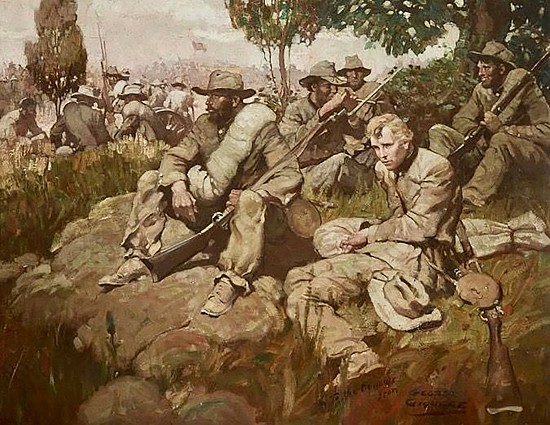
When Siegfried Sassoon talks about soldiers as dreamers, he knows what he’s talking about since he experienced trench warfare in the first World War. Today we honor all those who have encountered humankind at its worst.
Dreamers By Siegfried Sassooon
Soldiers are citizens of death’s grey land, Drawing no dividend from time’s to-morrows. In the great hour of destiny they stand, Each with his feuds, and jealousies, and sorrows. Soldiers are sworn to action; they must win Some flaming, fatal climax with their lives. Soldiers are dreamers; when the guns begin They think of firelit homes, clean beds and wives.
I see them in foul dug-outs, gnawed by rats, And in the ruined trenches, lashed with rain, Dreaming of things they did with balls and bats, And mocked by hopeless longing to regain Bank-holidays, and picture shows, and spats, And going to the office in the train.
Readers may think, as they begin the poem, that the soldiers are dreaming of great deeds in battle. In “Dulce in Decorum Est,” fellow World War I soldier Wilfred Owen writes of “children ardent for some desperate glory.” But Owen calls out the lie behind such dreaming while Sassoon, in his quieter poem, shows us what soldiers really want.
Note: If you wish to receive, via e-mail, (1) my weekly newsletter or (2) daily copies of these posts, notify me at rrbates1951@gmail.com and indicate which you would like. I promise not to share your e-mail address with anyone. To unsubscribe, send me a follow-up email.
Sunday
Of the many things that Christians for Trump must answer for, one is their support for policies that exacerbate wealth inequality while slashing support for indigent families. There’s no question where Jesus stood on the issue. In today’s Gospel reading he lambasts those who claim godliness while soaking the poor:
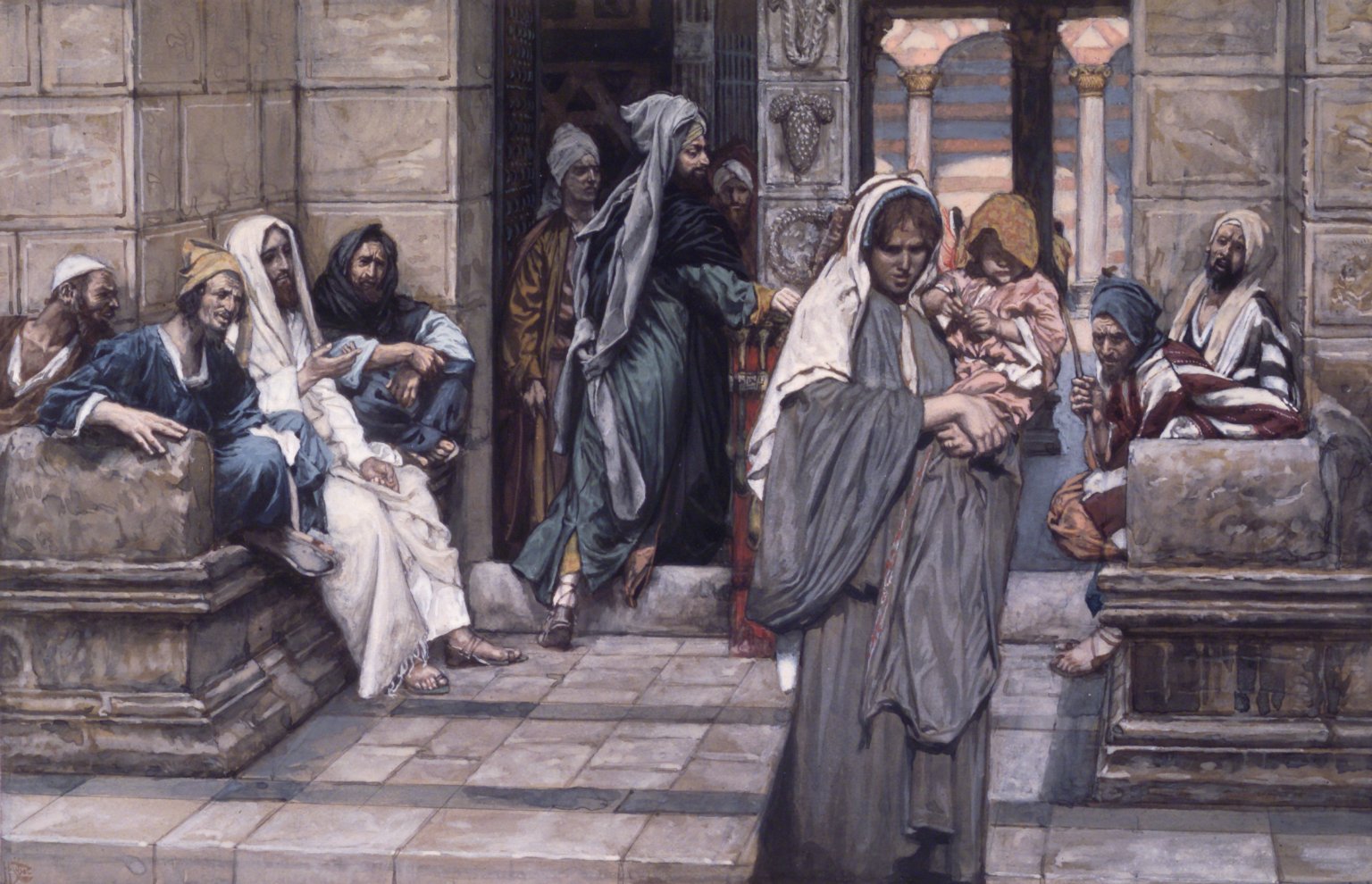
As Jesus taught, he said, “Beware of the scribes, who like to walk around in long robes, and to be greeted with respect in the marketplaces, and to have the best seats in the synagogues and places of honor at banquets! They devour widows’ houses and for the sake of appearance say long prayers. They will receive the greater condemnation.”
Many celebrate the widow who gave her two mites—”everything she had”—to the church box. It’s altogether possible, however, Jesus focus was less on her and more on the wealthy church people who had bamboozled her into thinking it’s a good idea to allow her house to be devoured:
He sat down opposite the treasury, and watched the crowd putting money into the treasury. Many rich people put in large sums. A poor widow came and put in two small copper coins, which are worth a penny. Then he called his disciples and said to them, “Truly I tell you, this poor widow has put in more than all those who are contributing to the treasury. For all of them have contributed out of their abundance; but she out of her poverty has put in everything she had, all she had to live on.”
We have many obscenely rich megachurch leaders, a fair number of them vocal Trump supporters, who are persuading their parishioners and followers that funding their lavish lifestyles is what God wants from them.
Seventeenth-century poet Richard Crashaw is clear what he thinks of such hypocrites. His four-line tribute to the widow is all the more powerful for being short:
Two mites, two drops, yet all her house and land, Fall from a steady heart, though trembling hand : The other’s wanton wealth foams high, and brave ; The other cast away, she only gave.
While Joe Biden and Kamala Harris campaigned to raise the minimum wage, expand the Child Tax Credit, bring down the cost of insulin and other prescription drugs, construct affordable housing, and support daycare and senior living, eight out of ten white evangelicals voted for Trump. Televangelist Kenneth Copeland, whose net worth has been estimated to be $300 million, has claimed that Trump is “led by the Spirit of God.” Meanwhile Pastor Robert Jeffress of First Baptist Church of Dallas, who has a net worth of between $10-$20 million, called Trump’s win “a great victory.”
Note: If you wish to receive, via e-mail, (1) my weekly newsletter or (2) daily copies of these posts, notify me at rrbates1951@gmail.com and indicate which you would like. I promise not to share your e-mail address with anyone. To unsubscribe, send me a follow-up email.
Friday
It’s been unsettling to teach Midnight’s Children following Donald Trump’s presidential victory. That’s because Salman Rushdie’s novel, which begins with high hopes for post-colonial India and ends with the election of an authoritarian leader, parallels our own story a little too closely. Throughout the novel, we see the increasing fragmentation and polarization of the Indian state, which is sometimes torn apart by religious infighting, sometimes by language wars, sometimes by foreign wars, and sometimes (when “the Widow,” Indira Gandhi, comes to power) by the imposition of forced sterilization and other authoritarian measures.
What I want to focus on today, however, is Rushdie’s account of amnesia in a victimized population. That’s because I think America’s own amnesia played a role in Trump’s victory. Just as America forgot about Trump’s abysmal handling of the pandemic and his orchestrating of the coup attempt, so narrator Saleem Sinai discovers that people have forgotten the bulldozing of the “Magician’s Ghetto” which contains a wonderful cast of characters:
The conjurers and other artistes marched beside the troops, entertaining the crowds; there were acrobats forming human pyramids on moving carts drawn by white bullocks; there were extraordinary female contortionists who could swallow their legs up to their knees; there were jugglers who operated outside the laws of gravity, so that they could draw oohs and aahs from the delighted crowd as they juggled with toy grenades, keeping four hundred and twenty in the air at a time; there were card-tricksters who could pull the queen of chiriyas (the monarch of birds, the empress of clubs) out of women’s ears; there was the great dancer Anarkali, whose name meant ‘pomegranate-bud’, doing leaps twists pirouettes on a donkey-cart while a giant piece of silver nose-jewellery jingled on her right nostril…
Rushdie uses such characters to capture the color and magic of India, and it is to the imagination wonderland that Saleem escapes from India’s traumatizing war with Pakistan. There he marries the wonderful Parvati-the-Witch, who like him possessed special powers from having been born between midnight and 1 a.m. on the day India gained its independence from England (August 15, 1947). There they marry and have a child.
Because the son of “the Widow” thinks that the Magician’s Ghetto is an eyesore, however (Donald Trump, Jr.?), he has it bulldozed, during which catastrophe Parvati dies. Their son, fortunately, is rescued and represents a hope for the future that I’ll explore in a future post. But what occurs first is that, following the destruction of their home, the dispersed magicians forget about this idyllic home—just as much of the world (not only Americans) has forgotten about the pandemic:
[W]hen I returned to find Picture Singh beaming in the shadow of a railway bridge, it rapidly became clear that the magicians, too, were losing their memories. Somewhere in the many moves of the peripatetic slum, they had mislaid their powers of retention, so that now they had become incapable of judgment, having forgotten everything to which they could compare anything that happened. Even the Emergency was rapidly being consigned to the oblivion of the past, and the magicians concentrated upon the present with the monomania of snails. Nor did they notice that they had changed; they had forgotten that they had ever been otherwise, Communism had seeped out of them and been gulped down by the thirsty, lizard-quick earth; they were beginning to forget their skills in the confusion of hunger, disease, thirst and police harassment which constituted (as usual) the present. To me, however, this change in my old companions seemed nothing short of obscene… I, who could remember every hair on the heads of jailers and surgeons, was deeply shocked by the magicians’ unwillingness to look behind them. ‘People are like cats,’ I told my son, ‘you can’t teach them anything.’
Sadly, when people forget catastrophes, they sometimes blame the subsequent problems on those in power taxed with cleaning up the mess. That’s not the entire reason why the Democrats lost to Trump, but since incumbents have been losing elections all over the world, it’s part of the explanation.
Note: If you wish to receive, via e-mail, (1) my weekly newsletter or (2) daily copies of these posts, notify me at rrbates1951@gmail.com and indicate which you would like. I promise not to share your e-mail address with anyone. To unsubscribe, send me a follow-up email.
Thursday
I know that W.H. Auden’s poem “Stop All the Clocks” is about the death of a loved one, but watching the dream of a multicultural democracy take a severe beating from a fascist is like witnessing the death of someone precious to us. So here’s the poem, which captures our agony as we watched our fellow citizens choose a rapist, felon, and insurrectionist over a classy woman who wanted to serve the people. At moments like this, a despairing lyric like this one can provide a modicum of relief.
While I know that, in the days to come, we will need to rally our forces and fight the good fight, for the moment it feels as if, indeed, “nothing now can ever come to any good.”
Stop All the Clocks By W. H. Auden
Stop all the clocks, cut off the telephone, Prevent the dog from barking with a juicy bone, Silence the pianos and with muffled drum Bring out the coffin, let the mourners come.
Let aeroplanes circle moaning overhead Scribbling on the sky the message He Is Dead, Put crepe bows round the white necks of the public doves, Let the traffic policemen wear black cotton gloves.
He was my North, my South, my East and West, My working week and my Sunday rest, My noon, my midnight, my talk, my song; I thought that love would last for ever: I was wrong.
The stars are not wanted now: put out every one; Pack up the moon and dismantle the sun; Pour away the ocean and sweep up the wood; For nothing now can ever come to any good.
And for good measure, here’s a bonus poem–by the sublime Emily Dickinson–which ends on a slightly more hopeful note. But only because it reminds us that there is a future.
For a day after experiencing the great pain, it felt indeed like we were just going through the motions. Mechanical? Leaden? In a stupor? Frozen? Our nerves sitting like tombs? Check, check, check, check, and check.
“He that bore” could be Christ or it could be a soldier killed while bearing a backpack (the poem was written during the Civil War). In either case, there’s intense grieving. But the poet also holds out the possibility that we mourners can outlive this and achieve the final stage of grief, which is letting go.
After great pain, a formal feeling comes – The Nerves sit ceremonious, like Tombs – The stiff Heart questions ‘was it He, that bore,’ And ‘Yesterday, or Centuries before’?
The Feet, mechanical, go round – A Wooden way Of Ground, or Air, or Ought – Regardless grown, A Quartz contentment, like a stone –
This is the Hour of Lead – Remembered, if outlived, As Freezing persons, recollect the Snow – First – Chill – then Stupor – then the letting go –
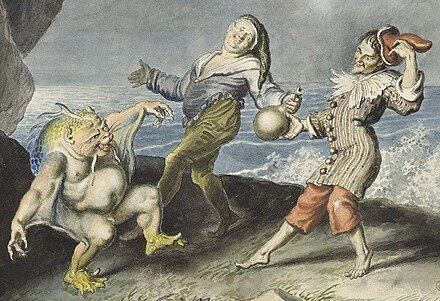
Johann Heinrich Ramberg, Caliban, Stefano and Trinculo
Note: If you wish to receive, via e-mail, (1) my weekly newsletter or (2) daily copies of these posts, notify me at rrbates1951@gmail.com and indicate which you would like. I promise not to share your e-mail address with anyone. To unsubscribe, send me a follow-up email.
Wednesday
Note: If today’s essay is a bit uneven, it’s because–writing it from Slovenia–I started it fairly confident that Kamala Harris would win the election, only to begin realizing we were witnessing 2016 redux as the night wore on. What is meant as a comic if somewhat disturbing subplot in Shakespeare’s final play–inept insurrectionists trying to overthrow Prospero, destroy his magic book, and seize Miranda–suddenly became the central action. It was as if The Tempest had transmuted into Richard III. (Think of Prospero’s book as the Constitution, Miranda as reproductive freedom.) In the course of the night, my headline changed from “Caliban vs. Prospero” to “Can Caliban Defeat Prospero?” to (sadly) “Caliban Defeats Prospero.” Following Trump’s victory, white nationalist Nick Fuentes gloated, in a tweet that received 22,000 likes, “Your body, my choice. Forever.” Or as Caliban fantasizes after Prospero reminds him that he “didst seek to violate the honour of my child,”
Anyway, here’s the essay that finally emerged from that dreadful night.
I taught The Tempest yesterday in my Ljubljana Shakespeare class and, as I await election results—it’s midnight on the east coast, early morning Central European Time—I’ve been having a fantasy based on the play. It involves many of Trump’s fanatical followers coming to see him as he really is.
Of course, this fantasy can only happen if he loses. If he wins, he will only build on the mythological status that he has assumed in their eyes.
I draw on one of the play’s subplots for the fantasy. Caliban, son of the witch Sycorax and a thoroughly disagreeable character, encounters two of the lesser survivors of the shipwreck, the drunken butler Stephano and court jester Trinculo. Thinking they are his key to overthrowing the magician Prospero and freeing him from servitude, Caliban links his fate with theirs.
Winning him over is the wine that Stephano is carrying, which I associate with Trump’s seductive rhetoric, whether it be his birther lie about Obama, his misogynist attacks on women, his xenophobic descriptions of Mexicans, his Muslim ban, or all his other countless invitations to become our worst selves. Caliban, like Trump’s ardent fans, is enthralled:
“Hast thou not dropp’d from heaven?” Caliban goes on to ask breathlessly and then goes even further in his adulation. Thrice we see him kneel down to kiss Stefano’s foot:
Why obey the old norms and conventions when one can follow a leader such as this? “A plague upon the tyrant that I serve!” Caliban declares as switches masters:
Caliban even has version of the Right’s “America for Americans” declaration: “This island’s mine, by Sycorax my mother,which thou takest from me“–ignoring the fact that his mother, the witch Sycorax, established her family by conquest, imprisoning original inhabitant Ariel in a tree.
To be sure, to Trinculo’s outsider perspective Caliban appears a howling, drunken monster. But that’s often the way with cults: they seem perfectly logical and sane to those caught up in them.
As every student of fascism understands, from blind adoration to violence is only a short step. Caliban’s plan is to overthrow Prospero and seize his daughter:
Stefano is as enthralled with the battle plan as were the January 6 insurrectionists with the idea of storming the Capitol. When he and Trinculo get to Prospero’s cave, however, they behave somewhat like those same intruders who wandered around the building taking selfies, trashing Nancy Pelosi’s office, and looting souvenirs. In this case, they put on Prospero’s garments, infuriating Caliban, who understands Prospero’s power:
Prospero, with the aid of the spirit Aeriel, then sends in his version of the National Guard—“Stage direction: Enter divers Spirits, in shape of dogs and hounds”—hunting the three as relentlessly as the FBI and Justice Department have hunted those who attacked the Capitol:
In the end they are routed and tormented, after which comes the moment that I’m hoping for with Trump cultists. Prospero having ordered Caliban to his cell—”As you look to have my pardon, trim it handsomely”—the monsters see butler Stephano for who he really is. This is the moment I’m dreaming of with regard to Trump supporters:
A major theme of The Tempest is rising above our earthly selves to a spiritual vision. As a white magic magus, Prospero seeks to bring order and enlightenment to a world that is riven by dark impulses, including political insurrection and unlawful passion.
But Caliban too is an integral part of who we are. America, a nation founded both on Enlightenment optimism and bloody conquest/enslaved labor, has a history of swinging back and forth between progressive ideals and brute impulse. “This thing of darkness, [I] acknowledge him mine,” Prospero says at the end of the play.
Will our version of Shakespeare’s tragicomedy end in tragedy or comedy? We stand here, as if on as knife edge, as
Waves of anger and fear Circulate over the bright And darkened lands of the earth, Obsessing our private lives.
The passage is from Auden’s poem “September 1, 1939,” written at another time when the world faced a fascist threat.
Note: If you wish to receive, via e-mail, (1) my weekly newsletter or (2) daily copies of these posts, notify me at rrbates1951@gmail.com and indicate which you would like. I promise not to share your e-mail address with anyone. To unsubscribe, send me a follow-up email.
Tuesday
Last evening and again this evening, Julia and I have been attempting to explain the American election to students at the University of Ljubljana.. We start our presentation off with a conversation that I had with Slovenian colleague Janez Stanovnek almost 40 years ago. Janez was a Melville scholar who had spent his career teaching American literature, but that day he sounded befuddled. “I don’t understand how America works,” he said, shaking his head.
I’ve thought about that comment many times in the years since, and I understand his confusion. My immediate answer to him is that we are all united by the American Dream, and I still think that, only I now see it as a more complicated matter than I did then. But I’m also more impressed with the series of civic rituals we use to keep the dream alive, including children reciting “The Pledge of Allegiance,” sports fans singing the “Star Spangled Banner,” people flying the American flag from their houses, and teachers having us read such foundational texts as “The Declaration of Independence,” “The Gettysburg Address,” Emma Lazarus’s words on the Statue of Liberty, and Martin Luther King’s “I Have a Dream” speech.
These rituals don’t always ensure success, however, as our intense levels of current polarization make clear. And how could they? After all, what single dream would speak equally to immigrants from all over the world, as well as to Native Americans and to the descendants of those forced to come here (African slaves, convicts). And even if Americans could agree on a dream, think of the many ways that the dream fails us and that we fail the dream. Think of the blood that has been spilled in building this nation, the seemingly irresolvable conflicts. How could there possibly be, to quote from the “Pledge of Allegiance,” “one nation, under God, indivisible, with liberty and justice for all.”
The American Dream is like that: some great constancy comes through, in spite of all the conflicts and contradictions.
Alicia Ostriker takes on these conflicts and contradictions in “Ghazal: America the Beautiful.” A ghazal is a Middle Eastern verse form composed of a least five couplets that often invokes a deep love and longing. Ghazals also feature repeated rhyme or word ending each stanza, and Ostriker’s repeated word–the subject of her longing–is “America.”
Ghazal: America the Beautiful Alicia Ostriker
Do you remember our earnestness our sincerity in first grade when we learned to sing America
The Beautiful along with the Star-Spangled Banner and say the Pledge of Allegiance to America
We put our hands over our first grade hearts we felt proud to be citizens of America
I said One Nation Invisible until corrected maybe I was right about America
School days school days dear old Golden Rule Days when we learned how to behave in America
What to wear, how to smoke, how to despise our parents who didn’t understand us or America
Only later learning the Banner and the Beautiful live on opposite sides of the street in America
Only later discovering the Nation is divisible by money by power by color by gender by sex America
We comprehend it now this land is two lands one triumphant bully one still hopeful America
Imagining amber waves of grain blowing in the wind purple mountains and no homeless in America
Sometimes I still put my hand tenderly on my heart somehow or other still carried away by America
There’s much I relate to in this poem, including the fragment from the song “School Days,” which we sang in first grade. It sounds like Ostriker, like me, would have preferred “America the Beautiful” as our national anthem over the more militant “Star Spangled Banner.” But whatever quarrels she has with “triumphant bully” America, she still finds herself putting her hand tenderly over her heart and pledging allegiance.
Langston Hughes, who as a Black man had every reason to hate America, nevertheless has a poem that concludes, “I too am America.” Despite our differences, somewhere deep is a dream that unites us all.
Note: If you wish to receive, via e-mail, (1) my weekly newsletter or (2) daily copies of these posts, notify me at rrbates1951@gmail.com and indicate which you would like. I promise not to share your e-mail address with anyone. To unsubscribe, send me a follow-up email.
Monday
Last week I compared Donald Trump to Shakespeare’s Richard II while examining the play for insights into peaceful vs. violent transfers of power. Today I look at similarities between Kamala Harris and the successor of Richard’s successor—which is to say, Prince Hal, who eventually becomes Henry V. If Harris wins tomorrow’s election, the parallel will be perfect since Hal is the son of Henry IV, who overthrew Richard.
There are significant differences, of course, starting with the fact that Harris has not engaged in the kind of dissolute behavior we see in Hal. There are no Falstaffs in her life, not any hijinks in a forest. But Harris, like Hal, has emerged as a formidable leader after many wrote her off. I believe that, if the Democrats hold on to the Senate and flip the House, she could become the most consequential leader since Franklin D. Roosevelt.
Like Prince Hal, Harris has kept her eye on the prize for a long time. Regarding Hal, we learn about his plans early in Henry IV, Part I. Shortly after we see him carousing with Falstaff and planning an elaborate prank, he surprises us with his famous soliloquy. Directed at his drinking companions, his words reveal that we shouldn’t underestimate him:
To be sure, Harris hasn’t been deliberately hiding her bright metal on a sullen ground. But the vice-presidency has a way of functioning like “base contagious clouds,” smothering up quality. Although we may no longer regard the position as “not worth a bucket of warm piss” (as John Nance Garner, an FDR vice president, characterized it), it can still hide excellence. Only when Harris started running for president did many begin to see her potential.
To be fair, Joe Biden saw it, which is why he recommended her as her successor. In that way, he differs from Henry IV, who has all but given up on his son. Seeing “riot and dishonor” staining the brow of Hal, he fantasizes about exchanging him with Harry Percy, the flashy son of his soon-to-be-enemy Northumberland. “O that it could be proved,” he says longingly,
So it’s not so much Biden that we should be thinking of as we read Henry’s disappointment but those Democrats who were rooting for anyone-but-Harris. Looking at Harris’s lackluster performance in the 2020 primaries—she dropped out before a single vote had been cast—they expressed disappointment not unlike that which Henry levels at Hal:
How could a woman with such “greatness of blood,” these Harris doubters wondered, be all but invisible in the first two years of her vice-presidency.
So far, however, Harris appears to have answered every challenge, just as Hal proves himself in battle, saving his father and defeating Hotspur. In the end, he receives his father’s grudging approval:
There will be further conflict between Hal and Henry, especially at the end when the dying king thinks that Hal is eager to see him gone. Thinking his father dead and recalling how kingship has weighed him down—earlier in the play Henry has complained, “Uneasy lies the head that wears a crown”–Hal takes the crown from his pillow. By the action, he means to signify that his father can be at rest now. Henry, however, awakes to find it gone and lays into his son. When Hal says, “I never thought to hear you speak again,” Henry replies,
Has Biden ever resented Harris for taking over the position he once thought should have been his? He would not be human if he didn’t feel some anger. But Harris, like Hal, has never shown any indication that she wanted to end Biden’s presidency prematurely, and Hal, like Harris with Biden, ends on good terms with the current occupant of the highest office. After Hal explains why he took the crown, Henry responds with the kind of fatherly sit-down chat that I can imagine Biden having with Harris:
Granted, Biden will not offer the kind of advice that Henry’s does: Hal, he says, should engage in foreign wars to distract the local feuding forces, a “wag the dog” strategy:
And indeed, we will see Henry V achieving something comparable in the next play, where suddenly we see the Scots, the Welsh, and the Irish united under his banner as he prepares to fight the French at Agincourt.
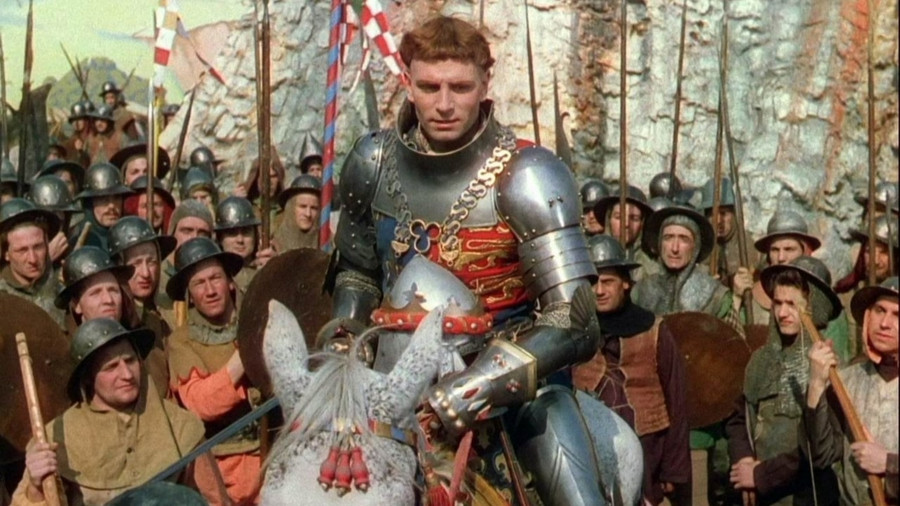
Then again, the coalition that Harris has assembled to defeat Trump is potentially just as fractious, with Bernie Sanders and Alexandria Ocasio-Cortez on the same side as Liz and Dick Cheney. Laurence Olivier’s 1944 national-unity version of the drama played down the fractiousness between Fluellen, Jamy and MacMorris. After all, the United Kingdom was facing a fascist determined to end democracy.
In the play we see Henry V demonstrating the common touch as he relates to his soldiers, a quality that Harris has as well. All over the United States at the moment, Get Out the Vote (GOTV) captains are giving versions of Henry’s famous speech on the eve of his famous battle against the French:
Thomas Matthews Rooke, The Story of Ruth (from a triptych)
Note: If you wish to receive, via e-mail, (1) my weekly newsletter or (2) daily copies of these posts, notify me at rrbates1951@gmail.com and indicate which you would like. I promise not to share your e-mail address with anyone. To unsubscribe, send me a follow-up email.
Sunday
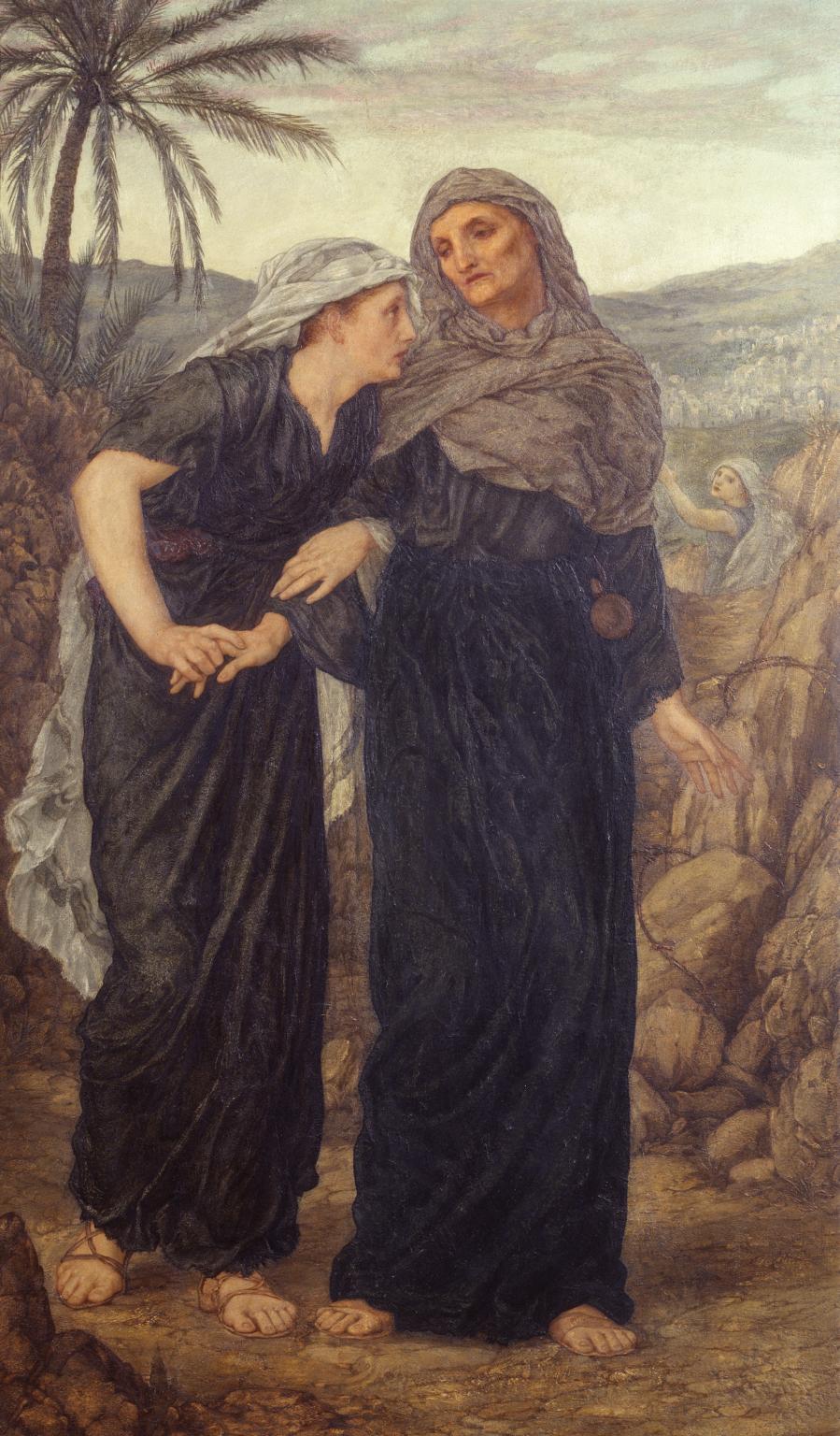
Today the Old Testament lesson is drawn from the “Book of Ruth, the drama in which a widowed Moabite woman chooses to remain with her widowed mother-in-law rather than return to her own people and birth family. Ruth’s words to Naomi are themselves a poem and one of the most beloved passages in the Bible:
Do not press me to leave you or to turn back from following you! Where you go, I will go; Where you lodge, I will lodge; your people shall be my people, and your God my God. Where you die, I will die— there will I be buried. May the Lord do thus and so to me, and more as well, if even death parts me from you!”
Poet Marge Piercy, returning to the book, is surprised by how much it focuses on “inheritance, lands, men’s names, how women must wiggle and wobble to live.” Yet despite that, the friendship is so powerful that it throws everything else into the shade. Piercy sees the relationship as a love story, which is why she includes Naomi in the title. At times in the poem, it’s not clear whether she’s talking about Ruth or Naomi although the answer is probably “both.”
Thanks to Rabbi Rachel Barenblatt, whose fabulously titled blog The Velveteen Rabbi alerted me to her anthology of Ruth poems, which includes this one by Piercy.
The Book of Ruth and Naomi By Marge Piercy
When you pick up the Tanakh and read the Book of Ruth, it is a shock how little it resembles memory. It’s concerned with inheritance, lands, men’s names, how women must wiggle and wobble to live.
Yet women have kept it dear for the beloved elder who cherished Ruth, more friend than daughter. Daughters leave. Ruth brought even the baby she made with Boaz home as a gift. Where you go, I will go too, your people shall be my people, I will be a Jew for you, for what is yours I will love as I love you, oh Naomi my mother, my sister, my heart.
Show me a woman who does not dream a double, heart’s twin, a sister of the mind in whose ear she can whisper, whose hair she can braid as her life twists its pleasure and pain and shame. Show me a woman who does not hide in the locket of bone that deep eye beam of fiercely gentle love she had once from mother, daughter, sister; once like a warm moon that radiance aligned the tides of her blood into potent order.
At the season of first fruits, we recall two travelers, co-conspirators, scavengers making do with leftovers and mill ends, whose friendship was stronger than fear, stronger than hunger, who walked together, the road of shards, hands joined.
Further thought on Rachel Barenblatt – I love the title of Barenblatt’s blog, not only because it’s a clever pun, but because the theme of Margaret Sharpe’s The Velveteen Rabbit is that the more you love and are loved, the more real you become. By being carried around and played with as much as it is, the stuffed rabbit takes a beating. But rather than being diminished in the process, it becomes more precious. A toy horse explains the process:
“Real isn’t how you are made,’ said the Skin Horse. ‘It’s a thing that happens to you. When a child loves you for a long, long time, not just to play with, but REALLY loves you, then you become Real.’
‘Does it hurt?’ asked the Rabbit.
‘Sometimes,’ said the Skin Horse, for he was always truthful. ‘When you are Real you don’t mind being hurt.’
‘Does it happen all at once, like being wound up,’ he asked, ‘or bit by bit?’
‘It doesn’t happen all at once,’ said the Skin Horse. ‘You become. It takes a long time. That’s why it doesn’t happen often to people who break easily, or have sharp edges, or who have to be carefully kept. Generally, by the time you are Real, most of your hair has been loved off, and your eyes drop out and you get loose in the joints and very shabby. But these things don’t matter at all, because once you are Real you can’t be ugly, except to people who don’t understand.”
My son’s grave, which overlooks the spot where he drowned
Note: If you wish to receive, via e-mail, (1) my weekly newsletter or (2) daily copies of these posts, notify me at rrbates1951@gmail.com and indicate which you would like. I promise not to share your e-mail address with anyone. To unsubscribe, send me a follow-up email.
Friday
Julia and I are currently enjoying a mid-fall break in Ljubljana, where we have been teaching. Yesterday was Reformation Day, when the Slovenians (to quote Wikipedia) “commemorate the 16th century religious, cultural and political movement that played a key part in the development and promotion of Slovenian language and national identity.” Then today they celebrate All Saints Day, with families tending to the gravesites of departed loved ones.
We will do our own remembering today. Why Ljubljana is a special place to remember our oldest son Justin requires some explaining.
We brought our family here for a Fulbright year in 1987-88 (when it was still Yugoslavia) and then again in 1994-95. Our children attended the international programs in Slovenian schools, and Justin especially treasured the special passes that children get for the Ljubljana bus system. He reveled in the freedom it gave him, and he had all the routes memorized, making a point of traveling to both ends of every line by the end of our stay here. (I think there are 20 or so lines.) He also loved his classes at Gimnazia Bežigrad, and he enjoyed being the starring pitcher for a local baseball team, which won a competitive tournament in the Netherlands.
Therefore, when he died almost 25 years ago, we set up a memorial scholarship in his name. For 17 years now (except for the Covid years) we have been bringing Slovenian students to St. Mary’s College of Maryland and sending St. Mary’s students to Ljubljana. Up until we retired, the Slovenian students lived with us so we came to see them as family.
We reconnect with them when we return and—this is the point I want to make—we see them having the future that Justin didn’t have. I didn’t anticipate this added benefit when we set up the scholarship, which we established out of gratitude to Slovenia, but that’s how it has worked out.
Yesterday, for instance, we met up with Nina Kremžar, who was an English-Japanese double major when she attended St. Mary’s ten years ago. Nina credits the creative writing class she took at St. Mary’s (with poet and my former colleague Jeff Coleman) with jumpstarting her own creative writing, and she has gone on to win a major creative writing competition.
Nina has since published a book of poetry (the award for winning the competition), along with a book or short stories, and she is currently working on a children’s book. (All this in addition to teaching high school English and competing for Slovenia’s national curling team.) I told Nina how meaningful it was for to learn how the scholarship, which wouldn’t have existed had Justin not died, is having these ripple effects.
To remember Justin and all those we have loved and lost, here’s Christina Rossetti’s “Remember Me.” I imagine Justin addressing it to us and telling us it’s okay if we forget him for a while. We are just to use occasions like this and poems like this to remember “the vestige of the thoughts” he has left with us and to smile.
Remember Me By Christina Rossetti
Remember me when I am gone away, Gone far away into the silent land; When you can no more hold me by the hand, Nor I half turn to go yet turning stay. Remember me when no more day by day You tell me of our future that you plann’d: Only remember me; you understand It will be late to counsel then or pray. Yet if you should forget me for a while And afterwards remember, do not grieve: For if the darkness and corruption leave A vestige of the thoughts that once I had, Better by far you should forget and smile Than that you should remember and be sad.