Note: If you wish to receive, via e-mail, (1) my weekly newsletter or (2) daily copies of these posts, notify me at rrbates1951@gmail.com and indicate which you would like. I promise not to share your e-mail address with anyone. To unsubscribe, send me a follow-up email.
Monday
It seldom drops to 0 degrees in Tennessee, but yesterday we faced wind chill temperatures of -2. My brother in Iowa City, meanwhile, experience a wind chill of -40. I therefore share, once again, a post I wrote nine years ago on Mary Oliver’s “Cold Poem.” While these frigid temperatures are causing a great deal of misery, Oliver finds “tree-splitting” cold at least gives us a chance to get real.
Cold Poem By Mary Oliver
Cold now. Close to the edge. Almost unbearable. Clouds bunch up and boil down from the north of the white bear. This tree-splitting morning I dream of his fat tracks, the lifesaving suet. I think of summer with its luminous fruit, blossoms rounding to berries, leaves, handsful of grain. Maybe what cold is, is the time we measure the love we have always had, secretly for our own bones, the hard knife-edged love for the warm river of the I, beyond all else; maybe that is what it means, the beauty of the blue shark cruising toward the tumbling seals. In the season of snow, in the immeasurable cold, we grow cruel but honest; we keep ourselves alive, if we can, taking one after another the necessary bodies of others, the many crushed red flowers.
I understand Oliver to be saying that, when we are in the grip of extreme cold–when we feel the breath of death upon us–that is when we value life the most. Just as the polar bear’s life-saving suet keeps it alive in extreme conditions, so we focus on our essential life at such moments as this. Dreaming of summer’s luminous fruit becomes an extraneous luxury.
Our “hard knife-edged love,” Oliver tells us, is for our “own bones,” for “the warm river of the I.” We must acknowledge the life force that burns within us.
That’s why we are so fascinated by “the blue shark cruising toward the tumbling seals”: we identify with this battle between life and death and know that, in this primal struggle, we need, no less than the shark, to take into ourselves the bodies of others. That’s why we find a beauty in cold.
The cold season, Oliver says, is a season of cruelty and of honesty. Hold that thought in your mind the next time you take a step out into sub-zero temperatures.
Further thought: As I honored Mary Oliver’s life following her death in 2019, I talked about her views of death and her views of Christianity. She was also an author of numerous depression poems, which stand in dramatic contrast to her ecstasy poems. (I wonder if, like many of our greatest poets, she had bipolar disorder.) Her insight in “Cold Poem” tracks with something that psychologist/philosopher Thomas Moore says in Care of the Soul about the value of depression:
Faced with depression, we might ask ourselves, “What is it doing here? Does it have some necessary role to play?”…
Some feelings and thoughts seem to emerge only in a dark mood. Suppress the mood, and you will suppress those ideas and reflections. Depression may be as important a channel for valuable “negative” feelings, as expressions of affection are for the emotions of love…Melancholy gives the soul an opportunity to express a side of its nature that is as valid as any other, but is hidden out of our distaste for its darkness and bitterness.
Note: If you wish to receive, via e-mail, (1) my weekly newsletter or (2) daily copies of these posts, notify me at rrbates1951@gmail.com and indicate which you would like. I promise not to share your e-mail address with anyone. To unsubscribe, send me a follow-up email.
Tuesday
Snow, which has been hammering much of the country (including Iowa City and Madison, where two of my brothers live), finally came to Tennessee. With Mary Oliver, who is also describing her “First Snow” of the year,
The snow began here this morning and all day continued, it’s white rhetoric everywhere…
Oliver sees the snow as a kind of “rhetoric”— the art of effective communication—because it asks of us foundational or existential questions. She says the loveliness
call[s] us back to why, how, whence such beauty and what the meaning…
The snowfall asks its oracular questions not calmly but feverishly, with a flowing energy that never seems to ebb. Only deep in the night, in the immense silence following the storm–when the broad fields “smolder with light” and “the heavens hold a million candles”–does there seem to be time to ask whether the questions have been answered.
And the answer to that is yes and no. There is no traditional answer as we normally understand it. And yet, a landscape with trees that “glitter like castles of ribbons” “feels like one.”
First Snow By Mary Oliver
The snow began here this morning and all day continued, it’s white rhetoric everywhere calling us back to why, how, whence such beauty and what the meaning; such an oracular fever! flowing past windows, an energy it seemed would never ebb, never settle less than lovely! and only now, deep into night, it has finally ended. The silence is immense, and the heavens still hold a million candles; nowhere the familiar things: stars, the moon, the darkness we expect and nightly turn from. Trees glitter like castles of ribbons, the broad fields smolder with light, a passing creekbed lies heaped with shining hills; and though the questions that have assailed us all day remain—not a single answer has been found— walking out now into the silence and the light under the trees, and through the fields, feels like one.
As Christians are in their Epiphany season, I considered using this poem this past Sunday. The Christmas message is one of renewal, a promise of new beginnings where we can walk out “into the silence and the light under the trees, and through the fields.”
Note: If you wish to receive, via e-mail, (1) my weekly newsletter or (2) daily copies of these posts, notify me at rrbates1951@gmail.com and indicate which you would like. I promise not to share your e-mail address with anyone. To unsubscribe, send me a follow-up email.
Monday – Martin Luther King, Jr. Day
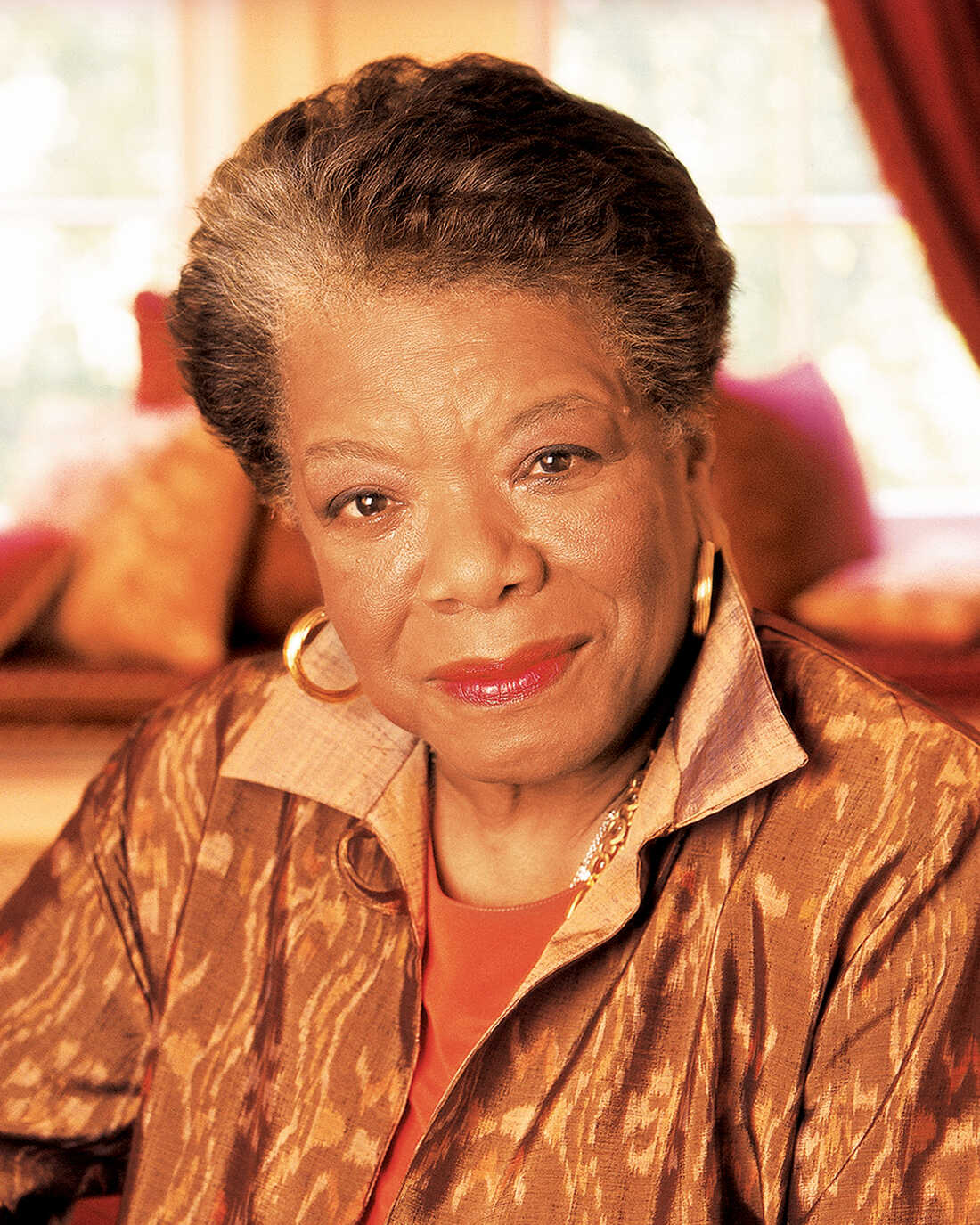
While most people associate the line “I know why the caged bird sings” with Maya Angelou’s account of her childhood, she borrows the line from Paul Laurence Dunbar’s magnificent poem “Sympathy.” In the last stanza Dunbar writes,
I know why the caged bird sings, ah me, When his wing is bruised and his bosom sore,– When he beats his bars and he would be free; It is not a carol of joy or glee, But a prayer that he sends from his heart’s deep core, But a plea, that upward to Heaven he flings– I know why the caged bird sings!
After borrowing the line for her autobiography, Angelou then wrote her own “caged bird” poem. In her case, she contrasts the life of a bird that is caged with that of a bird that is free. I share her poem on Martin Luther King Day since he dreamed of a world in which everyone would be able to (in Angelou’s words) “leap on the back of the wind” and “dare[ ] to claim the sky”:
Caged Bird By Maya Angelou
A free bird leaps on the back of the wind and floats downstream till the current ends and dips his wing in the orange sun rays and dares to claim the sky.
But a bird that stalks down his narrow cage can seldom see through his bars of rage his wings are clipped and his feet are tied so he opens his throat to sing.
The caged bird sings with a fearful trill of things unknown but longed for still and his tune is heard on the distant hill for the caged bird sings of freedom.
The free bird thinks of another breeze and the trade winds soft through the sighing trees and the fat worms waiting on a dawn bright lawn and he names the sky his own.
But a caged bird stands on the grave of dreams his shadow shouts on a nightmare scream his wings are clipped and his feet are tied so he opens his throat to sing.
The caged bird sings with a fearful trill of things unknown but longed for still and his tune is heard on the distant hill for the caged bird sings of freedom.
Further thought: Yesterday, in our church’s Sunday Forum, we heard our Christian Formation Director, Jeanne Babb, give a talk on the role of music in non-violent resistance. As Jeannie cited various instances of the power of music, I thought back to a workshop I attended on Johns Island, South Carolina when I was a junior in high school.
The workshop was organized by legendary human rights worker Esau Jenkins, an African American businessman who set up adult literacy and citizenship classes for poor Blacks in the 1960s, as well as services for migrant and seasonal farm workers. My most vivid memory of the workshop is the half hour we spent singing freedom songs that had been adapted from spirituals. Not much adaptation was needed for many of songs since the spirituals had always been about freedom, only in disguise.
Response from Reader Carl Rosin:
Thanks for this post, Robin. Angelou’s poem always makes me think of the musical concept of sampling: has the artist transformed the original enough to make it a new work, or is it derivative? Did Dunbar (whom I love: his “We Wear the Mask” strikes me as one of the five most powerful American poems of the past 150 years) really need an update — a cover version, to go back to the musical parlance?
What I appreciate most about Angelou is that her effort (successfully, nobly) reacquainted a modern audience with a poet who had slipped (undeservedly, sadly) into relative anonymity. She’s the country singer who reminds people how great Tracy Chapman’s “Fast Car” is. I don’t have an opinion on the country song, by the way, but I do tend to evaluate Angelou’s “Caged Bird” as not nearly as great a poem as it is often made out to be.
My Response to Carl
I love this observation, Carl, which has gotten me thinking about “derivative,” sometimes seen as the ultimate poetic insult. (“His lips curled into a derisive sneer as he looked up from the manuscript. ‘It’s derivative,’ he said, casting the pages contemptuously on the floor.”) In Harold Bloom’s “anxiety of influence” drama, authors are involved in an Oedipal battle with their predecessors, either finding their own voice or remaining forever in thrall to those giants that came before (as, to use one of his examples, Oscar Wilde as poet was to Keats). But some feminists have counterargued that, for women writers at least, it’s more like a community, where you feel nurtured by your predecessors rather than in competition with them. Angelou’s poem feels more in that vein. She freely acknowledges her debt, is grateful to it, and expands upon Dunbar vision.
For readers unfamiliar with Dunbar’s powerful poem, which I too love, here it is:
We wear the mask that grins and lies, It hides our cheeks and shades our eyes,— This debt we pay to human guile; With torn and bleeding hearts we smile, And mouth with myriad subtleties.
Why should the world be over-wise, In counting all our tears and sighs? Nay, let them only see us, while We wear the mask.
We smile, but, O great Christ, our cries To thee from tortured souls arise. We sing, but oh the clay is vile Beneath our feet, and long the mile; But let the world dream otherwise, We wear the mask!
Note: If you wish to receive, via e-mail, (1) my weekly newsletter or (2) daily copies of these posts, notify me at rrbates1951@gmail.com and indicate which you would like. I promise not to share your e-mail address with anyone. To unsubscribe, send me a follow-up email.
Sunday
Pastor Sue Schmidt alerted me to this comforting Epiphany poem by Madeleine L’Engle. I would say that it seems particularly timely this year only, given the way the world works, there’s always “war & tumult of war” going on somewhere. Also “fear & lust for power, license & greed and blight.” In other words, all things are always falling apart, making the poem timeless.
Christ is born, L’Engle reminds us, everywhere and every year. His stable is always our heart.
Into the Darkest Hour By Madeleine L’Engle
It was a time like this, War & tumult of war, a horror in the air. Hungry yawned the abyss – and yet there came the star and the child most wonderfully there.
It was a time like this of fear & lust for power, license & greed and blight – and yet the Prince of bliss came into the darkest hour in quiet & silent light.
And in a time like this How celebrate his birth When all things fall apart? Ah! Wonderful it is with no room on the earth the stable is our heart.
Note: If you wish to receive, via e-mail, (1) my weekly newsletter or (2) daily copies of these posts, notify me at rrbates1951@gmail.com and indicate which you would like. I promise not to share your e-mail address with anyone. To unsubscribe, send me a follow-up email.
Friday
In the early 1990s I became involved in a Toni Morrison controversy in St. Mary’s County, Maryland, where I taught for 36 years. One of my former students, David Flood, was teaching a unit at Leonardtown High School in which he paired Huckleberry Finn with Morrison’s Song of Solomon. A student was offended by three pages in Morrison’s novel—probably the scene where Milkman trades trash talk with a man he meets in a country store—and his mother took the offending pages to the school superintendent. She in turn banned the teaching of the novel in all St. Mary’s County public high schools, a ban (I believe) that is still in effect.
I visited the superintendent’s office to complain—it didn’t do any good—but that’s not where I’m going with today’s post. Rather, I am recalling a response I wrote to someone who wrote a letter to the local newspaper claiming that Morrison was a mediocre author not worth studying. (The Nobel Prize, in his view, was not based on merit but was literary affirmative action.) At the time, the so-called canon wars were underway, and his argument was that teachers should be teaching great authors, not figures like Morrison.
Not only did I contend that Morrison had more than earned her place in the pantheon of great authors—I consider her comparable to Faulkner among America’s novelists—but I pointed out that there were other authors in the canon who had passages far more graphic than anything in Song of Solomon. Among the works I mentioned was Paradise Lost.
I had meant this as a dig at those who worship the canon without truly seeing it—there were many like this in those days, including Secretary of Education William Bennet and National Endowment of the Humanities chair Lynne Cheney—but I didn’t anticipate that, one day, someone would actually ban Paradise Lost for its salacious content. Thanks to Florida governor Ron DeSantis, however, that has now happened. Apparently Milton’s immortal epic is among the works pulled from school library shelves in Orange County, Florida.
According to the Orlando Sentinel,
A total of 673 books, from classics to best-sellers, have been removed from Orange County classrooms this year for fear they violate new state rules that ban making “sexual conduct” available to public school students.
The list of rejected books, which the district began compiling during the summer, will get another review from Orange County Public Schools staff, so some could eventually be put back on shelves. But for now, teachers who had them in their classrooms have been told to take them home or put them away so students cannot access them.
In addition to Paradise Lost, the books pulled include John Steinbeck’s East of Eden, Thomas Hardy’s Jude the Obscure, Gustave Flaubert’s Madame Bovary, Jane Smiley’s A Thousand Acres, Morrison’s Beloved, Gabriel Garcia Marquez’s Love in the Time of Cholera, Alice Walker’s Color Purple, and Betty Smith’s A Tree Grows in Brooklyn. Also on the list are popular novels by Stephen King, Sue Monk Kidd, Jodi Picoult, John Grisham, and John Irving.
According to dissenting Orange County School Board member Karen Castor Dentel, the books pulled represent “over censorship” by media specialists who fear they will be held responsible for every item on their shelves. Castor Dentel said that the Florida law is “creating this culture of fear within our media specialists and even teachers who just want to have a library in their classrooms, so kids have access.”
The Sentinel article reports that the new state training required for all media specialists is warning them to “err on the side of caution” when approving books. If they approve inappropriate books, they “can face criminal penalties and the loss of their teaching certificates.”
So imagine a State Board confronting a media specialist who failed to remove Paradise Lost with the following passages from Book II. First there’s Satan having sex with his daughter Sin, who has sprung Athena-like from his head. Sin is describing to her father and lover how he got her pregnant:
…familiar grown, I pleas’d, and with attractive graces won The most averse, thee chiefly, who full oft Thy self in me thy perfect image viewing Becam’st enamored, and such joy thou took With me in secret, that my womb conceived A growing burden.
What happens next is a nightmarish birth scene in which their child, Death, tears through Sin’s birth canal. Sin describes this horrendous birth as she introduces Satan to his son:
At last this odious offspring whom thou seest Thine own begotten, breaking violent way Tore through my entrails, that with fear and pain Distorted, all my nether shape thus grew Transform’d…
Believe it or not, the worst is yet to come. After being born, Death doesn’t waste any time but straightway proceeds to rape his mother, engendering a pack of hell hounds that emerge from her now reptilian nether regions:
I fled, but he pursued (though more, it seems, Inflamed with lust then rage) and swifter far, Me overtook his mother all dismayed, And in embraces forcible and foul Engendering with me, of that rape begot These yelling Monsters that with ceaseless cry Surround me…
Earlier we have gotten a depiction of these hounds. The hideous birth has transformed Sin’s nether regions into something snake-like:
The one seemed Woman to the waist, and fair, But ended foul in many a scaly fold Voluminous and vast, a Serpent armed With mortal sting: about her middle round A cry of Hell Hounds never ceasing barked With wide Cerberian mouths full loud, and rung A hideous Peal: yet, when they list, would creep, If aught disturbed their noise, into her womb And kennel there, yet there still barked and howled Within unseen.
These hounds, meanwhile, continue to interbreed so that more are
hourly conceived And hourly born, with sorrow infinite To me, for when they list into the womb That bred them they return, and howl and gnaw My Bowels, their repast; then bursting forth [ 800 ] A fresh with conscious terrors vex me round, That rest or intermission none I find.
It’s a nightmare straight out of Dante’s Inferno (is that on the Orange County list?), a powerful image of how sin is perpetually breeding more sin.
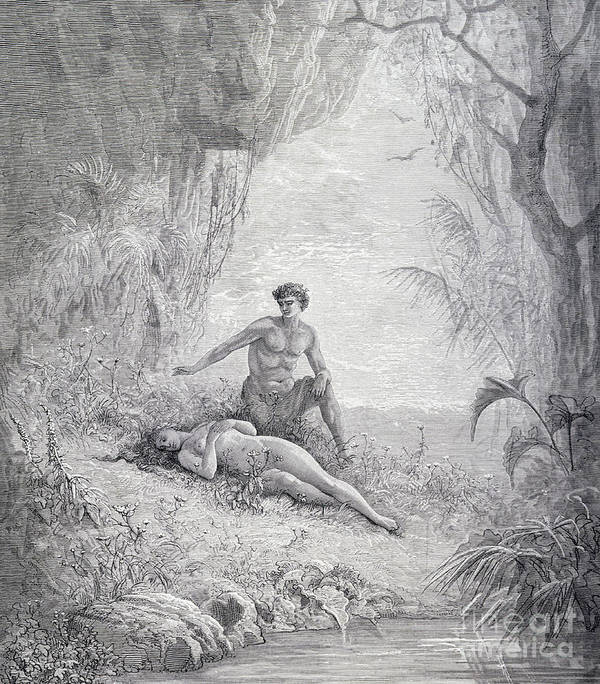
And now let’s turn to the Adam and Eve episodes. The two wander around naked, engaging first in good sex (this before the fall) and then bad sex (this after the fall). Milton was controversial in having them engage in sex before the fall but his point is that sex itself isn’t bad. In fact, it’s a gift that God “declares pure and commands to some, leaves free to all.” Those who think otherwise—who bid us abstain from sex—are parroting Satan. His words apply well to the Orange County School Board:
Whatever Hypocrites austerely talk Of purity and place and innocence, Defaming as impure what God declares Pure, and commands to some, leaves free to all. Our Maker bids increase, who bids abstain But our Destroyer, foe to God and Man?
Where sex goes wrong, in Milton’s eyes, is when it becomes bound up with power and ego. Lustful sex, he would say, is what the Chairman of the Florida Republican Party and his wife, the co-founder of Moms for Liberty, were having with a third party, a relationship that ultimately culminated in a rape. Here’s Milton’s description of Adam and Eve’s bad sex:
…but that false Fruit Far other operation first displayed, Carnal desire enflaming, he on Eve Began to cast lascivious Eyes, she him As wantonly repaid; in Lust they burn: Till Adam thus ‘gan Eve to dalliance move…
And a little later:
So said he, and forbore not glance or toy Of amorous intent, well understood Of Eve, whose Eye darted contagious Fire. Her hand he seized, and to a shady bank, Thick overhead with verdant roof embowered He led her nothing loath; Flowers were the Couch, Pansies, and Violets, and Asphodel, And Hyacinth, Earth’s freshest softest lap. There they their fill of Love and Love’s disport Took largely, of their mutual guilt the Seal, The solace of their sin, till dewy sleep Oppressed them, wearied with their amorous play.
The thrill that Adam and Eve experience comes from their disobedience. As Norman Mailer once wrote, guilt gives sex an existential edge. Whether or not one agrees with Milton, he includes sex in his work because, like all great authors, he is exploring all that goes with being human, which includes the sexual component. It’s what those other great works banned by Orange County—East of Eden, Madame Bovary, Beloved, Color Purple, Love in the Time of Cholera—are also doing.
The real perverts are not the authors who explore sex and the teachers and librarians who teach their works. The real perverts are those who, like Pentheus in Euripides’s The Bacchae, refuse to see sex as a gift and a joy. When Pentheus is condemning the women of the city, who have joined Dionysus to dance in the countryside, the prophet Teiresias tells him,
I am sorry to say it, but you are mad. Totally mad. And no drug could help you, even though you’re as sick as if you had been drugged.
Think of how many MAGA politicians and activists this describes.
Note: If you wish to receive, via e-mail, (1) my weekly newsletter or (2) daily copies of these posts, notify me at rrbates1951@gmail.com and indicate which you would like. I promise not to share your e-mail address with anyone. To unsubscribe, send me a follow-up email.
Thursday
In a Monday speech at the Charleston church that eight years ago saw a mass shooting, President Biden talked about how white supremacy is a poison that is ripping this country apart. Biden also criticized those people who are trying to whitewash American history and argued for truth, which in the words of Martin Luther King “shall make us free.” As Biden himself is going up against “the big lie” that he didn’t actually win the 2020, truth is of particular concern to him, and his remarks reminded me of what 18th century British poet William Cowper says about truth.
In his Charleston remarks Biden observed,
The truth is under assault in America. As a consequence, so is our freedom, our democracy, our very country, because without the truth, there’s no light. Without light there’s no path from this darkness.
In The Task, a long chain-of-association poem, Cowper talks about truth being a precious commodity that is nevertheless spurned by much of the world. When he says that the “proud, uncandid, insincere or negligent inquirer” looks with contempt at books that express the truth and reproaches ministers that do the same, I think of those in our own society who would dismiss Biden’s words as just politics. Some people are so jaded or partisan that they cannot hear what this good man is trying to tell them. Here’s the Cowper passage:
The only amaranthine flower on earth Is virtue; the only lasting treasure, truth. But what is truth? ’twas Pilate’s question put To truth itself, that deigned him no reply. And wherefore? will not God impart His light To them that ask it?—Freely—’tis His joy, His glory, and His nature to impart. But to the proud, uncandid, insincere, Or negligent inquirer, not a spark. What’s that which brings contempt upon a book And him that writes it, though the style be neat, The method clear, and argument exact? That makes a minister in holy things The joy of many, and the dread of more, His name a theme for praise and for reproach?— That, while it gives us worth in God’s account, Depreciates and undoes us in our own? What pearl is it that rich men cannot buy, That learning is too proud to gather up, But which the poor and the despised of all Seek and obtain, and often find unsought? Tell me, and I will tell thee what is truth.
Truth as a pearl is a reference to the parable (Matthew 13:45-46) about the kingdom of heaven, which Jesus says “is like unto a merchant man, seeking goodly pearls: Who, when he had found one pearl of great price, went and sold all that he had, and bought it.”
Maybe political spinmeisters and the cynical press, like the rich and the learned, cannot see the truth that Biden references, but it is clear to those of us who (to borrow the words of the prophet Micah) act justly, love mercy, and walk humbly with our God. We recognize that the president’s words come from genuine empathy for others and from deep love of country.
Focusing on truth at the beginning of election season is not a bad place to start.
Note: If you wish to receive, via e-mail, (1) my weekly newsletter or (2) daily copies of these posts, notify me at rrbates1951@gmail.com and indicate which you would like. I promise not to share your e-mail address with anyone. To unsubscribe, send me a follow-up email.
Wednesday
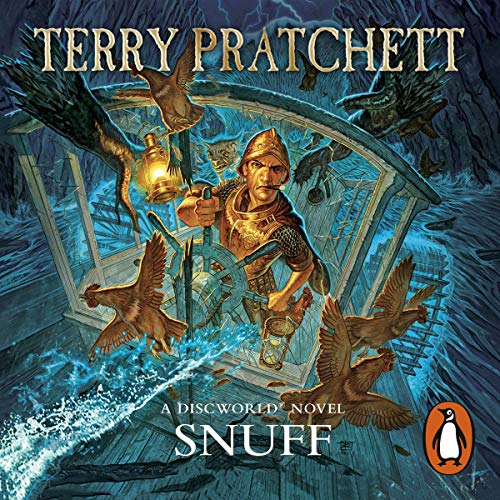
“We pledge to you that we will root out the communists, Marxists, fascists, and the radical left thugs that live like vermin within the confines of our country,” Donald Trump told a New Hampshire crowd in November, channeling Adolph Hitler in ways that stunned even those of us who thought that he had already scraped bottom. Terry Pratchett’s Snuff, which I’m currently listening to, has me thinking of Trump’s use of “vermin”since Pratchett villains use the word to justify exploiting, enslaving, and exterminating goblins, seen in the Discworld series as an historically oppressed race.
In the novel Commander Vimes, vacationing in the country, begins investigating the murder of a goblin woman, during which process he comes to see goblins in a new and sympathetic light. This particular encounter leads him to discover other crimes, including goblins being dragged from their caves and shipped off to parts unknown. When local police commissioner Feeney joins Vimes in the investigation, the Clerk to the Magistrates attempts to buy him off, telling him “not to bother about the goblin girl because goblins are officially vermin.”
In yesterday’s post, I noted Pratchett’s version of Pastor Martin Neimöller’s “first they came for…” Just as Trump starts with immigrants but soon is applying the word to all of his political opponents, Vimes tells the Clerk of the Magistrates that “once the goblins are vermin, then the poor are vermin, and the dwarfs are vermin, and the trolls are vermin.”
Snuff, while still containing Pratchett’s characteristic humor, is one of his angriest books as we see innocents killed and hearts broken. The author is so in love with the wondrousness of diversity that he feels violated to the core by those who deny others their full personhood. To cite again the observation of Granny Weatherwax, which appears in yesterday’s post on Pratchett’s I Shall Wear Midnight, “Evil begins when you begin to treat people as things.”
This story, however, has a happy ending as a goblin girl named Tears of the Mushroom plays such celestial music on her harp that hearts and minds are changed, leading to new laws guaranteeing goblin rights. As Lord Vetinari, Lord Patrician of the city-state of Ank-Morpork, reports to Vimes,
Ankh-Morpork, the kingdom of the Low King [the dwarfs] and also that of the Diamond King [the trolls], Uberwald, Lancre and all the independent cities of the plain are passing a law to the effect that goblins will henceforth be considered as sapient beings, equal to, if not the same as, trolls and dwarfs and humans and werewolves, et cetera et cetera, answerable to what we have agreed to call “the common law” and also protected by it. This means killing one would be a capital crime. You have won, commander, you have won.
And he attributes it all to the music:
One spends one’s life scheming, negotiating, giving and taking and greasing such wheels as squeak, and in general doing one’s best to stop this battered old world from exploding into pieces. And now, because of a piece of music, Vimes, a piece of music, some very powerful states have agreed to work together to heal the problems of another autonomous state and, almost as collateral, turn some animals into people at a stroke.
We all wish it could happen this way. Unfortunately, even as African American contralto Marian Anderson, defying the Daughters of the American Revolution, wowed thousands with her celestial version of “My Country ’Tis of Thee” at the Lincoln Memorial in 1955, Jim Crow still persisted for another ten years. Meanwhile, to this day, demagogues like Trump continue to characterize people of color as vermin.
Art helps but Vitineri’s scheming, negotiating, giving, taking and greasing are still necessary to “stop this battered old world from exploding into pieces.”
Note: If you wish to receive, via e-mail, (1) my weekly newsletter or (2) daily copies of these posts, notify me at rrbates1951@gmail.com and indicate which you would like. I promise not to share your e-mail address with anyone. To unsubscribe, send me a follow-up email.
Tuesday
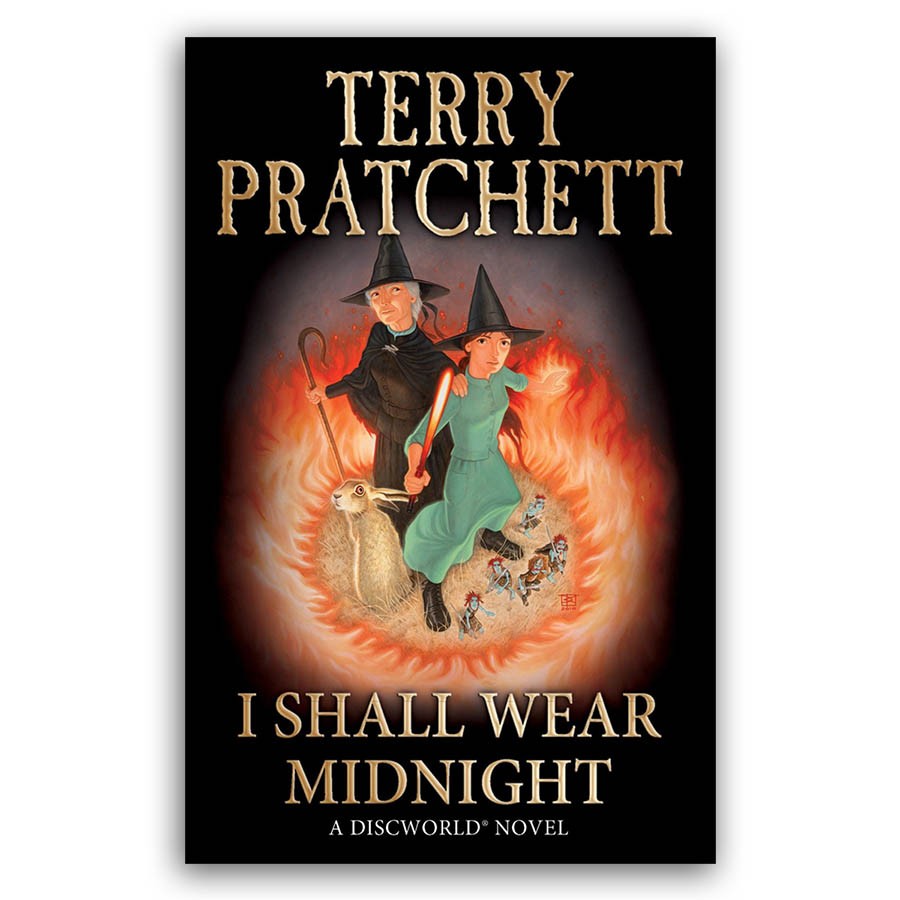
I have just finished listening to Terry Pratchett’s I Shall Wear Midnight, the fourth book in his Tiffany Aching series (which in turn makes up a part of his 41-book Discworld series). I see the brilliant Pratchett as a kind of postmodern Tolkien in that his world building is far more diverse and inclusive than Middle Earth. Rather than having elves, dwarfs, humans, hobbits and ents squaring off against trolls, goblins, orcs, and giant spiders, Pratchett has created a world in which all these figures (along with witches, vampires, werewolves, zombies, gorgons, and various other creatures from myth and folklore) must learn to get along if society is to survive. In other words, it sounds like our own world. Also, unlike Tolkien, Pratchett has a great sense of humor.
Tiffany Aching is a teenage witch who, by I Shall Wear Midnight, has established herself as the local witch in an area known as “the Chalk.” As witch, she functions mostly as doctor and veterinarian although she is also responsible for rescuing children kidnapped by fairies, guarding the population from various supernatural threats, advising the local baron, and so on.
In Midnight she must battle against a surge in anti-witch hysteria, which seems to arise from the storybook depictions of witches that everyone has grown up with. “Old stories, old rumors, and old picture books still seemed to have their own hold on the memory of the world,” the author observes.
Reading about such hysteria at the same time that we in the United States are witnessing the rise of Christofascism is illuminating. Previously hidden prejudices are suddenly fanned into open intolerance by a rabble-rousing priest known as “the Cunning Man.” Although he has died centuries before, Cunning Man has found a way to return to continue his mission. A shadowy figure with holes where his eyes should be, he spouts threats of hell and damnation as he goes after Tiffany, and his smell is as repulsive as his rhetoric. Tiffany always knows he is around because of his smell, a good metaphor for the hatred that populist demagogues stir up in their followers:
A stink. A stench. A foulness in her mind, dreadful and unforgiving. A compost of horrible ideas and rotted thoughts that made her want to take our her brain and wash it.
I can’t help but think of how Donald Trump is spurring his followers to hate immigrants, Muslims, members of the LGBTQ+ community, Democrats, moderate Republicans, and others, his own version of anti-witch hysteria. Pratchett has several passages describing how such sentiments can take over people’s minds and become lethal. For instance, people who have grown up with Tiffany or even have benefited from her healing ministrations suddenly regard her differently:
It’s always easier to blame somebody. And once you’ve called someone a witch, then you’d be amazed how many things you can blame her for.
Another passage helps explain MAGA hatred for undocumented immigrants, who are essential to our economy:
That was the problem with witchcraft: It was as if everybody needed the witches but hated the fact that they did, and somehow the hatred of the fact could become the hatred of the person.
As she encounters the hysteria, Tiffany remembers the words of one of her mentors, an old witch named Granny Weatherwax: “Evil begins when you begin to treat people as things.”
We also encounter Pratchett’s version of the famous Martin Niemöller quote about “first they came for…”:
But it’s very easy to push an old lady down to the ground and take one of the doors off the barn and put it on top of her like a sandwich and pile stones on it until she can’t breathe anymore. And that makes all the badness go away. Except that it doesn’t. Because there are other things going on, and other old ladies. And when they run out, there are always old men. Always strangers. There’s always the outsider. And then, perhaps, one day, there’s always you. That’s when the madness stops. When there’s no one left to be mad.
And tempting though it is to put all the blame on witch finders and demagogues like Donald Trump, there’s an observation that runs through Midnight that is only too true of our own society. It to comes to Tiffany courtesy of Granny Weatherwax:
Poison goes where poison’s welcome.
One thing I’ve noticed about the rise of Trumpism is that it gives people permission to act out their own worst impulses. So it is with anti-witch hysteria in Midnight. For instance, there is a duchess who is
the kind of bully who forces her victim into retaliation, which therefore becomes the justification for further and nastier bullying, with collateral damage to any innocent bystanders who would be invited by the bully to put the blame for their discomfiture onto the victim.
One of the most terrifying aspects of such transformations is how they come to be taken for granted. Just as people barely pay attention when Trump channels Hitler or his followers cheer authoritarianism, Tiffany reports at one point, “I have seen horrible things, and some of them all the more horrible because they were, well, normal”
So what does Tiffany do? First, she calls out the hatred for what it is:
Your power is only rumor and lies, she thought. You bore your way into people when they are uncertain and weak and worried and frightened, and they think their enemy is other people when their enemy is, and always will be, you – the master of lies. Outside, you are fearsome; inside, you are nothing but weakness.
And then, like Beowulf standing up to Grendel, she declares, “Inside I am flint.”
So instead of running from the witch-burning fire, she runs towards it, leaping through it and coming out safely on the other side. The Cunning Man, meanwhile, is consumed by the flames.
Which is to say, respond to Christian fascism, not through fear or accommodation, but through confident assertions of tolerance and kindness and decency and, yes, humor. All these qualities are alive and well in Pratchett’s teenage witch, which is why I think every child should be encouraged to disappear into the Tiffany Aching series.
Note: If you wish to receive, via e-mail, (1) my weekly newsletter or (2) daily copies of these posts, notify me at rrbates1951@gmail.com and indicate which you would like. I promise not to share your e-mail address with anyone. To unsubscribe, send me a follow-up email.
Monday
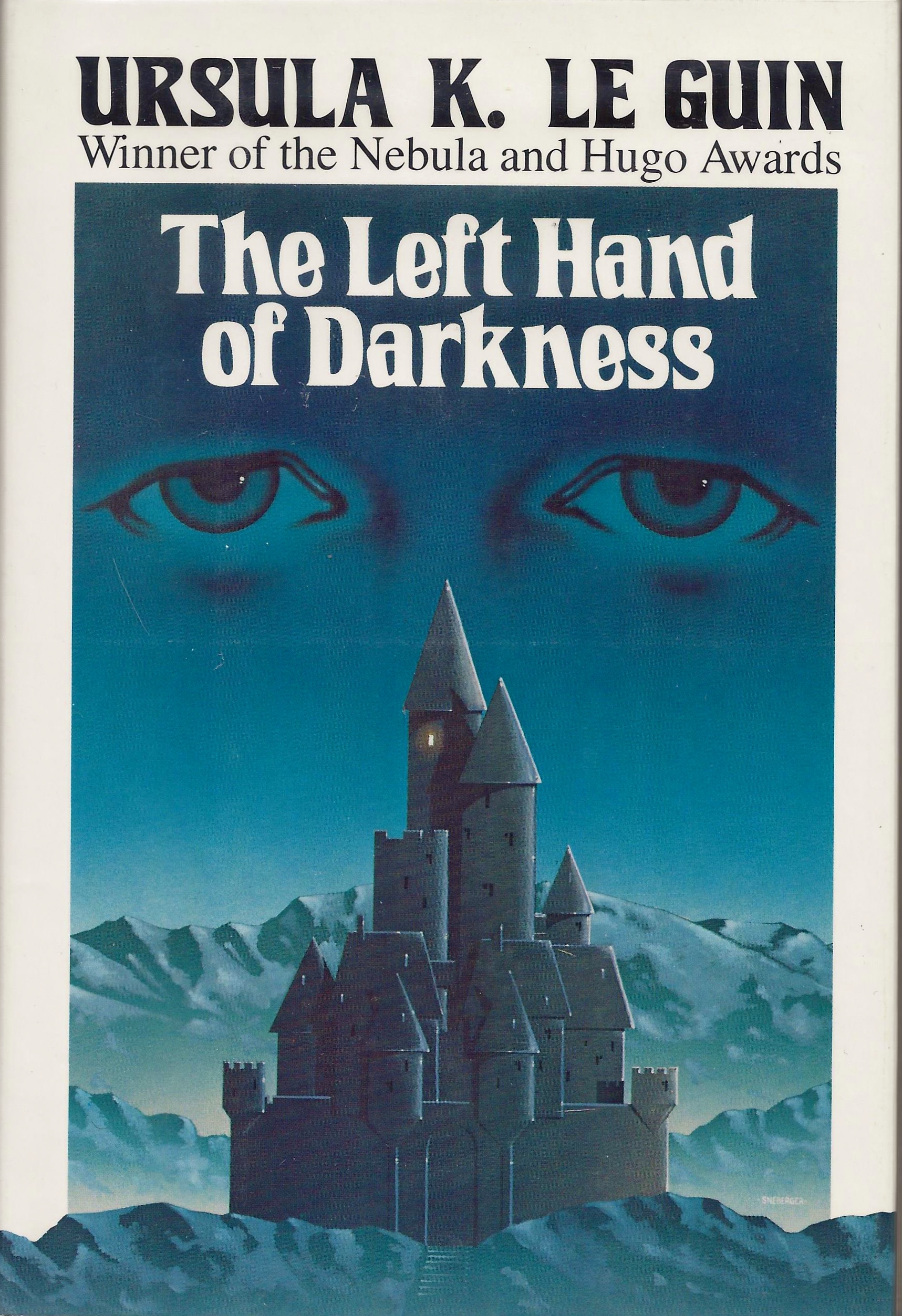
In my weekly series on Angus Fletcher’s book Wonderworks: The 25 Most Powerful Inventions in the History of Literature, I look today at his argument that Thomas More’s Utopia, Jonathan Swift’s Gulliver’s Travels, and Ursula Le Guin’s Left Hand of Darkness help us to “decide wiser.” By this he means that these works help us see the world through expanded awareness by getting us to suspend judgment, thereby freeing ourselves from bias.
In what I am calling Fletcher’s anthropological-psychological approach to literature, the Ohio State “professor of story science” says that while staying comfortably inside one’s own judgments can feel “instantly good to our neurons”—it delivers “pleasant microdoses of emotional superiority”—in the long run doing so “make[s] us anxious, incurious, and less happy.” But we can improve our long-term mental well-being by suspending judgment:
The longer we suspend our judgments, the more accurate our subsequent verdicts become. This valuable fact has been uncovered by researchers who’ve spent decades probing the mechanics of better decision-making, only to discover the key is simply more time and more information. Which is to say: reserving our judgment until the last possible moment.
One of the best ways for suspending our judgments and expanding our view of the world is through traveling to other cultures—and if one can’t travel in actuality, one can travel through books. Thus Fletcher mentions such works as “Herodotus’s fourth century-BCE musings on Egyptian circumcision; Fan Chengda’s twelfth-century geographies of the painted towers of the southern Song dynasty; and Ibn Battuta’s fourteenth-century guides to the fruited rivers of Persia, the pickled pepper pods of Zanzibar, and the seed-eating wizards of the old Mughal Empire.”
The problem with travel books, however, is that, while we are invited to sample other cultures, the narrator is often, comfortably, one of us:
The travelogues of Herodotus, Fan Chengda, and Ibn Battuta are all told in the voice of a single author who presents himself as a trustworthy set of eyes; the sort of experienced guide whom we might hire on a real trip to show us around. This style of writing sets our brain on autopilot. Even when the travelogue introduces us to people who act unexpectedly, it supplies us with a constant source of social cues: the narrator.
Because this perspective is less jolting than actual physical travel, such travelogues are less effective at boosting our sense of wonder. Fletcher therefore turns to three works that find ways to jolt us further, with each one (he contends) being an advance over the previous.
The first is Thomas More’s Utopia, which has two narrators arguing over an imaginary land. In other words, there are two perspectives about how we are to judge it, that of the character Hythloday and that of “Thomas More.” Between these two perspectives, Fletcher says, we inhabit a “netural in-between suspended forever.”
Only, he adds, we don’t. While More has given us two narrators, his original readers “decided the Utopia had only one true author: Hythloday. The ‘Thomas More’ fellow, they reasoned, was a satirical gag, so they compressed Utopia’s unique two author structure into a traditional one-author travelogue.”
Swift in Gulliver’s Travels found a different way to jolt us, turning its narrator into an untrustworthy witness. By the end of the work, Gulliver has gone mad, so if we have been relying on him to give us a solid view of the world, we find ourselves suddenly having to readjust where we thought we stood. Otherwise, we would find ourselves putting trust in a man who agrees that human beings (the Yahoos) should be exterminated. Indeed, when the Platonic horses order him to leave their kingdom, he uses the skin of human babies for his ship’s sails and human fat to caulk the boat. When he returns home to his family, meanwhile, he faints at the smell of his wife and spends four hours a day talking to the horses in his stables.
But Fletcher, for reasons that I’ll disagree with in a moment, says that we find a way to become comfortable in Swift’s vision: we just see it as satiric, and with that familiar category settled, we are no longer jolted. Therefore, Fletcher says, we need one more Henry Jamesian turn of the screw (my comparison, not his). This, he says, we get from Ursula Le Guin’s Left Hand of Darkness.
In that sci-fi novel we have a character, Genly Ai, who is so revolted “at the ‘animals’ of his own species that he flees to escape them in a separate room.” But when he visits the family of a Gethen friend—another people—he finds himself “overwhelmed with ‘strangeness,’ feeling as shockingly repelled by the Gethens as he does by humans.” Fletcher writes,
With this narrative twist, Ursula Le Guin doubles the innovation of Gulliver’s Travels. It’s as though Gulliver ended by swooning in horror at his wife—then swooning in horror at the horses of his stables….So rather than allowing us to follow the readers of Gulliver’s Travels in rocketing out of the narrator’s orbit, Left Hand interrupts our thrust away, suspending us in a state of half repulsion and half agreement…Gently Ai is crazy—and he’s sane. He’s so strange—and he’s just like me…our judgment hung in space indefinitely.
Fletcher calls this “the invention of the Double Alien,” and it’s worth noting that this is not the only work where Le Guin uses it. In The Dispossessed, for instance, against the backdrop of an Earth that has been environmentally destroyed, the protagonist bounces back and forth between a capitalist planet where some lessons have been learned and its desolate moon, which has been settled by idealistic anarchists. Each society has its flaws, as the anarchist protagonist discovers as he finds himself out of step with both societies. As in Left Hand of Darkness, there’s resistance to any final judgment.
But I think the same occurs with Gulliver’s Travels, which I consider the world’s greatest work of satire. The extra twist, which Fletcher doesn’t mention, is how Swift satirizes satire itself. Swift never ever allows one to rest comfortably. Gulliver by the end of the book has essentially become a satirist—only horses are worth talking to he thinks—and Swift shows that to be a dead-end as well.
At the same time, he provides us with a character, the Portuguese sea captain who rescues Gulliver, who all but restores our faith in humanity. Even though Brits of the time associated the Portuguese with the Portuguese Inquisition, Pedro de Mendez goes out of his way to make sure that Gulliver gets safely home. It’s an example of something Swift once remarked in a letter, of loving people but hating humanity. Or to use his exact words,
I have ever hated all nations, professions, and communities, and all my love is toward individuals: for instance, I hate the tribe of lawyers, but I love Counsellor Such-a-one, and Judge Such-a-one: so with physicians—I will not speak of my own trade—soldiers, English, Scotch, French, and the rest. But principally I hate and detest that animal called man, although I heartily love John, Peter, Thomas, and so forth.
So one problem I find with Fletcher’s mind-expanding book is that he talks as though literary techniques are superseded just as human inventions are. But literature is more than a technique. Authors can create timeless works even while working within limitations. Swift doesn’t need Le Guin’s “double alien technique” to pull the rug out from under us every time we become complacent. He’s brilliant at always keeping us off balance.
Which is to say, in great works of art our judgment never finds a comfortable position upon which to rest.