Wednesday
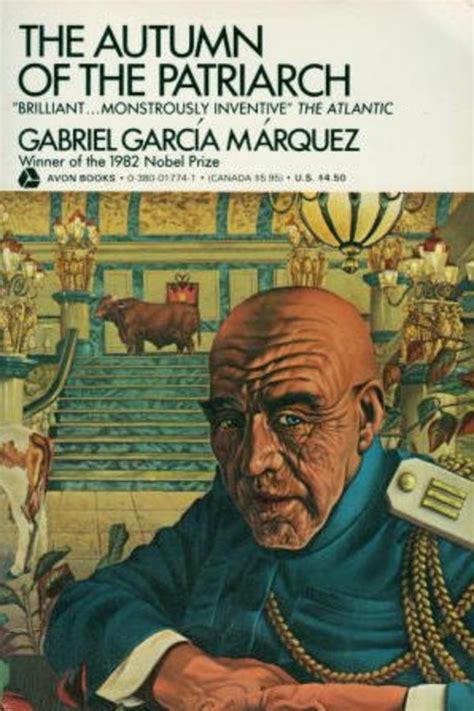
A Gabriel García Márquez passage shared by someone on Bluesky has sent me back to a novel I haven’t read since the 1980s but that suddenly seems disturbingly relevant. The dictator in Autumn of the Patriarch (1975) may be based on a compilation of South and Central American strongmen (Venezuela’s Juan Vincente Gómez, Haiti’s François Duvalier, Colombia’s Gustavo Rojas Pinilla, Nicaragua’s Anastasio Somoza, and the Dominican Republic’s Rafael Trujillo), but it disturbingly brings our own wannabe dictator to mind. Although DJT has not cooked up the body of one of his generals as a meal for those around him—not literally, at any rate— the general’s imprisoning 2000 innocent children lest they expose his fraudulent lottery scheme is closer to our reality than I would have thought possible ten years ago. (He then sinks them in a concrete barge.)
As a practitioner of magical realism, García Márquez can invent scenarios that, despite being fantastical, ring true. The dictator has been in power for 100 years, and with sentences that go on for pages, the novel reads like an unending fever dream—which is how Americans like me are experiencing DJT. In debt to a United States that is propping up his regime, the unnamed dictator at one point must sell the Caribbean Sea, which the United States then imports to Arizona, leaving behind a desert waste. How different is this to Trump selling our national parks and coastlines to oil companies, which in turn are hastening catastrophic climate change. The America in Autumn of the Patriarch, meanwhile, reminds us of how our president salivates over Greenland, Venezuela and Cuba.
As consolation for the loss of the sea, America provides Marquez’s dictator with large fans, which mimic the absent trade winds. As one review of the novel notes, “The ruler can counterfeit weather, but he cannot restore the world his power has emptied. The landscape becomes an inventory of political theft rather than a neutral setting.”
I turn to the novel’s last two pages, which capture the hollowness of absolute power. As with previous posts in which I have compared Trump to literary figures (especially to Lear), I must caution that García Márquez’s general is more complex and reflective than Trump so that he has some insight into the source of his sadness. Nevertheless, like Trump he thrashes around in unhappiness and lashes out in anger.
Also like Trump, the general has never known love, which he tries to compensate for by accumulating power and basking in the adulation of adoring crowds and of sycophants that use him while assuring him he will never die. In the following passage, I think the image of being the victim of his own sect may refer to his dependence on the cult he has fostered, which in its worship denies him his humanity (an “infinite holocaust”). The “little glass ball” may be an allusion to the snow globe of Citizen Kane, another character who never finds love:
…he had learned of his incapacity for love in the enigma of the palm of his mute hands [fortune tellers] and in the invisible code of the [Tarot] cards and he had tried to compensate for that infamous fate with the burning cultivation of the solitary vice of power, he had made himself victim of his own sect to be immolated on the flames of that infinite holocaust, he had fed on fallacy and crime, he had flourished in impiety and dishonor and he had put himself above his feverish avarice and his congenital fear [of death] only to keep up until the end of time the little glass ball in his hand without knowing that it was an endless vice the satiety of which generated its own appetite until the end of all times general sir, he had known since his beginnings that they deceived him in order to please him, that they collected from him by fawning on him, that they recruited by force of arms the dense crowds along his route with shouts of jubilation and venal signs of eternal life to the magnificent one who is more ancient than his age, but he learned to live with those and all the miseries of glory as he discovered in the course of his uncountable years that a lie is more comfortable than doubt, more useful than love, more lasting than truth [my emphasis], he had arrived without surprise at the ignominious fiction of commanding without power, of being exalted without glory and of being obeyed without authority when he became convinced in the trail of yellow leaves of his autumn that he had never been master of all his power, that he was condemned not to know life except in reverse, condemned to decipher the seams and straighten the threads of the woof and the warp of the tapestry of illusions of reality without suspecting even too late that the one livable life was one of show, …
As opposed to a life of show that is his only option, the rest of us live real lives. And even though this life may have aging (yellow leaves), misfortune, and death, there are also “ungraspable instants of happiness” and real love:
…the one [life] we saw from this side which wasn’t his general sir, this poor people’s side with the trail of yellow leaves of our uncountable years of misfortune and our ungraspable instants of happiness, where love was contaminated by the seeds of death but was all love, general sir…
Back to the general, who has been reduced to the tiny glimpses people get of him:
…where you yourself were only an uncertain vision of pitiful eyes through the dusty peepholes of the window of a train, only the tremor of some taciturn lips, the fugitive wave of a velvet glove on the no man’s hand of an old man with no destiny with our never knowing who he was, or what he was like, or even if he was only a figment of the imagination, a comic tyrant who never knew where the reverse side was and where the right of this life which we loved with an insatiable passion that you never dared even to imagine out of the fear of knowing what we knew only too well that it was arduous and ephemeral but there wasn’t any other, general, because we knew who we were while he was left never knowing it forever…
As this man flies through “the dark sound of the last frozen leaves of his autumn toward the homeland of shadows of the truth of oblivion, clinging to his fear of the rotting cloth of death’s hooded cassock,” he is, for one final time, cut off from human joy. In this case, it is joy over his death and jubilation over a return to freedom:
…a dead old man cut off at the roots by the slash of death, flying and alien to the clamor of the frantic crowds who took to the streets singing hymns of joy at the jubilant news of his death and alien forevermore to the music of liberation and the rockets of jubilation and the bells of glory that announced to the world the good news that the uncountable time of eternity had come to an end.
It’s a reminder that our present reality, whether through death or election cycle, will also come to an end. Perhaps accompanied by rockets of jubilation and bells of glory.