Thursday
Sometimes a book lands with seismic impact. Our faculty reading group is discussing Walden because Henry David Thoreau’s masterpiece was that book for John Gatta, who used to teach American environmental literature at Sewanee. John first encountered it at (I believe) 18.
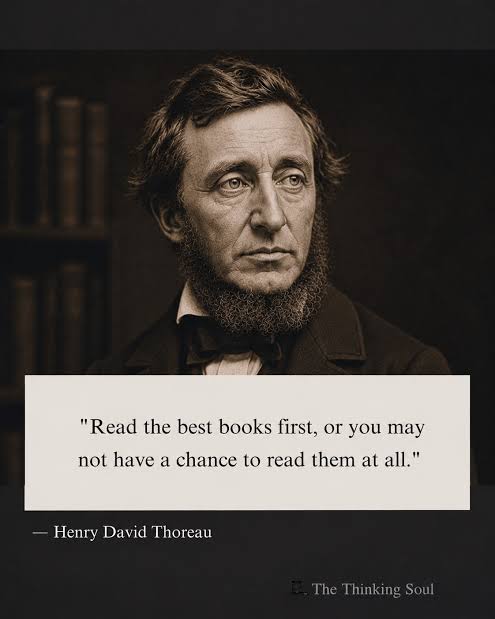
It so happens that Thoreau himself writes about life changing books in “Reading,” Walden’s third chapter:
There are probably words addressed to our condition exactly, which, if we could really hear and understand, would be more salutary than the morning or the spring to our lives, and possibly put a new aspect on the face of things for us. How many a man has dated a new era in his life from the reading of a book.
We have all encountered books that seemed “addressed to our condition exactly.” Or put another way, that knew us better than we knew ourselves. Books that, as I sometimes put it, throw us in our own faces.
These books not only know us but use that knowledge to push us deeper into life. “The book exists for us perchance,” Thoreau writes,
which will explain our miracles and reveal new ones. The at present unutterable things we may find somewhere uttered.
Alexander Pope discussed authors who utter the unutterable in Essay on Criticism:
True wit is nature to advantage dressed;
What oft was thought, but ne’er so well expressed;
Something, whose truth convinced at sight we find
That gives us back the image of our mind.
“True wit” for Pope is clearly articulating human nature rather than indulging in fancy but empty clichés. Thoreau agrees and then goes a step further, contending that human nature probably has been well expressed before. (“There is no new thing under the sun,” as the Ecclesiastes poet puts it.) Extensive reading alerts us that the same questions that disturb, puzzle, and confound us
have in their turn occurred to all the wise men; not one has been omitted; and each has answered them, according to his ability, by his words and his life.
Thus Thoreau is a passionate advocate for a classical education, declaring,
For what are the classics but the noblest recorded thoughts of man? They are the only oracles which are not decayed, and there are such answers to the most modern inquiry in them as Delphi and Dodona never gave. We might as well omit to study Nature because she is old.
If such a study is difficult, it’s because it’s worthwhile:
To read well, that is, to read true books in a true spirit, is a noble exercise, and one that will task the reader more than any exercise which the customs of the day esteem. It requires a training such as the athletes underwent, the steady intention almost of the whole life to this object. Books must be read as deliberately and reservedly as they were written.
With Thoreau’s emphasis on the classics, I think of those conservative culture warriors in the 1990s who accused liberals of destroying western culture by opening up the canon. Setting aside my belief that their fears were overblown—Dante, Homer, and especially Shakespeare continued to be well represented in English curricula—one wonders how committed they really were to open minds. There’s nothing like reading to send us in unexpected directions. As Barack Obama observed in a New York Review of Books interview,
When I think about how I understand my role as citizen…the most important set of understandings that I bring to that position of citizen, the most important stuff I’ve learned I think I’ve learned from novels. It has to do with empathy.
I don’t know if those old culture warriors would side with those current thinkers (I wrote about them Tuesday) who accuse liberals of destroying western civilization with their focus on empathy and diversity. If so, Thoreau is with Obama and not with them. From reading the classics, Thoreau writes, “we learn liberality,” which is to say open-mindedness. If we think our own faith tradition has a lock on the truth, reading widely will reveal that someone else has gotten there first. For an example of a closed mind, Thoreau imagines a born-again Christian:
The solitary hired man on a farm in the outskirts of Concord, who has had his second birth and peculiar religious experience, and is driven as he believes into the silent gravity and exclusiveness by his faith, may think it is not true; but Zoroaster, thousands of years ago, travelled the same road and had the same experience; but he, being wise, knew it to be universal, and treated his neighbors accordingly, and is even said to have invented and established worship among men.
It’s worth noting that, as the reference to Zoroaster indicates, Thoreau doesn’t limit himself to the western classics. As he writes at one point,
That age will be rich indeed when those relics which we call Classics, and the still older and more than classic but even less known Scriptures of the nations, shall have still further accumulated, when the Vaticans shall be filled with Vedas and Zendavestas and Bibles, with Homers and Dantes and Shakespeares, and all the centuries to come shall have successively deposited their trophies in the forum of the world. By such a pile we may hope to scale heaven at last.
Thoreau does not draw on the classics to promote conservative causes or authoritarian talking points. His ideal is a person who refuses to mindlessly follow a leader but instead thinks for him or herself. Some of his resonant pronouncements function as American sacred scripture, helping define the republic we aspire to be. Among them are the following:
— The universe is wider than our views of it.
— The mass of men lead lives of quiet desperation. What is called resignation is confirmed desperation.
— Why should we be in such desperate haste to succeed, and in such desperate enterprises? If a man does not keep pace with his companions, perhaps it is because he hears a different drummer. Let him step to the music which he hears, however measured or far away.
— While England endeavors to cure the potato-rot, will not any endeavor to cure the brain-rot, which prevails so much more widely and fatally?
Think of the following as a comment on DJT’s reality-tv presidency:
Shams and delusions are esteemed for soundest truths, while reality is fabulous. If men would steadily observe realities only, and not allow themselves to be deluded, life, to compare it with such things as we know, would be like a fairy tale and the Arabian Nights’ Entertainments. If we respected only what is inevitable and has a right to be, music and poetry would resound along the streets. When we are unhurried and wise, we perceive that only great and worthy things have any permanent and absolute existence,—that petty fears and petty pleasures are but the shadow of the reality. This is always exhilarating and sublime. By closing the eyes and slumbering, and consenting to be deceived by shows, men establish and confirm their daily life of routine and habit everywhere, which still is built on purely illusory foundations.
How many Americans have consented to be deceived by shows, regarding shams and delusions as soundest truths? Have been swept up by petty fears and petty pleasures? Have built their lives on purely illusory foundations?
And think of how much better off we would be if we made policy decisions based on “realities only.” If “only great and worthy things” guided us. Perhaps music and poetry would indeed resound along the streets.
Yesterday, I talked about a reading exercise in which I required students were to step out of their own minds and into those of readers who saw books differently. Rather than undermining western values, their empathy showed how differences could be bridged and a better society built.
That was also Thoreau’s project and reading was an integral part of it.