Monday
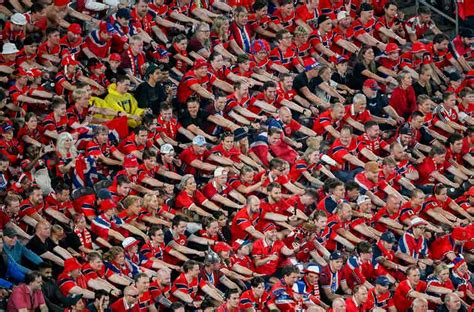
One of the things that we will carry away from this year’s World Cup is “the Viking Row” of Norwegian fans, which they once more exhibited in Norway’s unexpected win yesterday over favored Brazil.
As Fox Sports describes it, the Viking Row
involves a group of people — in this case, Norway’s men’s national team and their fans — sitting down and moving their bodies back and forth in a rowing motion. Fans will do it at any time of the game, with a drummer setting the rhythm. Every two beats, the crowd shouts, “ROW!” and the chant commences.
The article explains that the exercise celebrates that time in history—between 800 and 1050 AD— when Vikings ventured around the world, sometimes raiding, sometimes trading. England, whose thrilling victory over Mexico I’ve just watched, could take the celebration personally since the Vikings attacked their own shores.
This was also the period that produced Beowulf, and there are dramatic images of Scandinavian rowers in the poem, although the Geats were from modern day Sweden rather than Norway. Also, unlike the soccer team, they come in peace.
Imagine that Erling Haaland, Norway’s extraordinary striker, is Beowulf. The Geat hero has shown up in the Danish court—Denmark is the reigning power in the region— claiming that he can perform miracles, which would be like someone striding into the White House from a tiny country (let’s say Trinidad) and making a similar claim. In other words, he appears to be in above his head.
This is how some have viewed Norway, which (in stark contrast to Brazil) has only qualified for the World Cup four times, the last time in 1998. In fact, one of King Hrothgar’s retainers is outraged at Beowulf’s effrontery.
Beowulf, however, exudes absolute confidence, as though he belongs. Here he is landing in Denmark with his handpicked crew of young men:
When he heard about Grendel, Hygelac’s thanewas on home ground, over in Geatland.
There was no one else like him alive.In his day, he was the mightiest man on earth,
high-born and powerful. He ordered a boat
that would ply the waves. He announced his plan:
to sail the swan’s road and search out that king,
the famous prince who needed defenders.
Nobody tried to keep him from going,
no elder denied him, dear as he was to them.
Instead, they inspected omens and spurred
his ambition to go, whilst he moved about
like the leader he was, enlisting men,
the best he could find; with fourteen others
the warrior boarded the boat as captain,
a canny pilot along coast and currents.
Time went by, the boat was on water,
in close under the cliffs.
At this point the men begin engaging in the Viking Row:
Men climbed eagerly up the gangplank,
sand churned in surf, warriors loaded
a cargo of weapons, shining war-gear
in the vessel’s hold, then heaved out,
away with a will in their wood-wreathed ship.
Over the waves, with the wind behind her
and foam at her neck, she flew like a bird
until her curved prow had covered the distance
and on the following day, at the due hour,
those seafarers sighted land,
sunlit cliffs, sheer crags
and looming headlands, the landfall they sought.
Arriving like the Norwegian team in America, the Geats disembark with all their gear:
It was the end of their voyage and the Geats vaulted
over the side, out on to the sand,
and moored their ship. There was a clash of mail
and a thresh of gear. They thanked God
for that easy crossing on a calm sea.
The herald, on the outlook for sea invaders, is impressed by the confidence of the Geats:
Never before has a force under arms
disembarked so openly—not bothering to ask
if the sentries allowed them safe passage
or the clan had consented. Nor have I seen
a mightier man-at-arms on this earth
than the one standing here: unless I am mistaken,
he is truly noble. This is no mere
hanger-on in a hero’s armor.
Having satisfied the sentry, the Geats make their way to the stadium king’s hall::
So they went on their way. The ship rode the water,
broad-beamed, bound by its hawser
and anchored fast. Boar-shapes flashed
above their cheek-guards, the brightly forged
work of goldsmiths, watching over
those stern-faced men. They marched in step,
hurrying on till the timbered hall
rose before them, radiant with gold.
Nobody on earth knew of another
building like it. Majesty lodged there,
its light shone over many lands.
In the end, of course, Beowulf—a decided underdog—emerges triumphant. As, buoyed by the Viking Row, did his Scandinavian descendants.