Roland, the Dark Tower, Hitler and Trump

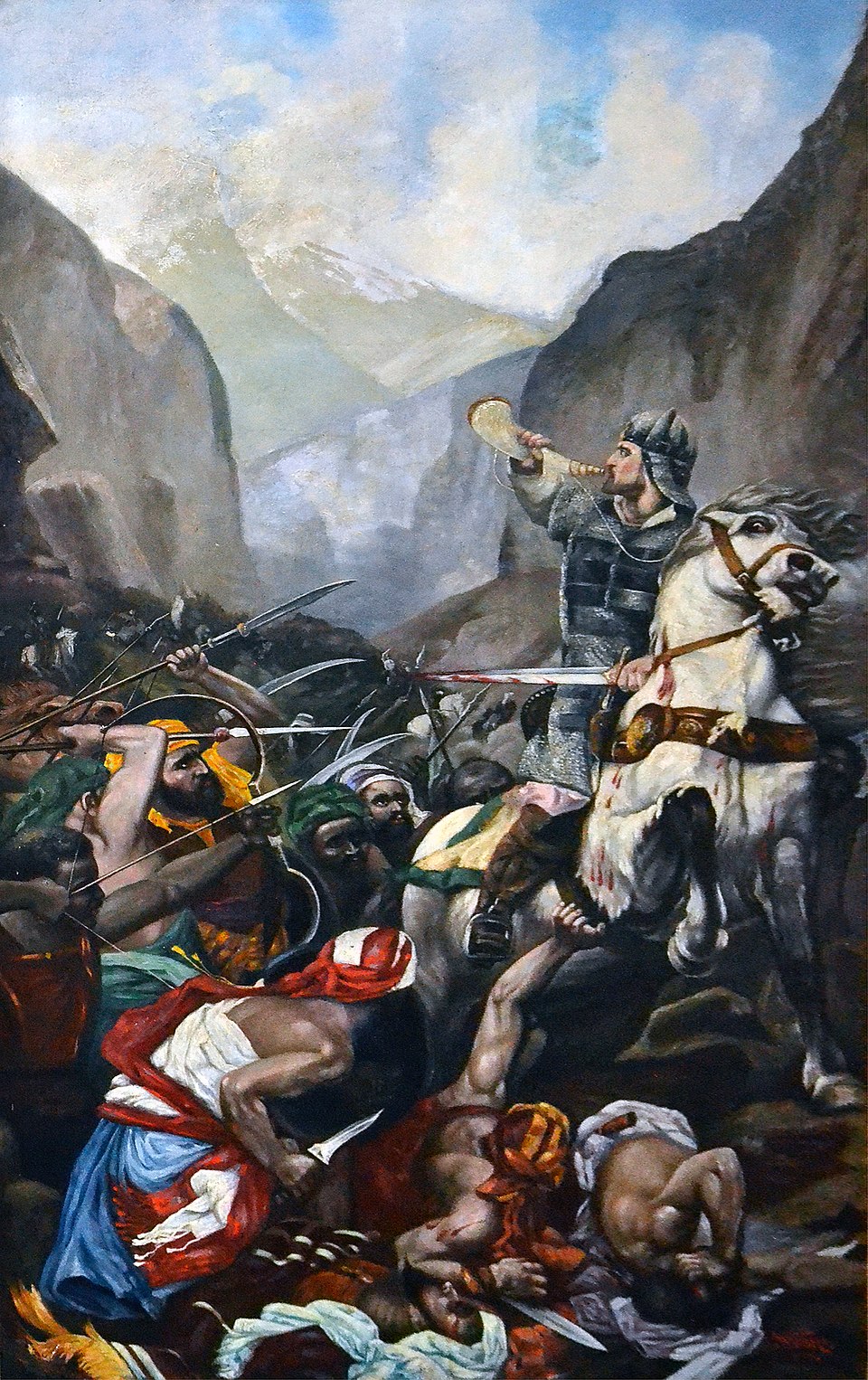
Roland at the Battle of Ronceveaux

Note: If you wish to receive, via e-mail, (1) my weekly newsletter or (2) daily copies of these posts, write to me at rrbates1951@gmail.com. Comments may also be sent to this address. I promise not to share your e-mail with anyone. To unsubscribe, write here as well.

Wednesday

My faculty book group discussed Robert Browning’s haunting poem “Childe Roland to the Dark Tower Came” last week, and the opening stanza couldn’t help but bring to mind Donald Trump and his administration:

My first thought was, he lied in every word,
 That hoary cripple, with malicious eye
 Askance to watch the working of his lie
On mine, and mouth scarce able to afford
Suppression of the glee, that pursed and scored
 Its edge, at one more victim gained thereby.

The “hoary cripple” is not only lying but knows that Roland knows that he is lying. If he is experiencing barely suppressed glee, it is because his mendacity has trapped the wandering knight in a downward spiral of doubt and despair. Something like what the Nazis pulled off with the German populace in the 1930s.

I mention this parallel because I’ve just read about a recently republished 1939 German memoir by one Sebasian Haffner (pen name Raimund Pretzel), which novelist and political blogger Greg Olear says is “the single most important work I’ve come across, in terms of understanding the here and now.” Defying Hitler describes what average Germans were feeling as Hitler, first slowly and then quickly and always signaling his intent, took over the government and imposed his will.

The situation is unnervingly similar to our own, which Olear sets forth as follows:

In just a few months, a coarse, artless, criminal strongman has taken control of the entire federal government—including, as of yesterday, the nation’s capital (or “Capital,” as he writes it, capitalizing his nouns like a good German).

Trump owns the Supreme Court, the Republican Party, the Speaker of the House. Congress is powerless to stop him. The wealthiest tech-bros in Silicon Valley and most of the legacy media CEOs have lined up behind him. Colleges and universities have capitulated to his demands, as have white-shoe law firms and venerable broadcasting companies. He’s transformed U.S. Immigration & Customs Enforcement into his own secret state police. He’s using the FBI and the Justice Department to attack his enemies. He’s building concentration camps. He’s enriching himself on a grand scale. And every word that comes out of his puckered little mouth is a lie.

Non-stop lying is how Hitler pulled off his power grab, according to Haffner, with his biggest lie being that the Jews, in coordination with the communists, engineered Germany’s defeat in World War I. Hitler understood, as does Trump, that big lies go down more successfully than small lies. Observing up close the impact of Hitler’s lying, Haffner provided the following explanation of how it worked:

[I]n the big lie there is always a certain force of credibility; because the broad masses of a nation are always more easily corrupted in the deeper strata of their emotional nature than consciously or voluntarily; and thus in the primitive simplicity of their minds they more readily fall victims to the big lie than the small lie, since they themselves often tell small lies in little matters but would be ashamed to resort to large-scale falsehoods.

Because they can’t imagine someone fabricating “colossal untruths,” normal people doubt and waver in the face of them, thinking there must be some other explanation. Thus, the German notes, “the grossly impudent lie always leaves traces behind it, even after it has been nailed down, a fact which is known to all expert liars in this world and to all who conspire together in the art of lying.”

Like a slow-seeping poison, such lying takes a toll, changing the narrative and sapping the opposition. Even though the burning of the Reichstag, which the Nazis blamed on the communists, was clearly a false flag operation—in fact, Nazis even tried to prevent fire fighters from putting out the flames—the pervasive lying had already so muddied the waters that many just went along. Even though the streets were calm and everything seemed relatively peaceful—which describes life in Washington, D.C. before the National Guard moved in—many Germans surrendered to Nazi propaganda:

So the Communists had burned down the Reichstag. Well, well. That could well be so, it was even to be expected. Funny, though, why they should choose the Reichstag, an empty building, where no one would profit from a fire. Well, perhaps it really had been intended as the “signal” for the uprising, which had been prevented by the “decisive measures” taken by the government. That was what the papers said, and it sounded plausible. Funny also that the Nazis got so worked up about the Reichstag. Up till then they had contemptuously called it a “hot air factory.” Now it was suddenly the holy of holies that had been burned down. Well, what suits their book, don’t you agree, my friend, that’s politics, isn’t it? Thank God we don’t understand it. The main thing is: the danger of a Communist uprising has been averted and we can sleep easy. Good night.

The reference to the papers brings to mind our own mainstream media, which is proving eerily passive in the face of Trump. The Washington Post may assert, in its masthead, that “Democracy dies in darkness,” but yesterday it framed Trump’s military occupation of Washington as “Donald Trump fulfills a dream role: Big-city mayor.” (Yes, and Hitler fulfilled his dream of finally visiting Paris.) Meanwhile the mainstream media’s German counterparts (Olear points out) were “either incapable of asking questions or unwilling to ask them, and took the Nazi press releases at face value.”

In the face of the false flag that was the Reichstag fire, Haffner says that the Germans were guilty of a

terrible collective weakness of character…With sheepish submissiveness the German people accepted that, as a result of the fire, each one of them lost what little personal freedom and dignity was guaranteed by the constitution; as though it followed as a necessary consequence. If the Communists had burned down the Reichstag, it was perfectly in order that the government took “decisive measures”! 

Such “sheepish submissiveness,” Olear says, has been

all too familiar here in the United States during the Trump era. Whether it’s Barack Obama being checkmated by Mitch McConnell with the doomed Merrick Garland SCOTUS nomination; Chuck Schumer and Hakeem Jeffries not grasping the severity of the threat to democracy posed by Trump; A.G. Garland’s feckless refusal to go hard at Donald in order to preserve “norms”; Jake Tapper and Dana Bash allowing Trump to Gish-gallop all over Biden in the first debate, not bothering to check even one of his countless lies; Joe Biden declining to use the mighty immunity powers granted him by the corrupt Roberts Court to save us from the orange menace; or the general reluctance of the press to report on Trump’s long ties to organized crime, the Kremlin, or Jeffrey Epstein, we have all seen a lifetime’s worth of pusillanimity from the “good guys.”

Haffner writes that the Germans were “under a spell,” and in Browning’s poem the same appears to be the case with Roland. Why else would he go along with the lying cripple’s agenda, which is as clear as Hitler’s and Trump’s agendas were:

What else should he be set for, with his staff?
What, save to waylay with his lies, ensnare
All travelers who might find him posted there,
And ask the road? I guessed what skull-like laugh
Would break, what crutch ‘gin write my epitaph
For pastime in the dusty thoroughfare,

If at his counsel I should turn aside
Into that ominous tract which, all agree,
Hides the Dark Tower. 

Roland fatalistically—sheeplike?—does what the man wants, walking directly into his trap:

                                       Yet acquiescingly
I did turn as he pointed: neither pride
Nor hope rekindling at the end descried,
So much as gladness that some end might be.

What ensues is a long trek through a desolate waste land that conveys Roland’s inner desolation. Yeats’s “the best lack all conviction” describes his condition, as does T.S. Eliot’s hollow men “behaving as the wind behaves.” Roland’s lost idealism–“my hope dwindled into a ghost”—could be describing Americans’ loss of faith in the American dream:

For, what with my whole world-wide wandering,
What with my search drawn out thro’ years, my hope
Dwindled into a ghost not fit to cope
With that obstreperous joy success would bring,
I hardly tried now to rebuke the spring
My heart made, finding failure in its scope.

In his trek Roland thinks back to former companions, now disgraced, which makes his quest seem all that more futile. Everyone has been dragged down by hopelessness, a situation which gives authoritarian figures and cynical operatives the advantage. Note the bleakness of his world:

So, on I went. I think I never saw
Such starved ignoble nature; nothing throve:
For flowers—as well expect a cedar grove!
But cockle, spurge, according to their law
Might propagate their kind, with none to awe,
You’d think; a burr had been a treasure-trove.

And

Now blotches rankling, colored gay and grim,
Now patches where some leanness of the soil’s
Broke into moss or substances like boils;
Then came some palsied oak, a cleft in him
Like a distorted mouth that splits its rim
Gaping at death, and dies while it recoils.

So are we all as doomed as Roland seems to be? While Olear sees Haffner’s memoir as an essential wake-up call, he also points out what’s different about our situation. We still have powerful people and powerful institutions that can push back as Germany did not:

But in 2025, the United States does have strong leaders in important and powerful positions. Gavin Newsom, lately Trump’s bugbear, presides over the world’s fourth-largest economy; the U.S. needs California more than California needs the U.S. Minnesota’s Tim Walz has been a strong resistance voice since Kamala Harris chose him to be her running mate. JB Pritzker of Illinois has not been shy about criticizing Dear Leader. Kathy Hochul, my governor here in New York, has been quieter than the others, but no less effective. And Zohran Mamdani, God bless him, is running one of the best political campaigns in recent memory and stands poised to become mayor of the country’s largest—and wealthiest—city. 

Olear notes that there was no equivalent to a state governor in Nazi Germany, no opposition leaders as charismatic as the Democrats he names, and nothing like the power of individual states. 

There are debates about whether the ending of Browning’s poem is negative or positive. While he sees himself as haunted by the failures of previous warriors and feels like a stag at bay—”Now stab and end the creature—to the heft!’“—yet he makes one last heroic stand: 

There they stood, ranged along the hillsides, met
To view the last of me, a living frame
For one more picture! in a sheet of flame
I saw them and I knew them all. And yet
Dauntless the slug-horn to my lips I set,
And blew. “Childe Roland to the Dark Tower came.”

Think of the slug-horn as calling us to rise above the exhaustion, depression, and emptiness that many are experiencing. In the medieval poem Song of Roland, when the warrior blows his horn, Charlemagne responds, so that even though it’s too late for Roland, the country is saved. The very fact that, despite the odds against him,  Roland is willing to face up to the darkness can serve as inspiration.

In C.S. Lewis’s Prince Caspian the embattled Narnians, at their lowest moment, blow Susan’s ancient horn and it brings in kings and queens from the past, who set things right. Think of those kings as the Enlightenment ideas upon which this country was founded. They are worth fighting for, whatever the cost.

Further note: For an instance of Democratic politicians fighting bravely, Illinois governor J.B. Pritzker particularly stands out. “If it sounds to you like I am alarmist, that is because I am ringing an alarm,” he said Monday afternoon in a magnificent speech. Here’s an excerpt in which he calls upon the press to do its job and help pull us out of our Childe Roland funk:

To the members of the press who are assembled here today, and listening across the country, I am asking for your courage to tell it like it is.

This is not a time to pretend here that there are two sides to this story. This is not a time to fall back into the reflexive crouch that I so often see, where the authoritarian creep by this administration is ignored in favor of some horse race piece on who will be helped politically by the president’s actions.

Donald Trump wants to use the military to occupy a U.S. city, punish his dissidence, and score political points. If this were happening in any other country, we would have no trouble calling it what it is: a dangerous power grab.

Posted in Uncategorized | Tagged , , , , , , , , | Comments closed

My Intense Interactions with Lit

Vincent Van Gogh, Old Man Reading

Note: If you wish to receive, via e-mail, (1) my weekly newsletter or (2) daily copies of these posts, write to me at rrbates1951@gmail.com. Comments may also be sent to this address. I promise not to share your e-mail with anyone. To unsubscribe, write here as well.

Tuesday

Last week I posed a set of questions about memorable reading experiences. Today I seek to answer them. Here they are:

–Who is your favorite hero and heroine? (they can be from different works)
–Who is your favorite couple?
–Who is your favorite villain?
–What work has held you in the greatest suspense?
–What work has given you the greatest shock?
–What work has given you the greatest erotic thrill?
–What literary ending do you find the most satisfying?
–What literary ending do you find the least satisfying?
–If you could change an ending to a work, what would you do?
–What work do you most wish had a sequel? (fan fiction is driven by such works)
–What is a work that you believe has damaged you?
–What is a work you wish you had never encountered?
–If you could have any character as a partner, who would it be?
–If you could have any author as a partner, who would it be?
–What literary family would you most like to belong to?
–What is a work that had you laughing out loud?
–What’s your favorite open ending?
–Add your own question and answer.

My favorite hero is Alyosha Karamazov, the spiritual brother in Dostoevsky’s novel. My favorite heroine is Dorothea Brooke from Middlemarch.

My favorite couple is Anne Elliot and Captain Wentworth from Jane Austen’s Persuasion. It helps that they have a wonderful couple to model themselves on, Admiral and Mrs. Croft, who are pretty much the only example of a long-time successful marriage we encounter in Austen’s novels (although the Gardiners in Pride and Prejudice seem contented).

Favorite villain: the horrifying Judge Holden from Cormac McCarthy’s Meridian. I think what particularly gets me about this psychopath is that he represents a violent streak within the American psyche.

The moment of greatest literary suspense is when Inspector Javert is closing in on Jean Valjean and little Cossette, who are trapped in an alley with no apparent exit. While, when reading, I consider it a sacred contract not to jump ahead, in this case I made an exception, thumbing ahead to make sure everything works out before going back and reading the intervening pages..

Greatest shock: I still remember exactly where I was when I read Flannery O’Connor’s “A Good Man Is Hard to Find.” I read it, as an Emory graduate student, on campus late on a Sunday afternoon with no one else around. The short story took me totally off guard as it shifted from comic social satire to mass murder in the space of a few pages. The ending of George Meredith’s Ordeal of Richard Feverel delivered a different kind of shock, with an ending so perverse (in my eyes) that I hurled the book across the room upon completion.  

Erotic thrill: Pauline Reagé’s Story of O held me riveted for years. I identified with O, not with her male tormenters.

Favorite ending: I decided to devote myself to 18th century British literature in large part because I fell in love with Henry Fielding’s Tom Jones: History of a Foundling. Samuel Taylor Coleridge called it one of the three most perfect plots in literature (the other two, he said, are Oedipus and Ben Jonson’s The Alchemist). How Fielding engineers the final union between Tom and Sophia still seems magical to me.

Least favorite ending: I hated, hated, hated the ending of John Fowles’s The Collector, where the kidnapping victim of the protagonist dies and we see him cruising the streets to find the next vulnerable young woman.

Most longed for sequel: I can only follow the mob with my answer here. I too fantasize about the future of Elizabeth and Darcy’s marriage.

–For a work that damaged me, I choose a novel that also came to my rescue. When I was growing up in the segregated south and was being called a “n***lover,” To Kill a Mockingbird bolstered me. The year was 1962, I was a vulnerable 12-year-old, and my family was engaged in a lawsuit to integrate schools in our Tennessee county. But although Harper Lee’s novel assured me that we were fighting the good fight, it also engraved in my mind the white savior myth and the notion that African Americans should all be like Tom Robinson and Calpurnia (which is to say, grateful to Whites for coming to their aid). This in turn made it hard for me to relate to a number of the African American students at Carleton College and even for a while after. I appreciate that Lee provided a healthy corrective years later with her sequel, Go Set a Watchman, showing that Atticus would go on to join the White Citizens Council when African Americans started demanding equal rights. (Calpurnia leaves him in disgust.)

–Although I generally admire Joyce Carol Oates–especially novels like The Gravedigger’s Daughter, short stories like “Where Are You Going, Where Have You Been?” and autobiographical works like The Lost LandscapeI wish I had never read Daddy Love. It’s a story about a child who is kidnapped from a loving family, with his mother becoming horribly mutilated as the the abductor’s car drags her, and I experience it as something rotten in my memory bank. There’s even something sickly in the supposedly happy ending when the child, years later, escapes death and reunites with his family. He appears to be psychologically destroyed, however. 

–I’ve already named the character I would most like as a partner: Dorothea Brooke, because of her integrity and determination to make the world a better place. But unlike Casaubon, I fantasize supporting her in her own ambitions rather than having her be subservient to mine.

I definitely would not make the choice of Woody Allen’s Kugelmass, who conjures up Emma Bovary (through a special device) and then regrets it when she starts running up their Macy’s credit card debt.

Author I would most like as a partner: Although Dorothea shortchanges herself by dreaming of becoming amanuensis to a great mind (she fantasizes about being like Milton’s daughters but Casaubon is no Milton), I have sometimes fantasized about seeing gender roles reversed and providing support for a great woman author. Aphra Behn sounds like she would have been a blast.

The family I would most like to belong to actually provided me a model for my own childhood. I loved the Bastable kids in E. Nesbit’s Treasure Seekers, Wouldbegoods, and New Treasure Seekers, identifying especially with Oswald. I therefore tried to engage my brothers and neighborhood kids in our own collective activities.

Funniest moment: I was reading John Irving’s A Prayer for Owen Meanie on a plane and nearly exploded trying to suppress my laughter at the Christmas pageant scene, where tiny Owen has been cast in the role of baby Jesus. Suddenly he is making oracular pronouncements—speaking in the voice of God, as it were—to his delinquent parents as they enter the church.

—Regarding my favorite open ending, it’s hard to beat Paradise Lost:

The world was all before them, where to choose
Their place of rest, and Providence their guide:
They hand in hand, with wandering steps and slow,
Through Eden took their solitary way.

But since, in a sense, we know what happens next—the archangel Michael tells Adam all about the future and we know our own history—we need a different story.

For a reluctant open ending, I choose Charlotte Bronte’s Villette, which might have had a closed—and grim—ending had not readers objected. Bronte therefore wrote the following, where a storm hits the ship carrying the Mr. Emanuel back to the heroine. Can you figure out whether he is drowned or makes it back safely?

Peace, be still! Oh! a thousand weepers, praying in agony on waiting shores, listened for that voice, but it was not uttered—not uttered till; when the hush came, some could not feel it: till, when the sun returned, his light was night to some!

Here pause: pause at once. There is enough said. Trouble no quiet, kind heart; leave sunny imaginations hope. Let it be theirs to conceive the delight of joy born again fresh out of great terror, the rapture of rescue from peril, the wondrous reprieve from dread, the fruition of return. Let them picture union and a happy succeeding life.

In other words, if you have a sunny imagination, you can imagine “the delight of joy born again fresh out of great terror,” etc. But if you don’t… 

Then, to make clear how unhappy she is with this open ending, Bronte concludes by showing that she is indeed capable of writing a closed ending when she is not being pressured by readers and publishers:

Madame Beck prospered all the days of her life; so did Père Silas; Madame Walravens fulfilled her ninetieth year before she died. Farewell.

If you would like to send in accounts of your own reading experiences, I’d love to read them.

Posted in Uncategorized | Comments closed

Sade and Trump’s Sadopopulism

Note: If you wish to receive, via e-mail, (1) my weekly newsletter or (2) daily copies of these posts, write to me at rrbates1951@gmail.com. Comments may also be sent to this address. I promise not to share your e-mail with anyone. To unsubscribe, write here as well.

Monday

For today’s post I am going into a very dark place and drawing on the darkest of authors to do so. My subject is the pleasure that comes from inflicting pain. According to Jay Kuo, whose substack blog The Status Kuo I subscribe to, oligarchs like Trump create a culture of pain in which everyone suffers, even their own supporters. “I’m going to hurt you,” they signal to their base, “so you’ll want to hurt others.”  

Fascism expert Timothy Snyder calls this “sadopopulism,” and perhaps no one has explored the attraction of inflicting pain more than the man whose name is applied to the phenomenon. I visited the Marquis de Sade’s repellant works decades ago and, if I didn’t find him useful now, I would be steering clear of him. In a moment I’ll stifle my gag reflex and cite some passages from his novel Juliette.

First, however, here’s Kuo asking a series of questions that highlight how the Trump administration is flaunting its sadism:

Why tear hardworking, non-criminal undocumented immigrants from their communities and families, often terrorizing them in plain sight of their children?

Why post videos of migrants in shackles as you render them to third-country torture prisons?

Why create “Alligator Alcatraz” merchandise and fantasize about people being eaten by reptiles in the Everglades swamps?

Why relish in “liberal tears” and rejoice when the other side is traumatized by your lack of humanity?

Kuo’s questions then take a twist since it’s not only liberals that Trump is hurting. Thinking of the president’s support amongst various Latino groups and rural and lower class white voters, he asks,

For that matter, why take healthcare away from your own voters, impose huge new tariffs on them, close down their rural hospitals, and send their costs soaring on groceries, electricity and housing?

Snyder and Kuo explain that oligarchs like Trump thrive on an ethos of pain. Following Snyder, Kuo reasons that “if you teach people that life is full of pain and grievance, then at least Trump’s voters have the consolation that they are not suffering as badly as immigrants, minorities, and queer people.” 

In this scenario, the very pain that Trump’s voters experience accentuates “long-held divisions and resentment.” The MAGA faithful find solace knowing that they are at least better off than people of color and LGBTQ+ folk. And that, Kuo says, is a powerful motivator.

Why would Trump deliberately withhold FEMA aid even from red states? Why does he send masked ICE agents into rural communities that voted for him? It’s because he wants people to understand that the government “inflicts pain”:

It makes you hurt. It’s all encompassing and all powerful, and you just want so badly for it to harm others more than you. So instead of thinking about how we all might prosper together in the future, Trump would see us cast into different competing groups, fighting over scraps, trying to feel less relative pain.

Kuo observes that the entire Confederacy, along with the Jim Crow era, was built on sadopopulism: 

It explains the public torture and lynchings of Black citizens while whites looked on with their children in tow, as if attending a happy social gathering. It explains how rich property owners in the South could continue to justify massive wealth inequality while dire poverty persisted in those states. The problem wasn’t the oligarchs; it was the Blacks, so the narrative went.

Kuo describes pain as a social resource that Trump doles out, and the president hopes that the taste for it will spread. By actively propagating images and memes about brutal detention and deportation, his administration invites us “to wallow in torture and cruelty.” Kuo turns to philosophy professor Jason Stanley at the University of Toronto, who explains,

“What you have is this desire to get people to buy into the fun of sadism.” It’s the U.S. government itself saying, “This is something we’re doing together, we’re having a blast, we’re laughing and those wimpy liberals are saying it’s scandalous. We’re going to show our power over them by having as much fun as possible.”

Once one creates a culture of pain, it’s only a short step for people to begin accepting mass atrocities.

Sade’s Juliette goes through life seeking erotic stimulation, which she gets from torturing and killing people. As Princess Olympia Borghese, one of her confederates, puts it, “Let us now turn to perpetrating some of this delicious evil in order to keep the habit bright and in order to dull our regrets over the evil we have done in the past.”

 In response, the evil Cardinal Bernis ups the ante, just as the Trump regime keeps striving to outdo itself: “But this projected evil, in order that it delight us the more, let us perpetrate it thoughtfully and on a broad scale.”

Juliette observes the effect on Olympia of poisoning her kindly father: 

Never before had I seen her in such a lively state. Ah, my friends, ’tis so, and well ye know it, crime embellishes a woman as does nothing else. Olympia was pretty, no more than that. But the moment she had committed this crime she took on an angelic loveliness. How intense, I then realized, is the pleasure one receives from someone cleansed of all prejudices and soiled by every crime. 

I think of Homeland Security secretary Kristi Noem, who auditioned for the vice-president spot by shooting a puppy and who dolls herself up to appear before men in cages.

Various Trump voters have begun lamenting, “This is not what we voted for,” but they shouldn’t be surprised that Trump’s sadism has been turned on them. Sade notes that there is particular pleasure to be gained from betraying former friends. Olympia, once confident that she was with the torturers, eventually becomes one of Juliette’s victims: 

“Slut,” she was told, “we are tired of you; we led you to this place with a view to your destruction. There is a volcano below: you are going to be thrown into it alive.” 

“Oh, my friends!” she gasped. “What have I done?” 

“Nothing at all. We are tired of you. Is that not quite enough?” 

So saying, we stuffed a pocket-handkerchief into her mouth, to avoid her screams and jeremiads. Clairwil then tied her hands with scarves we had brought for this purpose; I tied her feet; and when we had reduced her to helplessness, we contemplated her and laughed. 

Tears flowed from her beautiful eyes, splashed down in pearly drops upon her beautiful bosom. We undressed her, we laid hands on her, stroked and molested every part of her body; we mistreated her snowy breasts, we spanked her charming ass, we pricked her buttocks with hatpins, we plucked hairs from her bush; and I bit her clitoris almost in two. 

At length, after two hours of unremitting vexations, we picked her up by her bound hands and feet, carried her to the brink, and let her fall. Down she went into the volcano, and for several minutes we listened to the sounds of her body crashing from ledge to ledge, being torn by the sharp outcropping rocks: gradually the sounds subsided, and then we heard nothing more.

Liberals like Barack Obama and Joe Biden have often expressed faith in the fundamental decency of the American people and have governed accordingly. Such a faith is integral to the Enlightenment principles on which this country is founded. Sade, however, deliberately challenged Enlightenment idealism, revealing a heart of darkness in humanity that revels in dishing out humiliation and pain. He knew that people get an illicit thrill from seeing Olympia torn apart and thrown into a volcano, and Trump, ever the entertainer, has found electoral success in appealing to people’s sadism. As Kuo puts it,

The Trump regime wants the U.S. public to buy into and even delight in the horrors inflicted by ICE, as many MAGA cultists currently do. It wants its program of mass deportation to become more popular, for citizens to sport “Alligator Alcatraz” merch proudly, and for “woke culture” celebrating the broad diversity of our nation to be stamped out completely.

When liberals and some moderates wonder what has happened to the America they thought they knew, this is what they have in mind. Of course, African Americans and Native Americans will sometimes observe that they have always known the country has this side to it.

How do we counteract Trump’s sadopopulism? Kuo states that we must recognize it for what it is and respond with our own weapons, which are empathy, compassion, and kindness. We can flip the script once we realize that Trump’s playbook is built upon “the rationing of pain, and that he is justifying it all on a ‘greater purpose’ of making America white again”:

Each infliction of pain is now a moment for empathy. Each new horror is now a call to action for compassion and the rule of law. In the face of unflagging resistance, Trump’s culture of harm and suffering, of carnage and fear, could eventually give way. In its place would rise the fundamental promise America has long held: to be a nation not just built on but welcoming of immigrants and their contributions.

Public pushback is already having some effect as recent polls show that most Americans now favor immigration. If Democrats can keep Republicans from rigging the 2026 and 2028 elections, there could be a corrective coming.

Today we look back at Nazi brownshirts and KKK terrorists with horror (at least most of us do), and Kuo predicts that someday we will do the same with hooded ICE agents. In other words, sadopopulism will not necessarily get the last word. 

We just have to get there.

Posted in Uncategorized | Tagged , , , , , | Comments closed

Lifted and Straightened

Note: If you wish to receive, via e-mail, (1) my weekly newsletter or (2) daily copies of these posts, write to me at rrbates1951@gmail.com. Comments may also be sent to this address. I promise not to share your e-mail with anyone. To unsubscribe, write here as well.

Sunday

Today’s Gospel story, about the woman crippled by a spirit for 18 years, has me turning to Lory Hess’s book When Fragments Make a Whole: A Personal Journey through Healing Stories in the Bible. Lory and I share both a Carleton education and a passion for the Narnia Chronicles and the Oz books (check out her website, Entering the Enchanted Castle), and I’ve featured her work in the past. Fragments is a sensitive, intelligent, and moving exploration of the 18 episodes where we see Jesus healing people. For each Lory provides her own poetic version, along with a scholarly exploration of its meaning and an autobiographical account of the role it has played in her own healing.

The incident occurs on a Sabbath when Jesus is preaching in a synagogue (Luke 13:10-17): 

Just then there appeared a woman with a spirit that had crippled her for eighteen years. She was bent over and was quite unable to stand up straight. When Jesus saw her, he called her over and said, “Woman, you are set free from your ailment.” When he laid his hands on her, immediately she stood up straight and began praising God. But the leader of the synagogue, indignant because Jesus had cured on the sabbath, kept saying to the crowd, “There are six days on which work ought to be done; come on those days and be cured, and not on the sabbath day.” But the Lord answered him and said, “You hypocrites! Does not each of you on the sabbath untie his ox or his donkey from the manger, and lead it away to give it water? And ought not this woman, a daughter of Abraham whom Satan bound for eighteen long years, be set free from this bondage on the sabbath day?” When he said this, all his opponents were put to shame; and the entire crowd was rejoicing at all the wonderful things that he was doing.

Lory contends that the story can be read allegorically, with “daughter of Abraham” indicating that “the woman is a representative of her whole people, just as the ‘Son of Man’ is the representative of humanity.” Pointing out that the gospel account was probably written after the Romans brutally put down the final Jewish rebellion and destroyed the Second Temple, Lory equates the two: “The woman’s body cannot stand up straight, just as the ruined Temple in Jerusalem can no longer hold the religion of her people.”

In this light, the objection of the synagogue leader appears particularly petty while Jesus’s response points to a way forward in a time of despair. He essentially tells the congregation not to look for a brick and mortar rebuilding of the kingdom:

Christ restores humanity from within, not without. Old forms have fallen and cannot be repaired, but something can still arise when we reconnect to the lasting truth that built those forms in the first place and can continue to build ever-new structures for itself…Christ Jesus sees her, calls her over to him, and speaks the word of freedom from bondage (apoluo) that also means forgiveness of sins. He touches her with his hands and at once she is restored to uprightness (anorthoo). 

Lory concludes, 

Christ Jesus shows us, through his whole way of being, the rebuilt, rightly constructed human Temple. When we are seen by him, when we hear his call to freedom and feel his touch upon us, we become the people of God.

For her personal story, Lory recounts how, following disruption to her family and her own experience with a crippling ailment, she was finally able to find a way forward. In her poetic rendition of the story, she emphasizes the woman’s journey from “a tumbled wall that could no longer bear any weight” to a straightened spine and straightened spirit. The kingdom of God is made “not with hands/ but with unfettered hearts.”

Daughter of Abraham
By Lory Hess

It was eighteen years into Great Herod’s reign
when he took it in hand to restore our Temple,
to glorify God, or at least himself –
for him the difference was small.

My father was a mason, one of a thousand,
and a priest as well, as all must be
who worked on the holy restoration,
enlarging, repairing, making whole.

It soothed him to do this, as if our people,
shattered and scattered to the ends of the earth,
could as simply be brought back and rebuilt
as stones placed one on another.

But I did not think so. Though merely a girl,
not allowed to study or preach the scriptures,
I knew by heart the ones I’d heard,
I knew the words of the promise.

Our land had been stolen, our people betrayed.
The wicked reigned, and we had no king.
The faithful were parched fields waiting for rain.
Where was the one who would come in the clouds?

When my father collapsed one day beneath
his last load of bricks and mortar, I wept
for the waste of effort, the hopeless ruin
of Israel’s hope and Abraham’s seed.

There was a boy who loved me, and wanted
to speak for me, but I refused him.
My mother cried and called me insane,
but I stood firm. In these last days

I did not want to carry a babe
I’d only have to fear for, and run with
into the hills when the wrath of God
finally blasted us clean.

And so I fell back to this synagogue,
awaiting the word that would turn to flame
and fire the limp hearts of my sheepish folk
into something stronger than clay.

But I heard nothing, and as the years
piled into decades, I started to bend,
to shift, to collapse, like a tumbled wall
that could no longer bear any weight.

For eighteen years I’d been so bent,
eyeing the floor of the synagogue
and listening with only half an ear
to the usual moans, when I heard him.

‘Woman, you are free.’ Could it truly be
the one who had come to open our prison?
His word was not as I’d expected.
No flames of wrath, no furious blast,

but a gentle thrill that entered my spine
and straightened my spirit, so that I could see
my people again, standing like pillars,
bearing the weight of the world.

Let us be his temple. Let songs of praise
resound from the ones he lifts and straightens,
building a kingdom made not with hands
but with unfettered hearts.

Previous posts featuring Lory Hess
But the Light Will Come to Us Again
Excess and Deficiency in the Life Force
The Healing Power of Biblical Stories

Posted in Uncategorized | Tagged , , | Comments closed

Following the Steps of Haiku Master Basho

Hokusai, depiction of Matsuo Basho

Note: If you wish to receive, via e-mail, (1) my weekly newsletter or (2) daily copies of these posts, write to me at rrbates1951@gmail.com. Comments may also be sent to this address. I promise not to share your e-mail with anyone. To unsubscribe, write here as well.

Friday

I received the following missive from reader Patrick Logan, who described a visit he and his wife made to Japan last fall to follow in the footsteps of the 17th century poet Matsuo Basho. Basho, considered the greatest master of the haiku form, at one point reported on a lengthy journey he made through Japan (see map below). While this gave Patrick an opportunity to pay homage to one of his poetic idols, it also (as you will see) provided him, upon his return, with resources needed to remain strong in the face of MAGA’s fascist threat.

I also recommend checking out Patrick’s observations about the miracle of child vaccinations, which was brought home to him when he saw the many child graves in an old graveyard. (He alludes to Robert Frost’s “Home Burial” in his observations.) That post was written at a time when Robert Kennedy, Jr. seemed only a distant threat, as opposed to a man now largely responsible for bringing back measles and other diseases we had all but eradicated.

Here’s Patrick’s letter: 

Hi Robin,

I enjoyed your recent essay “Dachau and Hiroshima Remembered.” My wife and I spent a month in Japan last year, including a visit to the Peace Dome. The description of your father resonates with me: “Perhaps his pessimism served to insulate him against the kind of disappointment that causes people to withdraw from politics. Expecting nothing, he kept fighting.” With fighting in mind, let me tell you about the Lord Sanemori.

Last September my wife and I booked a four-week holiday in Japan. Our departure date, November 6, was chosen deliberately. Predicting chaos following an anticipated Harris victory, we planned to be elsewhere. After reading the headlines that Wednesday morning, we decided to postpone further post-election analysis until our return in December.

Our primary reading material during our trip was Donald Keene’s translation of Matsuo Basho’s Oku no Hosomichi – The Narrow Road to Oku, often translated as The Narrow Road to the Deep North. I’d first read the book decades earlier and had long dreamed of tracing the poet’s route.

Basho left Edo (modern-day Tokyo) in May 1689. Heading north, he reached present-day Iwate Prefecture before making his way to the Sea of Japan. Traveling in a south-westerly direction along the coast, he reached the port of Tsuruga and then turned southeast toward Ogaki.

Days after departing Edo, Basho arrived in Nikko (an express train took us there in just 94 minutes). We visited Urami Falls, where Basho and Sora, his traveling companion, “climbed a mile or so up the mountain to a waterfall that cascaded a hundred feet from the roof of a cave down into an azure pool.” In the taxi to the waterfall, we mentioned to the driver that we had just begun tracing Basho’s route and that our next destination would be Matsushima. He responded by reciting the poet’s reaction upon first seeing the bay there, “Matsushima ah! / A-ah, Matsushima, ah! / Matsushima, ah!”

As we read Basho’s narrative in the places he visited, we often experienced the same feelings of nostalgia and transient beauty that he felt. At Hiraizumi he lamented those who had failed to achieve their dreams. Sitting on the ground, his bamboo hat beside him, he recalled these lines from the 8th-century Chinese poet Tu Fu: “Countries may fall, but their rivers and mountains remain; when spring comes to the ruined castle, the grass is green again.” He then writes, 

There I sat weeping, unaware of the passage of time. 
The summer grasses–of brave soldiers’ dreams
The aftermath

 Arriving at Komatsu’s Tada Shrine months later, Basho commented on the helmet of Lord Sanemori, the 73-year-old samurai who had done his best to maintain his honor at a time of shifting alliances. Prior to the Battle of Shinohara, he dyed his hair black to disguise his age, hoping to give his opponents an image of the fierce warrior he had once been. Sanemori died at Shinohara, but his courage did not go unnoticed. When his severed head was later washed in a stream, the victor recognized the samurai’s identity and courage. Visiting the shrine 500 years later, Basho wrote what is perhaps my favorite haiku:

muzan ya na 
kabuto no shita no 
kirigirisu

Keene translates this: 

Alas for mortality! 
Underneath the helmet
A grasshopper. 

Here’s another translation: 

How pitiful
Under the helmet
A cricket’s chirping

 Basho ended his journey in Ogaki.  My wife and I spent an afternoon visiting the castle there, reluctant to return to our purple town in our purple state. There we reread Keene’s translation of Oku no Hosomichi’s opening lines, 

The months and days are the travelers of eternity. The years that come and go are also voyagers. Those who float away their lives on ships or who grow old leading horses are forever journeying, and their homes are wherever their travels take them. 

Upon our return, winter had arrived in northern New England, and our shoes crunched the crusty snow in our driveway. We resumed reading the newspaper, anticipating four more years of stories we would rather not read. Still, I hold on to those words of Tu Fu: “Spring comes to the ruined castle, the grass is green again.” And I think of Sanemori’s courage and determination before the Battle of Shinohara. 

Perhaps the time has come for us to dye our hair black.

Basho’s journey
Posted in Uncategorized | Tagged , , , , | Comments closed

Latino Author Battles Caricatures

Note: If you wish to receive, via e-mail, (1) my weekly newsletter or (2) daily copies of these posts, write to me at rrbates1951@gmail.com. Comments may also be sent to this address. I promise not to share your e-mail with anyone. To unsubscribe, write here as well.

Thursday

One of my book groups recently discussed Manuel Muñoz’s The Consequences (2022)a collection of short stories about Mexican Americans living in California’s Fresno Valley in the 1980s and 1990s. This account humanizes people that MAGA is currently demonizing and that ICE is chasing down. Could Trump get away with his fascistic caricatures if more people read stories like this?

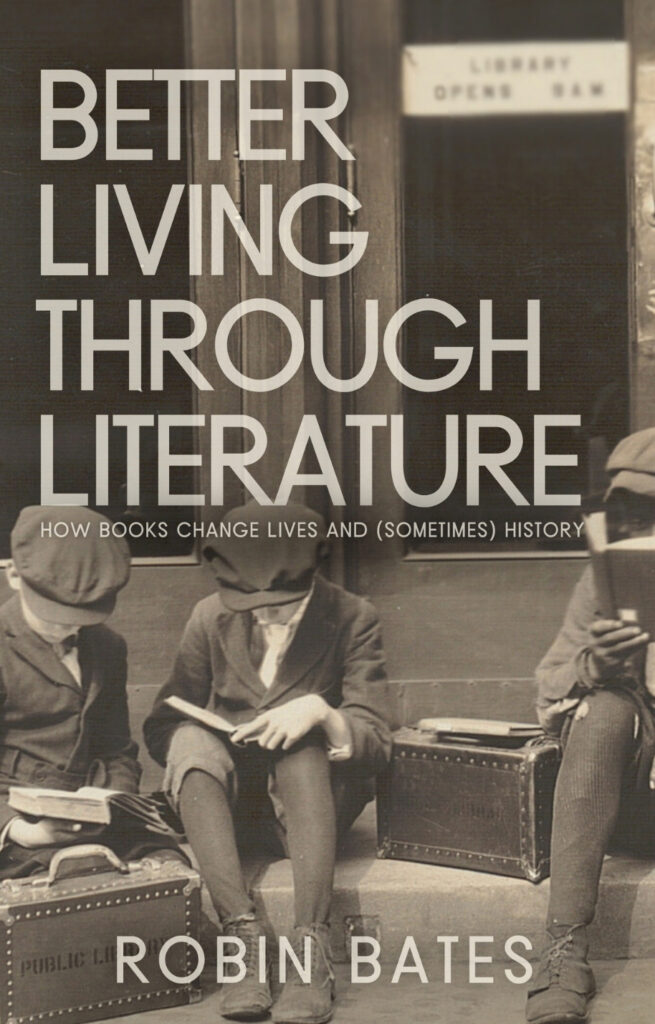
I think of how, in my book Better Living through Literature, I write about the power of the literary imagination to open minds. I explored how, in the 18th century, the Imagination became seen as a major force and was used to expand the franchise. By entering into the lives of formerly invisible people, figures like William Wordsworth and Percy Shelley encouraged their fellow citizens to

l step beyond their own narrow class boundaries in ways that would have been, well, unimaginable in earlier times. Through literature authors have entered the lives of the marginalized (Walt Whitman), the urban poor (Charles Dickens), American slaves (Harriet Beecher Stowe), Dorset dairy maids (Thomas Hardy), French coal miners (Émile Zola), Nebraska pioneers (Willa Cather), Harlem residents (Langston Hughes), African American sharecroppers (Jean Toomer), African American homosexuals (James Baldwin), bankrupted Oklahoma farmers (John Steinbeck), Laguna Pueblo war veterans (Leslie Marmon Silko), transplanted Pakistanis (Hanif Kureishi), West Indian immigrants (Zadie Smith), American lesbians (Alison Bechdel), and on and on.  

Many of the dramas Muñoz handles involve deportations. In “Anyone Can Do It,” a mother and child must figure out how to live after the husband/father has been deported. A neighbor reassures her,

Sometimes they don’t come back right away. But don’t worry. They’ll be back soon. All of them. If they take them together, they come back together. 

In “The Happiest Girl in the World,” the drama involves going to a border town to retrieve a husband who has been deported. We learn about a helpful bank teller servicing the narrator:

She knows the bus from Fresno stops once a week in our town now, Saturday midafternoon in front of the barbershop, as if the whole drama of deportation and return was a big plan between the migra and the charter companies. She hurries, and though she never says much of a pleasant word to any of us, I think it is because she doesn’t want us to miss the only bus going out of town, the only way to get our men back.

Often, the narrator tells us, the immigration authorities are alerted by the farmers themselves, always on a Thursday so that they don’t have to pay the week’s wages. Of the women taking the bus, the narrator reports,

Some of us have rings on our fingers and some of us don’t, but we all know what it means to watch the calendar turn to the last of the month. We know what some of the farmers do on final Fridays, and we know what to do on Saturday mornings. The farmers put their dusty hands on a phone receiver and very calmly place a call to the migra. Then the men in the green uniforms arrive at the rows of whatever crops are in season—grapes or peaches or plums—and round up the men into vans. No one ends up paid for the week’s labor, and everyone gets a standard booking in either Visalia or Fresno before being hustled back onto the vehicles. By nighttime, the vans reach Bakersfield and start the slow ascent into the mountains. They will head through Los Angeles—where all our men know it’s easy to get lost, but expensive to live—then on to San Diego, where it’s just expensive to live. Finally, they’ll reach the border itself and Tijuana, where the van doors open to let all of the men out so they can start over again.

The narrator is “the happiest girl in the world” because her man shows up.

In another story, we see enacted a scene with which we are becoming only too familiar:

That’s when it happened, the bad thing. They were all deep in the orchard, far away from the road, but still close enough to see the shape of one of those green migra vans, its bright gold star winking at them from the road. They saw two officers come out, bulky and towering over Eliseo, more slender than ever. They watched like rabbits in the field, statue-still, resisting the urge to run, the two officers putting Eliseo’s arms behind his back and leading him to the van.

The story “Fieldwork” has the most extensive account of the work that the men are doing. The narrator’s father is in rehab following a stroke and, to get him talking, the son reminds him how he used to wire money to his Mexico relatives, earned from picking oranges, grapes, and peaches:

Naranjas, right, Dad?

When he heard the Spanish, he nodded and continued recalling in his own language. Cotton and tomatoes, too. And almonds, my father added, and figs and nectarines, there was so much work. Apricots, plums, corn, pistachios, the lemon groves over on the eastern slope of the Valley into the Sierras. Walnuts and cauliflowers. Cherries and pears. He kept remembering things. Strawberries hiding in the dirt. Pecans. Persimmons. Avocado trees in the prettiest green rows you’ve ever seen. Olives and wheat. Hay bundled up for the horses and the cows. Apples, because the Americans liked their pies. 

The father also remembers fleeing with the other laborers, even though he had the necessary papers. It is an experience a number of people caught up in the ICE raids can relate to. The father here is responding to his son’s question about why he didn’t inform the authorities:

He laughed. You think anybody ever believed me? You think they believe you just because you say something? You think all you have to do is say you have papers? Here, my father said, thrusting his hands out as if in offering. Here, my papers.

For all the mentions of the “migra,” however, they are more of a backdrop than a focus. The richness of the stories lies in how the Mexicans and Mexican Americans interact with each other. Sometimes there are betrayals, sometimes there are unexpected acts of kindness, but always there are people being people. As a Christian Science Monitor review observes, each character “receives the gift of consideration: these are lives as deserving of attention and grace as any other.”

Providing us with such three-dimensional depictions is what good literature does, which is why we must keep turning to it if we are to hold on to our souls. Forces are at work seeking to strip us of our humanity, but authors like Muñoz give us the stories we need to resist.

Posted in Uncategorized | Tagged , , , | Comments closed

Questions about the Reading Experience

Marie Bashkirtseff, Young Woman Reading (1880)

 Note: If you wish to receive, via e-mail, (1) my weekly newsletter or (2) daily copies of these posts, write to me at rrbates1951@gmail.com. Comments may also be sent to this address. I promise not to share your e-mail with anyone. To unsubscribe, write here as well.

Wednesday

Yesterday I wrote about a series of questions about the reading experience that the Guardian asked author Barbara Kingsolver. The questions were so good that I started answering them myself and also invited readers to send in their own answers. Since then I have thought of additional questions, which are included at the end of today’s essay and which I will address in a later post. Again, please feel free to write in with your own answers since I love hearing other people’s reading stories.

Here are the responses, Kingsolver’s and my own, to the remaining questions asked by the Guardian:

The book I reread
Kingsolver mentions George Eliot’s Middlemarch, which many contend is England’s greatest novel. The author reports that she rereads it “at least once per decade, because it’s about everything, for every person, at every age.” 

It’s harder for me to come up with a book because there are so many of them. When I was an active teacher, I couldn’t teach a work without rereading it first, no matter how many times I had thumbed through its pages. I vaguely recall Julian Barnes’s narrator in Flaubert’s Parrot mentioning this as an occupational hazard of literature teachershow they wear works out for themselves through constant revisiting. 

While this can indeed be a problem, the compensation is discovering how multi-leveled the greatest works are. But to answer the question, I used to ritually reread Pride and Prejudice after turning in spring semester grades, using it to find peace following the frenzy of the school year. Other works that I particularly loved teaching, and so reread once or twice a year, were Jane Eyre, Sir Gawain and the Green Knight, Homer’s Odyssey, King Lear, and of course Beowulf.

The book I enjoyed as a teenager but could never read again
Kingsolver mentions J.D. Salinger’s Franny and Zooey, saying that, now that she knows that the author groomed young women, this has “poisoned the well.” 

It’s interesting that she mentions Salinger since I had the opposite experience with a work of his: I loathed Catcher in the Rye when I read it at 15 but was impressed when I read it again in my 40s. I came to realize that my aversion arose from how it captured my adolescent insecurities only too well. In other words, I couldn’t handle the truth. (Regarding Salinger’s taste for young women, I have only just now learned about it.)

For books that I enjoyed as a teen but can’t read again, I’d have to point to certain D. H. Lawrence novels, especially Lady Chatterley’s Lover and Women in Love. All that focus on male phallic energy I now find tiresome. I speak as one who was so in love with Lawrence in college that I included a poem about turtles mating (“Tortoise Shout”) in our wedding ceremony.

I once heard Sandra Gilbert say (the author of Madwoman in the Attic visited our college in the 1980s) that there are more unfinished female dissertations on D. H. Lawrence than on any other author. Energized initially by his acknowledgement of female sexuality, these female fans would become disenchanted as they explored the man further. My own growth away from him has been slower but I haven’t reread any of his novels in decades (with the exception of The Man Who Died).

All of which is to say that some authors are best encountered when we are young. Unlike, say, Shakespeare, who has something for every age group.  

The book I discovered later in life
For Kingsolver, it’s Willa Cather’s My Ántonia, which she says she resisted until late in life. Since both are regional authors (Cather for Nebraska, Kingsolver for southern Appalachia), the love affair makes sense. I too have fallen in love with Willa Cather’s novels in recent years, but the work I resisted reading—but now consider to be one of the great books of my life—is Tolstoy’s War and Peace.

The book I am currently reading
For Kingsolver, it’s Nikole Hannah-Jones’s The 1619 Project, which American conservatives (not just MAGA) have been demonizing ever since it appeared. I myself am currently listening to Antelope Woman by Louise Erdrich, whom Kingsolver mentions in her next answer.

My comfort read
Kingsolver responds, 

For long plane trips I grab a contemporary novel I can trust to be fabulous, because I’ve loved everything that author has written: Louise Erdrich, Margot Livesey, Maggie O’Farrell, Amor Towles, Russell Banks and Richard Powers, to name a few. The list is comfortingly long.

I recently wrote about how my go-to comfort read are novels by Haruki Murakami, especially 1Q84, which is a blend of magical realism, mystery suspense, and love story, with a very attractive hero and heroine. And I too have certain writers whose new novels I will read as soon as they come out, including Erdrich, Margaret Atwood, Kate Atkinson, and Kingsolver herself. Oh, and Philip Pullman, whose final volume in his Dust series I’ve been breathlessly awaiting for years.

Now to my own Guardian-style questions, which I’ll respond to in a future post. I limit my answers to poetry, drama, and prose fiction:

–Who is your favorite hero and heroine? (they can be from different works)
–Who is your favorite villain?
–What work has held you in the greatest suspense?
–What work has given you the greatest shock?
–What work has given you the greatest erotic thrill?
–What literary ending do you find the most satisfying?
–What literary ending do you find the least satisfying?
–If you could change an ending to a work, what would you do?
–What work do you most wish had a sequel? (fan fiction is driven by such works)
–What is a work that you believe has damaged you?
–What is a work you wish you had never encountered?
–If you could have any character as a partner, who would it be?
–If you could have any author as a partner, who would it be?
–What literary family would you most like to belong to?
–What is a work that had you laughing out loud?
–What’s your favorite open ending?
–Add your own question and answer.

Posted in Uncategorized | Tagged , , , , , , , , , , , , , , , , , | Comments closed

Kingsolver on Life-Changing Lit

Author Barbara Kingsolver

Note: If you wish to receive, via e-mail, (1) my weekly newsletter or (2) daily copies of these posts, write to me at rrbates1951@gmail.com. Comments may also be sent to this address. I promise not to share your e-mail with anyone. To unsubscribe, write here as well.

Tuesday

I’m revisiting an old Barbara Kingsolver interview because, in addition to providing insight into one of my favorite contemporary authors, it also has a series of questions that all literature lovers will benefit from answering. Along with Kingsolver’s responses, I’m providing some of my own. If any of you write back, I’ll share your answers as well. Here are the questions:

–Earliest reading memory
–Favorite book growing up
–The book that changed me as a teenager
–The writer who changed my mind
–The book that made me want to be a writer
–The book or author I came back to
–The book I reread 
–the book I enjoyed as a teenager but would never read again
 The book I discovered later in life
–The book I am currently reading
–My comfort read

My earliest reading memory

For Kingsolver, it was encountering the word “orange” when reading a newspaper over her father’s shoulder, at which point “my brain flooded with the thrills of colour and taste. I was hooked, forever.”

For myself, I remember being enchanted by the fact that, by simply changing the first letter of a word, you could change the word (as in “cat” to “hat”). I was four or five at the time and I can still remember where I was standing when, in my excitement, I explained this to a grown-up.

My favorite book growing up

For Kingsolver, it was Katharine Lee Bates’s fairytale collection Once Upon a Time, which scared her senseless. As she notes, 

This collection was no holds barred, with fully grotesque illustrations: two-headed giants, stolen babies. Toads and Diamonds, featuring a curse that made toads crawl out of a girl’s mouth instead of words. I credit this book with launching me into adult literature at the age of 12.

I’ve written numerous times about the book that saved my childhood was The Hobbit and Lord of the Rings, which I encountered in fourth or fifth grade. Tolkien’s vast “world building” fantasy taught me that the imagination has no limits.

The book that changed me as a teenager

Kingsolver says she was embarrassed to be cast as Juliet in 10th grade English and so clowned around. As a punishment, she had to “copy out sonnets until I was truly sorry,” which prompted her to fall for language, meter and Shakespeare. To this day she thanks her teacher.

I was really upset at having to attend a military high school (the only good school in the area), but having a teacher who had us read the entire Iliad aloud cushioned the blow. I had always loved Greek myths and, for the first time in my life, an English class was assigning reading I cared about.

The writer who changed my mind

For Kingsolver, this was Dorris Lessing, especially her Children of Violence novels. Kingsolver explains that she “suddenly had new eyes for racism, sexism, southern Africa and my own segregated town in Kentucky. Also, new eyes for what literary fiction can be and do in the world.” One sees in Kingsolver’s own novels a determination to make the world a better place.

In my book Better Living through Literature I express gratitude to the two novels that gave 11-year-old me a firm foundation as my parents joined black parents to fight for integration in segregated Tennessee: Huckleberry Finn and To Kill a Mockingbird. While I saw racism all around me, these books let me know that good people did not think this way.

The book that made me want to be a writer

Kingsolver names John Steinbeck’s Cannery Row, which she describes as a funny, beautiful novel about an odd little scramble of not-important people.” She thought, “I could try to write a book like that,” and she went on to produce her first novel, The Bean Trees.

When I was in high school, the fiction writer I imitated was Albert Camus, especially his allegorical short stories. They seemed at once mysterious and filled with deep import. I stopped writing fiction when I got to college, however.

The book or author I came back to

Kingsolver names Charles Dickens, which comes as no surprise since Demon Copperhead owes its structure and many of its characters to David Copperfield. About Dickens Kingsolver writes,

I liked him well enough as a younger reader but didn’t appreciate his genius. The craft is so solid, you don’t see the director backstage manipulating plot and point of view. Now, as a novelist, I’m back there with him asking after every scene, “How the heck did you pull that off?”

I find myself choosing Dickens as well. I too found him pleasant enough but now am dazzled by his depth. Another work, which as a teenager I read in a French abridged version, is Victor Hugo’s Les Misérables. As with Dickens, I enjoyed it at the time but now, upon rereading, I now rank it up there with War and Peace in its sweeping portrayal of the human condition.

I’ll return to the rest of the questions in tomorrow’s post.

Posted in Uncategorized | Tagged , , , , , , , , , , , , , , , , , , , | Comments closed

Trump as Mrs. Elton and Ozymandias

Note: If you wish to receive, via e-mail, (1) my weekly newsletter or (2) daily copies of these posts, write to me at rrbates1951@gmail.com. Comments may also be sent to this address. I promise not to share your e-mail with anyone. To unsubscribe, write here as well.

Monday

Compared to how Donald Trump and his administration are dismantling American democracy, his turning the White House into a tacky version of Versailles, gilding with gold its classical white marble, seems a minor matter. Still, it reveals his dream of being a monarch, which is at the heart of his rot. When I see photographs of his restoration job, I can’t help but think of Mrs. Elton in Jane Austen’s Emma.

Mrs. Elton is the foil of Austen’s protagonista daughter of new money who marries the suitor that Emma has rejected. Determined to replace Emma as the head of Highbury society, she talks incessantly about the barouche-landau owned by her wealthy brother and sister, and she is determined to show this backwater hamlet how things ought to be run. Her criticisms in the following passage are delivered aloud so that everyone can hear them:

She was a little shocked at the want of two drawing rooms, at the poor attempt at rout-cakes, and there being no ice in the Highbury card-parties. Mrs. Bates, Mrs. Perry, Mrs. Goddard and others, were a good deal behind-hand in knowledge of the world, but she would soon show them how everything ought to be arranged. In the course of the spring she must return their civilities by one very superior party—in which her card-tables should be set out with their separate candles and unbroken packs in the true style—and more waiters engaged for the evening than their own establishment could furnish, to carry round the refreshments at exactly the proper hour, and in the proper order.

One can imagine Mrs. Elton looking at the White House and concluding, like Trump, that it needs an attached ballroom.

In many ways her relationship to Emma is like Trump’s relationship to Barack Obama, who has a natural class that Trump hungers for and thinks he can achieve by amassing money and power. Oh, and by tarting up the president’s residence. 

Emma, who represents old money, also has natural class. The drama of the novel, however, is whether Emma can live up to potential or whether she will descend to Mrs. Elton’s level. There are times when she is in danger of doing just that, whether by snobbishly rejecting Roger Martin as an appropriate partner for her protégé Harriet or by making a cheap joke at impoverished Miss Bates’s expense. In each case, neighboring squire John Knightley has to coach her into behavior expected of society’s leaders.

In the end, through honest self-reflection, Emma rises to the occasion, and the reward is marriage to Knightley. They have a classy and dignified wedding, and it is Mrs. Elton’s reaction to the ceremony that came to mind when I saw contrasting pictures of the White House Oval Office under Joe Biden and under Donald Trump (see picture above). Austen’s novel concludes with the following subtle and pitch perfect putdown: 

The wedding was very much like other weddings, where the parties have no taste for finery or parade; and Mrs. Elton, from the particulars detailed by her husband, thought it all extremely shabby, and very inferior to her own.—“Very little white satin, very few lace veils; a most pitiful business!—Selina [her sister] would stare when she heard of it.”

To which Austen adds,

But, in spite of these deficiencies, the wishes, the hopes, the confidence, the predictions of the small band of true friends who witnessed the ceremony, were fully answered in the perfect happiness of the union.

Chef’s kiss for “in spite of these deficiencies.”

Speaking of Trump’s Obama envy, he also can’t stand that his predecessor won the Nobel Peace Prize, so much so that he even threatened the Norwegian finance minister with tariffs if Norway doesn’t give him one. This made blogger Greg Olear at Prevail think of “Ozymandias,” the well-known Percy Shelley sonnet about Egyptian pharaoh Ramesses II. 

After noting that Trump has also taken over the Kennedy Center so that he can host the awards ceremony and name the recipients, Olear observes, “He wants the thing to be named after him, probably”:

This is a guy who basically spent his entire career putting his name on everything. He literally made money by licensing other people to put his name on things. So he’s big into this vainglory, right? This kind of “Me, me, me! I want to be the best. I want to be acknowledged as the greatest, as the genius, as the peacemaker, as the best supporting actor,” whatever. That’s what he wants.

Now for the poem:

I met a traveler from an antique land
Who said: “Two vast and trunkless legs of stone
Stand in the desert . . . Near them, on the sand,
Half sunk, a shattered visage lies, whose frown,
And wrinkled lip, and sneer of cold command,
Tell that its sculptor well those passions read
Which yet survive, stamped on these lifeless things,
The hand that mocked them, and the heart that fed:
And on the pedestal these words appear:
‘My name is Ozymandias, king of kings:
Look on my works, ye Mighty, and despair!’
Nothing beside remains. Round the decay
Of that colossal wreck, boundless and bare
The lone and level sands stretch far away.”

To be sure, Trump is no Ramesses II. “Lone and level sands” pretty much captures the barrenness of his interior landscape, however. And he shares Ozymandias’s ego.

Posted in Uncategorized | Tagged , , , , | Comments closed

  • Sign up for my weekly newsletter