Minneapolis and Measure for Measure

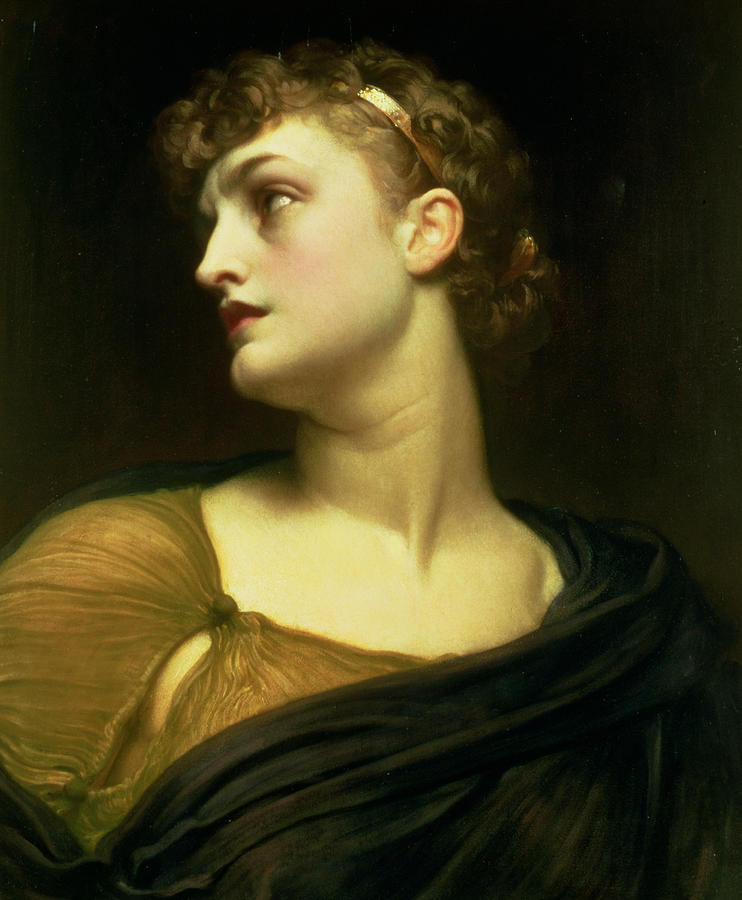
William Hamilton, Isabella Appealing to Angelo

Thursday

Isabella in Shakespeare’s Measure for Measure has a passage that the United States needs right now:

                                           O, it is excellent 
To have a giant’s strength, but it is tyrannous 
To use it like a giant.

Isabella is begging the cold-hearted Angelo to pardon her brother, whom he has sentenced to death on a technicality, but we can imagine her saying something similar to Donald Trump. After all, our president has been using the awesome power of the U.S. military and of the federal government like a giant. We need Vincentio, Duke of Vienna, to come to our rescue. 

Vincentio has put his deputy Angelo in charge of the city while he supposedly journeys to Poland on a diplomatic mission. In actuality, he disguises himself as a friar to monitor how well Angelo will perform his duties. He sees his designated leader promptly enact draconian measures, including ordering the execution of young Claudio for impregnating Juliet, even though they are well on their way to getting married. Angelo also orders all of the brothels in town to be torn down, which as one character wryly observes will work only if he also gelds and spays all the youth of the city. 

Angelo’s crackdown is a lot like Trump using his narrow victory over Kamala Harris as license to enact authoritarian measures. Indeed, his complicated rationale for executing Claudio bears some resemblance to the intricate reasons ICE has been citing for deporting people who have been living in the U.S. peacefully for years, with some of them having special protected status. Meanwhile, we have been witnessing our own version of Angelo’s brutality. 

There’s another parallel. Righteous Angelo starts lusting after Isabella after she begs for the life of her brother and offers her a deal: her body for a pardon. 

Now, I could comment on Trump’s own corrupt pardons or on the deal he has made with the evangelical right (power if they give up their Christian principles). For today’s essay, however, I have something Minnesota-related in mind. Although ICE’s “Metro Surge” is supposedly about capturing and deporting dangerous immigrants, it appears that the critical factor is Minnesota voting against Trump in three successive elections. This became clear when Attorney General Pam Bondi, acting as Trump’s personal lawyer, offered Minnesota Governor Tim Walz a proposition: hand over the state’s voting records and we’ll withdraw ICE. 

Jay Quo at the Substack blog Status Quo outlines what’s so frightening about this offer. Through voter records, which are kept private and maintained by top election officials in each state, it is possible to tell “who voted, what party they belong to, what race they are, what gender they are, how old they are, where they live, and who the strongest base supporters are based on voting history.” With such data, Kuo notes, “the Trump regime could cause real mayhem in the midterm elections, undermine confidence in the results and even use it to stay in power.” For instance, such voter information can be used in voter suppression efforts.

Shakespeare’s version of the deal Bondi has offered Walz is Angelo’s quid pro quo to Isabella. He puts it as a hypothetical, asking her how she would behave if a “supposed” someone offered her clemency for her brother in exchange for her body. This someone, of course, is himself:

Finding yourself desired of such a person,
Whose credit with the judge, or own great place,
Could fetch your brother from the manacles
Of the all-building law; and that there were
No earthly mean to save him, but that either
You must lay down the treasures of your body
To this supposed, or else to let him suffer;
What would you do?

Isabella responds as Governor Walz responded Bondi’s offer. Her sacred honor, just like the sacred cause of democracy, is more important than relief:

ISABELLA [W]ere I under the terms of death,
The impression of keen whips I’ld wear as rubies,
And strip myself to death, as to a bed
That longing have been sick for, ere I’ld yield
My body up to shame.
ANGELO Then must your brother die.
ISABELLA And ’twere the cheaper way:
Better it were a brother died at once,
Than that a sister, by redeeming him,
Should die for ever.

When she threatens to expose Angelo for his corrupt offer, he informs her that no one will believe her, given his reputation for purity and austerity. Then he moves in for the kill, giving his “sensual race the rein.” Either “fit thy consent to my sharp appetite,” he tells her, or Claudio gets torture (“lingering sufferance”) in addition to execution:

Who will believe thee, Isabel?
My unsoil’d name, the austereness of my life,
My vouch against you, and my place i’ the state,
Will so your accusation overweigh,
That you shall stifle in your own report
And smell of calumny. I have begun,
And now I give my sensual race the rein:
Fit thy consent to my sharp appetite;
Lay by all nicety and prolixious blushes,
That banish what they sue for; redeem thy brother
By yielding up thy body to my will;
Or else he must not only die the death,
But thy unkindness shall his death draw out
To lingering sufferance. Answer me to-morrow,
Or, by the affection that now guides me most,
I’ll prove a tyrant to him. As for you,
Say what you can, my false o’erweighs your true.

The prospect of Trump’s false o’erweighing our true is what is currently keeping us awake at night. And unfortunately, we don’t have a Vincentio secretly watching over us and intervening to save the day. Thanks to the duke’s machinations, Claudio and Juliet are saved, Angelo is exposed, and Vincentio himself marries Isabella.

Then again, the citizens of Minneapolis have shown us that there might be a Vincentio to save us after all, that being “we the people.” Their heroism and resolve have caused Trumpism to hesitate and even withdraw somewhat. Although we don’t know the final outcome, either in Minnesota or in the country as a whole, mass protests and a fervid allegiance to democracy look like they are packing a punch.

The giant may not get the last word.

Posted in Uncategorized | Tagged , , , , | Comments closed

J.D. Vance as Andrew Aguecheek

Sir Andrew Aguecheek from Twelfth Night

Wednesday

When my faculty book group discussed Shakespeare’s Twelfth Night last week, I gained a new insight into Vice-President J.D. Vance: he’s a Sir Andrew Aguecheek.

Vance has pretty much failed every character test with which he’s been presented, but he surpassed even himself earlier this month when he said, after ICE agent Jonathan Ross shot Renee Nicole Good through her car window, that the man “is protected by absolute immunity” and that “he was doing his job.” While this permission structure may not have directly led to the subsequent murder of Alex Pretti, it didn’t help. 

Vance has since walked back the “absolute” although he did so in his characteristic mealy-mouthed fashion: 

I didn’t say and I don’t think anyone in the Trump administration said that officers who engaged in wrongdoing would enjoy immunity. That’s absurd. What I did say is that when federal law enforcement officers violate the law that’s typically something federal officials would look into. We don’t want these guys to have kangaroo courts.

Speaking of kangaroo courts, Trump’s Department of Justice then figured that it should investigate Good and her partner, not Ross. Oh, and Governor Tim Walz and Minneapolis Mayor Jacob Frey as well (for inciting).

It’s a consensus view that Vance, who once suggested that Trump could be “America’s Hitler,” reeks of inauthenticity. It’s as though he says mean things because he believes this will earn him favors with Trump and the MAGA faithful. Instead of coming off as an obnoxious bully-in-charge, however, he appears merely weak and pathetic.

Which is how Sir Andrew appears in Twelfth Night.

Andrew is in Lady Olivia’s household because Sir Toby, her uncle, has persuaded him that he has a shot at marrying her. In actuality, he has no chance at all, which Toby knows full well. As the Twelfth Night Lord of Misrule, however, Toby likes to create mayhem however he can. He also wants to drain Sir Andrew of every last cent. “If I cannot recover your niece, I am a foul way out,” Andrew moans after Toby instructs him to send for more money.

Toby, like Trump with his cabinet, can get Andrew to caper around the room like an idiot. Andrew may think he’s impressing the older man with his dance steps, but he is just being mocked. “Let me see the caper,” Toby says, goading him on. “Ha! higher: ha, ha! excellent!

Like Vance, Andrew is the kid who is desperate to be one of the populars. While he thinks he can impress the gang by talking tough, however, he overshoots the mark, as in the following interchange:

MARIA Marry, sir, sometimes he [Malvolio] is a kind of puritan.
SIR ANDREW O, if I thought that I’ld beat him like a dog!
SIR TOBY BELCH What, for being a puritan? thy exquisite reason, dear knight?
SIR ANDREW I have no exquisite reason for’t, but I have reason good enough.

“Absolute immunity,” Vance said, sounding tough. And then failed to provide exquisite reason.

At times Andrew, like Vance, just echoes whatever the older man is saying. Note the scene where Toby is complimenting Maria for arranging the Malvolio prank:

SIR TOBY BELCH I could marry this wench for this device.
SIR ANDREW So could I too.
SIR TOBY BELCH And ask no other dowry with her but such another jest.
SIR ANDREW Nor I neither.
FABIAN Here comes my noble gull-catcher.
Re-enter MARIA
SIR TOBY BELCH Wilt thou set thy foot o’ my neck?
SIR ANDREW Or o’ mine either?
SIR TOBY BELCH Shall I play my freedom at traytrip, and become thy bond-slave?
SIR ANDREW I’ faith, or I either?
. . .
SIR TOBY BELCH To the gates of Tartar, thou most excellent devil of wit!
SIR ANDREW I’ll make one too.

Hanging with the cool kids, however, doesn’t protect you from their cruelty, as Andrew will discover when he himself becomes the butt of one of Toby’s pranks. Judging Viola/Cesario to be a coward and knowing Andrew to be one as well, Toby arranges a duel between the two of them. Assuring Andrew that “Cesario” is sure to back down, Toby goads him into writing a challenge, which is as waffling as a Vance declaration:

Youth, whatsoever thou art, thou art but a scurvy fellow. Wonder not, nor admire not in thy mind, why I do call thee so, for I will show thee no reason for’t. Thou comest to the lady Olivia, and in my sight she uses thee kindly: but thou liest in thy throat; that is not the matter I challenge thee for. I will waylay thee going home; where if it be thy chance to kill me,’–Thou killest me like a rogue and a villain.’ Fare thee well; and God have mercy upon one of our souls! He may have mercy upon mine; but my hope is better, and so look to thyself. Thy friend, as thou usest him, and thy sworn enemy, ANDREW AGUECHEEK.

While appearing to endorse the letter, Toby has as much contempt for his companion as Trump has for Vance. Knowing that the note will expose Sir Andrew as a “clodpole,” he chooses to deliver the challenge verbally:

Now will not I deliver his letter: for the behavior of the young gentleman gives him out to be of good capacity and breeding; his employment between his lord and my niece confirms no less: therefore this letter, being so excellently ignorant, will breed no terror in the youth: he will find it comes from a clodpole. But, sir, I will deliver his challenge by word of mouth…

Unlike Trump, Toby ultimately faces consequences for his behavior, although he takes down Andrew with him. (“Everything Trump touches dies,” says Lincoln Project’s Rick Wilson about those who associate themselves with the man.) Mistaking Viola’s twin brother for Viola/Cesario, Toby and Andrew try to fight with him and end up with broken heads. As Andrew reports, “we took him for a coward, but he’s the very devil incardinate.” In fact, Andrew appears to have the same sense of justice that Vance has:

I’ll have an action of battery against him, if there be any law in Illyria: though I struck him first, yet it’s no matter for that.

So again, the Justice Department believes that the struck, not the strikers, must be prosecuted. That decision has led roughly half a dozen federal prosecutors in Minnesota and several supervisors in the criminal section of the Civil Rights Division in Washington to resign, according to the Associated Press.

Andrew finally discovers what Toby really thinks of him at the end of the play when he offers him comforting companionship:

SIR ANDREW I’ll help you, Sir Toby, because we’ll be dressed together.
SIR TOBY BELCH Will you help? an ass-head and a coxcomb and a knave, a thin-faced knave, a gull!

Mike Pence, who sold his soul to be Trump’s first vice-president, thought that his loyalty would earn him his boss’s gratitude, only to see Trump sic an angry mob on him. Why does Vance think things will turn out better for him? His best hope is for Trump to die in office. (His odds of this happening are actually better than Andrew marrying Olivia.)

About Andrew’s name (Aguecheek or, as Toby calls him at one point, Agueface): face ague is a now obsolete phrase for a neuralgic disorder involving facial swelling or facial pain. Vance, for his part, is so embarrassed by his cherubic face that he has covered it up with a beard.

Oh, and while I’m stretching things, Andrew at one point—in his moment of greatest vulnerability and humanity—sadly recalls, “I was adored once.” In Vance’s case, his hillbilly grandmother (“mamaw”) adored him once as well.

Vance built a career by writing about their relationship. And now here he is, passing that adoration along to “America’s Hitler.”

Posted in Uncategorized | Tagged , , , | Comments closed

Seeing the World as Your Plaything

Tuesday

For the second day in a row, I offer up an 18th century poem that has Trump’s number. I thought of William Cowper’s line “great princes have great playthings” after reading an Atlantic article by Jonathan Rauch where he talks about Trump’s “effort to make the government his personal plaything.”

Rauch is responding to an observation, by former National Security Advisor John Bolton, that the president

listens to Putin, he listens to Xi, he listens to how they talk about governing unburdened by uncooperative legislatures, unconcerned with what the judiciary may do, and he thinks to himself, Why can’t I do that? This doesn’t amount to being a fascist, in my view, [or] having a theory of how you want to govern. It’s just Why can’t I have the same fun they have?

Rauch cites Bolton only to disagree with him, however. Whereas he too once worried about applying “fascist” to Trump—after all, leftwing activists have often proved too facile in their use of the word—not to use apply it when it is clearly appropriate is perverse. Here’s his account of what has changed:

Over Trump’s past year, what originally looked like an effort to make the government his personal plaything has drifted distinctly toward doctrinal and operational fascism. Trump’s appetite for lebensraum, his claim of unlimited power, his support for the global far right, his politicization of the justice system, his deployment of performative brutality, his ostentatious violation of rights, his creation of a national paramilitary police—all of those developments bespeak something more purposeful and sinister than run-of-the-mill greed or gangsterism.

Cowper’s own concern about self-indulgent monarchs appears in The Task, a long and brilliant poem taking up six books. As one reads the passage in 2026, one can’t help but think of Trump. For instance, DJT’s White House ballroom and his slapping his name on the Kennedy Center come to mind when Cowper mentions kings’ attempts “t’immortalize their bones”:

Great princes have great playthings. Some have play’d
At hewing mountains into men, and some
At building human wonders mountain-high.
Some have amus’d the dull, sad years of life
 (Life spent in indolence, and therefore sad)
With schemes of monumental fame; and sought
By pyramids and mausoleum pomp,
Short-lived themselves, t’ immortalize their bones.

More concerning, however, is when the plaything is one’s armed forces, which Cowper turns to next. One thinks here how Trump has enjoyed ordering bombing raids in Yemen, Iran, and Nigeria and how he saw the kidnapping of Venezuelan head Nicolás Marduro as a made-for-tv spectacle. He relished how possessing the world’s most powerful military allowed him to swagger before the heads of Europe about seizing Greenland, and sending ICE agents to terrorize Democratic cities has its own particular satisfaction. Cowper’s reference to “puny hands” reminds us of Trump’s insecurity about his own small hands:

Some seek diversion in the tented field,
And make the sorrows of mankind their sport.
But war’s a game, which, were their subjects wise,
Kings would not play at. Nations would do well
T’ extort their truncheons from the puny hands
Of heroes, whose infirm and baby minds
Are gratified with mischief; and who spoil,
Because men suffer it, their toy the world.

An infirm and baby mind that is gratified with mischief? One who spoils for confrontation just because he can get away with it? Whether or not one calls it fascist, it fits.

Yes, nations would do well “t’extort their truncheons.” Congress, it’s within your power.

Posted in Uncategorized | Tagged , , | Comments closed

A Historical Poem to Mourn Good, Pretti

Alex Pretti, Nicole Renee Good

Monday

Here’s a poem honoring 18th century activist William Orr that can help us mourn the deaths of Nicole Renee Good and Alex Pretti, both murdered by ICE. Orr was an Irish nationalist who, in 1797, was falsely accused of treason  and hanged. The false testimony marshaled against him was on the order of Department of Homeland Security claiming that Good and Pretti were “domestic terrorists.”

The British authorities wished to make an example of Orr to act as a deterrent to potential recruits for the Society of United Irishmen. The group involved Protestants and Catholics together striving together for representative government in Ireland. Although everyone, from the judge on down, knew that Orr was innocent, the execution still went ahead. It’s as though they refused to acknowledge what they could see on the videos.

The more we learn about Pretti and Good, the more fitting William Drennan’s poem appears. For instance:

Write his merits on your mind,
Morals pure, and manners kind;
On his head, as on a hill,
Virtue placed her citadel.

And:

Why cut off in palmy youth?
Truth he spoke, and acted truth;
“Countrymen, Unite!” he cried,
And died, for what his Saviour died!

Drennan’s poem speaks to our own political turmoil:

Hapless nation, hapless land,
Heap of uncementing sand!
Crumbled by a foreign weight,
Or by worse, domestic hate!

God of mercy, God of peace,
Make the mad confusion cease!
O’er the mental chaos move,
Through it speak the light of love!

Like Minneapolis protesters, the murder of Orr strengthened the resolve of Irish activists rather than—as was intended—silencing them.  “Watch with us, through dead of night–/But expect the morning light,” the poet writes before concluding, 

Conquer Fortune – persevere –
Lo! it breaks – the morning clear!
The cheerful cock awakes the skies;
The day is come – Arise, arise!

Here’s the poem, which so electrified people that it led to the rallying cry, “Remember Orr” in the 1798 rebellion. Drennan is also famous for having coined the phrase “Emerald Isle” to describe Ireland.

Wake of William Orr
By William Drennan

Here our brother worthy lies,
Wake not him with women’s cries;
Mourn the way that mankind ought;
Sit, in silent trance of thought.

Write his merits on your mind,
Morals pure, and manners kind;
On his head, as on a hill,
Virtue placed her citadel.

Why cut off in palmy youth?
Truth he spoke, and acted truth;
“Countrymen, Unite!” he cried,
And died, for what his Saviour died!

God of Peace, and God of Love,
Let it not thy vengeance move!
Let it not thy lightnings draw,
A nation guillotined by law!

Hapless nation! rent and torn,
Early wert thou taught to mourn!
Warfare of six hundred years!
Epochs marked by blood and tears!

Hunted through thy native grounds,
And flung reward to human hounds,
Each one pull’d, and tore his share,
Emblem of thy deep despair!

Hapless nation, hapless land,
Heap of uncementing sand!
Crumbled by a foreign weight,
Or by worse, domestic hate!

God of mercy, God of peace,
Make the mad confusion cease!
O’er the mental chaos move,
Through it speak the light of love!

Monstrous and unhappy sight!
Brothers’ blood will not unite.
Holy oil, and holy water,
Mix – and fill the Earth with slaughter.

Who is she, with aspect wild? –
The widow’d mother, with her child;
Child, new stirring in the womb,
Husband, waiting for the tomb.

Angel of this holy place!
Calm her soul, and whisper, Peace!
Cord, nor axe, nor guillotine,
Make the sentence, not the sin.

Here we watch our brother’s sleep;
Watch with us, but do not weep;
Watch with us, through dead of night –
But expect the morning light.

Conquer Fortune – persevere –
Lo! it breaks – the morning clear!
The cheerful cock awakes the skies;
The day is come – Arise, arise!

Posted in Uncategorized | Tagged , , , , | Comments closed

I Will Make You Fish for People

Sunday

Today’s Gospel reading includes the moment where Peter and Andrew leave their nets to follow Jesus. In Herman Sutter’s wonderful poem “Peter Returns to His Nets,” the poet imagines what it must have been like, after the crucifixion and resurrection, to return to their old employ. Here’s the initial invitation: 

As he walked by the Sea of Galilee, he saw two brothers, Simon, who is called Peter, and Andrew his brother, casting a net into the sea—for they were fishermen. And he said to them, “Follow me, and I will make you fish for people.” Immediately they left their nets and followed him. As he went from there, he saw two other brothers, James son of Zebedee and his brother John, in the boat with their father Zebedee, mending their nets, and he called them. Immediately they left the boat and their father, and followed him.

If Peter returns to his nets, it may be because, after all that has happened, he is seeking something he can be sure of. Sutter plays with the contrast between solid and safe: it seems safer to have water behaving as water normally does than to recall when Jesus walked upon the waves and invited Peter to do the same. 

In this final Sea of Galilee scene, resurrected Jesus appears on the beach following the disciples’ fruitless night of fishing and tells them to “throw your net on the right side of the boat and you will find some.” Following a large haul and breakfast, Jesus instructs Peter to “feed my sheep.” As a higher destiny calls him, Peter will no longer be free “to sink beneath the waves.”

Peter Returns to His Nets
By Herman Sutter

Before the sea was solid
              it was safe for me

to sink beneath the waves
              and rise upon each crest.

My only destiny:
              nets and hooks and fingers from

fashioning a day 
              out of sweat and sun,

scales and blood, and the salt breath 
              of an evening breeze

thick as my lungs.
                           But I was free

                                       always`

                            to find my way and sink 
              beneath the same 
waves 

I now have walked 
              upon.

We might say, with T. S. Eliot’s magi, that Peter discovers he is no longer at ease in the old dispensation, familiar and comfortable though it is.

Posted in Uncategorized | Tagged , , | Comments closed

Teaching and Reading in Yugoslavia

France Prešeren, Slovenia’s national poet

Friday

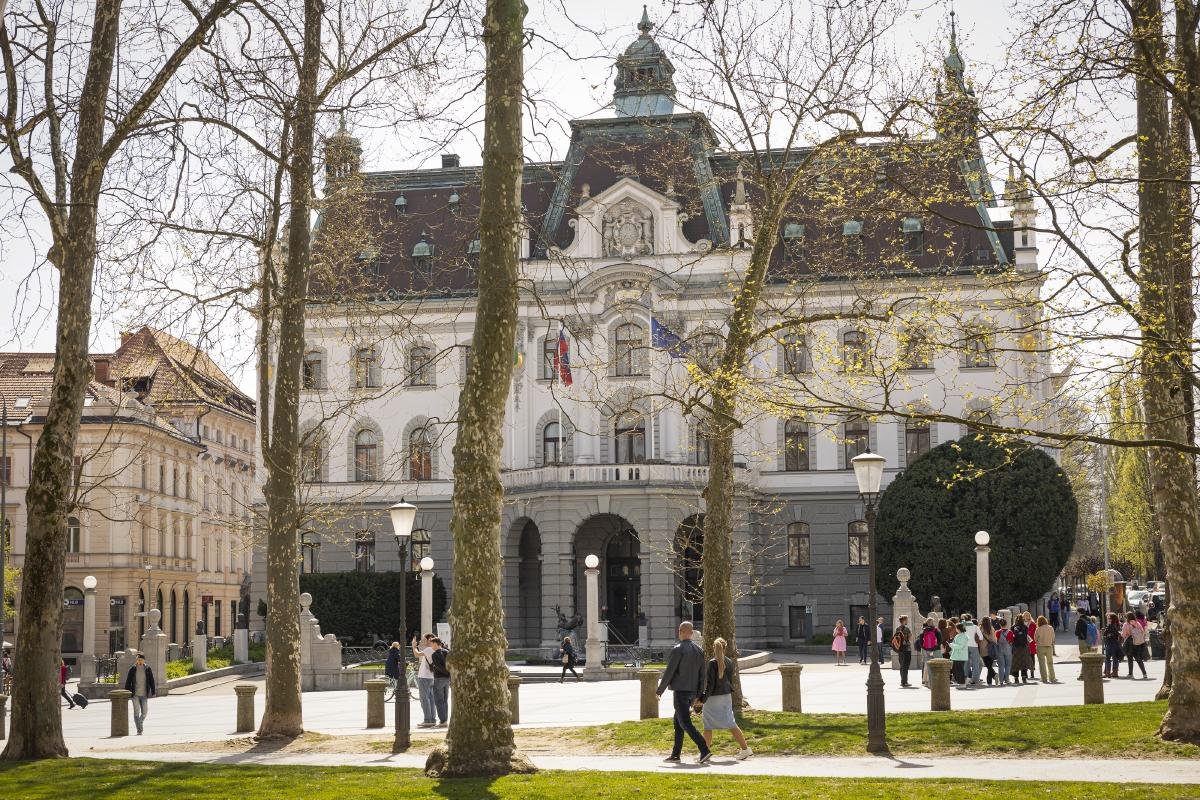
In my weekly memoir installment last Friday, I mentioned that I received a Fulbright Teaching Fellowship in 1987-88 to teach at the University of Ljubljana in Slovenia, Yugoslavia. How this came about requires an elaborate explanation.

When I was in graduate school, Julia and I attended films on almost a weekly basis. I found films to be as moving and as powerful as literature and, because Atlanta was a good film city in those years, we were able to immerse ourselves in films from all over the world. I also took a film class from Emory’s David Cook, and the essay that I wrote—“The Ideological Foundations of the Czech New Wave”—would prove to be my first publication.

What fascinated me was the role that cinema played in the intoxicating but short-lived Prague Spring of 1968. Always looking for instances of art contributing to social justice, I found here a narrative art form influencing the course of history, with Czech directors tapping into socialist ideals to imagine an alternative to both Soviet communism and western capitalism. While their history then took a dark turn, I started paying attention to other Eastern European cinemas that seemed to have similar potential, focusing particularly on the fine films coming out of Hungary.

At St. Mary’s, meanwhile, I started teaching the college’s first film classes, as my father had at the University of the South, and I also attended a National Endowment for the Humanities summer seminar on “Phenomenological, Semiotic, and Post-Structuralist Approaches to Film.” My article “Holes in the Sausage of History: May ’68 as Absent Center in Three European Films,” which dealt with the impact of the student-worker uprising on directors Jean-Luc Godard, Bertrand Tavernier, and Alain Tanner, appeared in Cinema Journal.

Determined to see up close whether films could influence a country’s history, I applied for a Fulbright to Hungary, only to learn that there were no openings there. Instead, the Fulbright office offered me a choice between Bratislava, Czechoslovakia (now Slovakia) and Ljubljana, Yugoslavia (now Slovenia). Since Yugoslavia was producing better films at the time, I took that option, not realizing that the good films were coming out of Serbia and Croatia, not Slovenia. (I didn’t even know about Slovenia.) My family packed up our bags in June to study Slovenian at UCLA before heading for Ljubljana.

I didn’t do much with Slovenian film—it’s since gotten better—but we fell in love with the country. The boys were 8, 5, and 3, and we took regular hikes, saw every film that was kid friendly (most were American), regularly attended the puppet theatre, traveled around the country, and made occasional excursions to Austria and Italy (including Mardi Gras in Venice). We also had with us an African American student who, in exchange for room and board, had helped with childcare for four years. William Boyd, who would follow his father as pastor of New Elizabeth Baptist Church in Baltimore, was a fabulous gospel baritone and he became a bit of a star, singing in the major concert halls in Zagreb and Sarajevo as well as appearing on Slovenian television.

Since I’m filtering my memoir through the books I’ve read and taught, I’ll turn my attention to those. What first struck me about the country was its reverence for poets, some of whom have prominent statues erected in their honor and streets bearing their names. One explanation is that, at a time when Slovenia was part of the Austro-Hungarian Empire, authors like France Prešeren and Ivan Cankar demonstrated that Slovenian was not just a local dialect but a language capable of producing major works of literature—which in turn meant that Slovenia deserved to be its own nation. (The Ukrainians revere Taras Shevchenko for the same reason.)

At the University of Ljubljana I shared an office with an old Melville scholar, Janez Stanovnek; spent many wonderful hours with the department’s Australian literature expert Igor Maver, then a young professor like myself; and would regularly join the department for two-hour lunches at a local tavern. The pace of life was so relaxed that I had plenty of time to teach my courses, do my research, read books on my own, and spend time with my family. I taught Theory of the Novel, African American Literature (in Serbia-dominated Yugoslavia, the Slovenians were sensitive to what it meant to be a minority), and Introduction to Literature.

The theory course led to my most significant friendship, albeit in a roundabout way. The local cultural center was running a program of Warner Brother cartoons, for which we had purchased tickets. Toby, however, was sick so I went to the box office to return one. Mladen Dolar, a philosopher and one of the so-called Ljubljana Lacanians (along with the internationally famous Slavoj Žizek), was there with two-year-old Kaja, and having been alerted to my turning in one ticket, he approached me to ask if I had another one. I, who was more interested in preparing for my Theory of the Novel class than in seeing the show, offered him mine if he would accompany my kids.

He noticed that I was reading Fredric Jameson’s The Political Unconscious, which he knew well. (Later, when Mladen was invited to teach at Duke, he would become a good friend of Jameson.) After the showing, a friendship developed with Mladen and his then wife Eva Bahovec, also a philosopher. The four of us were all the same age, and every time we return to Slovenia we reconnect. I spend hours talking with Mladen about literature—he is one of the best-read and most thoughtful scholars I have ever known—and visit Eva’s classes. (In our last visit Eve invited me to participate in discussions about Foucault, A Streetcar Named Desire, Freud and Jung, and the film Lost in Translation.)

Perhaps the most important thing I carried away from this Fulbright, in addition to lifelong friendships, was a reassessment of America. Having grown up in the midst of segregation and then witnessed the Vietnam War, I felt sour about our country. It was one reason I had looked toward eastern Europe, wondering whether Yugoslavia’s “market socialism” offered a viable alternative. What I discovered was that no country is perfect and that every country has its strengths and weaknesses. I developed a more balanced view of the United States, renewing the love I had had for it as a child even as I acknowledged its blemishes. Sometimes one has to leave to appreciate what one has.

My interactions with my colleagues helped me in this endeavor. At one time my office mate, genuinely perplexed, said to me, “I just don’t understand how America works.” It was a good puzzle and I put a lot of thought into it. I told him I thought the American Dream is the unifying factor, even though often Americans dream different and sometimes conflicting dreams. (This is the main point of The Wished For Country, a historical novel about southern Maryland written by my former neighbor Wayne Karlin.) This dream, I noted, is bolstered by various foundational documents, including “The Declaration of Independence,” The Constitution, “The Gettysburg Address,” “The Pledge of Allegiance,” and King’s “I Have a Dream” speech. Whether we can still hold together is, I suppose, an open question at this point.

Faced with such questions, I became interested in American literature for the first time in my life. I was fascinated how the Slovenians focused on certain authors often overlooked by the American academy—most notably Henry Wadsworth Longfellow and Jack London—and came to understand why a heavily forested and socialist country would take an interest in those two. 

Last week I noted that a major goal for my first sabbatical was finding new ways to make literature feel urgent to my students. I hadn’t yet had the epiphany I was to experience ten years later—more on that in a future post—but my vision of the different uses to which people put literature was expanding. 

Posted in Uncategorized | Tagged , , | Comments closed

Peter Thiel, Palantir, and Sauron

Peter Thiel

Thursday

In his list of “26 Villains of 2026” (“ranked by how much harm they’ve done and/or are poised to do to the people of this country and the world”), blogger Greg Olear mentioned a Tolkien allusion from this past year that I missed. Apparently former employees of Palantir believe that their company, which “develops data integration and analytics platforms enabling government agencies, militaries, and corporations to combine and analyze data from multiple sources” (Wikipedia), has taken on the negative aspects of Tolkien’s crystal ball, after which the company is namedThey headlined their open letter of May 5, 2025, “The Scouring of the Shire: a letter from concerned Palantir alumni to the tech workers of Silicon Valley.”

In case you need reminding, the palantír has been devised by men of old to allow people to (in Gandalf’s words) “see far off, and to converse in thought with one another.” The letter cites one reference to the sphere that appears in Tolkien’s unpublished writings: 

The palantíri were no doubt never matters of common use or common knowledge…They were kept in guarded rooms, high in strong towers, where only kings and rulers, and their appointed wardens, had access to them, and they were never consulted, nor exhibited, publicly.

Unfortunately Sauron has gained control of the palantíri and adjusted their algorithms to fit his ends. Therefore, other owners—Saruman and Steward of Gondor Denethor—don’t realize that the reality presented to them by the stone is in fact being manipulated by the dark lord. It is this unethical manipulation that Palantir’s former employees fear.

The “scouring of the shire” is a reference to the hobbits returning home and freeing their countrymen from the grip of Saruman and his quislings. Frodo and company reverse the Shire’s descent into a tyrannical and industrial hellhole and restore it to pastoral innocence and democratic governance. Sam will go on to be elected mayor for multiple terms.

Palantir’s alums fear that the forces of darkness are taking over our own shire. Their letter opens,

When J.R.R. Tolkien passed, he left the story of the palantíri, the all-seeing stones of Middle Earth, unfinished. In a sense, the story is still being written.

The myth of the powerful seeing stones warned of great dangers when wielded by those without wisdom or a moral compass, as they could be used to distort truth and present selective visions of reality. Similarly, Palantir Technologies’ platform grants immense power to its users, helping control the data, decisions, and outcomes that determine the future of governments, businesses, and institutions — and by extension, all of us.

Early Palantirians understood the ethical weight of building these technologies. A Code of Conduct was crafted to uphold democracy, preserve the spirit of free scientific inquiry, and ensure responsible AI development. Guardrails were set to prevent discrimination, disinformation, and abuses of power. These principles have now been violated, and are rapidly being dismantled at Palantir Technologies and across Silicon Valley.

It’s a grim irony that Tolkien fan Peter Thiel has missed the author’s central point, which is that power corrupts. In fact, these technofascists (as some are calling them) have begun espousing positions embraced by Adolph Hitler, the original model for Sauron. A profile on Thiel and his company elaborates:

Palantir . . . combines machine learning with military spending, data-driven “intelligence” with naked violence. This is most clear in its longstanding collaboration with ICE, which is now carrying out notorious immigration raids at the behest of the Trump administration. “On the factory floor, in the operating room, on the battlefield,” states a recent Palantir recruitment ad placed across US college campuses, “we build to dominate.”

Palantir’s alumni, shaken by Elon Musk’s looting of the government’s sensitive data, address the turn their former company has taken:

Palantir’s leadership has abandoned its founding ideals. Public statements have grown hostile to diversity, equity, and inclusion, principles that — despite corporate misuse — remain essential for critiquing power and ensuring ethical applications of technology. Instead, executives now employ inflammatory language, sow confusion, and invite controversy — going as far as threatening critics with violence.

Meanwhile, democracy faces escalating threats: biometric data collection on immigrant children, journalists being targeted, science programs defunded, and key U.S. allies, like Ukraine, sidelined. Trump’s administration has sought to greatly expand executive powers while alluding to monarchy. Recently, Trump’s Secretary of Defense, Pete Hegseth, removed distinguished military leaders from the Joint Chiefs of Staff for discriminatory reasons, replacing them with unqualified loyalists. Big Tech, including Palantir, is increasingly complicit, normalizing authoritarianism under the guise of a “revolution” led by oligarchs. We must resist this trend.

It’s worth reflecting for a moment on the popularity of Lord of the Rings amongst the Thiels of the world. Since Thiel is also a fan of Ayn Rand’s Atlas Shrugged, I wonder if John Rogers’s biting observation about the two works needs amending:

There are two novels that can change a bookish fourteen-year old’s life: The Lord of the Rings and Atlas Shrugged. One is a childish fantasy that often engenders a lifelong obsession with its unbelievable heroes, leading to an emotionally stunted, socially crippled adulthood, unable to deal with the real world. The other, of course, involves orcs.

Does Tolkien’s trilogy also lead to a stunted and socially crippled adulthood? It is true that Tolkien has created a black and white universe where there is little tolerance for other races (hobbits, dwarfs and elves excepted) where a king must return to restore order. Through fantasy one can leave one’s messy world behind, which is what both Thiel and Musk—also a Tolkien fan—dream of with their techno-utopias.

But fantasy doesn’t have to work in this way. Terry Pratchett’s multicultural disc world series can be seen as a Tolkien corrective as goblins, trolls, werewolves, vampires, witches, dwarfs, humans, leprechauns, and (most dangerous of all) elves must figure out how to peacefully co-exist. But that difference being noted, Pratchett fully endorses Tokien’s warning about power corrupting. In Thud!, for instance, we see how “the summoning dark” threatens to twist even a good man like Commander Vimes.

Does Thiel remember how, standing on Mount Doom, Frodo lacks the power to resist his own dark impulses—and that he is saved only by a moment of grace and a past act of mercy? It’s a Christian vision, coming out of the author’s deep Catholic faith. Thiel may claim to be a follower of Christ, but his Christianity is antithetical to Tolkien’s. 

Posted in Uncategorized | Tagged , , , , , , , | Comments closed

Beyond Close Reading: A Discussion

Ludwig Gloss, A Scholar

Wednesday

This past November my English professor son alerted me to a thoughtful essay on “The Claims of Close Reading” by Johanna Winant. As humanities programs at West Virginia University were being hollowed out, she turned to her classes for refuge. “Where everything else everywhere else felt exhausted,” she writes, 

the classroom was overflowing, plentiful. It was a space for analytic thinking, longform attention, clear expression, cooperative conversation—democratic society and a richer life. All we needed was a poem, a few hours each week, and trust in what we could do, in what we did do, together.

And then the clincher:

This task was very simple as well as very hard. In every course, at every level, every semester—in every single class, multiple times every week—I taught close reading.

According to Winant, close reading is currently having a moment. For an explanation, she connects “the renewed focus on our fundamental methodology” to “the austerity that has been inflicted on the humanities since the 2008 financial crisis led universities to freeze hiring, with conditions only continuing to erode since then with still more retrenchment and some institutions’ destructive embrace of AI.” 

I don’t entirely follow her reasoning here, unless she sees withdrawing into literary works as something akin to monks withdrawing to monasteries as barbarians ravage the surrounding countryside. In any event, that’s how she used the discipline. “My students,” she writes, “showed me how simple and how hard it can be to notice, to point to a detail that’s really on the page and small enough to fit under your finger.” 

So as not to appear entirely insular, Winant says that close reading has led to her students developing important life skills:

My students offered arguments, but they also showed me what making an argument offered them. One, who went on to be a nurse, told me that she writes notes for doctors the way we made arguments in class—interpreting and connecting symptoms, then making a claim with stakes—and they always do what she says. Another student told me that she filed a police report about an assault by writing her account as an argument, moving from noticing to claiming, so she would be understood and believed.

As a history major at Carleton College (1969-73), I didn’t encounter the phrase “close reading” until I enrolled in Emory’s English PhD program, and at first I was amazed at what my fellow students could do. Their ability to detect underlying image patterns in a work appeared like pulling rabbits out of a hat. I realized I would need to master this practice and in fact did so.

I’ve written about how I had majored in history rather than English because of the way New Criticism dismissed from consideration historical context, author biographies, and reader perspectives. How could those be irrelevant when the Civil Rights movement and the Vietnam War were dominating my life? In grad school, then, my challenge became to reconcile the different approaches. 

I concluded that, while the words on the page had to be the starting point of any conversation about literature, that conversation could then go in multiple directions. What did those words tell us about an author attempting to make sense of the world or a society undergoing significant upheaval? What did it mean that different readers and different time periods could take those exact words and interpret them differently? The fact that text-focused New Criticism, Structuralism, and Deconstruction would ultimately give way to New Historicism indicates that I was far from the only scholar searching for alternatives. 

Nevertheless, although my own thinking has taken a decidedly utilitarian direction, close reading is still at the core of my practice. I contend that, if one begins by playing close attention to the text, powerful and potentially life-changing insights emerge. As my book Better Living through Literature is filled with examples, both my own and those of my students, I’ll only mention one here. 

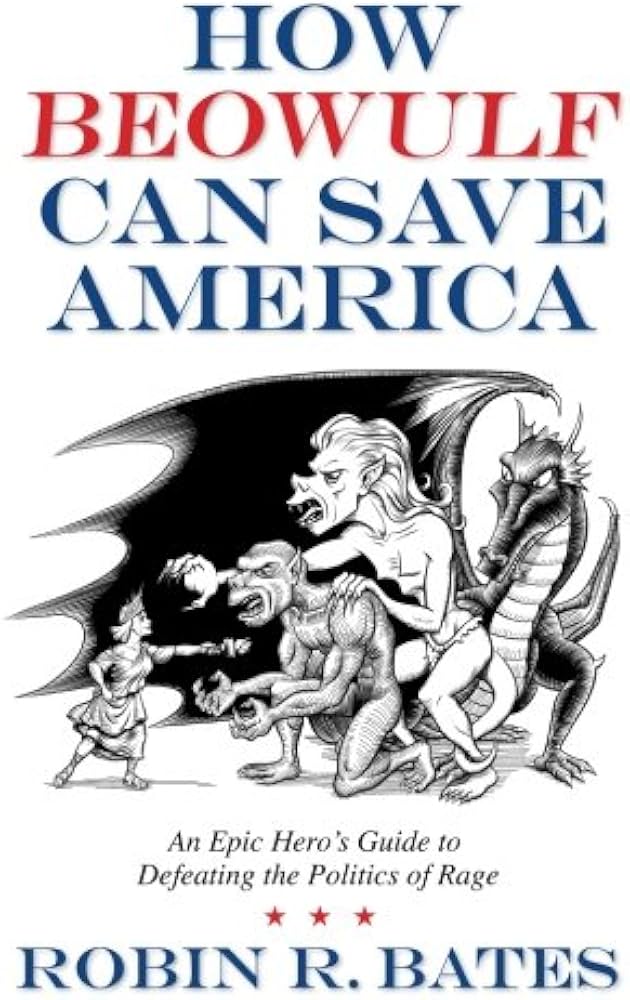
When I realized, after losing my oldest son, that Beowulf has powerful insights into the grieving process, I subjected the work to close reading. I saw the hero’s underwater contest with Grendel’s Mother as a meticulous psychological description of someone responding to debilitating grief, with no detail offered up by the text as too small to overlook. It was important to me that the lake was frozen on the surface but hot underneath—an image of repressed rage—and that one must dive directly into the anguish rather than shy away from it. (We learn that a deer fleeing from hounds would rather be torn apart on the shore than enter the dark waters.) It’s important as well that Beowulf’s normal ways of battling monsters don’t work on Grendel’s Mother, that he must draw on a primal power (a sword forged by giants before the flood) if he is not to be buried under the weight of his grief or succumb to the knife that the monster is stabbing at his heart.

In short, I went into the work convinced that a close reading would provide me with the guidance I needed. I came to see my own grieving process as a necessary journey that would take me through dark realms before I could see daylight again. As a result, I resolved to follow the grieving wherever it led rather than fight it.

Perhaps New Criticism lionizing the text to the exclusion of all else was a necessary stage if we were to take the words on the page as seriously as we would come to. Perhaps the same defense can be offered up for Deconstruction’s “il n’y pas hors-texte”(there is nothing outside the text). But once sufficient attention was being paid, we could go further than New Critics and deconstructionists were willing to go. In the world beyond the text, we could make our close attention pay off in tangible ways.

My advice to literature teachers, then, is to communicate a “why” when one is teaching close reading. The implied answer when I was in college—a beautiful work is so amazing that surely you want to see and understand its complexity—wasn’t enough for me (although it was for others). But I’m not offering up literature’s functionality as the ultimate answer. Those interested in practicality often prefer more direct routes than literature, which while it tells the truth tells it slant. For me, the magic lies in the balance between the delight we take in beauty and its practical application. Thinkers have been negotiating this balance for millennia, including Aristotle, Horace, Sir Philip Sidney, Percy Shelley, Matthew Arnold, Bertolt Brecht, W.E.B. Du Bois, Wayne Booth, Martha Nussbaum, and countless others.

Above all, I should mention John Stuart Mill, the great utilitarian who, as president of St. Andrew’s University, required all students to take literature classes and who may be the individual most responsible for Winant and me getting to teach close reading in the first place. “Who does not,” he said to the faculty and students who gathered for his inauguration, “feel himself a better man after a course of Dante, or of Wordsworth, or, I will add, of Lucretius or the Georgics, or after brooding over Gray’s “Elegy [Written in a Country Churchyard]” or Shelley’s “Hymn to Intellectual Beauty?” Such a course of study, he contended, lifts us above “the miserable smallness of mere self” and “brings home to us all those aspects of life which take hold of our nature on its unselfish side, and lead us to identify our joy and grief with the good or ill of the system of which we form a part.”

Imagine providing young people with the opportunity to find refuge from the world’s slings and arrows while simultaneously furnishing them with tools for better handling them. 

And having fun in the process.

Posted in Uncategorized | Tagged , , , , | Comments closed

Our Mad King’s Greenland Obsession

Greenland mountains

Tuesday

Our mad king’s obsession with Greenland has led me to a fascinating 18th century poem by William Cowper. “Greenland under the Influence of the Moravians” caught my eye in part because my wife grew up Moravian and in fact has stories of her ancestors carrying the faith into arctic lands.

In the case of her great-great-great-great grandfather Michael Miksch, however, the locale was northern Russia rather than Greenland. The egalitarian and communitarian faith of the Moravians appealed to many small communities, but Miksch was arrested as a suspected Swedish spy. He was released when he and his fellow Moravians saved their captors after they fell through the ice.

Michael would later turn his attention westward and ended up in Bethlehem, Pennsylvania. His descendants would move on to Gnadenhutten, Ohio (where a few years before a white militia group had massacred two Moravian missionaries and 125 Native American converts) and then to Grace Hill, Iowa, where Julia grew up.

Cowper, who became an evangelical Christian and an ardent opponent of slavery, appears to see the faith of the Moravians as purer and truer than that which flourishes in more temperate climes. (Cowper describes such “false religion” as accompanied by “the pride of lettered ignorance” that “binds in chains of error our accomplished minds.”) By contrast, the simple Moravian beliefs—which included genuine interest in the Inuits—are brighter beams that “shoot into your darkest caves the day/ From which our nicer [more delicate] optics turn away.”

Moravian missions flourished in Greenland until late in the 18th century, when the monopolistic practices of the Danish General Trade Company made imports prohibitively expensive.

In his poem Cowper focuses on Greenland’s harsh climate: “But Winter, armed with terrors here unknown,/ Sits absolute on his unshaken throne.” So American can’t be satisfied with its “soft airs and genial moisture [that] feed and cheer/ Field, fruit, and flower, and every creature here”? It must have frozen wastes as well?

It doesn’t take Moravians to shine the light of truth on Trump’s nakedly imperialistic designs.

Greenland under the Influence of the Moravians
By William Cowper

Fired with a zeal peculiar, they defy
The rage and rigor of a polar sky,
And plant successfully sweet Sharon’s rose
On icy plains and in eternal snows.
Oh, blest within the enclosure of your rocks,
Nor herds have ye to boast, nor bleating flocks;
No fertilizing streams your fields divide,
That show reversed the villas on their side;
No groves have ye; no cheerful sound of bird,
Or voice of turtle, in your land is heard;
Nor grateful eglantine regales the smell
Of those that walk at evening where ye dwell;
But Winter, armed with terrors here unknown,
Sits absolute on his unshaken throne;
Piles up his stores amidst the frozen waste,
And bids the mountains he has built stand fast;
Beckons the legions of his storms away
From happier scenes, to make your land a prey,
Proclaims the soil a conquest he has won,
And scorns to share it with the distant sun.
Yet Truth is yours, remote, unenvied isle!
And Peace, the genuine offspring of her smile;
The pride of lettered ignorance, that binds
In chains of error our accomplished minds,
That decks with all the splendor of the true
A false religion, is unknown to you.
Nature, indeed, vouchsafes for our delight
The sweet vicissitudes of day and night;
Soft airs and genial moisture feed and cheer
Field, fruit, and flower, and every creature here:
But brighter beams than his who fires the skies
Have risen at length on your admiring eyes,
That shoot into your darkest caves the day
From which our nicer optics turn away.

Posted in Uncategorized | Comments closed

  • Sign up for my weekly newsletter