Note: If you wish to receive, via e-mail, (1) my weekly newsletter or (2) daily copies of these posts, write to me at rrbates1951@gmail.com. I’ll subscribe you via Mailchimp for the weekly or email you directly for the daily (your choice). Comments may also be sent to this address. I promise not to share your e-mail with anyone.
Wednesday
For the last week of 2025, I am reposting essays from this past year that I found particularly meaningful. Of the many disasters visited upon us by Trump and the GOP, the “Big Beautiful Bill”may have had the biggest negative impact on ordinary Americans. Beauty, as they say, is in the eye of the beholder—with the beholder in this case being America’s billionaires.
Reprinted from May 26, 2025
You know that irony has caught the last train to the coast when one of the worst bills in recent memory is officially called “the Big Beautiful Bill.” While many are aware that its tax cuts for the rich will increase the American deficit by $3.3 trillion over the next ten years, even as it cripples food stamp and Medicaid programs, American Prospect has ferreted out some of the less-known but equally noxious provisions. The bill is beautiful in the same way that a rotten apple represents “perfection” in a William Carlos Williams poem by that name.
–prohibits courts from finding officials in the executive branch in contempt for not following judicial orders; –adds $45 billion to build immigration jails; –gives the administration the power to define nonprofits as “terrorist-supporting organizations” and to expedite the ending of their tax status; –guts the estate tax; –allots $20 million to school vouchers while slashing Department of Education spending for public education; –allows tax credits that subsidize ACA premiums to expire at the end of 2025 — repeals the $200 excise tax on the sale of gun silencers.
In short the bill, like Williams’s apple, is perfect in its thorough rottenness:
Perfection
O lovely apple! beautifully and completely rotten hardly a contour marred–
perhaps a little shriveled at the top but that aside perfect in every detail! O lovely
apple! what a deep and suffusing brown mantles that unspoiled surface! No one
has moved you since I placed you on the porch rail a month ago to ripen.
No one. No one!
This mention of rottenness brings to mind a Robinson Jeffers poem, “Shine, Perishing Republic,” about an America that is rotting. “The flower fades to make fruit, the fruit rots to make earth,” the poet writes of an America that is betraying its republican promise as it “settles in the mold of its vulgarity”:
While this America settles in the mold of its vulgarity, heavily thickening to empire, And protest, only a bubble in the molten mass, pops and sighs out, and the mass hardens,
I sadly smiling remember that the flower fades to make fruit, the fruit rots to make earth. Out of the mother; and through the spring exultances, ripeness and decadence; and home to the mother.
“Thickening into empire” is a reference to America’s increasing corruption in 1925, when the poem was written. The only silver lining that Jeffers sees is that, if America is going through a seasonal cycle, then perhaps the dark times are only a temporary setback. Although Jeffers didn’t know it at the time, unregulated capitalism would lead to the Great Depression, which in turn would trigger Roosevelt’s New Deal programs and the rise of the American century.
So perhaps Trumpism is only momentary. Perhaps the corruption we are seeing, which makes the 1921 Teapot Dome scandal seem quaint by comparison, will rot into earth that will be the source of new growth. As Percy Shelley once asked, “If winter comes, can spring be far behind?” Or as he imagined in an even more expansive moment,
The world’s great age begins anew, The golden years return, The earth doth like a snake renew Her winter weeds outworn: Heaven smiles, and faiths and empires gleam, Like wrecks of a dissolving dream.
Too hopeful for you? Just keep in mind that America has flirted with authoritarianism before and recovered.
Note: If you wish to receive, via e-mail, (1) my weekly newsletter or (2) daily copies of these posts, write to me at rrbates1951@gmail.com. Comments may also be sent to this addss. I promise not to share your e-mail with anyone. To unsubscribe, write here as well.
Tuesday
For this last week before 2026, I am reposting essays from this past year that I found particularly meaningful. I wrote several posts about the abominable actions of ICE. In one, I applied Eugene O’Neil’s play The Iceman Cometh to their activities. But my favorite was wresting control of Charlotte’s Web back from the ICE commander after he tried to commandeer E.B. White’s novel for his own purposes. Charlotte’s Web, in point of fact, stands for everything that ICE opposes.
Reprinted from Nov. 18, 2025
In a classic example of how bad people can twist a good book to their own ends, ICE is calling its Charlotte deportation efforts “Operation Charlotte’s Web.” Leader Gregory Bovino has even had the effrontery to quote from the novel: “Wherever the wind takes us. High, low. Near, far. East, west, North, south. We take to the breeze, we go as we please.” To which he adds, “This time, the breeze hit Charlotte like a storm.”
On Monday the Charlotte Observer reported that the storm involved masked ICE agents in green uniforms detaining 130 people in public places, supermarkets, busy roadways and an east Charlotte church.
The estate of E.B. White has hit back, with White’s granddaughter and literary executor saying that the operation is “antithetical” to the author’s values. Martha White has stated that her grandfather “certainly didn’t believe in masked men, in unmarked cars, raiding people’s homes and workplaces without IDs or summons. He didn’t condone fearmongering.”
In an interview with the Observer, White pointed out that the novel “is all about compassion. It’s all about taking responsibility for those who are vulnerable and putting yourself in another person’s shoes.” She added that White, in his White Flag collection of essays (1943-46), wrote that the United States is regarded by people everywhere “as a dream come true, a sort of world-state in miniature. Here dwell the world’s emigrants under one law, and the law is: Thou shalt not push thy neighbor around.”
Further on he stated,
By some curious divinity which in him lies, Man, in this experiment of mixed races and mixed creeds, has turned out more good than bad, more right than wrong, more kind than cruel, and more sinned against than sinning. This is the world’s hope and its chance.
It is in this spirit that Charlotte, in her final conversation with Wilbur, explains why she has expended her remaining energy to save his life. When he asks, “Why did you do all this for me? I don’t deserve it. I’ve never done anything for you,” the spider replies,
You have been my friend. That in itself is a tremendous thing. I wove my webs for you because I liked you. After all, what’s a life, anyway? We’re born, we live a little while, we die. A spider’s life can’t help being something of a mess, with all this trapping and eating flies. By helping you, perhaps I was trying to lift up my life a trifle. Heaven knows anyone’s life can stand a little of that.
Yes, antithetical to everything that ICE and Trump and Trump’s minions stand for.
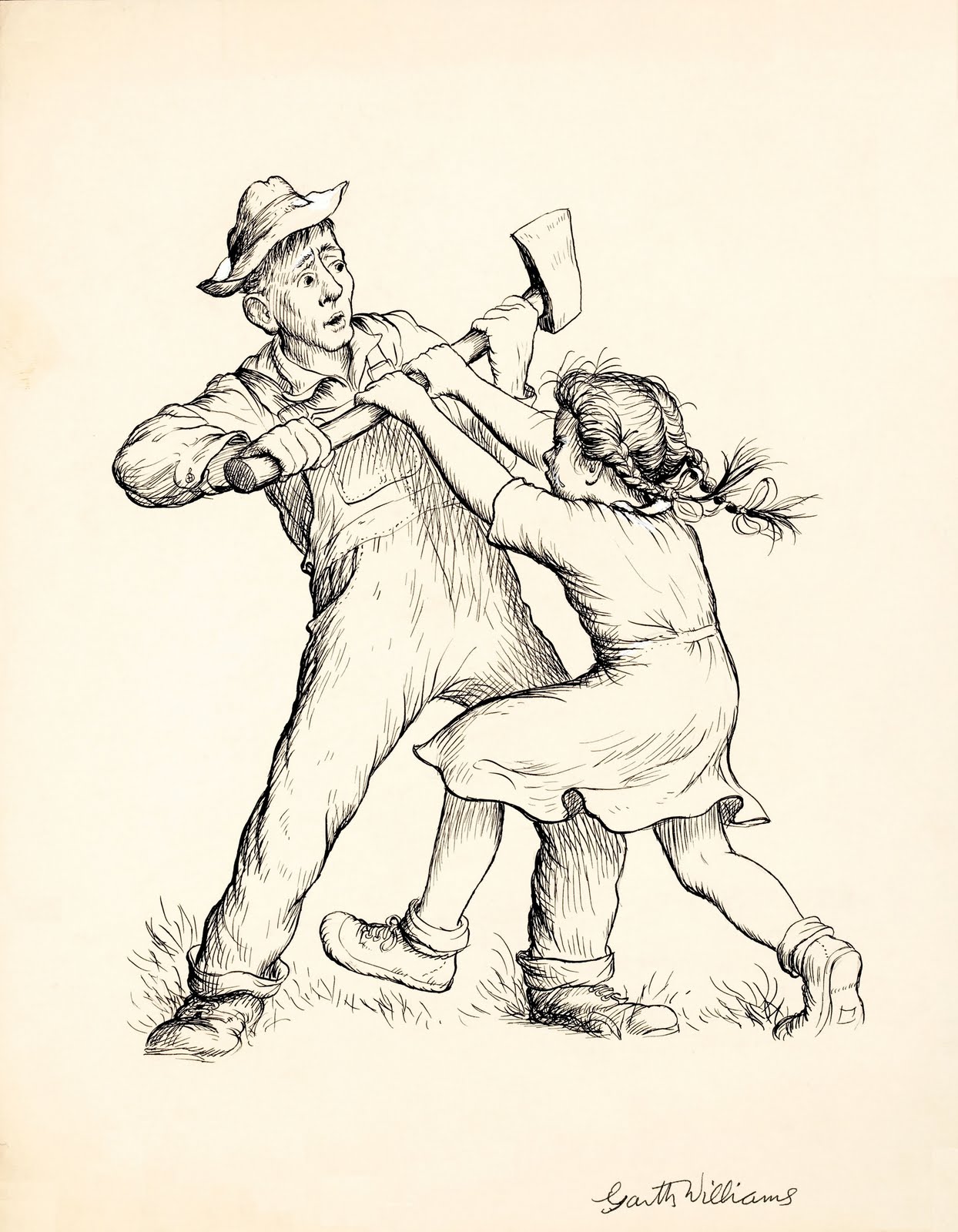
One Garth Williams illustration from Charlotte’s Web that was seared into my brain at six or so is Fern preventing her father from taking an axe to runt-of-the-litter Wilbur. Think of her as a Charlotte protester standing up against ICE. Of course, Mr. Arable is more justified than ICE in his rationale: farmers must kill animals to earn a living. This is the unwelcome news that the Old Sheep has for Wilbur: “Well, I don’t like to spread bad news but they’re fattening you up because they’re going to kill you…”
The only rationale that ICE has for going after most of those it is targeting is that they are people of color.
Bovino identifies ICE with the baby spiders who are about to be scattered to the wind. In actuality, there is nothing random about ICE, which is targeting blue cities. The passage he quotes more accurately describes our immigrants, who come down wherever circumstances allow. As the baby spiders put it, “We are aeronauts and we are going out into the world to make webs for ourselves.”
If Bovino wants to find a kindred soul in the novel, he should settle on Templeton the rat, who hoards rotten eggs and is described as having
no morals, no conscience, no scruples, no consideration, no decency, no milk of rodent kindness, no compunctions, no higher feeling, no friendliness, no anything. He would kill a gosling if he could get away with it – the goose knew that. Everybody knew it.
It is Templeton who, displaying a sadism characteristic of ICE, bursts Wilbur’s bubble at the fair, telling him, “I wouldn’t be surprised if Zuckerman changes his mind about you. Wait till he gets hankering for some fresh pork and smoked ham and crisp bacon! He’ll take the knife to you, my boy.”
Fortunately, Templeton doesn’t get the last word, and there’s a chance that Trumpism won’t either. The final message of Charlotte’s Web is one of renewal, which we all need at this moment. After Charlotte dies, breaking Wilbur’s heart, we are reminded that spring always follows winter:
The snows melted and ran away. The streams and ditches bubbled and chattered with rushing water. A sparrow with a streaky breast arrived and sang. The light strengthened, the mornings came sooner. Almost every morning there was another new lamb in the sheepfold. The goose was sitting on nine eggs. The sky seemed wider and a warm wind blew. The last remaining strands of Charlotte’s old web floated away and vanished.
A major reason why America has flourished is because immigrants, like baby spiders, have floated in, replenishing, rejuvenating and reinvigorating the nation. As E.B. White’s granddaughter notes, books like Charlotte’sWeb have been vital in opening our hearts and minds to the vulnerable. In the novel, Charlotte stands in for the author—Wilbur regards her as “a true friend and a good writer”—one who devotes her life to helping a fellow creature. The final result is a world in which we can live in harmony with a diverse population, “a sort of world state in miniature.” This vision even includes a place for rats:
Life in the barn was very good—night and day, winter and summer, spring and fall, dull days and bright days. It was the best place to be, thought Wilbur, this warm delicious cellar, with the garrulous geese, the changing seasons, the heat of the sun, the passage of swallows, the nearness of rats, the sameness of sheep, the love of spiders, the smell of manure, and the glory of everything.
Hold on to this vision and don’t stop fighting.
Further note: Carl Rosin, who teaches English and philosophy at Radnor High School and is one of the most extraordinary teachers that I know, alerted me to this poetic response to Charlotte’sWeb by Sarah Freligh. It appears in her collection Sad Math (2014). It captures the power and magic of imaginative fiction, not to mention the poignancy of this wonderful novel:
Wondrous By Sarah Freligh
I’m driving home from school when the radio talk turns to E.B. White, his birthday, and I exit the here and now of the freeway at rush hour,
travel back into the past, where my mother is reading to my sister and me the part about Charlotte laying her eggs and dying, and though this is the fifth time Charlotte has died,
my mother is crying again, and we’re laughing at her because we know nothing of loss and its sad math, how every subtraction is exponential, how each grief
multiplies the one preceding it, how the author tried seventeen times to record the words She died alone without crying, seventeen takes and a short walk during
which he called himself ridiculous, a grown man crying for a spider he’d spun out of the silk thread of invention — wondrous how those words would come back and make
him cry, and, yes, wondrous to hear my mother’s voice ten years after the day she died — the catch, the rasp, the gathering up before she could say to us, I’m OK.
Charles, Cabrera, Burke, Pasqualino in The Musketeers
Note: If you wish to receive, via e-mail, (1) my weekly newsletter or (2) daily copies of these posts, write to me at rrbates1951@gmail.com. Comments may also be sent to this address. I promise not to share your e-mail with anyone. To unsubscribe, write here as well.
Monday
For this last week before the new year, I am reposting essays that I found particularly meaningful. The biggest event personally was a beloved brother dying from pancreatic cancer. I had considered reposting an essay I wrote in the final weeks where, to sort through my own feelings, I looked into what a number of poets and novelists said about dying. These included Mary Oliver, Dylan Thomas, Raymond Chandler, Joseph Conrad, D. H. Lawrence, John Keats, and Jane Kenyon. (You can read that post here.) But I have chosen instead to repost the essay I wrote after my brother died. Alexander Dumas’s The Three Musketeers was important to my three brothers and me since, throughout our childhood, we saw ourselves as the four companions.
Reposted from Feb. 9, 2025
Monday
When I was growing up, we Bates boys sometimes regarded ourselves as Athos, Porthos, Aramis, and D’Artagnan. As the eldest, I identified with Athos, the wily old veteran. Now that we have lost our Aramis, no longer can no longer say together–as we once did– “All for one and one for all.”
Sons of a French professor who read us The Three Musketeers as children, we were such fans that we went on to read the sequels as well, Twenty Years After and The Man in the Iron Mask. In these later works, each of the four companions goes his own way, experiencing various adventures and sometimes even finding himself at odds with the others. But the feeling of inseparable unity, forged in their early acquaintance, subsists in spite of all differences. It is this sacred four that D’Artagnan invokes with his dying words at the end of Iron Mask. Here’s the scene:
Leaning upon the arms held out on all sides to receive him, he was able once more to turn his eyes towards the place, and to distinguish the white flag at the crest of the principal bastion; his ears, already deaf to the sounds of life, caught feebly the rolling of the drum which announced the victory. Then, clasping in his nerveless hand the baton, ornamented with its fleurs-de-lis, he cast on it his eyes, which had no longer the power of looking upwards towards Heaven, and fell back, murmuring strange words, which appeared to the soldiers cabalistic—words which had formerly represented so many things on earth, and which none but the dying man any longer comprehended…
While those words are not in fact cabalistic, they do invoke the special unity. So even though they don’t match our current configuration—three of us are still alive—they point to a mystical number that we all experienced as such. I therefore offer them up here in the spirit with which D’Artagnan delivers them, homage to a band of brothers whose roots sink deep:
“Athos—Porthos, farewell till we meet again! Aramis, adieu forever!”
To which Dumas adds:
Of the four valiant men whose history we have related, there now remained but one. Heaven had taken to itself three noble souls.
Note: If you wish to receive, via e-mail, (1) my weekly newsletter or (2) daily copies of these posts, write to me at rrbates1951@gmail.com. Comments may also be sent to this address. I promise not to share your e-mail with anyone. To unsubscribe, write here as well.
Sunday
For this week following Christmas, I am reposting my favorite essays from 2025.
Reprinted from Aug. 9, 2025, slightly amended
I am no theologian and so can’t speak systematically about what God is, but my mind still grapples with the question. Carl Sagan once observed that there are more stars in the universe than there are grains of sand on earth, and while that couldn’t possibly be true, it does help get at the immensity of what we are talking about. Just as the universe is not only bigger than we think but bigger than we can think, so God is bigger than even that.
But if this is so, how can we imagine that God cares about us? After all, compared to the universe, we are so infinitesimally tiny as to practically not exist. “Not one sparrow will fall to earth without your father’s care,” Jesus assures us in Matthew 10:29, which means that the impossibly large and the impossibly small are somehow bound together. How can this be?
Percy Bysshe Shelley comes as close to resolving this conundrum for me as anyone. Although Shelley was famously kicked out of Oxford for co-authoring a pamphlet entitled “The Necessity of Atheism,” in his poem Adonais he talks of “the One Spirit,” which could just as well be called God. In Shelley’s eyes, the One Spirit
Sweeps through the dull dense world; compelling there All new successions to the forms they wear; Torturing th’ unwilling dross, that checks its flight, To its own likeness, as each mass may bear; And bursting in its beauty and its might From trees and beasts and men into the heaven’s light.
If one sees creation as the process of the One Spirit blowing through matter—“torturing th’ unwilling dross”—so that new forms are created, then one has an image of how large and small interact. Shelley says that this Power “wields the world with never wearied love,/ Sustains it from beneath, and kindles it above.”
Dante articulates a version of this vision in the Divine Comedy, beginning with humans who are locked in the hell of self but ending with the celestial rose of Paradiso, where the poet is able to envision, through specially granted insight, the whole universe being driven by “the love that moves the sun and the stars.” Reflecting the astronomy of his day, Dante gets only as far as Saturn and the fixed stars—those we can see with the naked eye—but that’s vast enough to get his point across.
I had a vision of the One Spirit at work during our church’s Adult Forum this past year, which had nature as its focus. As different experts talked about different dimensions of the natural world and our natural bodies, each astounding in its creative complexity, I thought of the God of Genesis looking at creation and seeing that it was good. I felt the same as one of my reading groups discussed Richard Power’s The Overstory and then, this past week, Zoë Schlanger’s The Light Eaters: How the Unseen World of Plant Intelligence Offers a New Understanding of Life on Earth. What formerly I had seen as a “green smudge” (Schlanger’s phrase) now seems infused with, well, the One Spirit.
Since Adonais is a poem about the death of a great poet, Shelley focuses on how the One Spirit produces beauty. In lines that we had engraved on our eldest son’s grave, Shelley writes,
He is made one with Nature. There is heard His voice in all her music, from the moan Of thunder to the song of night’s sweet bird. He is a presence to be felt and known In darkness and in light, from herb and stone…
In other words, Keats is a particular sensitive receiver of the One Spirit; he is dross that comes as close as dross ever can to capturing the beauty and enchantment of that Spirit. Our interactions with nature are heightened by his poems like “Ode to a Nightinggale,” just as they are by, say, the Hudson Valley painters or Beethoven in his Pastoral Symphony.
As he mourns Keats, Shelley is somewhat consoled by the idea that his friend is being reunited with this energy source: “He is a portion of the loveliness/ Which once he made more lovely.” If this is true, then there is no final death because we are all part of the eternal Spirit. “The One remains, the many change and pass;/ Heaven’s light forever shines, earth’s shadows fly,” Shelley writes, and then elsewhere,
The splendors of the firmament of time May be eclipsed, but are extinguished not; Like stars to their appointed height they climb, And death is a low mist which cannot blot The brightness it may veil.
Shelley, in short, comes close to answering the question that has triggered this post. TheBook of Job does so as well. When Job expresses his anguished sense that he has been abandoned by God, God responds with a version of Shelley’s One Spirit: while not catering specifically to the individual tragedies of infinitesimally small beings, God points out that He/She is nevertheless present in our lives. Somewhat sarcastically God asks Job,
Where were you when I laid the foundation of the earth? Tell me, if you have understanding. Who determined its measurements—surely you know! Or who stretched the line upon it? On what were its bases sunk, or who laid its cornerstone, when the morning stars sang together and all the sons of God shouted for joy?
While I didn’t think of either Shelley or Job when we lost Justin, I remember thinking of God in these terms. I didn’t blame God because I didn’t think that God interacts with us as one individual to another. Rather, I saw God as presenting me with a Spirit I could embrace. If I opened myself to its light, even at the darkest of times, I could move beyond perpetual gloom.
I couldn’t do this all at once, nor could Shelley. The early parts of Adonais are filled with his despair at Keats’s death. But he has faith that a greater force—one manifesting itself as love and beauty—is at work in our lives. That faith gave me something to rally around.
Note: If you wish to receive, via e-mail, (1) my weekly newsletter or (2) daily copies of these posts, notify me at rrbates1951@gmail.com and indicate which you would like. I promise not to share your e-mail address with anyone. To unsubscribe, send me a follow-up email.
Friday
This upcoming week, as our two sons and five grandchildren visit us, I will be reposting essays from this past year that stand out for me. In this first one, I thank Kate Atkinson, whose novels I have fallen in love with, for giving me special insight into this blog and my literary project generally. If you’re interested in what I’m all about (and it’s okay if you’re not), this is a good essay to read.
Reposted from January 26, 2024, slightly amended
I owe to novelist Kate Atkinson a major self-insight, one that I touched on in Tuesday’s post and that I elaborate on today. This blog, which I launched on April, 2009 and have been maintaining faithfully six days a week ever since (for one exhausting spell, it was seven days a week), is not unlike the Modernist project that T.S. Eliot describes in TheWaste Land. I too use cultural and poetic fragments to “shore up against my ruins.”
I hope you’ll indulge me as I engage in a bit of navel-gazing. To see myself as doing anything remotely like what Eliot does in The Waste Land catches me off guard as the poet’s signature poem has frustrated me ever since I encountered it in a Carleton College survey class. Despite great lines like “April is the cruelest month” and “I will show you fear in a handful of dust,” it utterly baffled me and made me feel stupid.
And it wasn’t only Eliot that baffled me. A lot of poetry from this era struck me as inaccessible. For me to conclude that Better Living through Beowulf is a Modernist project, therefore, is like Molière’s bourgeois gentleman waking up one day to discover that all his life he has been speaking in prose:
MONSIEUR JOURDAIN: Oh, really? So when I say: Nicole bring me my slippers and fetch my nightcap,” is that prose?
PHILOSOPHY MASTER: Most clearly.
MONSIEUR JOURDAIN: Well, what do you know about that! These forty years now I’ve been speaking in prose without knowing it!
I can’t explain the rationale behind Modernism in a short space but suffice it to say that it was characterized by intense experimentation, with poets prepared to reject what people normally thought of as poetry. The reason lies in the changing landscape: no longer could people confidently assert, as they had in the 19th century, that one day great minds would formulate theories that explained whole fields (think Marx, Darwin, and Freud). Instead, everything seemed to be fragmented. As a short piece in Poetry Foundation reports, figures like Gertrude Stein explored the possibilities of creating literary works that “broke with conventional syntactical and referential practices” while Ezra Pound’s guiding star was to “make it new” and “break the pentameter.” The essay notes that Waste Land became the “archetypical Modernist text, rife with allusions, linguistic fragments, and mixed registers and languages.”
Many people were angry at the Modernist movement, feeling that it was taking poetry away from them. Where, they wondered, were the regular rhythms, the rhyming, the clear themes? Not that earlier poetry was necessarily self-explanatory, but Modernist poets seemed to introduce new levels of obscurity. Or that’s how it seemed to me. As a scholar specializing in the 18thcentury—famous for the Age of Reason—I was accustomed to more direct discourse.
Once, when discussing this with my St. Mary’s colleague Bruce Wilson–a brilliant literary mind who taught courses on “Dante and Eliot” and “Yeats and Japanese Noh Theatre”–I told him that Modernism was the one period that I just didn’t get. He replied that the 18th century was that way for him.
Nor is he alone. In the semi-autobiographical novel The Bell Jar, Sylvia Plath’s protagonist explains that the 18th century literature requirement is what kept her from majoring in English:
There were lots of requirements, and I didn’t have half of them. One of the requirements was a course in the eighteenth century. I hated the very idea of the eighteenth century, with all those smug men writing tight little couplets and being so dead keen on reason. So I’d skipped it. They let you do that in honours, you were much freer. I had been so free I’d spent most of my time on Dylan Thomas.
I wouldn’t characterize Dryden and Pope, the foremost practitioners of the heroic couplet, as smug, but I get Plath’s point. They are nowhere near as elliptical and confessional as she is in her poetry. I myself prefer their poetry, which explains further my shock at discovering my kinship with Eliot.
How is my blog a Modernist project? In my early days as a scholar, I sought to come up with a universal theory about literature’s impact upon audiences. Knowing that novels, plays, and poems had shaped my own life in profound ways, I thought I could use the emerging fields of reception theory and reader response theory to provide significant answers to the question, “Why literature?” I soon came to realize, however, that there are far too many variants at play, variants involving both multiple definitions of literature and multiple responses from audiences, to arrive at anything comprehensive.
Blogging provided an Eliot-like solution, however. If, on a daily basis, I recorded ways that this or that work—let’s call them fragments of the larger field—were shoring up my life, then I was partially answering the question I had set out to answer. Even if I couldn’t generalize, I could offer personal testimony.
I’m sounding almost confessional when I say this, not unlike a confessional poet such as, say, Sylvia Plath. And while I hastily add that I’m interested in a wide variety of responses, not only my own, a daily blog is still a fairly random and haphazard way to explore literary impact. Whatever is happening, from one day to the next, prompts me to search for relevant literary works.
Which is to say, I am responding to people using literature as Eliot responded to his confusing, chaotic world, only I do so as a scholar rather than as a poet. Suspicious of tidy generalizations, Modernists grabbed whatever was around them. A character in Kate Atkinson’s God in Ruins refers to the process as “scraps from her ragbag because words were all that were left now.” Eliot sometimes appears to throw literary passages, like spaghetti, at the wall to see what will stick. In any event, we all of us seem to be preforming a kind of bricolage, which is to say attempting to create something out of anything that comes to hand.
I tried to be more systematic in my other large-scale attempt to explore literary impact, which was to write a book on the subject. Predictably, however, Better Living through Literature: How Books Change Lives and (Sometimes) History is no more successful that my other efforts at arriving at a unified theory. Instead, it settles for surveying what major thinkers throughout history have said on the subject. In the end, I hope that readers will at least get a sense of the possibilities.
To be sure, many of the thinkers–even when they are disagreeing with each other–don’t have my level of doubt. Aristotle, for instance, seems certain that everyone shares his own cathartic experience when watching Oedipus Rex, and Sir Philip Sidney is absolutely convinced that works like The Aeneid will cause people to become more virtuous. But if I have not been able to achieve their level of certainty—that’s why I don’t settle on just one of them—I hope my readers will be able to choose the ones that speak most directly to them.
As for myself, my two favorite theorists are Percy Shelley, who believes that great literature causes historical shifts (albeit sometimes slowly), and Wayne Booth, who says that it changes individuals. Others may find a guide in Plato or Matthew Arnold or W.E.B. Du Bois or Rachel Blau DuPlessis. In the end, perhaps we can do no other than adopt the explanations that resonate with us most.
John Leech, illus. of the Spirit of Christmas Present
Note: If you wish to receive, via e-mail, (1) my weekly newsletter or (2) daily copies of these posts, write to me at rrbates1951@gmail.com. Comments may also be sent to this addss. I promise not to share your e-mail with anyone. To unsubscribe, write here as well.
Thursday – Christmas
Allow me the parental privilege of recommending an hour-long interview about Dickens’s Christmas Carol with my son Tobias Wilson-Bates, a Victorian literature professor at Georgia Gwinnett College.Bill Nigut of Atlanta’s public radio station WABE talked to Toby about why the story was so popular and why it has remained so. He also asked whether Dickens really did invent Christmas. (You can listen to the interview here.)
Part of Christmas Carol’s popularity, Toby says, lies in how it combined two popular topics of the day, time and ghosts. Toby wrote his dissertation on 19th century time travel literature, and while H.G. Wells’s Time Machine may be the first work that comes to mind, Christmas Carol also involves going backward and forward in time. Toby explains that 19th century Europe was obsessed with time, with railway time, factory time, and business time changing the way people saw themselves. Suddenly people started organizing their lives around pocket watches rather than the sun.
Also, whereas time had once varied from one locale to the next, universal time—necessary so that trains wouldn’t run into each other—prompted people to think of time as tyrannical. Lewis Carroll’s Mad Hatter talks of quarreling with and being bullied by time in Alice in Wonderland.
Ghost stories, meanwhile, were popular around Christmas, it being the darkest season of the year. Toby points out that the ghosts in Christmas Carol show up promptly at various appointed times, as if their wages would be docked if they were late (which almost happens to Bob Cratchit).
In the interview Toby also discusses how shrewd Dickens was in marketing his book, binding it beautifully and having it lavishly illustrated so that it had the look and feel of a present. He also priced it low so that people could buy it for friends. It sold out quickly and, as he self-published, he didn’t have to share the proceeds with a publisher.
While Dickens didn’t invent Christmas with Christmas Carol and, earlier, with The Pickwick Papers, Toby says that he could be said to have reinvented it for the modern industrial age. Although British celebrations of Christmas go back centuries, in the past they were more associated with the landed estates, which up until the 18th century were the largest source of British wealth. The lord of the manor would bring the community together to burn a yule log and engage in games and feasting. We see such a celebration in Shakespeare’s Twelfth Night (1601), and Robert Herrick’s 17th century poem “Ceremonies for Christmas” captures the spirit:
Come, bring with a noise, My merry, merry boys, The Christmas Log to the firing; While my good Dame, she Bids ye all be free; And drink to your heart’s desiring.
With the last year’s brand Light the new block, and For good success in his spending, On your Psaltries play, That sweet luck may Come while the log is a-tinding.
Drink now the strong beer, Cut the white loaf here, The while the meat is a-shredding; For the rare mince-pie And the plums stand by To fill the paste that’s a-kneading.
There were rumblings of discontent, however. Malvolio complains of the merrymaking in Shakespeare’s play, and there were times when celebrations got out of hand. Although the aptly named Sir Toby Belch chastises Malvolio—“Dost thou think because thou art virtuous, there shall be no more cakes and ale?”—and although Sir Andrew Aguecheek calls him “a kind of puritan”—for a while the Puritans would get the last word. When they came to power in 1642, along with closing the theaters they also banned traditional Christmas celebrations.
We can see why from Henry Vaughan’s “The True Christmas.” While no Puritan, Vaughan worried that the religious meaning of the season was getting lost. “The True Christmas” begins with a sarcastic reference to people that wish to restore pagan practices, beginning with Christmas greenery:
So stick up ivy and the bays, And then restore the heathen ways. Green will remind you of the spring, Though this great day denies the thing. And mortifies the earth and all But your wild revels, and loose hall. Could you wear flowers, and roses strow Blushing upon your breasts’ warm snow, That very dress your lightness will Rebuke, and wither at the ill.
My rector recently informed me that there are two approaches to Advent, penitential and anticipatory. Do we emphasize our present sinful condition, as one does in Lent, or (as we do in our church) on the promise of God come to earth? Vaughan feared that, by focusing so much on the spring, we don’t give enough attention to our current state.
Vaughan objects to the celebrations the way people today complain about the commercialization of Christmas. Christ, he says, came to earth to “provide a check to pomp and mirth”:
Not unto music, masque, nor show: Nor gallant furniture, nor plate; But to the manger’s mean estate. His life while here, as well as birth, Was but a check to pomp and mirth; And all man’s greatness you may see Condemned by His humility.
Even Herrick, though a fan of Christmas revels, expresses a similar sentiment in “A New Year’s Gift.” If we all followed his advice, we would ruin businesses reliant on Christmas sales:
Let others look for pearl and gold, Tissues, or tabbies manifold: One only lock of that sweet hay Whereon the blessed Baby lay, Or one poor swaddling-clout, shall be The richest New-year’s gift to me.
So how should we celebrate instead? Vaughan concludes his poem by recommending quiet prayerfulness (like “the poor shepherd’s watchfulness”) and by sharing our wealth (“what you abound with”) with “those that want.” We ease our load when we empty ourselves like this:
Then leave your open house and noise, To welcome Him with holy joys, And the poor shepherd’s watchfulness: Whom light and hymns from heaven did bless. What you abound with, cast abroad To those that want, and ease your load. Who empties thus, will bring more in; But riot is both loss and sin. Dress finely what comes not in sight, And then you keep your Christmas right.
Vaughan is not wrong here, providing a necessary corrective to Christmas excess and consumer decadence. But Puritan fundamentalism went too far, as fundamentalism often does, and Charles II would restore some of the old traditions (and also reopen the theaters) when the Puritan interregnum collapsed. Christmas, however, would not regain its old footing until Dickens.
Toby notes that Dickens didn’t do it alone. With industrialization’s assault on nature, it made sense to “stick up ivy and the bays” at this time of year, and Victoria and Albert imported the Christmas tree tradition from northern Europe’s winter solstice celebrations. Dickens’s ghost of Christmas present, meanwhile, is brought to you by the color green:
It was his own room. There was no doubt about that. But it had undergone a surprising transformation. The walls and ceiling were so hung with living green, that it looked a perfect grove; from every part of which bright gleaming berries glistened. The crisp leaves of holly, mistletoe, and ivy reflected back the light, as if so many little mirrors had been scattered there; and such a mighty blaze went roaring up the chimney as that dull petrification of a hearth had never known in Scrooge’s time, or Marley’s, or for many and many a winter season gone.
Herrick and Sir Toby would be pleased with the outlay:
Heaped up on the floor, to form a kind of throne, were turkeys, geese, game, poultry, brawn, great joints of meat, sucking-pigs, long wreaths of sausages, mince-pies, plum-puddings, barrels of oysters, red-hot chestnuts, cherry-cheeked apples, juicy oranges, luscious pears, immense twelfth-cakes, and seething bowls of punch, that made the chamber dim with their delicious steam. In easy state upon this couch there sat a jolly Giant, glorious to see; who bore a glowing torch, in shape not unlike Plenty’s horn, and held it up, high up, to shed its light on Scrooge as he came peeping round the door.
This jolly giant hearkens back to the pagan Green Man. He is introduced as a figure of peace on earth:
[The Spirit] was clothed in one simple deep green robe, or mantle, bordered with white fur. This garment hung so loosely on the figure, that its capacious breast was bare, as if disdaining to be warded or concealed by any artifice. Its feet, observable beneath the ample folds of the garment, were also bare; and on its head it wore no other covering than a holly wreath, set here and there with shining icicles. Its dark-brown curls were long and free; free as its genial face, its sparkling eye, its open hand, its cheery voice, its unconstrained demeanor, and its joyful air. Girded round its middle was an antique scabbard: but no sword was in it, and the ancient sheath waseaten up with rust.
While the description functions as a reproof of those who want an austere and purely Christian Christmas, Dickens’s own religious sentiments are obscure. Tiny Tim may declare, “God bless us everyone,” but Jesus never gets mentioned in Christmas Carol. Dickens’s parable is successful, Toby says, largely because it is partly secular, partly religious, with the religious part hard to pin down. It proved to be unobjectionable to Catholics, Anglicans, and Methodists alike.
Dickens also makes a central part of Christmas’s message a concern for “those that want,” an important message at a time when London’s slum population was exploding. Our modern day Scrooges, meanwhile, need to hear its message as they insist on taxes for themselves while slashing the social safety net and affordable healthcare for the less fortunate. Imagine if they had a Scrooge-like conversion and insisted that they be taxed at a level that would afford a decent standard of living for all.
Now that would be a Christmas Carol worth singing.
Note: If you wish to receive, via e-mail, (1) my weekly newsletter or (2) daily copies of these posts, write to me at rrbates1951@gmail.com. Comments may also be sent to this addss. I promise not to share your e-mail with anyone. To unsubscribe, write here as well.
Wednesday – Christmas Eve
Reprinted from December 31, 2009, slightly revised
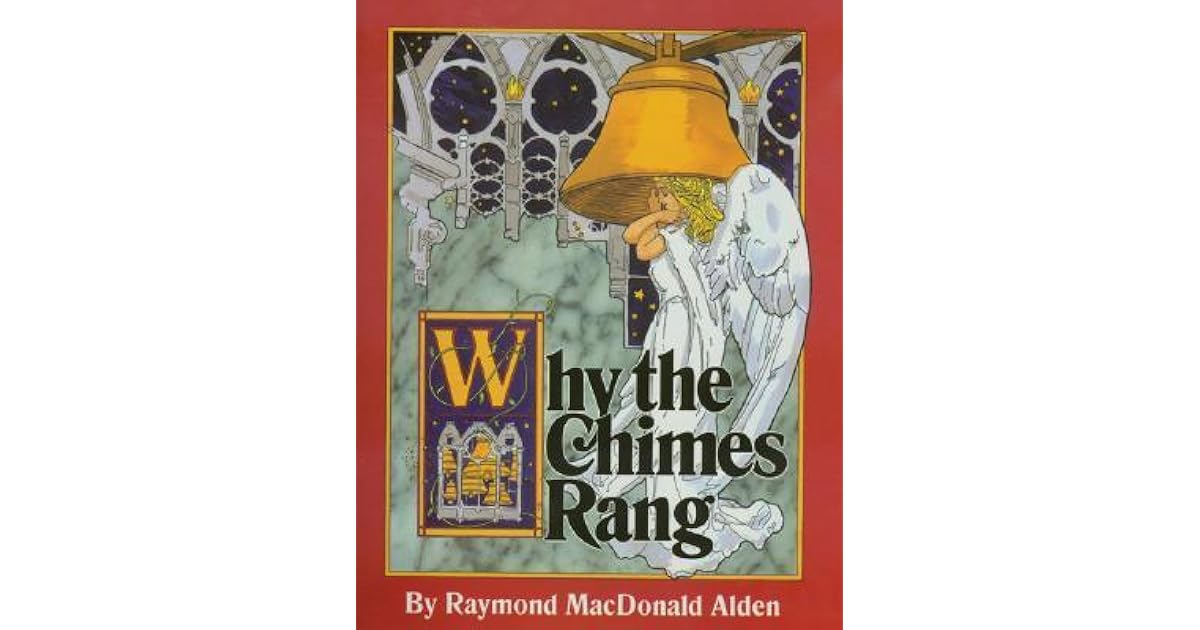
My favorite Christmas story when I was growing up was Raymond Macdonald Alden’s “Why the Chimes Rang.” My father read it to us on Christmas Eve, and I read it to my own children in turn. I choke up every time I return to it. (You can read it here.)
The story is about a church with a tower so high that no one can see the top. It is reputed to house the most beautiful-sounding chimes in the world, chimes that sound like “angels far up in the sky” or “strange winds swinging through the trees.”
No one living has ever heard them, however. The story explains, “It was said that people had been growing less careful of their gifts for the Christ-child, and that no offering was brought great enough to deserve the music of the chimes.” Nevertheless, each Christmas the rich and famous gather at the church in hopes of bestowing the gift that will set off the chimes. Each gift surpasses the previous:
And last of all walked the king of the country, hoping with all the rest to win for himself the chime of the Christmas bells. There went a great murmur through the church, as the people saw the king take from his head the royal crown, all set with precious stones, and lay it gleaming on the altar, as his offering to the holy Child. “Surely,” every one said, “we shall hear the bells now, for nothing like this has ever happened before.”
The only response from the bells, however, is silence:
But still only the cold old wind was heard in the tower, and the people shook their heads; and some of them said, as they had before, that they never really believed the story of the chimes, and doubted if they ever rang at all.
Pedro and Little Brother are on their way to the service, where they plan to lay a silver coin on the altar. On the way, however, they come across a woman who has fallen in the snow. Pedro decides to stay with her to care for her and sends Little Brother on to the church. The decision is hard:
In this way he hurried Little Brother off to the city, and winked hard to keep back the tears, as he heard the crunching footsteps sounding farther and farther away in the twilight. It was pretty hard to lose the music and splendor of the Christmas celebration that he had been planning for so long, and spend the time instead in that lonely place in the snow.
Of course, it is their gift that sets the chimes playing. Here’s how the story ends:
The procession was over, and the choir began the closing hymn. Suddenly the organist stopped playing as though he had been shot, and everyone looked at the old minister, who was standing by the altar, holding up his hand for silence. Not a sound could be heard from anyone in the church, but as all the people strained their ears to listen, there came softly, but distinctly, swinging through the air, the sound of the chimes in the tower. So far away, and yet so clear the music seemed—so much sweeter were the notes than anything that had been heard before, rising and falling away up there in the sky, that the people in the church sat for a moment as still as though something held each of them by the shoulders. Then they all stood up together and stared straight at the altar, to see what great gift had awakened the long-silent bells.
But all that the nearest of them saw was the childish figure of Little Brother, who had crept softly down the aisle when no one was looking, and had laid Pedro’s little piece of silver on the altar.
If tears come to my eyes every time I read this story, I think it’s because it reminds me that each of us has chimes buried deeply within us. I’m referring here to the inner divinity that Jesus perceived and that he shared with his disciples and anyone else who would listen. “For behold, the kingdom of God is in the midst of you,” he proclaims in Luke (17:21).
We need reminding, however, because we get sidetracked when the winter wind is howling. The world is too much with us, as Wordsworth put it, so that we cannot hear the chimes. Or to put it another way, although the chimes may always be ringing, we do not open ourselves to them. As Jesus puts it, “He who has ears let him hear.”
Jesus also says, “Unless you become as little children, you shall not enter into the kingdom of heaven.” Pedro and Little Brother remind me of the child I once was. I recall how my heart used to swell as Pedro sacrifices what he wants for something more important. It still does. In the grip of the story, I become innocent again. It doesn’t matter that no one sees me, that no one acknowledges me, as I lay my coin quietly on the altar. I am in touch with the chimes.
Reading “Why the Chimes Rang,” in short, opens a door to the numinous, which is why I incorporate it into my yearly Christmas rituals. To borrow from Emily Dickinson, such stories truly are chariots that bear the human soul.
Note: If you wish to receive, via e-mail, (1) my weekly newsletter or (2) daily copies of these posts, write to me at rrbates1951@gmail.com. Comments may also be sent to this addss. I promise not to share your e-mail with anyone. To unsubscribe, write here as well.
Tuesday
My father’s favorite holiday was Christmas—he felt it kept the child in him alive—and every year he would write a poem for the occasion. This my parents sent out as a Christmas card and also published in the town newspaper (which my mother founded before she passed it on). Here’s a mystical villanelle he wrote about the quest that the Christmas tree represents. ’Tis the season for such poems.
For the record, a villanelle is a 19-line verse form consisting of five three-line stanzas and a final four-line stanza, with various lines repeated. The best-known villanelle is Dylan Thomas’s “Do Not Go Gentle.”
My father insisted that, on Christmas day, we follow various rituals. The youngest members of the family would go down and retrieve the stockings, beautifully knitted for us by my mother and each carrying our name. We would empty these at the dining room table while eating a braided coffee cake, with icing and pecans, that my mother had made and frozen a few days before. My father had spent the previous year keeping his eye open for things to put in the stockings.
Breakfast eaten, we would go into the living room, gazing at the presents that had miraculously appeared around the tree. We would sit in a circle while the youngest would again bring us our gifts, one at a time for each of us. The predominant gifts, especially as we grew older, were books and videos/dvds. We’d spend the rest of the day reading, watching films, and phoning relatives. When I had my own family, we would drive the twelve hours from Maryland and spend a week. Now Julia and I live in this same house, and our two sons and five grandchildren will be traveling here to join us.
Our book-heavy Christmases provide insight into the poem. First of all, the marvelous tree is not only a reference to the evergreen symbolism of northern European solstice traditions, although it is partly that. It also points to how the season is about miraculous transformation. Imagination is the key to the magical cave, an “open sesame” password that “only the children know.” Well, children and those adults in touch with their inner child.
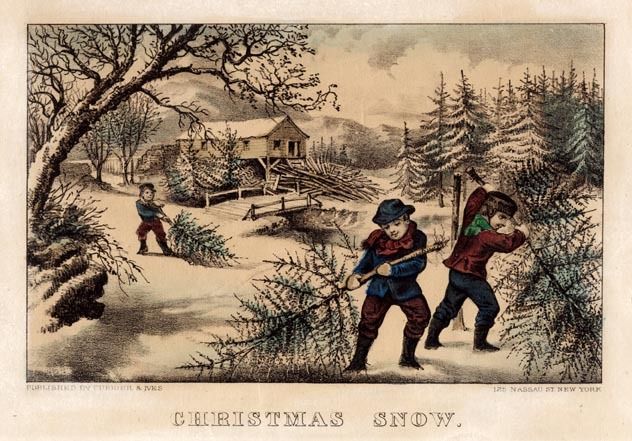
To capture this journey, my father echoes poems and stories about journeys to magical lands. I catch allusions to Cavafy’s “Ithaka,” Edward Lear’s “The Jumblies” and “The Owl and the Pussycat,” poems by Charles Baudelaire and Derek Walcott, and Arabian Nights. The sailors are like children—or children are like sailors–with the skiing over the snow recalling Currier and Ives paintings. This is Christmas seen through a child’s eyes.
Quentin Hope, to whom the poem is dedicated, was a French professor at Indiana University and a close friend of my father’s. They spent many hours “in lybrarye” (Chaucer’s spelling) searching for literary treasures. For my father, library archive work was like an Easter egg hunt, so it makes sense to me that he groups himself with children entering a cave portal by means of a magical key and with sailors discovering exotic new worlds. He and Quentin are carried on the wings of poetry, which include songs/poems like this one.
Here’s the poem:
The Quest of the Marvelous Tree By Scott Bates
On the quest of the marvelous tree The children ski over the snow As sailors sail out to sea
Past islands of ginger and tea Over dolphin hills they go On the quest of the marvelous tree
So scholars in lybrarye On greening mastheads flow As sailors sail out to sea
Past the Islands of Cybele And the Hills of the Cat and the Crow On the quest of the marvelous tree
In the Cave with the Wonderful Key Which only the children know And sailors who sail out to sea
And scholars like Quentin and me Who sail on our songs through the snow On the quest of the marvelous tree As sailors sail out to sea
Further thought: When my father mentions children skiing in the snow, I suspect he has partly in mind the boy Charles Foster Kane in Orson Welles’s Citizen Kane, sailing down seemingly endless snowbanks on his rosebud sled before he is brutally wrenched out of his childhood. The loss of innocence, which was one of my father’s defining themes, leaves a hole in Charlie that is never filled. Citizen Kane was my father’s favorite film, articulating as it did his own shock at “the desecration of innocence” (a favorite phrase of his). Through Christmas rituals he reconnected with lost innocence.
Trump’s “enigmas never age” birthday card to Epstein
Note: If you wish to receive, via e-mail, (1) my weekly newsletter or (2) daily copies of these posts, write to me at rrbates1951@gmail.com. Comments may also be sent to this addss. I promise not to share your e-mail with anyone. To unsubscribe, write here as well.
Monday
As many, including Jeffrey Epstein’s victims, predicted, the Department of Justice failed to release the full Epstein files on Friday, despite Congress’s order. Instead we have a partial document, heavily redacted and selectively edited.
Of those whose names have been released, I’m struck by how many claim that they were ignorant of Epstein’s pedophilia. It’s not like he hid his cravings, calling his private jet “The Lolita Express” and hosting sex parties on board with underage teenage girls. As Donald Trump himself said at one point,
I’ve known Jeff for fifteen years. Terrific guy. He’s a lot of fun to be with. It is even said that he likes beautiful women as much as I do, and many of them are on the younger side. No doubt about it — Jeffrey enjoys his social life.
There are even a couple of photos—this according to blogger Greg Olear, who has been looking through those photos have been released—of the opening lines of Nabokov’s novel written out on a young woman’s body (her feet, back, and an arm). I haven’t seen the photos but here’s how Humbert Humbert’s narration begins:
Lolita, light of my life, fire of my loins. My sin, my soul. Lo-lee-ta: the tip of the tongue taking a trip of three steps down the palate to tap, at three, on the teeth. Lo. Lee. Ta.
The novel is narrated by a smooth-talking pedophile who marries a woman to get at her 12-year-old daughter and then, when the mother fortuitously dies (before she can expose him), uses his stepfather status to sexually abuse the girl. The scandal of the novel is that Humbert gets to tell the tale himself in a bid for the reader’s sympathy. We are invited to adopt a monster’s perspective and some readers do.
This has been a complaint leveled at novels from the very beginning. Our natural inclination is to identify with the protagonist, no matter how abhorrent, which is one reason why early novels like Daniel Defoe’s Moll Flanders (about a thief)and Roxanna (about a prostitute)had to be sold under the counter. Lolita has proved controversial over the years in large part because of how Humbert seduces the reader with his cosmopolitan flair and his facility with language. What I’m wondering is whether Epstein, even as he rode around in the Lolita Express, pulled off the same trick.
Now, if one pays close attention to Lolita, one realizes that Nabokov undercuts him time and again. As Olear observes, because of the author’s genius “we are able to see that this guy is nuts and he’s horrifying and that what he sees is not what’s actually true.” Olear even points out that Humbert’s (fictional) editor warns us that he is not to be trusted. The man’s description applies to Epstein as well:
No doubt he is horrible. He is abject. He is a shining example of moral leprosy, a mixture of ferocity and jocularity that betrays supreme misery, perhaps, but is not conducive to attractiveness. He is ponderously capricious. Many of his casual opinions on the people and scenery of this country are ludicrous. He is abnormal. He is not a gentleman.
In short, reading carefully—both the novel and Epstein—reveals the dark truth. Lolita, one could say, trains us to recognize pedophiles.
Two critical observations about Lolita stand out to me. One is scholar Lionel Trilling observing that the book attempts to makes us complicitous in its monstrous behavior:
[W]e find ourselves the more shocked when we realize that, in the course of reading the novel, we have come virtually to condone the violation it presents … we have been seduced into conniving in the violation, because we have permitted our fantasies to accept what we know to be revolting.
Then there is Azar Nafisi, author of Reading Lolita in Tehran, who said her students identified with Lolita and saw in Humbert the mullahs who were erasing their personhood and turning them into objects. Nafisi writes,
Lolita is given to us as Humbert’s creature … To reinvent her, Humbert must take from Lolita her own real history and replace it with his own … Yet she does have a past. Despite Humbert’s attempts to orphan Lolita by robbing her of her history, that past is still given to us in glimpses.
Thanks to the courageous women who are now speaking out about their Epstein experience, we are finally getting those glimpses. We will learn even more if the Justice Department fully releases the files.