Historical Fiction Is about the Present

Note: If you wish to receive, via e-mail, (1) my weekly newsletter or (2) daily copies of these posts, write to me at rrbates1951@gmail.com. Comments may also be sent to this addss. I promise not to share your e-mail with anyone. To unsubscribe, write here as well.

Wednesday

Author Ursula K. Le Guin once contended that, in science fiction, the future is a metaphor for the present. Something similar can be said about historical fiction, in which case it’s the past that’s a metaphor for the present. I’ve just completed two novels in which the U.S. history casts dark light on our tumultuous times, Dennis Lehane’s Small Mercies (2023) and Will Martin’s self-published Surrection (2022)(Warning: the following contains spoilers for both.)

I discovered Small Mercies (2023) on a “Best Mysteries of the Past 25 years” list and then located an audiobook version on Libby. The novel threw me back to the summer of 1974—Julia and I had graduated from college the year before—and I recalled the racial unrest that greeted enforced busing in Boston. At the time I had just returned to Tennessee, where overt racism was alive and well, but it was dispiriting to see it so nakedly displayed in the north.

The novel is not for the fainthearted as the n-word is thrown around with abandon, along with a dozen other racial slurs and stereotypes. One of the novelist’s two protagonists, Mary Pat, is a tough Irish American mother who has unthinkingly imbibed the racism of her Irish neighborhood and then passed it along to her children. Her husband has left her because of the hate, and living as she does from paycheck to paycheck, her bleak life becomes even bleaker when her 17-year-old daughter goes missing. 

Desperate to find out what has happened to Jules, who is the one bright spot in her life, she looks everywhere. Then she goes on the warpath when she discovers that the Irish godfather who rules Southie—a man she grew up with—is mixed up in Jules’s murder. She also discovers that he is running the local drug trade, which connects him as well with the death of Mary Pat’s son, who died from a heroin overdose after returning from Vietnam.  

Although she faces impossible odds, she is tough herself, with detective Bobby Coyne, the novel’s other protagonist, describing her as “irretrievably broken and wholly unbreakable.” In a doomed Billy Jack-type rebellion, she manages to take down some of those responsible for her daughter’s death before she herself is killed. While one roots for her, there are no moments of easy grace in the novel. For one thing, she learns that her daughter is mixed up in the killing of a Black man whose car breaks down.

Yet even this horrific act includes an act of small mercy, with Jules first speaking up for the man and then killing him with a rock before her friends can subject him to a gruesome death. This is part of the reason why she herself is killed. Coyne observes, “The worst of us has good in him. The best of us has pure fucking evil in his heart. We battle. It’s all we can do.”

Although Coyne is also from Irish Boston, his parents were comparatively enlightened. At any rate, they weren’t racists. As he explains them, 

Something about the idea of [racism]—the pure irrationality of it—offended them. They didn’t think black people were necessarily good, don’t get me wrong, they just thought everyone—regardless of what color they were—was probably an asshole. And to say you were less of an asshole because your skin was lighter was reprehensible to them. It just made you a bigger asshole.

Partly because he served in Vietnam, partly because he’s a police officer, Coyne has a clear view of how racism works:

Call them gooks, call them niggers, call them kikes, micks, spics, wops, or frogs, call them whatever you want as long as you call them something—anything—that removes one layer of human being from their bodies when you think of them. That’s the goal. If you can do that, you can get kids to cross oceans to kill other kids, or you can get them to stay right here at home and do the same thing.

As I listened to the book, I sensed that I was encountering some of Trump’s diehard supporters, those to whom he has given permission to indulge in their worst instincts. Lehane wrote the novel in 2023 so he has seen how this permission structure works under Trump. In fact, his description of an anti-busing rally is reminiscent of the January 6 demonstration on the mall.

There’s also a passage that anticipates the rise of ICE. Coyne sees too clear what happens when society starts militarizing the police:

Several of the major weapons companies have been sending urban police departments amped-up military-grade weapons for years. New law enforcement philosophies coming out of L.A. and New York have begun to advocate for special teams of combat-ready police cells. In L.A., the first of these has been given a name, SWAT, and they took on the Black Panthers and the SLA in sustained firefights that armchair John Waynes love to believe put the order back in law and order. In reality, Bobby knows, those gunfights led to limited results, a shitload of property damage, and a new micro-generation of substandard cops who think they can compensate for bad instincts, poor people skills, and limited intelligence with high-powered weaponry.

Small Mercies doesn’t hold out much hope that people will move past their prejudices. Still, even Mary Pat, confronted by the father of the man her daughter helped to injure and kill, accepts rather than defensively rejects an accusation that he levels at her: 

You raised a child who thought hating people because God made them a different shade of skin was okay. You allowed that hate. You probably fostered it. And your little child and her racist friends, who were all raised by racist parents just like you, were sent out into the world like little fucking hand grenades of hate and stupidity.

The other book, Surrection, goes back to a time when emotions were even rawer, if that is possible. “Bleeding Kansas” served as an opening act for the Civil War as slaveowners and abolitionists battled over whether Kansas would enter the union as a slave state or a free state. Author Will Martin, a Nashville lawyer and a friend, became interested in the period after reading T.J. Stiles’s biography, Jesse James, Last Rebel of the Civil War, and his novel is a riveting account of the guerilla warfare that occurred before, during, and even after the Civil War.

The novel reminds me somewhat of Cormac McCarthy’s nightmarish novel Blood Meridian. Two historical figures featured by Martin are John Brown and Jesse James. If Brown’s righteous religious fury is hard to take, James’s psychopathic killing is even worse. The bushwhackers (as the southern guerillas are called) even take scalps of their union enemies.

Eventually Jabez, one of their number, is sickened by the carnage and flees. He recounts to his future wife a story that brings to mind the “second tap” that killed two survivors of Trump’s September boat attacks. The noncombatant victims in the book are decommissioned union soldiers who are returning home following Sherman’s southern campaign:

Jabez took a deep breath and filled them in on what had transpired. His voice quavered. “Those Union soldiers on the train were just heading home. They were unarmed. It’s not like they were fighting us in a battle. Nothing would be accomplished by killing them. But Anderson and Clement lined them up and our men shot them down in cold blood, Slaughtered ’em like pigs at a hog killing.

The Christian justification for such behavior is not unlike some of the rationalizing of Trump’s violence that we’re getting from MAGA Christians. Here’s Jabez recounting a conversation with a bushwhacker preacher:

“Preacher said he believed the Yankees are the aggressors, and we are just seeking to keep our way of life, so he said yes he believed God was on our side.

“I said, ‘But what about the Commandment against killing?’

He said, ‘Jaybird, the proper interpretation of the Sixth Commandment is that thou shalt not murder and that’s different from killing in war.’ Then I said, “But did Jesus ever kill anyone? Or command his disciples to kill anyone? They had enemies.’

Cait interrupted. “What did Preacher say to that?”

“Well, he acted like he didn’t hear me. He started to walk away, but I said to Preacher, ‘There’s another thing I would like to ask. What does the Bible say about scalping and cutting off ears and noses and such in a war?’

“Preacher stopped and turned around. For a long time, he didn’t say anything. Then he stroked that red bear and said ‘Jaybird, I do not do those things.’ That’s all he said.”

I’ll share one other excerpt from the book since it shows Shakespeare getting abused as much as Jesus. Frank James, Jesse’s older brother, is relating what he regards as the bloodiest scene in Shakespeare: Gloucester having his eyes poked out in King Lear. When people want to know what lesson to draw, their leader observes, “Maybe the point was you need to be cruel sometimes to get what you want.”

Which indeed is Goneril, Regan and Edmund’s ruling philosophy, as well as that of Trump, Pete Hegseth, and Stephen Miller. “Thou, Nature, art my goddess,” Edmund thunders as he rejects all human constraints.

Both Small Mercies and Surrection use the past to remind us that our current warring is not new. Indeed, it’s remarkable that we achieved as much as we have when it comes to the rights of Jews, African Americans, Native Americans, Hispanics, LGBTQ+ folk, Asians, and, yes, immigrants from Ireland and others who now self-identify as white. Progress has always involved a struggle, and it’s when we become complacent that reactionary forces storm the gates. 
Posted in Uncategorized | Tagged , , , , , , , , | Comments closed

The Bus Boycott’s Invisible Actors

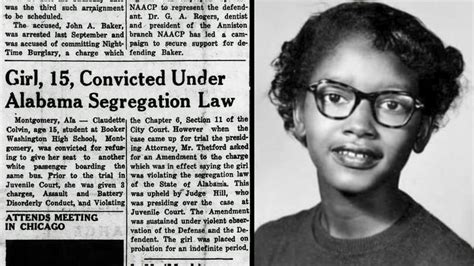
Eight months before Parks, Colvin also refused to give up her bus seat

 Note: If you wish to receive, via e-mail, (1) my weekly newsletter or (2) daily copies of these posts, write to me at rrbates1951@gmail.com. Comments may also be sent to this addss. I promise not to share your e-mail with anyone. To unsubscribe, write here as well.

Tuesday

Rosa Parks triggered the Montgomery Bus Boycott 70 years ago this past Friday. Two weeks after attending a workshop for activists at the Highlander Folk School, she refused to give up her seat to a white passenger and was arrested. The resulting collective action, which saw massive grassroot efforts (including a carpool operation that, at its peak, saw 15-20,000 rides a day), kickstarted the civil rights movement and changed history. 

As a recent article in the Guardian explains, however, often we draw the wrong lessons from the boycott. There was every reason to believe it wouldn’t work. In other words, sometimes we have to dream the impossible and then continue acting as though it’s possible:

Today, as people see rising injustice, many get mired in the question: What will work? We search for the right legal case, the right tactic, the right leader. But the greatest lesson of the Montgomery bus boycott is that is the wrong question. If Rosa Parks had asked what will work on 1 December, she wouldn’t have refused to give up her seat. If Black Montgomery residents had worried about being too disruptive, if the Kings had listened to their parents, if Georgia Gilmore had thought about how much money they needed, they wouldn’t have acted. What worked was the ability to keep going, amid fear and uncertainty, amid job loss and police harassment, amid years of stands that produced nothing, amid the need to organize and maintain a massive carpool system no one had ever built before. “We can learn to play on locked pianos,” King’s friend Vincent Harding observed, “and to dream of worlds that do not yet exist.”

Among the stands that appeared to produce nothing was that of 15-year-old Claudette Colvin eight months prior to Rosa Parks. She too refused to give up her seat and, when the police dragged her off the bus, she was charged with assaulting an officer. Although there was some outrage in the Black community over the arrest, no mass movement followed. That’s because (according to the Guardian) “many adults saw Colvin as too young, poor and feisty to rally behind.” Yet without Colvin having done what she did, 

it is unlikely Parks’s arrest would have galvanized people the way it did. Movements do not result from the first or second outrage but from an accumulation of injustice that brings people to a breaking point.

In 1998 Rita Dove honored Colvin—and by extension all those anonymous historical actors so critical to significant change–in “Claudette Colvin Goes to Work.” The poem captures Colvin when she was working in a Manhattan nursing home, having been forced to leave Montgomery because of her reputation. The poem focuses on her invisibility, having her remark, “Sometimes I wait until it’s dark enough for my body to disappear.” That her heroic action led to exile and abandonment prompts her to lament, “What do we have to do to make God love us?”

Colvin’s heroism did not end in 1955. As Dove has her say,

I help those who can’t help themselves,
I do what needs to be done . . . and I sleep
whenever sleep comes down on me.

 Here’s the poem:

Claudette Colvin Goes to Work
By Rita Dove

Another Negro woman has been arrested and thrown into jail because she refused to get up out of her seat on the bus and give it to a white person. This is the second time since the Claudette Colbert [sic] case. . . . This must be stopped. — Montgomery Bus Boycott flier

December 5, 1955
Menial twilight sweeps the storefronts along Lexington
as the shadows arrive to take their places
among the scourge of the earth. Here and there
a fickle brilliance — lightbulbs coming on
in each narrow residence, the golden wattage
of bleak interiors announcing Anyone home?
or I’m beat, bring me a beer.

Mostly I say to myself Still here. Lay
my keys on the table, pack the perishables away
before flipping the switch. I like the sugary
look of things in bad light — one drop of sweat
is all it would take to dissolve an armchair pillow
into brocade residue. Sometimes I wait until
it’s dark enough for my body to disappear;

then I know it’s time to start out for work.
Along the Avenue, the cabs start up, heading
toward midtown; neon stutters into ecstasy
as the male integers light up their smokes and let loose
a stream of brave talk: “Hey Mama” souring quickly to
“Your Mama” when there’s no answer — as if
the most injury they can do is insult the reason

you’re here at all, walking in your whites
down to the stop so you can make a living.
So ugly, so fat, so dumb, so greasy —
What do we have to do to make God love us?
Mama was a maid; my daddy mowed lawns like a boy,
and I’m the crazy girl off the bus, the one
who wrote in class she was going to be President.

I take the Number 6 bus to the Lex Ave train
and then I’m there all night, adjusting the sheets,
emptying the pans. And I don’t curse or spit
or kick and scratch like they say I did then.
I help those who can’t help themselves,
I do what needs to be done . . . and I sleep
whenever sleep comes down on me.

Posted in Uncategorized | Tagged , , , , | Comments closed

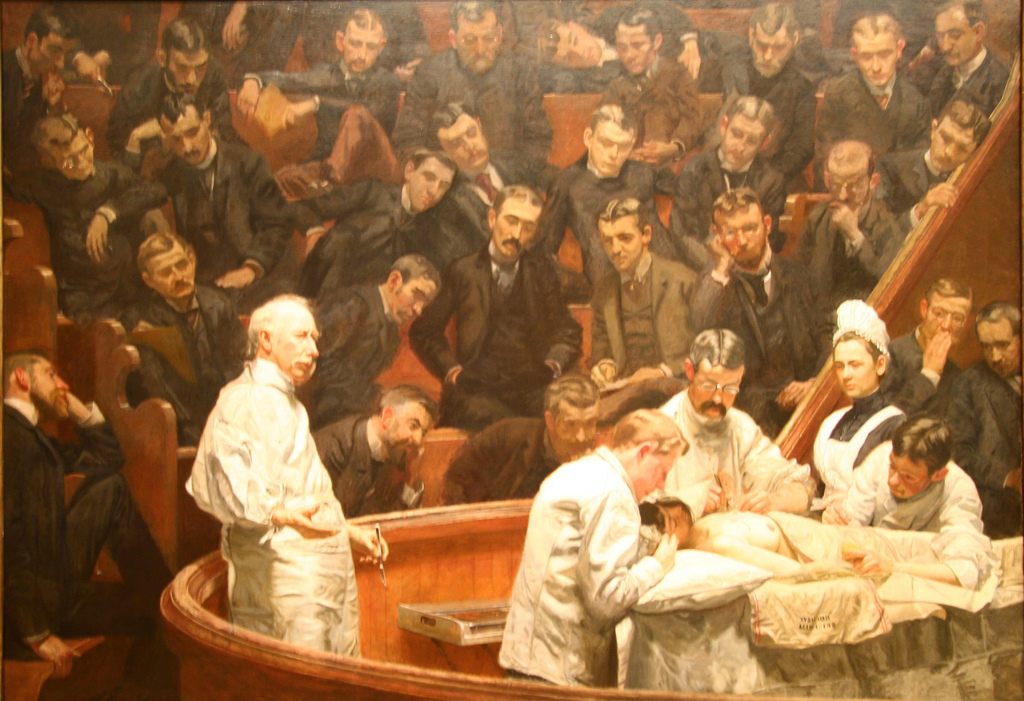
Poetry in the Operating Room

Thomas Eakin, The Operating Room (1899)

 Note: If you wish to receive, via e-mail, (1) my weekly newsletter or (2) daily copies of these posts, write to me at rrbates1951@gmail.com. Comments may also be sent to this addss. I promise not to share your e-mail with anyone. To unsubscribe, write here as well.

Monday

I report today on a lovely note I received from a reader recounting how he used a poem in a critical situation. Anyone about to undergo a surgical operation should consider sharing Denise Levertov’s “The Avowal” with his or her operating team.

Responding to my recent post on how Tom Stoppard’s Arcadia inspired a cancer researcher to a breakthrough discovery, the reader wrote,

Poetry, drama, science, our hearts work together. Yesterday, moments before I was to fall asleep, I invited my new heart pacemaker team to take a moment for a benediction. My doctor hadn’t entered yet, but a team of five became still. I recited “The Avowal” by Denise Levertov, and all paused, listened, and nodded before returning to their labors.

The surgery was apparently successful. “All is well,” the patient reported. “Especially when we work together.”

Here’s the poem, which echoes metaphysical poet George Herbert in title and sentiment (although Herbert sometimes struggles a bit more before surrendering to God’s “all-surrounding grace”). Levertov informs us she wrote it to celebrate the poet’s birthday:

The Avowal
By Denise Levertov

For Carolyn Kizer and John Woodbridge,
Recalling Our Celebration
of George Herbert’s Birthday, 1983

As swimmers dare
to lie face to the sky
and water bears them,
as hawks rest upon air
and air sustains them,
so would I learn to attain
freefall, and float
into Creator Spirit’s deep embrace,
knowing no effort earns
that all-surrounding grace.

I imagine the patient, as the anesthesia is about to take effect, thinking of himself floating in the “Creator Spirit’s deep embrace.” He is daring “to lie face to the sky.” How could his operating team not take special care with someone who has, so thoughtfully, surrendered his body to their care?

I suspect, when performing a routine surgery, such medical professionals are in danger of regarding themselves as mere mechanics of the body. Hearing a patient cite “The Avowal” would remind them of medicine’s higher calling. And perhaps why they became doctors in the first place.

Posted in Uncategorized | Tagged , , , , | Comments closed

Jesus Christ the Apple Tree

 Note: If you wish to receive, via e-mail, (1) my weekly newsletter or (2) daily copies of these posts, write to me at rrbates1951@gmail.com. Comments may also be sent to this addss. I promise not to share your e-mail with anyone. To unsubscribe, write here as well.

Sunday

A Calvinist clergyman from Northhamptonshire is believed to have written the poem that, once set to music, became one of the season’s most beloved carols. I love Rev. Richard Hutchins’s “Christ the Apple Tree” composed in 1761, for how it grounds Jesus in the beauty of the natural world. “The tree of life my soul hath seen,” the poem begins, “Laden with fruit and always green.” And if the trees of nature are wondrous, then Christ the Apple Tree is more so. 

As I researched the poem, I was reminded of three Biblical passages where trees stand in for the spiritual realm. In Song of Solomon (2:3), which uses erotic love to convey the nature of divine love, we read, “Like an apple tree among the trees of the forest is my beloved among the young men. I delight to sit in his shade, and his fruit is sweet to my taste.”

Then there is Jesus using a mustard tree to convey to his disciples a sense of the kingdom of God (Luke 13:18-19):

Then Jesus asked, “What is the kingdom of God like? What shall I compare it to? It is like a mustard seed, which a man took and planted in his garden. It grew and became a tree, and the birds perched in its branches.” 

Finally, John of Patmos mentions the tree of life in the Book of Revelation (22:1-2):

And he showed me a river of the water of life, clear as crystal, coming from the throne of God and of the Lamb, in the middle of its street. On either side of the river was the tree of life, bearing twelve kinds of fruit, yielding its fruit every month; and the leaves of the tree were for the healing of the nations.

Here’s the poem:

Christ the Apple Tree
By the Rev. Richard Hutchins

The tree of life my soul hath seen,
Laden with fruit and always green;
The trees of nature fruitless be,
Compared with Christ the Apple Tree.

His beauty doth all things excel,
By faith I know but ne’er can tell
The glory which I now can see,
In Jesus Christ the Apple Tree.

For happiness I long have sought,
And pleasure dearly I have bought;
I missed of all but now I see
‘Tis found in Christ the Apple Tree.

I’m weary with my former toil – 
Here I will sit and rest awhile,
Under the shadow I will be,
Of Jesus Christ the Apple Tree.

With great delight I’ll make my stay,
There’s none shall fright my soul away; 
Among the sons of men I see 
There’s none like Christ the Apple Tree.

I’ll sit and eat this fruit divine, 
It cheers my heart like spirit’al wine; 
And now this fruit is sweet to me, 
That grows on Christ the Apple Tree.

This fruit doth make my soul to thrive,
It keeps my dying faith alive;
Which makes my soul in haste to be
With Jesus Christ the Apple Tree.

British Christianity has special power because of its roots in Celtic nature religions (Sir Gawain and the Green Knight is my favorite example), so I’m not surprised to learn that “Christ the Apple Tree” may have grown out of winter season songs used in wassailing apple orchards. Apparently there were once special ceremonies that involved pouring out libations to ensure the fertility of the trees. One imagines communities sitting around fires at this time of year, imbibing hard cider while praying to God or the green man or a combination of the two to ensure the return of spring. 

I’ll set and eat this fruit divine, it cheers my heart like spirit’al wine.  

Posted in Uncategorized | Tagged , , , , | Comments closed

Grad School, Baptism by Literary Fire

Matthias Stomer, Student Reading by Candlelight

Note: If you wish to receive, via e-mail, (1) my weekly newsletter or (2) daily copies of these posts, write to me at rrbates1951@gmail.com. Comments may also be sent to this addss. I promise not to share your e-mail with anyone. To unsubscribe, write here as well.

Friday

An English graduate program is, by definition, literature-intense, which means that recounting how this stage of my life intersected with poetry and fiction risks overshadowing everything else in my life. This “everything else” included my developing marriage with Julia, then in its third year, and the birth of our first child four years later. For simplicity’s sake I will separate the academic out from the personal, starting with the academic.

In tracking my intellectual development in those years, I use as a model a book I read in a Carleton class on “The 20th century French Novel.” Roger Martin du Gard’s Jean Barois is the life story of a man who is raised Catholic, breaks with the church and his devout wife over his scientific interests, becomes an activist intellectual in response to the Dreyfus affair, and finally circles back to his Catholicism and his wife at the end of his life. Given that I was going through my own intense intellectual exploration, Jean Barois read to me less like a novel and more like, well, life. 

I mention the novel here because I think it has helped shape how I am writing this memoir and how I see my life. Like Barois’s life arc, mine has progressed through various intellectual, political, literary, and religious movements.

[As an aside, I find myself amazed at all the novels that Don Scheer assigned in that class. In ten weeks we read, in French, Jean Barois, André Malraux’s La Condition Humaine, Jean Paul Sartre’s Nausea, Albert Camus’s The Plague, and Michel Butor’s La Modification. And Scheer had also been planning to have us read Simone de Beauvoir’s Les Mandarins but dropped it.]

So what were my movements? The year was 1975, which meant that the political tumult caused by the Vietnam War and the Black power movement was subsiding. I came from Carleton carrying my intellectual Marxism although, if truth be told, it was a fairly benign Marxism since I was also committed to Martin Luther King’s principles of non-violence. At Emory I encountered New Criticism, which still had a strong hold on English Departments, and I felt out of my depth when I saw my fellow students ferreting out image patterns running through works. They appeared to me as magicians pulling rabbits out of hats, which led me to believe that literary criticism was an arcane discipline where one, like Talmudic rabbis, read between the lines to discover the work’s deep secrets. I desperately wanted to acquire this ability, even if I wasn’t sure where it was supposed to lead.

New Criticism is a formalist approach to literature, which is to say it focuses above all on the text while giving short shrift to author, reader, and historical context. Its successors—structuralism and deconstruction—did the same. As I would break with formalism once I discovered its limited scope, I’d like to say a few words in its defense. If scholars focused exclusively on the text for several decades, it was because they were so enthralled by literature’s dazzling complexity that it seemed enough to devote all their energies to that purpose. Why study such secondary topics as authors’ lives and time periods, not to mention what readers carry away from a work, when the works themselves are so thrilling.

Although I developed my own close reading skills, I was fortunate that not everyone at Emory was a dyed-in-the-wood New Critic. Victorianist Jerome Beaty introduced me to reception theory in a departmental presentation he gave on Jane Eyre. The novel, he pointed out, played with and ultimately overturned the expectations that readers brought to it, especially gothic expectations. In other words, the work is engaged in an active dialogue with the reader. In his talk Beaty recommended the German reception theorist Hans Robert Jauss, and when I read Jauss’s major article I discovered there was a place for me in literary scholarship after all.

Jauss argues that great literature widens a reader’s “horizon of expectations” whereas lesser literature just confirms what the reader already knows. While Jauss is somewhat modest in his claims—he’s just talking about how literary history evolves—I immediately took the next step: great literature, I wanted to believe, radically changes readers and (because readers are part of society) history itself. In my college senior thesis I had argued that the French Enlightenment brought about the French Revolution, and now I had someone explaining how such momentous change could happen. 

I immediately put the theory to work in Beaty’s “Early Novels of Charles Dickens,” arguing that, in Martin Chuzzlewit, the author springs a trap on the reader. Because Dickens had already established the family hearth as the most holy place in British society—he was beloved for warm family scenes in The Pickwick Papers, Oliver Twist, and The Old Curiosity Shop—readers were shocked when the author placed a hypocritical villain spouting Dickensian platitudes smack dab in the middle of this hearth. Dickens was concerned that people were only paying lip service to these values, embracing them on Sunday before returning on Monday to ruthless laissez faire capitalism. Dickens wanted to shake his audience up and shake them up he did: Martin Chuzzlewit would be his first commercial failure and only years later did they come around to praising it. Jauss would say their horizon had to be widened before that could appreciate the novel’s vision.

I felt like I shouldn’t apply reader response theory to every work I studied—I wouldn’t learn anything new if I did the same thing over and over-—so I branched out and experimented with other approaches in other classes. Some resulted in essays that felt inauthentic (see my post on inauthenticity here), others moved me forward. Of the latter, I took a class in Carl Jung and saw how literature could function as a kind of therapy, changing lives in the process. In a Chaucer class I wrote about how the Wife of Bath wants to be one of the guys, with her prologue and tale expressing longing and frustration. 

I brought all my interests together in my dissertation, contending that the Scottish novelist Tobias Smollett used his novels to understand the economic, political, and cultural shifts underway in his society. Literature, I contended, could work as a social barometer.

During my time at Emory I developed a deep friendship with Norman Finkelstein—the noted poet and literary scholar, not the outspoken critic of Israel—and together we explored various form of literary Marxism. For a brief moment we flirted with the ideas of Lyndon LaRouche, who saw philosophers and artists playing a major role in world history. In LaRouche’s view, Aristotle and his intellectual and artistic heirs have had a deleterious effect on history whereas Plato and those who followed in his wake (Renaissance artists and the Romantics among them) offer a vision of the true and the good. Norman and I quickly learned that Larouchites were narrowly doctrinaire—LaRouche had his origins in Trotskyism but swung hard to the right in his later years—but the idea that literature could play a significant role in history was heady stuff.

We were also drawn to the Marxist criticism of such figures as Terry Eagleton and Frederic Jameson. Both warned against literature that towed a party line (they called this “vulgar Marxism”) and argued that great literature opened the mind to progressive possibilities, even when the authors were themselves conservative. (I remember applying these ideas in a Jane Austen essay, arguing that the author is seeking wholeness in a world that she feels is falling apart.) Ultimately our scholarship would go in different directions, with Norman pursuing a more esoteric path, I a more utilitarian one. The friendship, however, was one of the high points of my graduate experience, and it has continued to this day.

I mention one other development although it is only peripherally connected to literature. Film historian David Cook had begun teaching film classes in the English Department and I became enthralled with cinema. Movies had an immediacy that balanced out my focus on 18th century studies: I could examine how they change contemporary lives as authors like Fielding, Smollett and Austen had once changed past lives. An essay I wrote for Cook on the Czech New Wave—I argued that the films produced in 1967 and 1968 redefined socialism in ways that galvanized the Czech populace but threatened Soviet control—would become my first scholarly publication. I would subsequently introduce film classes to St. Mary’s College of Maryland and travel to Yugoslavia to study its cinema. My major scholarly publications are in film rather than in literature, even though my deepest love has always been literature.

As I look back, I realize my scholarly life could have taken a different direction—a road not taken—had I chosen a different dissertation topic. I thought I wanted to study how literature could change history and, since satire seemed the form of literature most concerned with changing lives, I mentioned this to Paul Hunter. He suggested I write about Smollett, the ship surgeon turned novelist, and I dutifully went along, even though I didn’t really like him. (Smollett is grumpy all the time, so much so that fellow author Laurence Sterne once referred to him as Dr. Smellfungus). It’s hard to pursue scholarship where there’s distaste. In retrospect, I wish I had chosen a topic related to a presentation Hunter once delivered to the department. 

In “The Loneliness of the Long Distance Reader,” Hunter talked about the radical experience of immersing oneself in the new (or novel) genre that had burst upon the public in the 18th century. People became acquainted with a new kind of solitude, and their engagement with novels was sometimes so intense that some wives would disappear for days in works like Samuel Richardson’s Clarissa, which is over a million words long. Domestic duties were abandoned, servants slacked off, and husbands became upset, all because of a new literary form. No wonder so many critics attacked or satirized the novel in that century, leading to Jane Austen’s mixed defense in Northanger Abbey.

If, in discussing possible dissertation topics with Hunter, I had said, “I want to do something along these lines,” I would have delved into accounts of reading rather than focuses on an author about whom I was indifferent. This in turn would have linked me up with scholars who were beginning to focus on the reader, and I would have written articles and books on the subject. Instead, I wrote articles about Citizen Kane, Jean Renoir’s Rules of the Game, and other films.

Am I (to borrow from Robert Frost’s “The Road Not Taken”) saying this with a sigh? A little. Then again, my incursion into film studies led me down such interesting paths—an article co-written with my father, a lifelong relationship with Slovenia—that I can’t complain. And, in the end, I have returned to my early interest in how literature changes lives and (sometimes) history. 

In the short story “The Garden of Forking Paths,” Jorge Luis Borges has a different take on Frost’s poem, noting that sometimes paths that diverge go on to reconverge at a later time. The landscapes through which one travels may be different, but the end point can still be the same, or at least can rhyme. A question first formulated in college, it so happens, has been there guiding me all along. 

Posted in Uncategorized | Tagged , , , , , , , , | Comments closed

Hegseth, Banquo, and Murders at Sea

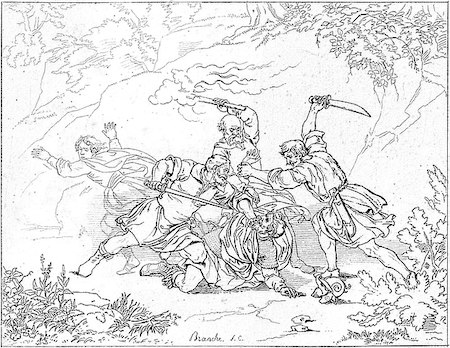
Murder of Banquo in Macbeth

Note: If you wish to receive, via e-mail, (1) my weekly newsletter or (2) daily copies of these posts, write to me at rrbates1951@gmail.com. Comments may also be sent to this addss. I promise not to share your e-mail with anyone. To unsubscribe, write here as well.

Thursday

On Tuesday I applied Shakespeare’s Macbeth to the Trump administration, seeing rising levels of violence associated with both. I look today at how Macbeth orders one of the killings since there’s currently disagreement as to who, in the U.S. military, gave the order to kill two survivors clinging to the wreckage of one of the boats destroyed by the Navy. Of course, the initial attack was already a crime, but the so-called “double tap” is particularly egregious given that killing survivors is specifically spelled out and expressly forbidden in the Navy handbook.

The act was so bad that even Trump and Hegseth are attempting to pass the buck, Trump to Hegseth and Hegseth to commander of the operation Admiral Frank “Mitch” Bradley. Hegseth had originally ordered Bradley to “kill everybody,” and perhaps Bradley took to heart Hegseth’s words—this when he postured before the nation’s military leaders this past September–that we  

don’t fight with stupid rules of engagement. We untie the hands of our warfighters to intimidate, demoralize, hunt, and kill the enemies of our country. No more politically correct and overbearing rules of engagement, just common sense, maximum lethality, and authority for warfighters. 

If he chose to dispense with the rules of engagement, Bradley may be sweating bullets as Hegseth now appears to be backing away from him. Hegseth’s declaration, “I stand by him and the combat decisions he has made” is not the same as “Bradley carried out my orders.” While acknowledging that he witnessed the initial strike, the Defense Secretary said he left the room before the double tap because “at the Department of War we got a lot of things to do.” He also said that the “fog of war” obscured what actually happened.

Macbeth too seeks to distance himself from the crime he is orchestrating. As he addresses the two men who are to kill his former companion Banquo, he acknowledges that he could “with barefac’d power sweep him from my sight.” Doing so, however, would alienate certain allies. “I must not,” he says,

For certain friends that are both his and mine,
Whose loves I may not drop, but wail his fall
Who I myself struck down: and thence it is
That I to your assistance do make love [beg your help],
Masking the business from the common eye
For sundry weighty reasons.

In addition to masking the business, he tells the men to make sure they kill Banquo far from the palace. 

Catching my eye in Macbeth’s exchange is the Trumpian tactic of inflaming grievances to get people to do one’s dirty work. Banquo had done you wrong, he tells the two men, which sounds a lot like Trump and Hegseth inflaming passions against (in this case) the men in the boats. Now, we don’t have any evidence that Banquo has in fact rendered the murderers’ lives destitute and miserable, just as there’s no evidence that the drugs on board the boats (if drugs were in fact involved) were bound for the U.S. But facts don’t matter to autocrats. Still, Macbeth’s killers, like Trump’s supporters, buy into his accusations:

Mabeth: Both of you
Know Banquo was your enemy.
Both Murderers: True, my lord.

For his part, Bradley sounds like he bought the Trumpian line of drug traffickers at war with the U.S., rationalizing that the survivors “were still legitimate targets because they could theoretically call other traffickers to retrieve them and their cargo.” Realizing how problematic this sounded, the Joint Special Operations Command subsequently said the second strike was not to kill survivors but to remove a navigation hazard.  

Macbeth doesn’t only seek to stir up vengeful resentment but also challenges the killers’ manhood. Do you let religion get in your way, he asks at one point, and at another, are you hounds and demi-wolves or lapdogs and spaniels? Tell me you’re “not i’ th’ worst rank of manhood,” he demands. Pete Hegseth made his own macho challenge when strutting before the generals. “Weak men won’t qualify because we’re not playing games,” he said at one point and, at another, “Should our enemies choose foolishly to challenge us, they will be crushed by the violence, precision, and ferocity of the War Department. In other words, to our enemies, FAFO [Fuck Around and Find Out]. If necessary, our troops can translate that for you.”

So, if you don’t blast small boats out of the water, you’re not real men.

“Banquo, thy soul’s flight, if it find heaven, must find it out tonight,” Macbeth gloats after the murderers leave, and I can imagine Hegseth indulging in his own private gloating. But people who thrill to the prospect of killing people we call sociopaths and psychopaths.

The difference between the two is that sociopaths are at least capable of feeling guilt. This would make the Macbeths sociopaths since they both arrive at moments of searing self-reflection. “Out, damned spot! out, I say!” says Lady Macbeth as she walks in her sleep and then, “What, will these hands ne’er be clean?….Here’s the smell of the blood still: all the perfumes of Arabia will not sweeten this little hand.”

Macbeth, meanwhile, comes to realize the hollowness of his life and the emptiness of ambition in one of literature’s most memorable passages:

Tomorrow, and tomorrow, and tomorrow,
Creeps in this petty pace from day to day,
To the last syllable of recorded time;
And all our yesterdays have lighted fools
The way to dusty death. Out, out, brief candle!
Life’s but a walking shadow; a poor player,
That struts and frets his hour upon the stage,
And then is heard no more: it is a tale
Told by an idiot, full of sound and fury,
Signifying nothing.

Trump and Hegseth are both idiots full of sound and fury. Will they ever be capable of realizing it? 

Posted in Uncategorized | Tagged , , , | Comments closed

Stoppard (R.I.P.) and a Cancer Discovery

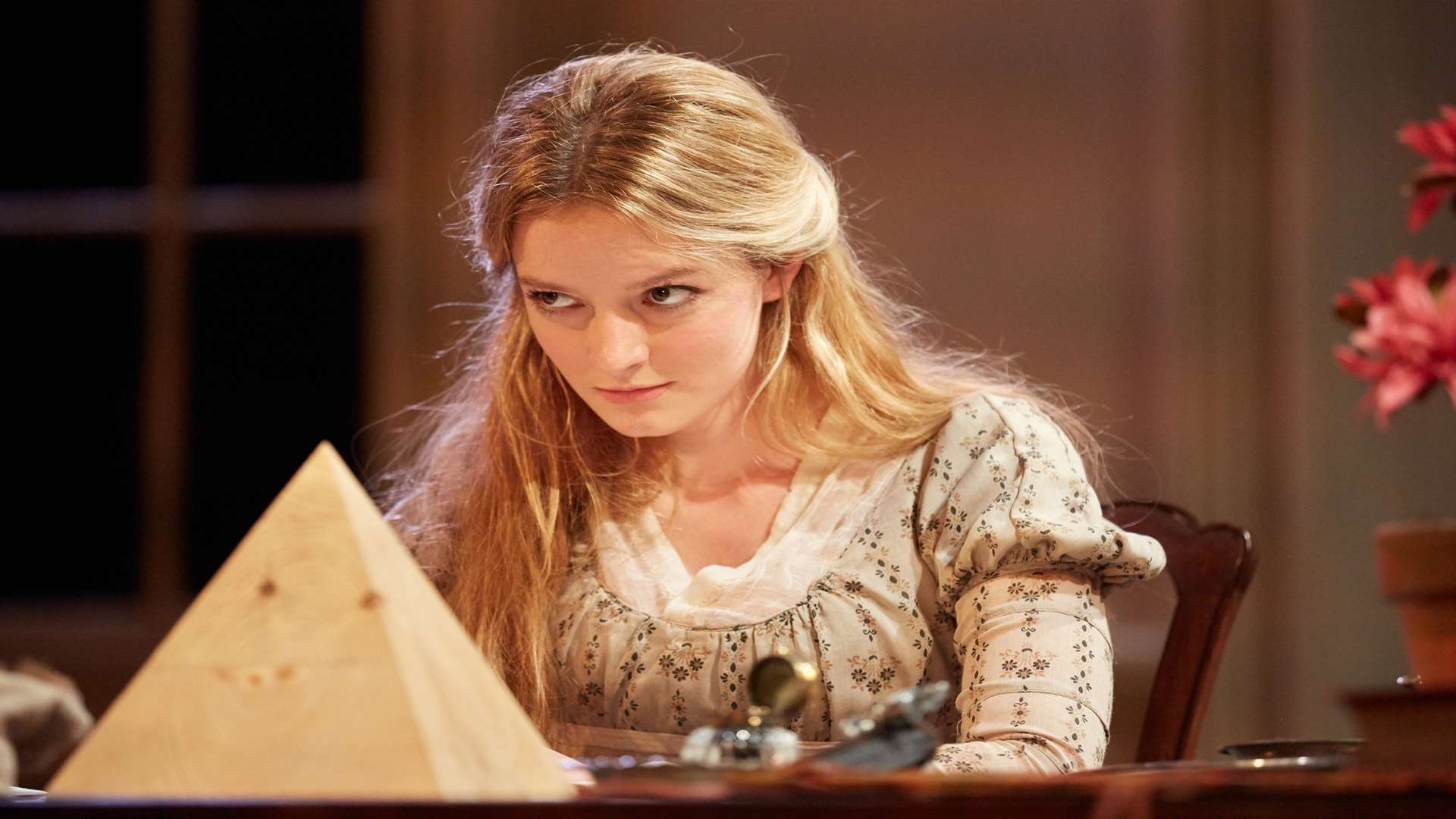
Dakota Blue Richards as Thomasina in Arcadia

Note: If you wish to receive, via e-mail, (1) my weekly newsletter or (2) daily copies of these posts, write to me at rrbates1951@gmail.com. Comments may also be sent to this addss. I promise not to share your e-mail with anyone. To unsubscribe, write here as well.

Wednesday

Of the many responses to playwright Tom Stoppard’s recent death, the most interesting to me has been a letter written to (I think) the London Times by Michael Baum, Professor Emeritus of Surgery and Visiting Professor of Medical Humanities at University College London. According to Wikipedia, Baum pioneered a radical breakthrough in breast cancer treatment, one that led to a 30% drop in mortality (!) while providing effective prevention in susceptible women. Baum said he owes the breakthrough in part to Stoppard’s play Arcadia.

Perhaps Stoppard’s best play and my personal favorite, Arcadia features 17-year-old Thomasina, who is based on mathematical genius Ada Lovelace. The daughter of Lord Byron, Lovelace anticipated the invention of the computer while her work on fractals was a century ahead of its time. (It would take computers to prove her right.) In the play Thomasina points out that the Euclidean geometry of her day doesn’t come close to capturing the complexity of nature:

Thomasina: Each week I plot your equations dot for dot, xs against ys in all manner of algebraical relation, and every week they draw themselves as commonplace geometry, as if the world of forms were nothing but arcs and angles. God’s truth, Septimus, if there is an equation for a curve like a bell, there must be an equation for one like a bluebell, and if a bluebell, why not a rose? Do we believe nature is written in numbers? 
Septimus: We do. 
Thomasina: Then why do your equations only describe the shapes of manufacture? 
Septimus: I do not know. 
Thomasina: Armed thus, God could only make a cabinet.” 

Later she points out, 

Mountains are not pyramids and trees are not cones. God must love gunnery and architecture if Euclid is his only geometry. There is another geometry which I am engaged in discovering by trial and error…

The play toggles between past and present, with contemporary historians discovering Thomasina’s amazing work. They find a journal in which the 17-year-old declares, 

I, Thomasina Coverly, have found a truly wonderful method whereby all the forms of nature must give up their numerical secrets and draw themselves through number alone. This margin being too mean for my purpose, the reader must look elsewhere for the New Geometry of Irregular Forms discovered by Thomasina Coverly.

We also see Thomasina’s insights into the nature of entropy:

When you stir your rice pudding, Septimus, the spoonful of jam spreads itself round making red trails like the picture of a meteor in my astronomical atlas. But if you stir backward, the jam will not come together again. Indeed, the pudding does not notice and continues to turn pink just as before. Do you think this is odd?

And one more observation:

If you act only on what you should do without heed for what you want to do, you’re nothing more than a machine, a phenomenon.

Dr. Baum calls his medical breakthrough a road-to-Damascus moment:

Sir, 
In 1993 my wife and I went to see the first production of Arcadia by Tom Stoppard (obituary, Dec. 1), and in the interval I experienced a Damascene conversion. As a clinical scientist I was trying to understand the enigma of the behavior of breast cancer, the assumption being that it grew in a linear trajectory spitting off metastases on its way. In the first act of Arcadia, Thomasina asks her tutor, Septimus: “If there is an equation for a curve like a bell, there must be an equation for one like a bluebell, and if a bluebell, why not a rose?” With that Stoppard explains chaos theory, which better explains the behavior of breast cancer. At the point of diagnosis, the cancer must have already scattered cancer cells into the circulation that nest latent in distant organs. The consequence of that hypothesis was the birth of “adjuvant systemic chemotherapy,” and rapidly we saw a striking fall of the curve that illustrated patients’ survival. 

Stoppard never learnt how many lives he saved by writing Arcadia. 

I’m no scientist but it sounds like the play did more than provide Baum with compelling metaphors for chaos theory. Arcadia shows a character refusing to be bound by conventional categories and choosing instead to think outside the box—which it sounds like Baum did to arrive at his discovery.

Amazing things happen when scientists interact with the work of creative writers. Another reason why pre-med students should take literature courses.

Posted in Uncategorized | Tagged , , , | Comments closed

Macduff as the Trump Resistance

Macduff battles Macbeth

 Note: If you wish to receive, via e-mail, (1) my weekly newsletter or (2) daily copies of these posts, write to me at rrbates1951@gmail.com. Comments may also be sent to this addss. I promise not to share your e-mail with anyone. To unsubscribe, write here as well.

Tuesday

For a while I’ve thought that King Lear was the Shakespeare tragedy that best captures the Trump presidency. After all, it involves a demented leader whose narcissism plunges his country into civil war and destroys everyone around him. Now, however, I’m wondering if the escalating violence of Macbeth is a better fit.

In the Scottish tragedy, as we all know, Macbeth and his wife keep adding to the body count in their efforts to seize and hold on to power: first Duncan and his guards, then Macbeth’s best friend Banquo, then Macduff’s family. In our own case, we first witnessed the kidnappings of law-abiding immigrants and the deployment of national guard units to cities and states that don’t want them. Then, just as Americans were figuring out how to push back against these actions, Defense Secretary Pete Hegseth (or, as he sees himself, War Secretary) began ordering the armed forces to blow up boats at sea and kill everyone on board. The only debate is whether “war crime” or “murder” is the better descriptor. At the same time, Trump is threatening to go to war with Venezuela.

Appalled at what they have been witnessing, six Democratic lawmakers, all former members of the military, made a video reminding officers that they took an oath to follow only legal orders. Indeed, they are required to disobey unlawful orders. In response to the video, Trump called the six lawmakers “traitors” and accused them of sedition, which he said is “punishable by death.” Other Trumpists followed suit. 

In Macbeth one also finds law-abiding characters who are accused of treason. After Macbeth kills Duncan and pins the blame on the two guards, Duncan’s two sons flee the court. Unlike Banquo and Macduff, they can see what is really going on and know that they will be targeted next. Here’s their conversation:

Malcolm: What will you do? Let’s not consort with them:
To show an unfelt sorrow is an office
Which the false man does easy. I’ll to England.

Donalbain: To Ireland, I; our separated fortune
Shall keep us both the safer: where we are,
There’s daggers in men’s smiles: the near in blood,
The nearer bloody.

Malcolm: This murderous shaft that’s shot
Hath not yet lighted, and our safest way
Is to avoid the aim. Therefore, to horse;
And let us not be dainty of leave-taking,
But shift away: there’s warrant in that theft
Which steals itself, when there’s no mercy left.

I’m not seeing many smiles in Trump, Miller or Hegseth. But daggers, yes.

At first, Malcolm and Donalbain’s flight is seen as proof of guilt. Even Macduff, who will later become their ally, is fooled:

Malcolm and Donalbain, the king’s two sons,
Are stol’n away and fled; which puts upon them
Suspicion of the deed.

Macduff and Banquo bring to mind those former supporters of Trump that fell out with him. The Lincoln Project’s Rick Wilson coined the phrase that “everything Trump touches dies” (ETTD), and that’s true of what Macbeth touches as well. Banquo is killed, as are Macduff’s wife and children. 

Given that we require our officers to swear loyalty to the Constitution, not to Trump, it’s interesting to see how Malcolm tests Macduff to determine his allegiance. Macduff pretends to believe that Macbeth is a better king than he could be, prompting Macduff to cry out in despair, “O Scotland, Scotland!” and 

O nation miserable,
With an untitled tyrant bloody-scepter’d,
When shalt thou see thy wholesome days again?

Convinced that Macduff puts Scotland first, Malcolm then reveals that he is fully prepared to overthrow Macbeth and will do whatever is required. While it isn’t Macduff who prods Malcolm into action—Duncan’s son is fully prepared to battle Macbeth—I still think of Democratic voters prodding their elected representatives to take stronger action against Trump. It’s certainly easier for Malcolm to act once he knows he has a fully committed Macduff fighting for him.

In the final confrontation, Macbeth taunts his enemy with a Renaissance version of “bring it on”—“Lay on, Macduff; and damn’d be him that first cries, ‘Hold, enough!’”—and to his sorrow Malcolm does. After months of DJT appearing indomitable, Birnam Wood is on the move and it’s no time to cry, “Hold, enough!”

Posted in Uncategorized | Tagged , , , , | Comments closed

A Poem for Entering December

North Dakota winter prairie

 Note: If you wish to receive, via e-mail, (1) my weekly newsletter or (2) daily copies of these posts, write to me at rrbates1951@gmail.com. Comments may also be sent to this addss. I promise not to share your e-mail with anyone. To unsubscribe, write here as well.

Monday

As we enter the final month of the year, here’s a winter poem by Tom McGrath, who grew up in North Dakota and then moved just across the border—and across the Red River—to teach at the University of Moorhead in Moorhead, Minnesota. In “Beyond the Red River” the poet has watched the progression of the seasons and is now awaiting “a winter lion,/ Body of ice-crystals and sombrero of dead leaves.”

It’s only been a month, McGrath tells us, since “a machinery of early storms rolled toward the holiday houses,” which is to say summer homes “where summer still dozed in the pool-side chairs.” In its turn, the “long freight of autumn” has gone “smoking out of the land.” But rather than packing up and journeying south where new things are possible, the poet tells us that he is “happy enough here, where Dakota drifts wild in the universe.”

As McGrath sees them, the Dakota prairies are like a dark sea, “shaking in the surf of the winter dark.”

Beyond the Red River
By Thomas McGrath 

The birds have flown their summer skies to the south,
And the flower-money is drying in the banks of bent grass
Which the bumble bee has abandoned. We wait for a winter lion,
Body of ice-crystals and sombrero of dead leaves.

A month ago, from the salt engines of the sea,
A machinery of early storms rolled toward the holiday houses
Where summer still dozed in the pool-side chairs, sipping
An aging whiskey of distances and departures.

Now the long freight of autumn goes smoking out of the land.
My possibles are all packed up, but still I do not leave.
I am happy enough here, where Dakota drifts wild in the universe,
Where the prairie is starting to shake in the surf of the winter dark.

The poem reminds me of Mary Oliver’s “A Poem for the Blue Heron,” which I’ve written about here. There’s so much crossover that I wonder if Oliver took her inspiration from McGrath. Oliver too talks of choosing not to chase what is possible although, in her case, she has long ago given up imagining alternative lives. She has no possibles packed:

I do not remember who first said to me, if anyone did:
Not every thing is possible:
some things are impossible,

and took my hand, kindly,
and led me back
from wherever I was.

Regardless of their different life paths, however, both Oliver and McGrath determine to stay in place:

Toward evening
the heron lifts his long wings
leisurely and rows forward

into flight. He
has made his decision: the south
is swirling with clouds, but somewhere,
fibrous with leaves and swamplands,
is a cave he can hide in
and live.

“Blue Heron” can be read as a determination to gut through a depressed state. Even as the winter wind howls around her house and through her mind, she is strengthened by thinking of “a bird with an eye like a full moon/ deciding not to die, after all.” Here’s how she lives: 

I sit out the long afternoons
drinking and talking;
I gather wood, kindling, paper; I make fire
after fire after fire.

McGrath, by contrast, doesn’t so much hunker down as embrace the season. “I am happy enough here,” he writes, “where Dakota drifts wild in the universe.” The dark prairie sends his imagination soaring.

Posted in Uncategorized | Tagged , , , , , , | Comments closed

  • Sign up for my weekly newsletter