Friday
As tomorrow is Valentine’s Day, I devote today’s memoir installment to my marriage to Julia, now in its 53rd year. Like many such marriages, it has had its ups and its downs, during which time literature has often played a key role.
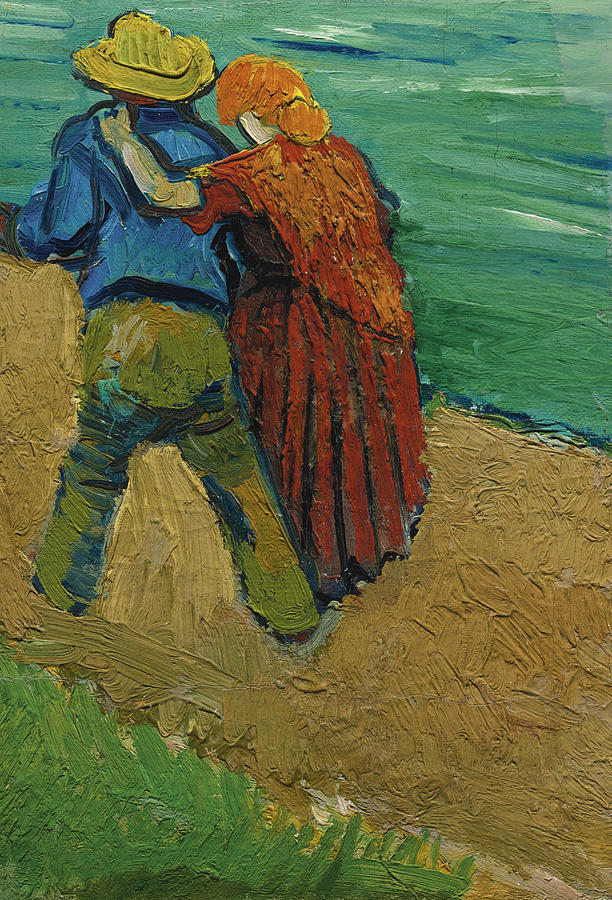
For this week’s poem in the Mountain Messenger, I shared W. S. Merwin’s poem “Here Together,” even though it pivots around a verb that I have long abhorred. That “cling” now seems the right word shows me how my marriage has evolved:
These days I can see us clinging to each other
as we are swept along by the current
I am clinging to you to keep you from
being swept away and you are clinging to me
we see the shores blurring past as we hold
each other in the rushing current
the daylight rushes unheard far above us
how long will we be swept along in the daylight
how long will we cling together in the night
and where will it carry us together
While we don’t normally see “clingy” as positive—it suggests an over-dependence and a reaction to fear rather than a positive affirmation—it now strikes me as a positive description of two people who have been through a lot for a long time and who are now propping each other up as they enter their final years. (Julia and I both turn 75 this year, which some say is transitioning from young old age to middle old age.)
I didn’t want to see ourselves in a clinging relationship when we started out, however. One can see this in a portion of our marriage ceremony, which was influenced by Karl Marx’s dialectic and D. H. Lawrence’s fixation (influenced by Walt Whitman) on the tension between wanting to be self-sufficient and wanting to be part of a greater whole. The stars image is taken from Archibald MacLeish’s “Ars Poetica”:
Minister: The marriage bond is a bond between two individuals. It does not entail a merging of one into the other, for in merging the individuality is lost.
Congregation: There must be a tension of difference. Without the tension, there can be no growth.
Minister: From the tension, this man and this woman will grow to new awarenesses and reach new syntheses. Marriage can be beautiful because it provides a unified form in which to search.
Congregation: Marriage is like a sonnet. As a fixed form, it endows a heightened beauty on the infinite number of variations within.
Minister: The bond is the attraction between two stars revolving around each other, caught in each other’s orbit but resisting an incorporation which would burn brightly but die quickly.
Congregation: “Love is the leaning grasses and two lights above the sea.”
I also acknowledge that I wrote the wedding ceremony in part to rationalize marriage, which in 1973 seemed an outdated institution. So if you detect a slight undertone of defensiveness—or at least, of overexplaining—you’re not wrong.
But I knew I wanted a relationship with Julia, even though—and partly, because—we were so different. She had grown up on a small farm in southeast Iowa and felt that she was entering foreign terrain when she left the state to attend Carleton College. I, on the other hand, was swimming in the water that I had known my entire life.
Often one is drawn to one’s partner because one wants to grow into the undeveloped parts of oneself that the other represents. This was certainly our case. To the extent that she aspired to the world of the intellect and wanted to marry a man comfortable with ideas who could recite poetry (I had reeled off the opening lines from Gerard Manley Hopkins’s “The Golden Echo and the Leaden Echo” in our first encounter), I was attractive to her. On the other hand, as an airy intellectual, I was drawn to how Julia was immersed in what struck me as a real life (milking cows, killing chickens, baling hay). She had a solidity and maturity to her that I felt that I lacked and that, in fact, made her much admired at Carleton. For instance, she was one of the few juniors chosen to be a resident assistant on her hall floor, and her teaching mentor (Harriet Sheridan) said she was one of the most mature students she had ever encountered.
Julia also was much more comfortable with physicality than I was. My family didn’t hug or even like to touch each other when I was growing up, and I will be forever grateful to Julia for helping me push past that taboo.
But of course, whatever draws one to the other person can also become a source of conflict. That’s because growing into the potential that the other person represents—and that a deep part of you knows is essential to your growth–is hard and sometimes painful. Better to fall back on what is familiar. It’s not just that Julia sometimes thought I should be more of the rugged man that her farmer father was (I didn’t know how to fix things) and I thought she should be more of the supportive faculty wife that my mother was, although that was part of it. It’s that she resented my success in the academic world, which she thought she wanted to join even though part of her found it a bit arid. I meanwhile didn’t fully appreciate her need to be grounded in social relationships, including a church community. I bring this up to understand those moments of tension that have arisen in our relationship.
To draw a literary parallel, Darcy needs Elizabeth’s liveliness and sense of humor if he is to escape the smug, self-satisfied, and suffocating world of Catherine de Bourg while she needs his steadiness and community commitment if she is not to grow into the detached satirist that her father is. But if their marriage is to live up to its potential, hard work and a departure from familiar patterns of behavior will be necessary. Darcy will need to learn “to laugh at himself,” as Elizabeth puts it, and she will need to take life more seriously. Her father’s philosophy—”For what do we live, but to make sport for our neighbors, and laugh at them in our turn?”—will not fully serve her when she is patroness of a village.
When tensions arose in our marriage, Julia would become outwardly angry while I would retreat into cold silence (fire and ice, to borrow from Robert Frost). Eventually we dealt with the issues by undergoing family therapy, where we learned that we both had anger suppression issues, which we were passing along to our kids. Although it’s embarrassing to admit, we were also aided by Lifespring, a cultish program that nevertheless featured powerful relationship and leadership exercises that I’ve found to be of use. Somehow we survived the bumps and the marriage grew stronger.
Having acknowledged the differences that led to our disputes, I add that we never stopped admiring and seeking to grow into the undeveloped side of ourselves that had led us into marriage in the first place. Our marriage was strong enough to raise three spectacular men and to survive the death of one of them. We also supported each other in our careers so that, in the end, we were both doing what we most wanted to do. To this day I admire tremendously Julia’s commitment to sustaining community, and Better Living through Beowulf owes much to her as I have sought to understand how literature can aid in this effort. For her part, she came to appreciate my academic work. We sometimes marvel at how calm our lives have become now that we no longer trigger each other.
I was in high school when I first encountered and admired Ezra Pound’s “The Merchant’s Wife: A Letter,” little knowing that it would prove predictive. The difference is that it takes the speaker only a year to overcome feelings of separateness and fully bond with her husband while it has taken Julia and me a lifetime to reach something comparable:
At fourteen I married My Lord you.
I never laughed, being bashful.
Lowering my head, I looked at the wall.
Called to, a thousand times, I never looked back.
At fifteen I stopped scowling,
I desired my dust to be mingled with yours
Forever and forever, and forever.
In the poem, the couple hate to be separated, and while they are technically teenagers while we are septuagenarians, I experience something similar when Julia and I are apart:
At sixteen you departed
You went into far Ku-tō-en, by the river of swirling eddies,
And you have been gone five months.
The monkeys make sorrowful noise overhead.
You dragged your feet when you went out.
By the gate now, the moss is grown, the different mosses,
Too deep to clear them away!
The vision of marriage that I had on our wedding day—“two stars revolving around each other, caught in each other’s orbit but resisting an incorporation which would burn brightly but die quickly”—appears to have come about. We balance our individual interests (tennis and writing for me, community service and various writing, memory, and sewing projects for her) with collective interests (church, politics, travel). And yes, as we face various medical challenges, we cling to each other to keep from being swept away. “In sickness and in health, til death us do part” has taken on special resonance.
I find strangely comforting the vision of our dust being mingled forever and forever and forever.
Past Installments of A Life Lived in Literature
A Life Lived in Literature: How It All Began (Sept. 5, 2025)
Early Reading Memories (Sept. 12, 2025)
Childhood Confusion: Reading to the Rescue (Sept. 19, 2025)
Confronting Segregation (Sept. 26, 2025)
School Reading vs. Real Reading (Oct. 10, 2025)
Childhood in Paris (Oct. 17, 2025)
My Time at Sewanee Military Academy (Oct. 24, 2025)
Existentialism for High School Seniors (Oct. 31, 2025)
Why I Majored in History, Not English (Nov. 7, 2025)
My College Search for Authenticity (Nov. 14, 2025)
On D. H. Lawrence and a Sexual Awakening (Nov. 21, 2025)
My Life as a Bildungsroman (Nov. 28, 2025)
Grad School: Literary Baptism by Fire (Dec. 5, 2025)
Early Scenes from a Marriage (Dec. 12, 2025)
Bringing Up Baby in Grad School (Dec. 19, 2025)
Grappling with Racism (Jan. 2, 2026)
Journal of a Young Teacher (Jan. 16, 2026)
Teaching and Reading in Yugoslavia (Jan. 23, 2026)
Life at 40: Barely Controlled Chaos (Jan 30, 2026)
From Secular Humanist to Christian Believer (Feb. 6 2025)
Looking Back at a Lifetime Together (Feb. 13, 2026)