Passover: The Hard Stories Are Never Told the Same Way Twice

Marc Chagall, Passover Seder

Wednesday Evening – Beginning of Passover

One of many wonderful aspects of Passover is the ritual retelling of the Jewish freedom story.  Ellen Blum Barish explains why the story never gets old.

The Retelling
By Ellen Blum Barish

At my seder table,
I learned that some stories need to be told more than once
to make us stop, gather together and tell it aloud
though we have heard it many times before
so we remember. 

Every spring, we read the same story of our exodus from Egypt
but it is never the same twice.
Every spring, someone is missing for work, move, illness or death.
Every spring, there’s a new mood or geo-political incident. 

The annual retelling is like the sharing of all hard stories,
never told the same way twice.
never heard the same way twice. 

It is a crossing over a desert of shifting sand
that allows us to see something that we hadn’t before
as if for the first time.

Previous Passover Posts
Ellen Blum Barish: The Hard Stories Are Never Told the Same Way Twice (April 1, 2026)
MAGA Reenacts the Enslavement of Joseph (April 14, 2025)
Marge Piercy: Open the Door for Elijah (April 12, 2025)
Chaya Lester: Ask Not for Whom the Bush Burns (April 20, 2024)
Adam Zagajewski: Passover, a Time to Remember Refugees (April 5, 2023)
Harvey Shapiro: Passover Originated in Poetic Vision  (April 14, 2022)
Marge Piercy: Choosing the Dessert over Bondage (March 27, 2021)
Henry Weinfield: Passover, A Ritual for Wanderers  (April 7, 2020)
Harvey Shapiro: Drawn Forth to Eat the History Feast (April 19, 2019)
Norman Finkelstein: This Bloody Flesh, Our Only Food (March 30, 2018)
George Moses Horton: Must I Dwell in Slavery’s Night? (April 8, 2017)
Norman Finkelstein: Blood on the Door Posts (April 16, 2016)
Norman Finkelstein: Death and Miracles and Stars without Number (April 23, 2016)
Nicole Krauss: Replacing the Temple with the Torah (March 29, 2015)
Muriel Rukeyser: The Journeys of the Night Survive (April 13, 2014)
Yehuda Amichai: Finding Peace, Along with a Lost Goat (April 21, 2013)
Primo Levi: A Night Different from All Other Nights (April 17, 2011)

Posted in Uncategorized | Tagged , , | Comments closed

A Morris Bishop April Fools’ Day Poem

Wednesday – April Fools’ Day

Before turning to today’s April Fools’ Day poem, I take a news break to mention that the Tennessee librarian I lauded as a free speech hero last week has been fired by her library board, dominated as it is by homophobic Christians. The fascist assault on public and school libraries continues. I learned about the news too late to retool today’s post so I apologize for the discordant note as I move on to something lighter. If you want an April Fools’ Day essay that calls out oppressive authorities, however, check out the one on Jonathan Swift’s “Modest Proposal” in the appended links.

Today’s poem has a personal story behind it. Humorist Morris Bishop’s poem “How to Treat Elves” captured the sardonic sense of humor that appealed to my college self. To amuse Julia—this was during the summer after we met—I sent it to her. Her romantic sister melted upon reading it until… But I’ll let you read it first before saying more:

How To Treat Elves
By Morris Bishop

I met an elf man in the woods,
The wee-est little elf!
Sitting under a mushroom tall–
‘Twas taller than himself!

“How do you do, little elf,” I said,
“And what do you do all day?”
“I dance ‘n fwolic about,” said he,
“‘N scuttle about and play;”

“I s’prise the butterflies, ‘n when
A katydid I see,
‘Katy didn’t’ I say, and he
Says ‘Katy did!’ to me!

“I hide behind my mushroom stalk
When Mister Mole comes froo,
‘N only jus’ to fwighten him
I jump out’n say ‘Boo!’

“‘N then I swing on a cobweb swing
Up in the air so high,
‘N the cwickets chirp to hear me sing
‘Upsy-daisy-die!’

“‘N then I play with the baby chicks,
I call them, chick chick chick!
‘N what do you think of that?” said he.
I said, “It makes me sick.

“It gives me sharp and shooting pains
To listen to such drool.”
I lifted up my foot, and squashed
The God damn little fool.

Have you recovered yet? Once you have, you can follow me into my story.

First, Wikipedia’s entry on Bishop informs me that novelist Allison Lurie has described the poem as “a brilliant counterattack” against “a particularly cloying sort of supernatural whimsy” that was fashionable in the early 20th century. I know, from having been steeped in Edwardian children’s literature, that readers of the period were fascinated by childhood innocence. In A.S. Byatt’s The Children’s Book, a novel about the period, we see families taking delight in performing the fairy scenes in Midsummer Night’s Dream. 

That being said, I’m not sure what Bishop’s satiric target would have been when he wrote the poem in the 1940s or 1950s.

Humor such as this, Freud points out, can be a way of throwing up defenses, which may explain why I found the poem hilarious. Perhaps my love for Julia was making me feel dangerously vulnerable. After all, as one who was proud of his reasoning powers, I saw the realm of the emotions as treacherous ground. Maybe I regained my balance by laughing at Morris crushing this caricature of unalloyed sweetness.

Italian semiotician and novelist Umberto Eco captures a similar dynamic in his discussion of postmodernism’s suspicion of sentimentality. There too one shies away from naked acknowledgements of deep emotion:

I think of the postmodern attitude as that of a man who loves a very cultivated woman and knows he cannot say to her “I love you madly,” because he knows that she knows (and that she knows he knows) that these words have already been written by Barbara Cartland. Still there is a solution. He can say, “As Barbara Cartland would put it, I love you madly,” At this point, having avoided false innocence, having said clearly it is no longer possible to speak innocently, he will nevertheless say what he wanted to say to the woman: that he loves her in an age of lost innocence.

I’ve written how the movie Princess Bride operates out of this postmodernist stance.

Anyway, although Julia’s sister was appalled, Julia herself made allowances and married me anyway. Perhaps she sensed that repressed intellectuals respond weirdly when they meet the love of their life.

Previous April Fools’ Day Posts
Oliver Goldsmith, “On the Death of a Mad Dog” 
William Combe, The First of April or the Triumph of Folly
Jonathan Swift, The Isaac Bickerstaff Papers
Jonathan Swift, Meditation upon a Broomstick
Jonathan Swift, “The Last Speech and Dying Words of Ebenezer Elliston”
Jonathan Swift, “A Modest Proposal”
Joan Drew Ritchings, “April Fool” 

Posted in Uncategorized | Tagged , , , | Comments closed

Iran War Planners Should Read Tolstoy

Ernest Meissonier, The Retreat from Moscow

 Tuesday

An Israeli foreign-policy analyst writing for the New York Times has offered a literary explanation about why the American and Israeli administrations are blundering so badly in the Middle East: because they don’t read literature or history, they don’t understand their enemy.

Their mistaken belief is that, because they have access to extraordinary weapons and technology, they think they can impose their will. For instance, while their spy tools can penetrate Tehran’s traffic cameras and communications networks, the planners misread what comes through. Touval notes that both America and Israel’s leaders “remain strikingly obtuse about human beings — about their pride, shame, convictions and historical memory.” Or put another way, “never has so much been seen, so precisely, by so many people who understand so little of what they are seeing”:

A system can tell you where a man is. It cannot tell you what his death will mean for a nation. Such systems are trained on behavior, not on meaning — they can track what an adversary does but not what he fears, honors, remembers or would die for.

Then Touval wades into my territory:

What this war exposes, then, is a failure not only of strategy but of literacy. Literature and history, at their most serious, train precisely the faculties these leaders lack: the capacity to grant that other minds are not transparent to us and are governed by purposes not our own. A mind tutored by history and literature knows that actors in the grip of a sacred cause tend to mean what they say — and that bombing a founding myth is more likely to consecrate it than to dissolve it.

Observing that our culture “has increasingly ceded authority to systems that mistake information for understanding and speed for judgment,” Touval turns to Shakespeare, who “understood this blindness better than our strategists.” The Scottish play makes his point:

Macbeth is not merely a play about ambition. It is about a man who catches sight of a possible future and mistakes that glimpse for a license to force events to conform to his interpretation — and then watches that interpretation devour him. Soon he ceases even to pretend that action should wait on understanding. There are things in his head, he tells his wife, that “must be acted ere they may be scanned” — done before they can be thought through.

Just as Macbeth acts not after deliberation but in place of it, so modern targeting systems “promise the same fantasy in technological form: to collapse the interval between seeing and striking, to eliminate the pause in which judgment might still enter.” It is precisely this pattern, Touval declares, that the literary and historical imagination “exists to counter.”

Tolstoy, meanwhile, shows us how, even when military planners use their judgment, things can still go horribly wrong:

In War and Peace, he depicted Napoleon — nourished on Plutarch’s Lives and its portraits of greatness — who marched through Borodino to Moscow and still could not fathom a people who would let their city burn rather than submit. His error was not tactical. It was imaginative: He could not credit the Russians with a logic that was not his own. That is the mistake the architects of this campaign are repeating.

Touval concludes,

The more technologically sophisticated war becomes, the more dangerous it is to place it in the hands of people untrained in irony, contingency and the darker constants of human nature. Such leaders will speak fluently of capabilities, timelines and kill chains. They will have no language for resentment, dishonor, loyalty or grief — and they will discover, too late, that wars are made of these as much as of steel and fire. That is the illiteracy of this war. The algebra of the war makers will have been flawless. But what they cannot read, they will not have reckoned with.

On Nicole Wallace’s MS NOW show yesterday, a military analyst laid out the horror show that will follow if the United States sends “boots on the ground” to seize Kharg Island or, for that matter, Iran’s enriched uranium. Using his imagination, he was very clear about the extreme lengths to which Iran will go to defend itself and the casualties that will result.

Napoleon in Russia sounds about right, only without the snow. 

Posted in Uncategorized | Tagged , , , , , | Comments closed

Optimism in the Face of Trumpism

Marxist theorist Antonio Gramsci

Monday

While many of us are rending our garments and tearing our hair at the current state of the world, feminist author Rebecca Solnit’s new book has a positive message. In Guardian article about The Beginning Comes After the End: Notes on a World of Change, columnist Zoe Williams quotes Solnit as saying that we’re so focused on the grim present that we fail to realize we are witnessing the death throes of an old order. In making her case, Solnit quotes the theorist who influenced me the most when I was a history major at Carleton College.

That theorist was the Italian Marxist Antonio Gramsci, and I’ve devoted a chapter to him in my book. Solnit quotes his observation, “The old world is dying, and the new world struggles to be born: now is the time of monsters.” 

I didn’t know this Gramsci quotation but I dwell on it here because a version shows up in a Matthew Arnold poem while there’s a related image in a Virginia Woolf novel. First, however, let’s look at Solnit’s optimism.

There certainly doesn’t seem to be much cause for it given that, at the moment, we are struggling with the monster in the White House and his billionaire and grifter friends. But Gramsci was himself struggling with Mussolini and, in fact, would die in one of his prisons. The monsters, in other words, are often lethal. Nevertheless, Solnit is channeling Gramsci’s faith that the new world will in fact be born, even if we don’t always live to see it. If we lack his faith, it’s because we are myopic:

People do not remember the past … [they] often seem to live in a perpetual present. And some find that reassuring, that nothing is ever going to change. Some find it despair-inducing, because nothing is ever going to change. I wanted, in this horrible moment, to remind people that what the far right is doing globally, I think, is largely backlash. A new world is being born, and they’re basically trying to abort it. Which is a little ironic, given their views on abortion.”

Solnit points to the remarkable advances made by various liberation movements, noting that they can’t be entirely overcome. If authoritarians are panicking in the face of them, it’s because they recognize their power:

“Something big I propose in the book,” she says, “is that the whole idea of the ascent of man, his separation from nature, his inevitable progress towards the supremacy of industrialised capitalism, towards this supreme version of himself, is a weird detour from how most people, throughout most of time, have thought about nature and our place in it.” The mistakenness of that detour might show itself in environmental destruction, or it might show itself in an epidemic of loneliness, or in the scourge of corporate rapacity, but, once the imagination has woken up to it, says Solnit, “the change is deep and profound.”

Solnit believes that class consciousness and environmental awareness can’t just be extinguished once they’ve been enlivened:

 “Fossil fuel lobbyists cannot undo it. Putin and Trump and that idiot in Argentina [Javier Milei] cannot undo it. They’re trying to push rewind on the VCR, which feels like the right technological moment in history for them. They’re essentially saying, if you listen closely: ‘You all are very powerful. You’ve changed the world profoundly, with the environmental and climate work, feminism, queer rights, the general anti-authoritarian push for accountability and equality. All those things are connected.’ Your enemies appraise you accurately, even when you don’t believe it yourself.”

The Matthew Arnold poem doesn’t share Gramsci’s Marxist optimism about the future but it may capture a version of our present moment. Visiting an old monastery in the Swiss Alps (“La Grande Chartreuse”), the Victorian poet finds himself longing for a world that is past. Unlike Trumpism, however, he knows he can’t return to it, which leaves him trapped in melancholy: 

Wandering between two worlds, one dead, 
The other powerless to be born, 
With nowhere yet to rest my head, 
Like these, on earth I wait forlorn. 
Their faith, my tears, the world deride— 
I come to shed them at their side.

It is a sentiment that he also expresses in “Dover Beach,” his best-known poem:

The Sea of Faith
Was once, too, at the full, and round earth’s shore
Lay like the folds of a bright girdle furled.
But now I only hear
Its melancholy, long, withdrawing roar,
Retreating, to the breath
Of the night-wind, down the vast edges drear
And naked shingles of the world.

Perhaps we can see white Christian supremacists as panicking at the ebbing of this Sea of Faith, which includes young people leaving the church, some of them repulsed by the narrowness of their elders. This would help explain the fearful and angry embrace of Trumpism. Like Solnit, however, Arnold believes that no return is possible, although he does express a smidgen of hope in the future. Perhaps the tide will flow again, bringing in a new age. As he writes later in “La Grande Chartreuse,”

There may, perhaps, yet dawn an age
More fortunate, alas than we.

This admission aside, however, he appears for the most part to be one of Solnit’s mayflies.

Woolf resorts to a more brutal account of someone tormented by the in-between-state. In her novel Between the Acts, stockbroker Giles is so appalled at the violence involved in the new world being born that he is one of those who aborts the process:

There, couched in the grass, curled in an olive green ring, was a snake. Dead? No, choked with a toad in its mouth. The snake was unable to swallow; the toad was unable to die. A spasm made the ribs contract; blood oozed. It was a birth the wrong way round—a monstrous inversion. So, raising his foot, he stamped on them. The mass crushed and slithered. The white canvas on his tennis shoes was bloodstained and sticky. But it was action. Action relieved him. He strode to the Barn, with blood on his shoes.

Given time, the snake would have digested the toad and the cycle of life would have continued, which appears to be Solnit’s point. Giles’s revulsion at the messy process of change—and the old world dying and the new world struggling to be born—causes him to lash out in violence.

But with over over eight million people having participated in No Kings marches on Saturday—Julia and I joined up with 150 others in bright red Winchester, Tennessee—it’s easier to begin believing in a brighter future. If Trumpism is a backlash against freedom, then its days may indeed be numbered.

In the meantime, however, it’s doing a lot of smashing.

Posted in Uncategorized | Tagged , , , , , , | Comments closed

Palm Sunday and Two Donkey Poems

James Tissot, Jesus Enters Jerusalem

Palm Sunday

I know of two fine poems that feature Jesus’s Palm Sunday donkey, with the later one appearing to be a response to the first. G.K. Chesterton’s “The Donkey” and Mary Oliver’s “The Poet Thinks about a Donkey tell us as much about the poets as about the Biblical passage.

The donkey in question is mentioned in the account of Jesus’s entry into Jerusalem in anticipation of the Passover celebrations. Here is Matthew’s account (21:1-11):

When Jesus and his disciples had come near Jerusalem and had reached Bethphage, at the Mount of Olives, Jesus sent two disciples, saying to them, “Go into the village ahead of you, and immediately you will find a donkey tied, and a colt with her; untie them and bring them to me. If anyone says anything to you, just say this, `The Lord needs them.’ And he will send them immediately.” This took place to fulfill what had been spoken through the prophet, saying,

“Tell the daughter of Zion,
Look, your king is coming to you,
humble, and mounted on a donkey,
and on a colt, the foal of a donkey.”

The disciples went and did as Jesus had directed them; they brought the donkey and the colt, and put their cloaks on them, and he sat on them. A very large crowd spread their cloaks on the road, and others cut branches from the trees and spread them on the road. The crowds that went ahead of him and that followed were shouting,

“Hosanna to the Son of David!
Blessed is the one who comes in the name of the Lord!
Hosanna in the highest heaven!

I sense in Chesterton’s “The Donkey” a certain amount of disgust at his own body and voice. He was bullied as a child and then grew to be over six feet tall and close to 400 pounds. His voice, meanwhile, was described as “cracked and creaking, which gave the impression of adenoids.”  In certain ways, then, he relates to the donkey he describes:

The Donkey
By G.K. Chesterton

When fishes flew and forests walked
   And figs grew upon thorn,
Some moment when the moon was blood
   Then surely I was born.

With monstrous head and sickening cry
   And ears like errant wings,
The devil’s walking parody
   On all four-footed things.

The tattered outlaw of the earth,
   Of ancient crooked will;
Starve, scourge, deride me: I am dumb,
   I keep my secret still.

Fools! For I also had my hour;
   One far fierce hour and sweet:
There was a shout about my ears,
   And palms before my feet.

In the final stanza, I see the power of Jesus’s love to lift Chesterton out of his self-loathing. In this ecstatic moment, he experiences divine joy.

Whereas Chesterton’s donkey expresses the repressed resentment of one who has been abused, Oliver’s articulates the quiet humility of one who doesn’t particularly mind that it has been been overlooked–but who, nevertheless, is grateful to have this chance to serve. The poem is unusual for Oliver since she doesn’t normally allude to the Bible in such a specific way, her spiritual imagery usually being more generalized. Note how, unlike the extroverted Chesterton, the introverted Oliver identifies more with the donkey than with the celebrating crowds:

The Poet Thinks about the Donkey
By Mary Oliver

On the outskirts of Jerusalem
the donkey waited.
Not especially brave, or filled with understanding,
he stood and waited.

How horses, turned out into the meadows,
    leap with delight!
How doves, released from their cages,
    clatter away, splashed with sunlight!

But the donkey, tied to a tree as usual, waited.
Then he let himself be led away.
Then he let the stranger mount.

Never had he seen such crowds!
And I wonder if he at all imagined what was to happen.
Still, he was what he had always been: small, dark, obedient.

I hope, finally, he felt brave.
I hope, finally, he loved the man who rode so lightly upon him,
as he lifted one dusty hoof and stepped, as he had to, forward.

The stanza in italics, the second one about horses and doves, captures Oliver’s inner feelings. Her poetry is filled with moments of such spiritual ecstasy, which invariably accompany nature sightings, whether of breaching whales, egrets at dawn, or small wild plums. But as far as her outer action goes, she feels she has far more in common with the “small, dark, obedient” donkey.

Notice that the donkey finds Jesus’s touch to be light and loving. To celebrate the entry of love into one’s soul, dancing isn’t essential. One has but to open one’s heart.

Posted in Uncategorized | Tagged , , , , | Comments closed

Lit in the Year after Justin’s Death

Illus. from Sir Gawain and the Green Knight

Friday – A Life Lived in Literature, Installment #27

During the year following Justin’s death, I lived as though in a different reality. On the one hand it felt as though I was in a continuous fog so that my normal way of seeing things was blurred. On the other, just as certain sounds are sharper in a fog, so was it the case here. I became acutely aware of the preciousness of life and also of the suffering of others, especially of certain students.

In the early days, I noticed that people were sending me poems. I especially recall a colleague in Psychology sending me W. H. Auden’s “Musée des Beaux Arts,” which describes a Breughel painting about the fall of Icarus. Because no one in the painting notices the tragedy, which is occurring in the lower corner of the painting, Auden makes the point that we are blind to tragedies going on around us. “How well they understood suffering, the old masters,” he observes in the opening line.

I remember thinking that it was a curious poem to receive since, as far as I could tell, the entire community was focused on our suffering, at least for a little while. My suffering didn’t feel overlooked or ignored, although I appreciated my colleague’s concern. More to the point, I realized that people seldom say exactly the right thing in such instances. Often, they greeted me awkwardly or even, fearing a blunder, avoided me altogether. When I walked across campus, I would sometimes see them ducking behind bushes, fearful that they would respond insensitively.

I didn’t take this amiss, however, but rather regarded their behavior as arising from their care for me. They felt inadequate in the face of death, which was only to be expected.

Justin died on April 30—the day before final exams—so I had the summer to reflect on what had happened. As one must do something, I returned to my book. Last week I recounted the role Beowulf played in my grieving process, but Sir Gawain and the Green Knight was almost as important. After all, it is about a man grappling with death, although in this case the death will be his own. Once Sir Gawain keeps his rendezvous with the Green Knight and receives the return axe blow, that should be it.

As I interpret the poem, it is about the ways we cope with death. Gawain thinks that, in his Christianity and his code of chivalric knighthood, he has the answer: all he has to do is remain indifferent about his life, putting his faith instead in the Christian afterlife and the courage expected of Camelot. His coping mechanism of not caring whether he lives or dies—or at least telling himself that he doesn’t care—is taken as a direct affront by the poem’s pagan fertility deities, the Green Knight and Morgan Le Faye. Their aim is to prove to Gawain (and, by extension, to Christian England) that he cares for his life after all.

In the end, to their satisfaction and to Gawain’s shame, they prove that he does. In a set of trials, Gawain encounters gruesome images of death (from three hunts) along with sweet enticements of life. The three hunts represent three different ways of responding to death: ignoring it and being caught unawares (the deer), fighting it (the boar), and attempting to escape it (the fox). Meanwhile, in parallel hunts, the lady of the castle attempts to seduce Gawain and, in the end, gets him to accept a gift from her. This elaborate plot was composed by someone who had either first or secondhand experience with one of history’s greatest natural disasters, the black plague of 1348-50, which killed a third of Europe. That the poet concludes with Gawain learning to appreciate life after having been self-protectively closed down spoke directly to my own grieving.

I remember looking out the window of my study at the woods bordering our back yard and being awestruck, in my own season of death, by how life kept on relentlessly asserting itself. It was a prodigal summer (to borrow from Barbara Kingsolver), and the grass, dandelions, buttercups, catbrier, small shrubs, and tree foliage never stopped. In the pain of losing Justin, I had closed myself off from this daily miracle, and the Green Knight was determined that I reconnect.

In addition to the works I was examining for my book, I searched for elegies that spoke to my condition. Thomas Gray’s “Elegy on a Country Churchyard,” John Milton’s “Lycidas,” A.E. Housman’s “To an Athlete Dying Young,” and Percy Shelley’s Adonais didn’t do much for me, although I would choose a stanza from Shelley’s poem for Justin’s gravestone. Lamenting the death of Keats, Shelley writes,

He is made one with Nature: there is heard
His voice in all her music, from the moan
Of thunder, to the song of night’s sweet bird;
He is a presence to be felt and known
In darkness and in light, from herb and stone…

Tennyson’s In Memoriam, on the other hand, struck deep. The longest of the great elegies, the poem was written over a 17-year-period by the poet as he mourned the untimely death of his closest friend and soulmate Arthur Hallam. (Hallam was 22 when he died, Justin 21.) Once I discovered it, I became mesmerized. Each day, when I returned home from the college, I would open my copy randomly, reading four or five of the 130 sections. The poem was apparently of great comfort to Queen Victoria when she lost Prince Albert and it was of great comfort to me. Tennyson is frustrated by the inadequacy of language to express all he feels, which was my situation as well. I related to:

I sometimes hold it half a sin
        To put in words the grief I feel;
        For words, like nature, half reveal
    And half conceal the Soul within.

    But, for the unquiet heart and brain,
        A use in measur’d language lies;
        The sad mechanic exercise
    Like dull narcotics, numbing pain.

    In words, like weeds, I’ll wrap me o’er,
        Like coarsest clothes against the cold;
        But that large grief which these enfold
    Is given in outline and no more.

And:

Behold! we know not anything;
        I can but trust that good shall fall
        At last–far off–at last, to all,
    And every winter change to spring.

    So runs my dream: but what am I?
        An infant crying in the night:
        An infant crying for the light:
    And with no language but a cry.

My teaching, meanwhile, took on a new urgency. I became attuned to students who were going through bad times and invited them to explore sorrows when they were triggered by a poem or a story. Sometimes responses came from entirely unexpected places, such as when an athlete was moved by Henry Vaughan’s “Silence and Stealth of Days” because he, like the poet, had lost a brother. Vaughan compares his brother to a lamp in a mine to which he seeks to return, only to find the extinguished snuff: 

Silence, and stealth of days! ’tis now
Since thou art gone,
Twelve hundred hours, and not a brow
But clouds hang on.
As he that in some cave’s thick damp
Lockt from the light,
Fixeth a solitary lamp,
To brave the night…
I search, and rack my soul to see
Those beams again,
But nothing but the snuff to me
Appeareth plain…

Towards the end of the year I read C.S. Lewis’s A Grief Observed, written following the death of his wife Joy Davidman, and learned about “the second death,” which is the death of the death. In a way, the continued pain keeps the loved one present, so when that goes, the absent one seems even more absent. I remember feeling deeply depressed a week before the one-year-anniversary, which I afterwards attributed to fearing that the pain would end on that day.

The continuing pain had also meant picking up on vibrations previously unnoticed. I remember relating to a passage from Lloyd Alexander’s Black Cauldron, which I had read to the boys. In it, the protagonist has inherited a magical talisman that enhances his senses:

As Melynlas cantered over the frosty ground, Taran caught sight of a glittering, dew-covered web on a hawthorn branch and of the spider busily repairing it. Taran was aware, strangely, of vast activities along the forest trail. Squirrels prepared their winter hoard; ants labored in their earthen castles. He could see them clearly, not so much with his eyes but in a way he had never known before.

The air itself bore special scents. There was a ripple, sharp and clear, like cold wine. Taran knew, without stopping to think, that a north wind had just begun to rise.

Taran describes the experience like this:

“All I know is that I feel differently somehow. I can see things I never saw before—or smell or taste them. I can’t say exactly what it is. It’s strange, and awesome in a way. And very beautiful sometimes. There are things that I know…” Taran shook his head. “And I don’t even know how I know them.”

After the death of the second death, when I didn’t think of Justin continually and my emotional life returned to normal, I sometimes felt like Taran when he must give up the ring. Life felt flatter. Then again, listening to my students’ stories and to others who had lost loved ones restored some of the three-dimensionality.

I had earned a sabbatical for the next year and had originally planned to apply for another Fulbright to Slovenia. Toby, however, had a strong friendship group and didn’t want to leave. Given all the trauma we had been through, we allowed him to decide. More about him and his brother Darien in the next two posts.

Past Installments of A Life Lived in Literature
A Life Lived in Literature: How It All Began (Sept. 5, 2025)
Early Reading Memories (Sept. 12, 2025)
Childhood Confusion: Reading to the Rescue (Sept. 19, 2025)
Confronting Segregation (Sept. 26, 2025)
School Reading vs. Real Reading (Oct. 10, 2025)
Childhood in Paris (Oct. 17, 2025)
My Time at Sewanee Military Academy (Oct. 24, 2025)
Existentialism for High School Seniors (Oct. 31, 2025)
Why I Majored in History, Not English (Nov. 7, 2025)
My College Search for Authenticity (Nov. 14, 2025)
On D. H. Lawrence and a Sexual Awakening (Nov. 21, 2025)
My Life as a Bildungsroman (Nov. 28, 2025)
Grad School: Literary Baptism by Fire (Dec. 5, 2025)
Early Scenes from a Marriage (Dec. 12, 2025)
Bringing Up Baby in Grad School (Dec. 19, 2025)
Grappling with Racism (Jan. 2, 2026)
Journal of a Young Teacher (Jan. 16, 2026)
Teaching and Reading in Yugoslavia (Jan. 23, 2026)
Life at 40: Barely Controlled Chaos (Jan 30, 2026)
From Secular Humanist to Christian Believer (Feb. 6 2025)
Looking Back at a Lifetime Together (Feb. 13, 2026)
To Ljubljana with Love (Feb. 20, 2026)
Forging a Separate Identity from My Father (Feb. 27, 2026)
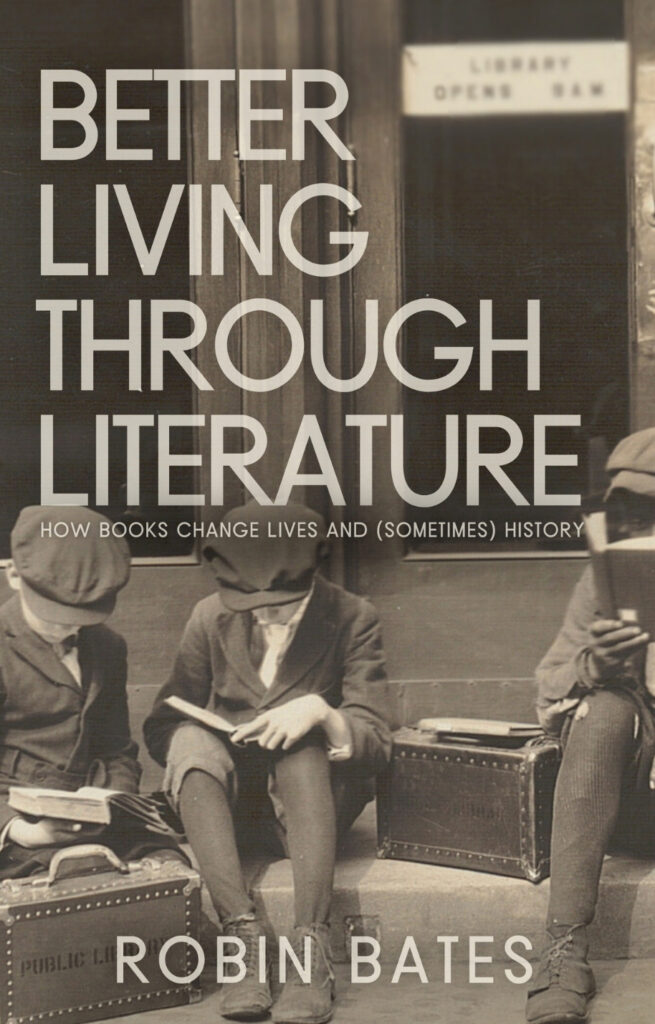
“Better Living” Emerged from a Midnight Epiphany (March 6, 2026)
The Golden Years before Tragedy Struck (March 13, 2026) 
Using Lit to Grapple with a Death (March 20, 2026) 
Lit in the Year following Justin’s Death (March 27, 2026)

Posted in Uncategorized | Tagged , , , , , , , , , , | Comments closed

The Courage of a Tennessee Librarian

Luanne James, Director, Rutherford County Libraries (TN)

Thursday

Last October, Sewanee’s Friends of the Library, which I chair, held a “Banned Book Week” event where we invited author Christina Soontornvat and librarian Keri Lambert to discuss rightwing book banning attempts. Soontornvat is a founding member of Authors against Book Bans while Lambert is involved with the Rutherford County Library Alliance, which recently received the Tennessee Library Association’s Intellectual Freedom Award. 

Rutherford County, which is Tennessee’s third largest county and only an hour up the road from me, is again in the news, thanks to a heroic stance taken by its director. Luanne James is refusing to comply with her reactionary board’s 8-3 directive to relocate over a hundred LGBTQ+ children’s titles to the adult section. She has also revealed that the board chair made several private demands that were unethical and in some instances illegal, including obtaining personal data from library patrons and violating FOIA laws.

“Unhappy is the land that needs heroes,” Brecht has Galileo say in his play about the scientist, and our own unhappy times have led James to put her job on the line. Here’s her inspiring letter:

Good afternoon everyone.

As the Director of the Rutherford County Library System (RCLS), I am professionally and ethically bound to uphold the First Amendment of the U.S. Constitution.

Public libraries serve as vital repositories of diverse ideas, both popular and unpopular. Restricting access to these materials through subjective relocation or removal constitutes a violation of the community’s right to information and a direct infringement on the principles of free speech. Our libraries are funded by and for the citizens; therefore, the right to access information—free from government interference—is a protected hallmark of our democracy.

The 8-3 vote by the Library Board on March 16th to relocate over 100+ LGBTQIA children’s titles to the adult section is a clear act of viewpoint discrimination. Furthermore, the vote to move the books was done without following the library’s established Request for Reconsideration policy.

My duty to protect public access is not merely a personal opinion; it is a core tenet of the American Library Association’s Code of Ethics. As an arm of the county government, the Board cannot legally limit the public’s access to materials owned by the people based on the content of the ideas expressed within them.

Therefore, I will not comply with the Board’s decision to relocate these books. Doing so would violate the First Amendment right of all citizens of Rutherford County and myself. Consequently, I would compromise my professional obligation to oppose government-mandated viewpoint discrimination.

I want you to know that I am more than willing to discuss this decision with members of the Board at any time. I trust you understand my position expressed in this letter. As the Director of RCLS, I must uphold the obligations owed to the citizens of Rutherford County, and in particular the duty owed by the public library to its patrons, to allow access to views expressed by authors to benefit the public’s right to read and access protected speech.

Sincerely,
Luanne James

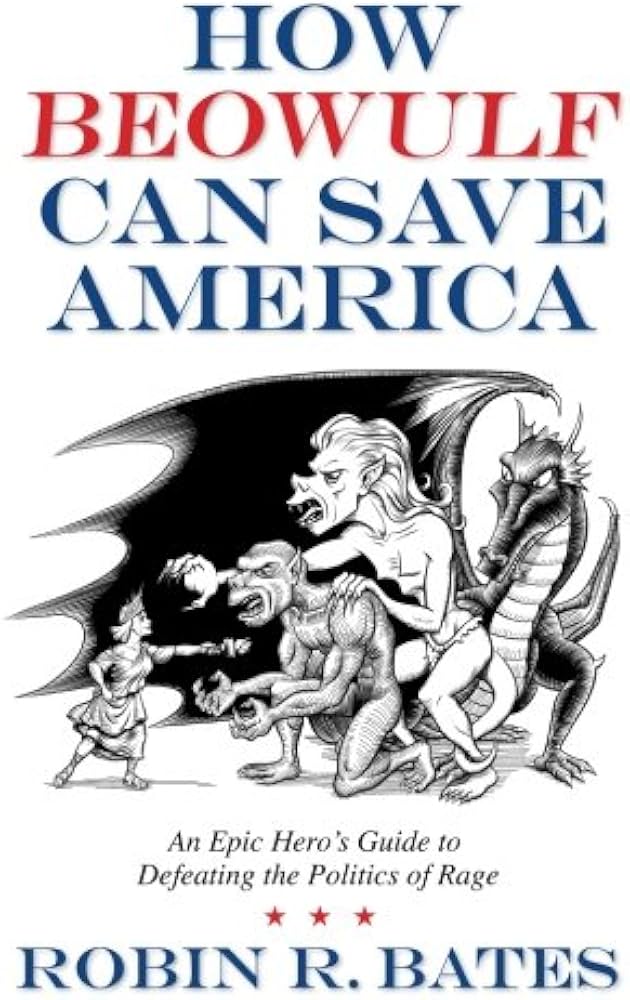
I’ve been thinking about what I wrote in 2012 about heroism in How Beowulf Can Save America: An Epic Hero’s Guide to Defeating the Politics of Rage. In the years since, I’ve worried that, even though our monsters continue to operate as I described, what I wrote about heroism was overly optimistic. I wrote the book in the year leading up to Obama’s reelection to a second term, but if I’d foreseen Trump in our future, I perhaps would have replaced “defeating” with “resisting.” I underestimated the rightwing reaction to liberalism’s advances.

Nevertheless, what I had to say about the reserves that Boewulf draws on to defeat Grendel’s Mother is still relevant.  As I explained on Friday, I see the troll as the archetype of destructive grieving and, as such, far more difficult to defeat than her son’s raging resentment. People can grieve over the death of an ideal as much as of an individual, and the grieving that we are witnessing amongst portions of America is over the death of white, patriarchal, heterosexual, Christian America, often associated with the 1950s. The rage burns so hot that people are willing to cheer the burn-it-all-down governance of Donald Trump, even when they themselves are victimized. We see such rage expressed in the Finn episode:

                              The wildness in them
had to brim over.
                                    The hall ran red
with blood of enemies.

The anger against liberals, feminists, LGBTQIA folk, and others can appear daunting, threatening to swallow us up as Grendel’s Mother threatens to swallow up Beowulf in her underwater sea cave. He discovers, however, that he has resources within he didn’t know he had. In the poem, aid comes in the form of a giant sword dating back to the golden age before the flood. Luanne James, the citizens of Minnesota, and all those others resisting Trump’s grievance-driven authoritarianism have their own sword to turn to. As I write in my book, 

Our higher ideal, expressed in The Declaration of Independence, is bigger than our individual grievances and will fortify us, just as, in his darkest moment, Beowulf’s great sword fortifies him.  Those who came before, like the warrior giants who forged that weapon, can infuse us with their spirit and inspire us to push through our pain. Wielding the sword means acknowledging and claiming that we stand on the shoulders of those who have come before. We are fighting the good fight, one that the founding fathers began and that Abraham Lincoln, Susan B. Anthony, Martin Luther King, Harvey Milk, and a host of others continued, each working to ensure that America honors its promise.

When James cites the First Amendment and declares that “the right to access information—free from government interference—is a protected hallmark of our democracy,” she is tapping into the power of the sword.

There’s another important element in this battle, however, which calls for communal rather than individual action. At the end of his life, Beowulf at first thinks he must go it alone against the latest monster and is in danger of yielding to dragon despair. He triumphs only after his nephew Wiglaf comes to his assistance.

Luanne James, we learn from the write-up on her, “felt more able to speak up in this way” thanks to the “fiercely proactive” Rutherford County Library Alliance. This Saturday, millions of Americans will experience the power of standing together as they protest Trump’s authoritarian rule in the third No Kings protest. As I write in my book,

Always we must remember that, while the battle seems daunting, it is less so when we work in concert with others. There are few activities more exhilarating than joining with a group of fellow citizens to build a better society. The dragon’s hoard has wealth sufficient for all of us if we marshal up the collective will to liberate it.

Posted in Uncategorized | Tagged , , , , | Comments closed

An Optimist Revises Yeats’s “Second Coming”

Wednesday

For a little midweek levity—we all need some these days, right?—here’s a revision of Yeats’s well-known but arguably fascist poem, forwarded to me by my son. It’s like the revision I shared recently of Philip Larkins’s “This Be the Verse.” While (needless to say) it’s far inferior to the original and does not stand on its own, it does raise the question whether Yeats was a tad hysterical with his apocalyptic vision.

Everything’s Fine 🙂 
By “the domestic mammoth” (on tumblr)

Tracing a neat straight line, adept and sure, 
The falcon heeds the calling falconer; 
Things hang together, and the center holds; 
Mere symmetry is ordering the world, 
The sea-bright tide is loosed, and everywhere 
The ceremony of innocence proceeds; 
The best have strong convictions, while the worst 
Are full of resignation and are sad.

Surely no revelation is at hand; 
Surely the Second Coming’s far away. 
The Second Coming! Hardly are those words out 
When an indifference borne of stable comfort 
Leaves my sight clear: somewhere in sands of the desert 
A lion with lion body and the head of a lion, 
A gaze calm and leonine, as is usual, 
Is moving its slow thighs, while all around it 
Reel shadows of the normal desert birds. 
What a nice lion, right? And now I know 
That twenty centuries have gone along 
And things were bad sometimes, and things were good, 
And if a lion slouches toward Bethlehem, 
That’s ’cause it’s native to the Levant.

After this was posted, someone responded with a changed version of William Carlos Williams’s “This Is Just to Say.” By just changing four or five words, the respondent removed the “ick” factor. I’ve expressed my ambivalence toward Williams’s poem in the past (here) so it was fun to read this version.

I acknowledge that, like the Yeats parody, it lacks the punch of the original. We are not witnessing a Lewis Carroll, whose parodies made great poems out of mediocre ones. In addition to sparking thought, however, these ones can get us to appreciate more what Yeats and Williams accomplished.

I have not eaten
the plums
that were in
the icebox

that you said
you were
saving 
for breakfast

enjoy them
they look delicious
so sweet 
and so cold

I guess thoughtful partners are not as fascinating as jerks.

Posted in Uncategorized | Tagged , , , , | Comments closed

The Goddess Nemesis at Work in Iran

Pierre-Paul Prod’hon, Justice and Nemesis Pursuing Crime

Tuesday

Retired General Mark Hertling, surveying Trump’s Iranian nightmare, has invoked an ancient Greek historian and a Greek goddess to explain the chaos. Herodotus, he writes in the Bulwark ,

believed the greatest danger to powerful nations was not external enemies but hubris—the arrogance that comes from believing success makes one invulnerable. That hubris always summoned Nemesis, the goddess of divine retribution, who then punished arrogant heroes and leaders.

I hadn’t heard of Nemesis as a goddess until Hertling’s piece, but I see that she shows up in The Theogony (c. 750-700 BCE)which is Hesiod’s genealogy of the gods. Nemesis is the daughter of Night, who herself is born of Chaos and who is also the mother of “hateful Doom, black Destiny and Death/ And Sleep and Dreams,” along with Disgrace, “painful Woe,” and the three fates. Hesiod concludes,

And then did deadly Night
Give birth to Nemesis, who is a blight
To mortals…

Wikipedia tells us that, while Nemesis was originally a distributor of fortune (“neither good nor bad, simply in due proportion to each according to what was deserved”), she came to be associated with “the resentment caused by any disturbance of this right proportion, the sense of justice that could not allow it to pass unpunished.” 

I was unaware of Nemesis as a goddess because the references to her in Greek and Roman literature are so fleeting. She is mentioned in Sophocles’s  Electra, where Orestes and Electra enact justice on their father’s murderers (their mother and her lover), and again in Ovid’s  Metamorphoses, where under the name Rhamnusia she transforms the gorgeous young Narcissus into a flower that gazes perpetually upon its watery reflection. “Thus, though he should love, let him not enjoy what he loves!” pray the mountain nymphs whom Narcissus is spurning, and Ovid informs us that Rhamnusia/Nemesis “assented to a prayer so reasonable.” 

Given that Trump is the quintessential narcissist, it’s appropriate that Nemesis would trap him in the lonely hell of self. Ovid does a good job of capturing the emptiness of self-obsession:

While he is drinking, being attracted with the reflection of his own form, seen in the water, he falls in love with a thing that has no substance; and he thinks that to be a body, which is but a shadow.

And further on:

In his ignorance, he covets himself; and he that approves, is himself the thing approved. While he pursues he is pursued, and at the same moment he inflames and burns. How often does he give vain kisses to the deceitful spring; how often does he thrust his arms, catching at the neck he sees, into the middle of the water, and yet he does not catch himself in them. He knows not what he sees, but what he sees, by it is he inflamed; and the same mistake that deceives his eyes, provokes them. Why, credulous youth, dost thou vainly catch at the flying image? What thou art seeking is nowhere; what thou art in love with, turn but away and thou shalt lose it; what thou seest, the same is but the shadow of a reflected form; it has nothing of its own.

It sounds like Trump seeing himself in the buildings he names after himself and in the awards he arranges to have bestowed upon him. Nemesis is indeed at work on him, making his life a misery to himself and, with the Iran debacle, punishing him for his arrogance. Unfortunately, Trump also embodies the arrogance of the country that elected him twice, and he is taking us all down with him. Multiple commentators are observing that this is how empires fall.

With its military might, America thought it could intervene in Korea, multiple Central American countries, Vietnam, Iraq (twice), Somalia, Afghanistan, Libya, Venezuela, and now Iran (I could also include various CIA-sponsored coups). In retrospect, it’s striking that Nemesis took so long to show up.

Then again, given how much blood we’ve shed and how much treasure we’ve squandered over the past 75 years, maybe she’s been with us all along.

Posted in Uncategorized | Comments closed

  • Sign up for my weekly newsletter