Friday – A Life Lived in Literature, Installment #27
During the year following Justin’s death, I lived as though in a different reality. On the one hand it felt as though I was in a continuous fog so that my normal way of seeing things was blurred. On the other, just as certain sounds are sharper in a fog, so was it the case here. I became acutely aware of the preciousness of life and also of the suffering of others, especially of certain students.
In the early days, I noticed that people were sending me poems. I especially recall a colleague in Psychology sending me W. H. Auden’s “Musée des Beaux Arts,” which describes a Breughel painting about the fall of Icarus. Because no one in the painting notices the tragedy, which is occurring in the lower corner of the painting, Auden makes the point that we are blind to tragedies going on around us. “How well they understood suffering, the old masters,” he observes in the opening line.
I remember thinking that it was a curious poem to receive since, as far as I could tell, the entire community was focused on our suffering, at least for a little while. My suffering didn’t feel overlooked or ignored, although I appreciated my colleague’s concern. More to the point, I realized that people seldom say exactly the right thing in such instances. Often, they greeted me awkwardly or even, fearing a blunder, avoided me altogether. When I walked across campus, I would sometimes see them ducking behind bushes, fearful that they would respond insensitively.
I didn’t take this amiss, however, but rather regarded their behavior as arising from their care for me. They felt inadequate in the face of death, which was only to be expected.
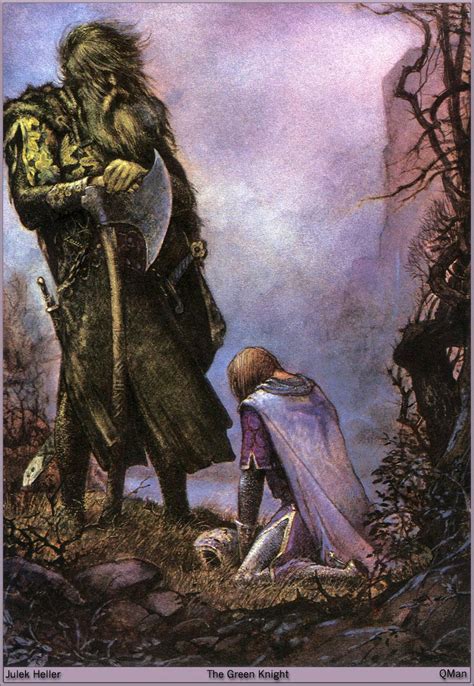
Justin died on April 30—the day before final exams—so I had the summer to reflect on what had happened. As one must do something, I returned to my book. Last week I recounted the role Beowulf played in my grieving process, but Sir Gawain and the Green Knight was almost as important. After all, it is about a man grappling with death, although in this case the death will be his own. Once Sir Gawain keeps his rendezvous with the Green Knight and receives the return axe blow, that should be it.
As I interpret the poem, it is about the ways we cope with death. Gawain thinks that, in his Christianity and his code of chivalric knighthood, he has the answer: all he has to do is remain indifferent about his life, putting his faith instead in the Christian afterlife and the courage expected of Camelot. His coping mechanism of not caring whether he lives or dies—or at least telling himself that he doesn’t care—is taken as a direct affront by the poem’s pagan fertility deities, the Green Knight and Morgan Le Faye. Their aim is to prove to Gawain (and, by extension, to Christian England) that he cares for his life after all.
In the end, to their satisfaction and to Gawain’s shame, they prove that he does. In a set of trials, Gawain encounters gruesome images of death (from three hunts) along with sweet enticements of life. The three hunts represent three different ways of responding to death: ignoring it and being caught unawares (the deer), fighting it (the boar), and attempting to escape it (the fox). Meanwhile, in parallel hunts, the lady of the castle attempts to seduce Gawain and, in the end, gets him to accept a gift from her. This elaborate plot was composed by someone who had either first or secondhand experience with one of history’s greatest natural disasters, the black plague of 1348-50, which killed a third of Europe. That the poet concludes with Gawain learning to appreciate life after having been self-protectively closed down spoke directly to my own grieving.
I remember looking out the window of my study at the woods bordering our back yard and being awestruck, in my own season of death, by how life kept on relentlessly asserting itself. It was a prodigal summer (to borrow from Barbara Kingsolver), and the grass, dandelions, buttercups, catbrier, small shrubs, and tree foliage never stopped. In the pain of losing Justin, I had closed myself off from this daily miracle, and the Green Knight was determined that I reconnect.
In addition to the works I was examining for my book, I searched for elegies that spoke to my condition. Thomas Gray’s “Elegy on a Country Churchyard,” John Milton’s “Lycidas,” A.E. Housman’s “To an Athlete Dying Young,” and Percy Shelley’s Adonais didn’t do much for me, although I would choose a stanza from Shelley’s poem for Justin’s gravestone. Lamenting the death of Keats, Shelley writes,
He is made one with Nature: there is heard
His voice in all her music, from the moan
Of thunder, to the song of night’s sweet bird;
He is a presence to be felt and known
In darkness and in light, from herb and stone…
Tennyson’s In Memoriam, on the other hand, struck deep. The longest of the great elegies, the poem was written over a 17-year-period by the poet as he mourned the untimely death of his closest friend and soulmate Arthur Hallam. (Hallam was 22 when he died, Justin 21.) Once I discovered it, I became mesmerized. Each day, when I returned home from the college, I would open my copy randomly, reading four or five of the 130 sections. The poem was apparently of great comfort to Queen Victoria when she lost Prince Albert and it was of great comfort to me. Tennyson is frustrated by the inadequacy of language to express all he feels, which was my situation as well. I related to:
I sometimes hold it half a sin
To put in words the grief I feel;
For words, like nature, half reveal
And half conceal the Soul within.
But, for the unquiet heart and brain,
A use in measur’d language lies;
The sad mechanic exercise
Like dull narcotics, numbing pain.
In words, like weeds, I’ll wrap me o’er,
Like coarsest clothes against the cold;
But that large grief which these enfold
Is given in outline and no more.
And:
Behold! we know not anything;
I can but trust that good shall fall
At last–far off–at last, to all,
And every winter change to spring.
So runs my dream: but what am I?
An infant crying in the night:
An infant crying for the light:
And with no language but a cry.
My teaching, meanwhile, took on a new urgency. I became attuned to students who were going through bad times and invited them to explore sorrows when they were triggered by a poem or a story. Sometimes responses came from entirely unexpected places, such as when an athlete was moved by Henry Vaughan’s “Silence and Stealth of Days” because he, like the poet, had lost a brother. Vaughan compares his brother to a lamp in a mine to which he seeks to return, only to find the extinguished snuff:
Silence, and stealth of days! ’tis now
Since thou art gone,
Twelve hundred hours, and not a brow
But clouds hang on.
As he that in some cave’s thick damp
Lockt from the light,
Fixeth a solitary lamp,
To brave the night…
I search, and rack my soul to see
Those beams again,
But nothing but the snuff to me
Appeareth plain…
Towards the end of the year I read C.S. Lewis’s A Grief Observed, written following the death of his wife Joy Davidman, and learned about “the second death,” which is the death of the death. In a way, the continued pain keeps the loved one present, so when that goes, the absent one seems even more absent. I remember feeling deeply depressed a week before the one-year-anniversary, which I afterwards attributed to fearing that the pain would end on that day.
The continuing pain had also meant picking up on vibrations previously unnoticed. I remember relating to a passage from Lloyd Alexander’s Black Cauldron, which I had read to the boys. In it, the protagonist has inherited a magical talisman that enhances his senses:
As Melynlas cantered over the frosty ground, Taran caught sight of a glittering, dew-covered web on a hawthorn branch and of the spider busily repairing it. Taran was aware, strangely, of vast activities along the forest trail. Squirrels prepared their winter hoard; ants labored in their earthen castles. He could see them clearly, not so much with his eyes but in a way he had never known before.
The air itself bore special scents. There was a ripple, sharp and clear, like cold wine. Taran knew, without stopping to think, that a north wind had just begun to rise.
Taran describes the experience like this:
“All I know is that I feel differently somehow. I can see things I never saw before—or smell or taste them. I can’t say exactly what it is. It’s strange, and awesome in a way. And very beautiful sometimes. There are things that I know…” Taran shook his head. “And I don’t even know how I know them.”
After the death of the second death, when I didn’t think of Justin continually and my emotional life returned to normal, I sometimes felt like Taran when he must give up the ring. Life felt flatter. Then again, listening to my students’ stories and to others who had lost loved ones restored some of the three-dimensionality.
I had earned a sabbatical for the next year and had originally planned to apply for another Fulbright to Slovenia. Toby, however, had a strong friendship group and didn’t want to leave. Given all the trauma we had been through, we allowed him to decide. More about him and his brother Darien in the next two posts.
Past Installments of A Life Lived in Literature
A Life Lived in Literature: How It All Began (Sept. 5, 2025)
Early Reading Memories (Sept. 12, 2025)
Childhood Confusion: Reading to the Rescue (Sept. 19, 2025)
Confronting Segregation (Sept. 26, 2025)
School Reading vs. Real Reading (Oct. 10, 2025)
Childhood in Paris (Oct. 17, 2025)
My Time at Sewanee Military Academy (Oct. 24, 2025)
Existentialism for High School Seniors (Oct. 31, 2025)
Why I Majored in History, Not English (Nov. 7, 2025)
My College Search for Authenticity (Nov. 14, 2025)
On D. H. Lawrence and a Sexual Awakening (Nov. 21, 2025)
My Life as a Bildungsroman (Nov. 28, 2025)
Grad School: Literary Baptism by Fire (Dec. 5, 2025)
Early Scenes from a Marriage (Dec. 12, 2025)
Bringing Up Baby in Grad School (Dec. 19, 2025)
Grappling with Racism (Jan. 2, 2026)
Journal of a Young Teacher (Jan. 16, 2026)
Teaching and Reading in Yugoslavia (Jan. 23, 2026)
Life at 40: Barely Controlled Chaos (Jan 30, 2026)
From Secular Humanist to Christian Believer (Feb. 6 2025)
Looking Back at a Lifetime Together (Feb. 13, 2026)
To Ljubljana with Love (Feb. 20, 2026)
Forging a Separate Identity from My Father (Feb. 27, 2026)
“Better Living” Emerged from a Midnight Epiphany (March 6, 2026)
The Golden Years before Tragedy Struck (March 13, 2026)
Using Lit to Grapple with a Death (March 20, 2026)
Lit in the Year following Justin’s Death (March 27, 2026)