Julia and I live by a small lake, which means that, when we eat our suppers on our screen porch these days, we get to hear a full-throated frog chorus, both spring peepers and bullfrogs. Thinking of how the Modern Major General in Gilbert and Sullivan’s Pirates of Penzance boasts of knowing “the croaking chorus from The Frogs of Aristophanes,” I decided to check out the play.
It turns out that there are relatively few lines in the frog chorus, so the MMG doesn’t have much to boast about. It could also be that he himself is like one of the frogs, croaking out a meaningless list accomplishments that have nothing to do with effective military leadership. In the play, the frogs of Hades are pestering the Greek god Dionysus as he travels to the underworld. His mission is to free one of the great Greek tragedians, either Euripides or Aeschylus, since Greek theater has declined since their deaths.
I’m not clear what thematic role the frogs play or why the play is called The Frogs. Maybe they represent the babble of the modern theater. Emily Dickinson’s frog comes to mind:
I’m Nobody! Who are you? Are you – Nobody – too? Then there’s a pair of us! Dont tell! they’d banish us – you know!
How dreary – to be – Somebody! How public – like a Frog – To tell your name – the livelong June – To an admiring Bog!
Whatever they represent, their incessant chirping—sound without substance–drives Dionysus crazy. Here they are:
Brekekekex, ko-ax, ko-ax! Brekekekex, ko-ax, ko-ax! We children of the fountain and the lake Let us wake Our full choir-shout, as the flutes are ringing out, Our symphony of clear-voiced song. The song we used to love in the Marshland up above, In praise of DIOnysus to produce, Of Nysaean DIOnysus, son of Zeus, When the revel-tipsy throng, all crapulous and gay, To our precinct reeled along on the holy Pitcher day. Brekekekex, ko-ax, ko-ax.
When Dionysus complains, “Hang you, and your ko-axing too! There’s nothing but ko-ax with you,” the annoying frogs reply:
That is right, Mr. Busybody, right! For the Muses of the lyre love us well; And hornfoot Pan who plays on the pipe his jocund lays; And Apollo, Harper bright, in our Chorus takes delight For the strong reed’s sake which I grow within my lake To be girdled in his lyre’s deep shell. Brekekekex, ko-ax, ko-ax.
When Dionysus prays for them to “give o’er, sing no more,” the frogs takes this as a challenges to grow louder:
Ah, no! ah, no! Loud and louder our chant must flow. Sing if ever ye sang of yore, When in sunny and glorious days Through the rushes and marsh-flags springing On we swept, in the joy of singing Myriad-divine roundelays. Or when fleeing the storm, we went Down to the depths, and our choral song Wildly raised to a loud and long Bubble-bursting accompaniment.
Finally Dionysus concludes that, if he can’t beat them, he’ll join them, so that both parties are croaking by the end of the scene:
DIO. Go, hang yourselves; for what care I? FR. All the same we’ll shout and cry, Stretching all our throats with song, Shouting, crying, all day long. FR. and DIO. Brekekekex, ko-ax, ko-ax.
Unlike the Greek god, Julia and I enjoy the frogs. In fact, we’ll miss them later in the summer when the katydids drown everything out, from frogs to coyotes. At the moment, however, the frogs capture our excitement over the warm spring nights and the tree foliage bursting out all over.
Hungarians turning out to defeat Viktor Orbán yesterday is hugely consequential, not only for Hungary but for Europe and the world. As commentator Ron Filipowski of MeidasTouch puts it, “Orban has done everything possible to prevent the EU from assisting Ukraine in their struggle against Russian barbarians. The big winners are Magyar, the Hungarian people, Zelensky/Ukraine and all of freedom-loving Europe.” Given how American fascists have been attempting to use the Orbán playbook, it’s good news for us as well.
To celebrate, I share a set of poems by the extraordinary Octavia Butler. In her depiction of a dystopian America in Parable of the Sower and Parable of the Talents, she has a religion of hope. Its sacred text is Earthseed: The Books of the Living, in which we learn (among other things) why countries choose authoritarian rulers. Earthseed also instructs us in how to push back.
While I’ve read Butler’s novels, I owe to Maria Popova’s Marginalian blog the particular poems that I cite here.
As Butler sees it, change is both inevitable (“God is change,” Earthseed observes) and unsettling. When one looks at the momentous changes that have occurred in the United States over the past 50 years—starting with the Civil Rights movement and including all the other “woke” movements (feminism, LGBTQ+, Native American, Latino, AAPI, immigrant, and neurodiversity rights)—perhaps it was inevitable that we should experience reactionary blowback. Octavia’s formulation helps explain why Hungary kept electing Orbán and why America elected Donald Trump twice:
When apparent stability disintegrates, As it must — God is Change — People tend to give in To fear and depression, To need and greed. When no influence is strong enough To unify people They divide. They struggle, One against one, Group against group, For survival, position, power. They remember old hates and generate new ones, They create chaos and nurture it. They kill and kill and kill, Until they are exhausted and destroyed, Until they are conquered by outside forces, Or until one of them becomes A leader Most will follow, Or a tyrant Most fear.
Hungary temporarily lost the vision that prompted it to break free from the Soviet Union, and America has lost sight of its founding ideals. When vision fails, Earthseed declares, emotion takes over:
When vision fails Direction is lost.
When direction is lost Purpose may be forgotten.
When purpose is forgotten Emotion rules alone.
When emotion rules alone, Destruction… destruction.
The decent Joe Biden tried to appeal to our better angels but a number of factors—including post-pandemic inflation (which impacted all the world) and his own declining health—did him in. Although he had gotten the economy back on track by the end of his four years, Earthseed has an explanation as to why a plurality of American voters would hasten America’s decline by turning to Trump:
Drowning people Sometimes die Fighting their rescuers.
Earthseed then provides, with blinding clarity, what Hungarians and Americans have been experiencing:
Choose your leaders with wisdom and forethought. To be led by a coward is to be controlled by all that the coward fears. To be led by a fool is to be led by the opportunists who control the fool. To be led by a thief is to offer up your most precious treasures to be stolen. To be led by a liar is to ask to be told lies. To be led by a tyrant is to sell yourself and those you love into slavery.
So how to respond? Earthseed tells us what the moment demands of us. Hungarians rose to the occasion and, increasingly, Americans are doing so as well:
Are you Earthseed? Do you believe? Belief will not save you. Only actions Guided and shaped By belief and knowledge Will save you. Belief Initiates and guides action — Or it does nothing.
Hungary has shown us that authoritarians can be stopped. That should inject a shot of adrenaline into the No Kings and other anti-Trumpism movements.
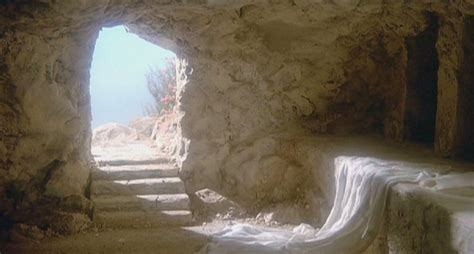
William McKeachie alerted me to this lovely Easter poem by the Welsh poet and Anglican priest R.S. Thomas. It puts me in mind of the poetry of George Herbert in that the speaker has doubts, even though the night of Good Friday has given way to the twilight of Easter. Why twilight rather than dawn? Perhaps because, even after the resurrection, there are still problems—new problems—that need to be sorted out. I assume the problem that “towers immovable before us” is that of death, despite Jesus’s reassurance.
The speaker mentions spending a long time “on my knees in a cold chancel,” which sounds like the dark night of the soul. As Herbert describes such moments,
“As good go anywhere,” they [my bent thoughts] say, “As to benumb Both knees and heart, in crying night and day, Come, come, my God, O come! But no hearing.”
Along these lines, I love Thomas’s image of passing
our hands over their surface like blind men feeling for the mechanism that will swing them aside.
Yet from our kneeling in prayer, as Herbert too testifies, something marvelous can happen. A stone is rolled from the mind as the old questions become yesterday’s news. The speaker seeing them lying “folded and in a place by themselves” is a reference to Peter seeing “the linen wrappings lying there.” The answer has come after all.
The Answer By R. S. Thomas
Not darkness but twilight In which even the best of minds must make its way now. And slowly the questions occur, vague but formidable for all that. We pass our hands over their surface like blind men feeling for the mechanism that will swing them aside. They yield, but only to reform as new problems; and one does not even do that but towers immovable before us
Is there no way of other thought of answering its challenge? There is an anticipation of it to the point of dying. There have been times when, after long on my knees in a cold chancel, a stone has rolled from my mind, and I have looked in and seen the old questions lie folded and in a place by themselves, like the piled graveclothes of love’s risen body.
Tobias Wilson-Bates, English, Georgia Gwinnett College
Friday
Last week I applied Walter Shandy’s theory of names to my eldest son. According to the protagonist’s father in Laurence Sterne’s Tristram Shandy, your name determines your destiny, and I found that somewhat to be the case with Darien.
So how about my second son, Toby, who it so happens is a fan of Tristram Shandy? Looking back, I think I named Toby after Uncle Toby in Sterne’s novel, although perhaps I also had in mind Tobias Smollett, the 18th century Scottish novelist and my dissertation subject. I also have long been enamored of the story of young Tobias and the three angels from Tobit, the most fairytale-like book in the Bible. Names are often overdetermined in this fashion.
As I mention Sterne’s Uncle Toby and the Scottish novelist, I hear Toby’s voice: “So Dad, you named me after a character who may have been rendered impotent by a groin wound from the 1695 siege of Namur and who, to recover from his PTSD, becomes obsessed with constructing a miniature model of the fortified city?! And also after a novelist who was so cranky that Sterne nicknamed him Dr. Smelfungus?! What kind of destiny does that set me up for?”
In my defense, however, my major association with Sterne’s Uncle Toby is his kindness, and my Toby is one of the kindest people I know. He evinces such interest in other people, even those with opposite political views, that they come away feeling respected and heard. Here’s Tristram’s description of his uncle:
My uncle Toby was a man patient of injuries;—not from want of courage,—I have told you in a former chapter, “that he was a man of courage:”—And will add here, that where just occasions presented, or called it forth,—I know no man under whose arm I would have sooner taken shelter;… he was of a peaceful, placid nature,—no jarring element in it,—all was mixed up so kindly within him; my uncle Toby had scarce a heart to retaliate upon a fly.
Tristram isn’t kidding about the fly:
—Go—says he, one day at dinner, to an over-grown one which had buzzed about his nose, and tormented him cruelly all dinner-time,—and which after infinite attempts, he had caught at last, as it flew by him;—I’ll not hurt thee, says my uncle Toby, rising from his chair, and going across the room, with the fly in his hand,——I’ll not hurt a hair of thy head:—Go, says he, lifting up the sash, and opening his hand as he spoke, to let it escape;—go, poor devil, get thee gone, why should I hurt thee?——This world surely is wide enough to hold both thee and me.
Tristram talks about the influence:
I was but ten years old when this happened….I often think that I owe one half of my philanthropy to that one accidental impression.
Along with his kindness, my Toby also has an affinity for children (he is finely attuned to the individual personalities of each of his four kids) and for small animals. I mention the latter because the Biblical Tobias, when he goes off with the angels, has an unexpected companion: “So they went forth both, and the young man’s dog with them.” (This strange throwaway detail has delighted at least one novelist although it’s driving me crazy that I can’t remember who. If you know, please write.)
Tobias, incidentally, is Hebrew for “God is good.” When we visited the Uffizi Gallery in Florence, I purchased for my Toby a Francesco Botticini print of Tobias and his angel companions.
For all his kindness, it cannot have been easy for Toby to grow up in the shadow of his two older brothers, who were both straight A students and standout athletes. Toby was far quieter and, unlike Justin and Darien, excelled only in the subjects that caught his attention (like English). His standout qualities were less flashy, and it took a professional-level coach to notice that, when Toby played soccer fullback, no one scored on his side of the field. Even when he was in elementary school, he would amaze the family by his psychological insights into human behavior. I later recall a moment—I think he was a high school junior—when I gave him Beowulf (he wanted to read something I assigned my students) and saw him detect power dynamics that I myself had missed. As a sophomore in college, he once decided he would read every major literary epic and proceeded to immerse himself in Gilgamesh, The Iliad, The Odyssey, The Aeneid, Beowulf, Orlando Furioso, The Fairy Queene, Paradise Lost, Wordsworth’s Prelude, Leaves of Grass, and The Waste Land. (He would write his senior thesis on the last three.)For much of his childhood and adolescence, Toby flew under the radar.
To make sure he didn’t fly under mine, I made sure that we did special things together, including ice cream after soccer and lacrosse games and nightly reading. Also, once a year, I’d pull him out of school and we’d spend the day together, often watching a movie or visiting a park.
Toby and Justin were very close and Justin’s death devastated him. He once reported—I believe when visiting Justin’s grave—of experiencing in a visceral way Justin’s presence, feeling goose pimples all over although the weather was warm and there was no breeze. I don’t believe he was just fantasizing this—he’s too honest about his feelings to do that—and I find it interesting that he is now writing about Victorian ghost stories (including Dickens’s Christmas Carol).
Toby connects ghost stories with time travel literature, the subject of his dissertation, and he recently texted me about how the interest dates back to Justin. He was at home alone when news started to circulate that Justin had drowned and, when the phone began to ring, he started “telling stories that I thought were probably true.” To this day, he says, he has “never stopped having dreams, from then to now, where he talks to me about that very concept. He tells me that they never found him and that he’s been living on the other side of the river.”
Toby adds that this is, in some ways, “the philosophical basis for my entire approach to the idea of a time machine.” In his dissertation Toby wrote about Frankenstein, David Copperfield, Alice in Wonderland, Williams Morris’s News to Nowhere, Joseph Conrad’s Secret Agent, and H.G. Wells’s Time Machine, all of which explore different aspects of time, and he says that reading a work that takes one back in time is a form of time travel. As he puts it, it’s a sort of “intentional acceptance of the alienation that happens when we accept the provisional reality of a mediated experience.” In such instances, he believes, narrative “becomes every bit as load bearing as concrete or electricity.”
If I understand this correctly, the fact that Toby’s own experience with death was initially mediated, not only through invented narrative but through a machine (the telephone)–and that there was a time disjunction (Justin alive in the narrative dimension, dead in the physical one)–led Toby to his time machine focus at the University of California at Davis. In Toby’s vision, H.G. Wells’s time machine is only one form that time travel takes, and one can also see the historical romances of Sir Walter Scott as time machines. Of course Christmas Carol also features time travel.
Toby once told me that his favorite Wordsworth poem is “We Are Seven,” which at first surprised me as I’ve never taken it all that seriously. I was deeply moved, however, when I saw it in light of Toby’s experience. After all, it explores the the collision of two different realities. Narrative is indeed “load bearing” for the child:
We Are Seven By William Wordsworth
A simple child, That lightly draws its breath, And feels its life in every limb, What should it know of death?
I met a little cottage girl: She was eight years old, she said; Her hair was thick with many a curl That clustered round her head.
She had a rustic, woodland air, And she was wildly clad; Her eyes were fair, and very fair; — Her beauty made me glad.
“Sisters and brothers, little maid, How many may you be?” “How many? Seven in all,” she said, And wondering looked at me.
“And where are they? I pray you tell.” She answered, “Seven are we; And two of us at Conway dwell, And two are gone to sea.
“Two of us in the churchyard lie, My sister and my brother; And in the churchyard cottage, I Dwell near them with my mother.”
“You say that two at Conway dwell, And two are gone to sea, Yet ye are seven! — I pray you tell, Sweet maid, how this may be.”
Then did the little maid reply, “Seven boys and girls are we; Two of us in the churchyard lie, Beneath the churchyard tree.”
“You run about, my little maid, Your limbs they are alive; If two are in the churchyard laid, Then ye are only five.”
“Their graves are green, they may be seen,” The little maid replied, “Twelve steps or more from my mother’s door, And they are side by side.
“My stockings there I often knit, My kerchief there I hem; And there upon the ground I sit, And sing a song to them.
“And often after sunset, sir, When it is light and fair, I take my little porringer, And eat my supper there.
“The first that died was sister Jane; In bed she moaning lay, Till God released her of her pain; And then she went away.
“So in the churchyard she was laid; And, when the grass was dry, Together round her grave we played, My brother John and I.
“And when the ground was white with snow, And I could run and slide, My brother John was forced to go, And he lies by her side.”
“How many are you, then,” said I, “If they two are in heaven?” Quick was the little maid’s reply, “O master! we are seven.”
“But they are dead; those two are dead! Their spirits are in heaven!” ‘T was throwing words away; for still The little maid would have her will, And say, “Nay, we are seven!”
Toby’s interest in the intersection between machines and narrative helped land him a post-doctoral fellowship at Georgia Tech, where he got along well with his engineering students. He also did some work in the robotics lab, and he understands A-I better than anyone I know. Toby is currently completing a book on time travel literature that, among other things, looks at how conceptions of time changed in the course of the 19th century. His research has somehow plunged him into the origins of calculus, and he only half-jokingly says that, to truly understand Newton, one must read Paradise Lost.
While all this was going on, Toby also married Candice, a Trinidadian woman who teaches Film Studies at the University of North Georgia. Toby himself teaches at Georgia Gwinnett College and they have three girls and a boy. As I mentioned last week, he also maintains weekly contact with his brother Darien and they are currently reading together TheBrothers Karamazov, my own all-time favorite novel. Toby’s latest observation, texted to me yesterday, was filled with his characteristic humor:
Doctor Herzenstube showing up and not understanding anything is one of the funniest reoccurring bits in Karamazov. It’s like a Marx Brothers’ punchline. He always shows up at the end of a scene where there’s been a dangerous sickness or a seizure and then the narrator describes how respected and venerable he is. And every time he says, “I don’t understand,” and the scene ends.
While I don’t think Toby carefully ushers flies out of the house, he remains the kind and thoughtful human being he was as a child. Tragedy, marriage, and fatherhood have only deepened him.
I don’t know how many times I’ve seen the following Great Gatsby passage applied to DJT but it’s always worth revisiting:
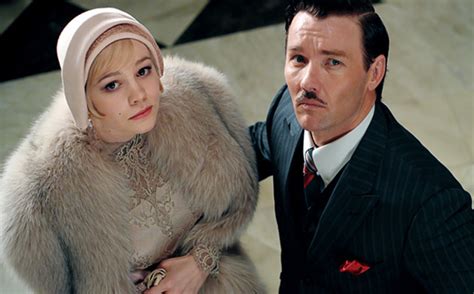
I couldn’t forgive [Tom] or like him, but I saw that what he had done was, to him, entirely justified. It was all very careless and confused. They were careless people, Tom and Daisy—they smashed up things and creatures and then retreated back into their money or their vast carelessness, or whatever it was that kept them together, and let other people clean up the mess they had made …
Political commentator Ben Rhodes has a great summation of the latest mess, which our president is desperately trying to retreat from:
In the best-case scenario, Trump struck a deal to reopen a Strait that was open before the pointless war he started, with [Iran] demonstrating its control over the Strait and potentially extracting fees plus sanctions relief. Thousands of innocents—including hundreds of children—dead in Lebanon and Iran for no reason. U.S. troops killed and wounded. U.S. embassies and bases in the Middle East badly damaged. U.S. standing in the world obliterated. U.S. munitions badly depleted. Hundreds of billions spent. Prices up everywhere. More global economic fallout to come. Putin strengthened and enriched. Just a catastrophic situation even in the best of circumstances. A profoundly shameful episode in American history no matter what happens next.
In Fitzgerald’s novel, Tom’s infidelity sets off a chain of events that results in three deaths. Daisy has accidentally run down Myrtle, Tom’s lover, after her own fling with Gatsby is ending. Tom then lies to Myrtle’s husband George, telling him that Gatsby did it. (“He ran over Myrtle like you’d run over a dog and never even stopped his car,” he tells Nick, prompting Nick to observe, “There was nothing I could say, except the one unutterable fact that it wasn’t true.”) Tom’s lie prompts George to shoot Gatsby and then himself.
At the inquest, there are no ramifications for the Buchanans as Daisy’s sister Catherine tells her own set of lies:
When Michaelis’s testimony at the inquest brought to light Wilson’s suspicions of his wife I thought the whole tale would shortly be served up in racy pasquinade—but Catherine, who might have said anything, didn’t say a word. She showed a surprising amount of character about it too—looked at the coroner with determined eyes under that corrected brow of hers, and swore that her sister had never seen Gatsby, that her sister was completely happy with her husband, that her sister had been into no mischief whatever. She convinced herself of it, and cried into her handkerchief, as if the very suggestion was more than she could endure. So Wilson was reduced to a man “deranged by grief” in order that the case might remain in its simplest form. And it rested there.
Think of Catherine as those Fox News pundits, who are currently attempting to turn Trump’s acceptance of Iran’s 10-point-plan into a victory. Examples:
Laura Ingraham: It looks like Trump ultimately hits the home run here, takes it to the brink. Iran blinks. Matt Towery: When will the Democrats and some Republicans ever learn that the rhetoric he uses is done for a reason. And it works.
The reality, of course, is that Trump’s entire life has consisted of creating messes that others have tried to clean up, from when his father bailed him out of bankruptcies to the Supreme Court letting him off the hook for his January 6 coup attempt. Whether he has found the offramp he is frantically looking for remains to be seen.
Returning to the book, it’s no surprise to discover that Tom Buchanan, like Trump, is also a white supremacist. Those in positions of privilege, whether class or race, are capable of inflicting immense damage when their preeminence is threatened:
“Civilization’s going to pieces,” broke out Tom violently. “I’ve gotten to be a terrible pessimist about things. Have you read The Rise of the Coloured Empires by this man Goddard?”
“Why, no,” I answered, rather surprised by his tone.
“Well, it’s a fine book, and everybody ought to read it. The idea is if we don’t look out the white race will be—will be utterly submerged. It’s all scientific stuff; it’s been proved.”
“Tom’s getting very profound,” said Daisy, with an expression of unthoughtful sadness. “He reads deep books with long words in them. What was that word we—”
“Well, these books are all scientific,” insisted Tom, glancing at her impatiently. “This fellow has worked out the whole thing. It’s up to us, who are the dominant race, to watch out or these other races will have control of things.”
And a little later:
“This idea is that we’re Nordics. I am, and you are, and you are, and—” After an infinitesimal hesitation he included Daisy with a slight nod, and she winked at me again. “—And we’ve produced all the things that go to make civilization—oh, science and art, and all that. Do you see?”
Cocooned in their privilege and sense of superiority, such men are convinced that only their own needs matter. If a civilization has to be destroyed to salvage one’s ego, then it must be destroyed. As Nick puts it, talking with Tom feels like “talking to a child.”
One other Gatsby passage comes to mind after reading a fascinating article by John Gray in The Statesman. Gray says that “Trump seems driven by an impulse to reimagine the past and reassert American – and his own – greatness,” and then adds, “When an infantile fantasy of omnipotence comes up against unyielding realities, the response is inchoate rage.” That rage, in the words of former Trump supporter Alex Jones, is making him sound “like an unhinged super villain from a Marvel comic movie.”
Fitzgerald understands what’s going on. “So we beat on,” he writes in his famous last sentence, “boats against the current, borne back ceaselessly into the past.” The beating on is particularly frightening when the party has access to nuclear weapons.
A friend recently alerted me to a review of Don Sperrin’s State of Ridicule: A History of Satire in English Literature in the New York Times Book Review, which gives me an excuse to explore my own mixed feelings about satire. While I specialized in the golden age of British satire (the Restoration and 18th century) and for years taught such satirists as the John Wilmot, John Dryden, William Wycherley, Aphra Behn, Jonathan Swift, Alexander Pope, Lady Mary Wortley Montagu, Henry Fielding, Oliver Goldsmith, Richard Sheridan, Fanny Burney, and Jane Austen, some part of me has always bridled at satire’s judgmental stance. More on that in a moment.
Sperrin, it appears, regards literary satire as always local and political, not universal and moral. In his view, satire wants to change conditions as they are at the time, not make grand pronouncements about human beings. Thus, as reviewer Aaron Matz summarizes Sperrin’s project,
Satire is never so sweeping as to say, “Rulers and politicians are like this.” Instead it says, “This person, in this year, with this background, in service to this regime, in response to this crisis, did this.”
This means that Sperrin concentrates on specific historical moments, from the Anglo-Saxons and Anglo-Normans through the Victorians, along with a brief glance in his conclusion at the 20th century. As Matz puts it, in Sperrin’s book we encounter
the decade-to-decade, even year-to-year march of English political history, with one king giving way to another, Catholics to Protestants, Whigs to Tories, Walpole as prime minister in the first of the the eighteenth century and Pitt the Younger at the end.
Despite the sweep, Sperrin does not talk about satire as a timeless genre and dismisses those who do. In Matz’s summary,
If we don’t focus on satire as a field of “motivated agents” with “interventionist purposes,” [Sperrin] warns, there is a risk that “it will become a literature of decontextualized social comedy referring to little other than a series of poorly defined social values.” Critics who go down that path are doomed to “construct universalist, atemporal definitions of satire” and to conclude that “satirists as different as Juvenal, Geoffrey Chaucer, John Skelton, John Dryden, and Jonathan Swift, for instance, were all doing exactly the same thing.”
Given this perspective, it makes sense that Sprerrin would be drawn to Dryden, whose masterpiece Absolom and Architophel is a detailed treatment of the “exclusion crisis” of 1679-81. This was an attempt to exclude James, the brother and the rightful heir to Charles II, from the throne on account of him being Catholic. Instead, the plotters were hoping to replace him with Charles’s Anglican but bastard son the Duke of Monmouth. (Side note: Bates family lore has it that we are descendants of Monmouth, although through a second wrong-side-of-the-bed twist. I tell the story here.)
Early in my teaching career, I gave up teaching Absalom and Architophel because, amazing poem though it is, my students would get lost in the convoluted politics. The same was true of Pope’s Dunciad, another magnificent poem which, however, requires comprehensive knowledge of the early 18th century publishing wars to be truly appreciated. It’s far easier to teach the (also magnificent) Gulliver’s Travels, whose political context can be summed up in a tidier fashion.
So I suppose, from Sperrin’s point of view, we English professors are part of the problem: we’re scared of politics and so settle for vapid generalizations about satire of the past. To further compound the crime, in this blog I regularly pull satiric works out of their historical period to apply them to our own. Matz sums up what Sperrin sees as wrong with this:
[T]he choice Sperrin presents—satire is either a “literature of motivated practical activities” or “decontextualized social comedy”—is a false one. He seems suspicious of the considerably body of satire that exists between these two poles, neither consumed with day-to-day matters of statecraft nor given over to airy ruminations about human nature…Sperrin is unmoved by the fact that satire excoriates human behavior beyond the corridors of the palace or the parliament. But that more nebulous realm is where a lot of satirists have always been skulking.
Even though I myself used a both/and approach in teaching satire—I both contextualized and universalized–I understand Sperrin’s single-minded insistence on politics: it discovers things other scholars have missed. Matz points out, however, this stance causes Sperrin to overlook some of the literature’s greatest satiric works, such as Book IV of Gulliver’s Travels, Chaucer’s Wife of Bath’s Prologue and Tale, Charles Dickens’s Our Mutual Friend, and Evelyn Waugh’s A Handful of Dust.
Now, to a personal story. When I met with my advisor to choose a dissertation topic in 1978, I knew I wanted to break out of formalist New Criticism’s belief that only text is important and that everything else, including historical context and reader, is irrelevant. For this reason, the New Critics had problems with satire, which so clearly engages with context. Since satirists are overtly interested in changing reader behavior, I thought I wanted to study satire.
In retrospect, I should have said I wanted to study readers’ relationship to literature because I then wouldn’t have spent the next two years immersed in a cranky Scottish satirist with an immense chip on his shoulder. The fact that I’ve never taught Tobias Smollett in a course tells you it was a mistake, even though I learned a lot while writing it.
I now realize that all kinds of literature can change lives and that, in some ways, I’m most interested in literature that does so indirectly. “Tell the truth but tell it slant,” as Emily Dickinson writes. Like many people, I don’t like to be told bluntly how to behave. Now, I still value satire, but I prefer Horatian satire, which gently mocks, to Juvenalian satire, which lashes out in savage indignation. Many of my favorite authors combine satire with sentimental comedy, authors such as Fielding, Goldsmith, Burney, Austen, Dickens, and Trollope. Even as satire engages with social conditions, comedy distances one from these same conditions. Close but not too close appears to be my sweet spot.
In short, while I’m interested in Sperrin’s findings—how satire engages with the politics of the time–it sounds like he undervalues satire’s comic side and its general entertainment value, which is where my heart lies. While I enjoy watching Austen skewer Mr. Collins, I appreciate her wit even more. And that wit (as Ben Jonson wrote of Shakespeare) is not of an age but of all time.
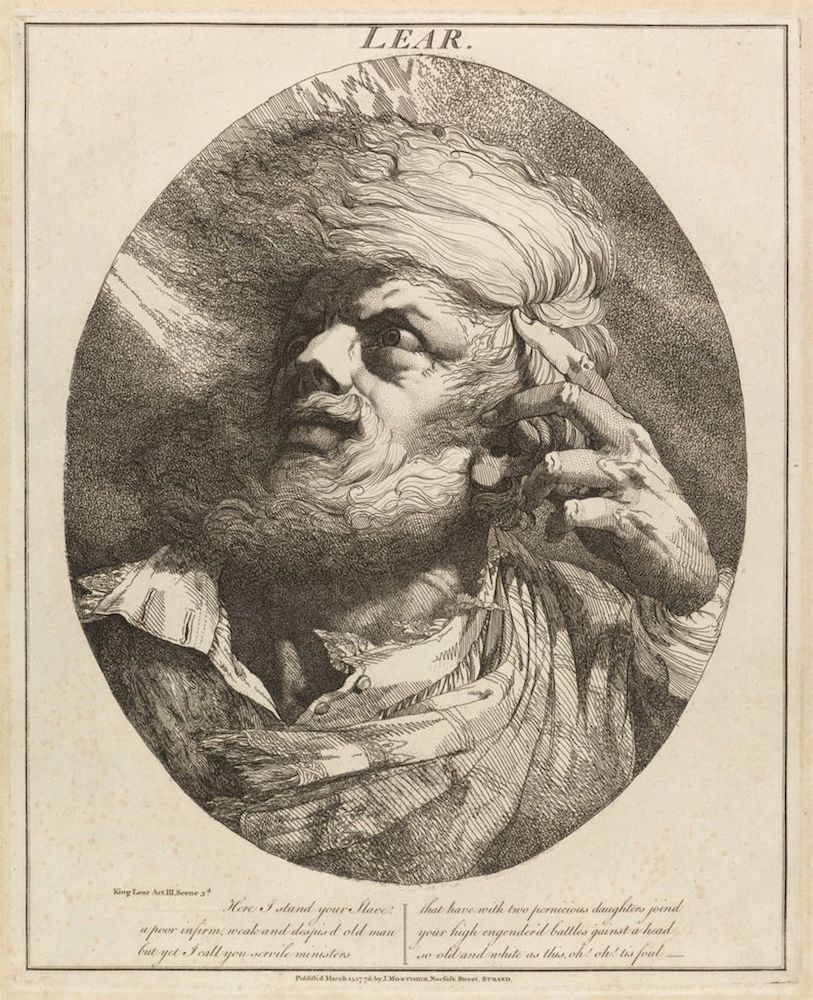
William Sharp engraving of Sir Joshua Reynolds painting of Lear
Tuesday
What do you do when your leader goes insane? While many of us have suspected for a while that Donald Trump is descending into dementia, his unhinged Easter tweet threatening Iran has even former ally Marjorie Taylor Green leveling the charge. Here’s what she had to say:
Everyone in his administration that claims to be a Christian needs to fall on their knees and beg forgiveness from God and stop worshipping the President and intervene in Trump’s madness. I know all of you and him and he has gone insane, and all of you are complicit.
She was responding to the following Truth Social message from the president:
Tuesday will be Power Plant Day, and Bridge Day, all wrapped up in one, in Iran. There will be nothing like it!!! Open the Fuckin’ Strait, you crazy bastards, or you’ll be living in Hell – JUST WATCH! Praise be to Allah.
The literary figure that comes to mind is the raging King Lear, although in saying this I am mindful of a critique from my eldest son. A former theater major who knows his Shakespeare well, Darien complains that I elevate the president by making such comparisons. Trump might even embrace the comparison if he knew who King Lear is (which I doubt) since, even in his madness, Lear can still draw himself up and describe himself as “every inch a king.” If I’m going to compare the two, I must include the kind of disclaimer that T.S. Eliot’s J. Alfred Prufrock makes in his extended soliloquy:
No! I am not Prince Hamlet, nor was meant to be; Am an attendant lord, one that will do To swell a progress, start a scene or two, Advise the prince; no doubt, an easy tool, Deferential, glad to be of use, Politic, cautious, and meticulous; Full of high sentence, but a bit obtuse; At times, indeed, almost ridiculous— Almost, at times, the Fool.
Prufrock would like to think of himself as a tormented Hamlet but, upon reflection, admits he is more like the foolish Polonius. Trump too appears to be an easy tool, easily manipulated by any number of bad actors (Putin, Netanyahu, the king of Saudi Arabia, Kushner, the fossil fuel industry, I could go on). He’s not even a Prufrock, who at least is capable of self criticism.
In my defense, in the past I’ve used Lear for contrastive as well as comparative purposes. All those figures to which I’ve compared our president—Lear, Macbeth, Richard III—are capable of looking inward, and they achieve a certain level of dignity in doing so, no matter how black their crimes. Lear even discovers love for the first time in his life.
Trump, on the other hand, is more like Dante’s souls in Inferno, locked forever in the hell of self. Or to choose another character destined for hell, one drop of repentance—even half a drop (I’m quoting here from Christopher Marlowe’s Doctor Faustus) would save his soul, but he can’t manage even that much. I predict that Trump’s death, when it comes, will be as agonizing as Faustus’s.
The reason that I can’t let go of such comparisons is because Shakespeare, with his deep understanding of human beings, gets why someone like Trump would go mad. Both Lear and Trump are consummate narcissists, so accustomed to thinking the world revolves around them that they can’t handle it when reality claps back. Trump’s increasingly panicked and often contradictory pronouncements about the war in Iran remind me of Lear when he is humiliated by Goneril and Regan. He sounds like a toddler making threats:
A number of political commentators are observing that the Constitution’s 25th Amendment–which calls for a president to be removed when he or she “is unable to discharge the powers and duties of his office”—was drawn up for moments like this. However, neither Trump’s cabinet officials nor the GOP will intervene. As a result, they are all (to use Green’s word) complicit.
It’s noteworthy that Shakespeare, when he wrote the play, probably had the recent Annesley affair in mind. In this family drama (I quote from the Norton Anthology here), “the two elder daughters of a doddering gentleman named Sir Brain Annesley had attempted to get their father legally certified as insane, thereby enabling themselves to take over his estate, while his youngest daughter vehemently protested on her father’s behalf.”
Trump’s enablers, unfortunately, just continue to do his bidding. They are like Oswald, Goneril’s sycophantic steward who does her dirty work. Oswald is even prepared to kill the blind Gloucester in his boss’s service.
So for all those who are choosing Trump over God, the Constitution, the country, and all that is decent, I conclude with Kent’s characterization of Oswald:
Kent: Fellow, I know thee. Oswald: What dost thou know me for? Kent: A knave; a rascal; an eater of broken meats; a base, proud, shallow, beggarly, three-suited, hundred-pound, filthy, worsted-stocking knave; a lily-livered, action-taking knave, a whoreson, glass-gazing, super-serviceable finical rogue;one-trunk-inheriting slave; one that wouldst be a bawd, in way of good service, and art nothing but the composition of a knave, beggar, coward, pandar, and the son and heir of a mongrel bitch: one whom I will beat into clamorous whining, if thou deniest the least syllable of thy addition.
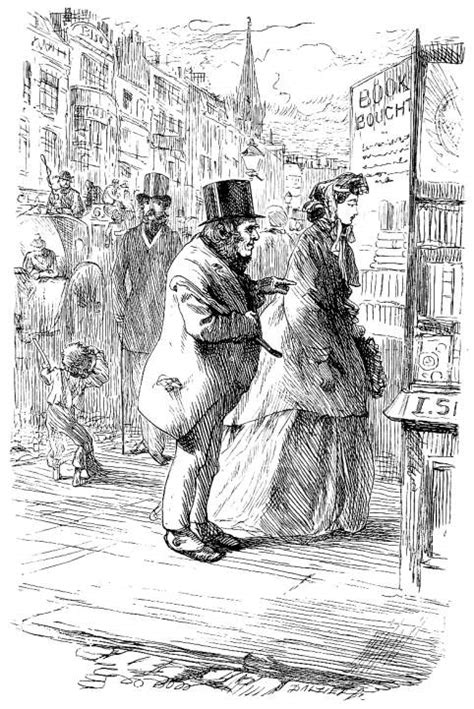
Marcus Stone, illus. from Our Mutual Friend (Mr. Boffin in search of books about misers)
Monday
I’ve just completed Charles Dickens’s Our Mutual Friend and find myself fantasizing that those American billionaires benefitting from GOP tax cuts would read it and undergo a magical transformation. Would they become ashamed at how they are pressuring Trump and Republicans to strip the rest of the country of much needed funds for education, healthcare, and basic living expenses? Would they recognize themselves in Mr. Boffin, whom we see being corrupted by undreamt of wealth?
The billionaires I have in mind are those who have been doing Trump’s bidding, including Peter Thiel, Mark Zuckerberg, Jeff Bezos, Tim Cook, Elon Musk, and David Ellison. While some of these (although not all) once had a more generous view of social welfare, they now appear willing to sacrifice the rest of us to their own narrow interests.
It so happens that, as I was finishing the novel, Trump was voicing their selfish views in a private Easter luncheon. In remarks utterly at odds with the spirit of Christ, Trump said that he had told Office of Management and Budget Director Russell Vought,
Don’t send any money for daycare, because the United States can’t take care of day care. That has to be up to a state. We can’t take care of day care. We’re a big country. We have 50 states. We have all these other people. We’re fighting wars. We can’t take care of day care. You got to let a state take care of day care, and they should pay for it too.”
A little later (I quote from an NBC News report here), the president added
that states would have to raise their taxes to pay for child care costs and that the federal government “could lower our taxes a little bit to them to make up” for it.
“It’s not possible for us to take care of day care, Medicaid, Medicare, all these individual things,” Trump said. “They can do it on a state basis. You can’t do it on a federal. We have to take care of one thing: military protection. We have to guard the country.”
In Mutual Friend we see Mr. Boffin, one of Dickens’s most engaging characters, turn unexpectedly ugly after inheriting a rich man’s money. Suddenly we see him immersing himself in the stories of famous misers:
A kind of illegibility, though a different kind, stole over Mr Boffin’s face. Its old simplicity of expression got masked by a certain craftiness that assimilated even his good humor to itself. His very smile was cunning, as if he had been studying smiles among the portraits of his misers. Saving an occasional burst of impatience, or coarse assertion of his mastery, his good humor remained to him, but it had now a sordid alloy of distrust; and though his eyes should twinkle and all his face should laugh, he would sit holding himself in his own arms, as if he had an inclination to hoard himself up, and must always grudgingly stand on the defensive.
Boffin becomes suspicious of everyone, surly with his personal assistant (who has been masterfully managing his finances), and transactional with Bella, a beautiful woman whom he initially supports out of his generous nature but whom he now expects to make a mercenary marriage. In fact, he becomes so ugly that Bella, who once thought that she must find a wealthy husband, is repelled and instead follows her heart, marrying the personal assistant.
As it turns out, Dickens is essentially writing a fairy tale in which wonderful reversals occur (as they do in many of his novels, most notably Christmas Carol). At the end we learn that Boffin has just been putting on an act in order to show Bella the ugliness of choosing wealth over love, integrity, generosity, and general humanity. In fact, Boffin has no problem surrendering his wealth when the rightful heir unexpectedly appears. Bella, grateful to him for awakening her to the danger of choosing money over love, thanks him for the success of his plan:
‘What?’ cried Bella, holding him prisoner by the coat with both hands. ‘When you saw what a greedy little wretch you were the patron of, you determined to show her how much misused and misprized riches could do, and often had done, to spoil people; did you? Not caring what she thought of you (and Goodness knows that was of no consequence!) you showed her, in yourself, the most detestable sides of wealth, saying in your own mind, “This shallow creature would never work the truth out of her own weak soul, if she had a hundred years to do it in; but a glaring instance kept before her may open even her eyes and set her thinking.” That was what you said to yourself, was it, sir?’
So as I turned the pages, I had this dream: that our billionaires—those greedy little wretches–would realize how spoiled they have become and how they have been misusing their wealth and influence. I imagined Dickens’s heartfelt novel opening their eyes and setting them to thinking. The happiness that is Bella’s could become theirs if they set about using their genius and wealth for the benefit of the nation.
Now that would be an awakening in the true spirit of Easter.
For many Easter posts in the past, I have shared poems by Mary Oliver, thinking that I was finding a resurrection message from a poet who didn’t seem to me to be particularly religious. Only later did I learn that Oliver was an Episcopalian and that I wasn’t reading too much into her when I would read the road to Calvary in a poem like “Egrets” (“Finally I could not save my arms from the thorns”) or “Swamp” (“My bones knock together at the pale joints, trying for foothold, fingerhold, mindhold over such slick crossings”). Resurrection imagery, meanwhile, appears in poems like “The Fish,” where she describe life following a death:
Now the sea is in me: I am the fish, the fish glitters in me; we are risen, tangled together, certain to fall back to the sea. Out of pain, and pain, and more pain we feed this feverish plot, we are nourished by the mystery.
Like Emily Dickinson, Oliver sometimes keeps the Sabbath by walking in nature rather than going to church, but the Easter message runs through much of her poetry. Think of that as you read “Swan,” with the white cross of the bird “streaming across the sky.”
Incidentally, it’s possible that Oliver here is alluding to Christopher Marlowe’s “See, see, where Christ’s blood streams in the firmament” in Doctor Faustus, which Edith Sitwell also does in her own crucifixion poem “Still Falls the Rain.” The line “did you feel it, in your heart?” also brings to mind Wordsworth’s “felt in the blood, and felt along the heart;/ And passing even into my purer mind,” which is how recalling a visit to the Wye River affects him.
In her encounter with the swan, Oliver says the wings are like “the stretching light of the river.” At such moments, we are called upon to reflect on the meaning of beauty in the world. Are we ready to change our lives?
Or as she puts it at the end of “Morning at Great Pond,”
[Y]ou’re healed then from the night, your heart wants more, you’re ready to rise and look! to hurry anywhere! to believe in everything.
As I say, Easter messages pervade Oliver’s poetry.
The Swan By Mary Oliver
Did you too see it, drifting, all night, on the black river? Did you see it in the morning, rising into the silvery air – an armful of white blossoms, a perfect commotion of silk and linen as it leaned into the bondage of its wings; a snowbank, a bank of lilies, biting the air with its black beak? Did you hear it, fluting and whistling a shrill dark music, like the rain pelting the trees, like a waterfall knifing down the black ledges? And did you see it, finally, just under the clouds— a white cross streaming across the sky, its feet like black leaves, its wings like the stretching light of the river? And did you feel it, in your heart, how it pertained to everything? And have you too finally figured out what beauty is for? And have you changed your life?