Note: If you wish to receive, via e-mail, (1) my weekly newsletter or (2) daily copies of these posts, write to me at rrbates1951@gmail.com. Comments may also be sent to this addss. I promise not to share your e-mail with anyone. To unsubscribe, write here as well.
Sunday
In these days of No Kings marches, it seems somewhat ironic to be celebrating “Christ the King Sunday” today. Indeed, applying the king metaphor to Christ has always struck me as wrong and, even worse, ineffective. Figurative language is supposed to carry us beyond ourselves whereas applying “king” to Jesus seems to lessen him.
Malcolm Guite solves the problem by seeing “Christ the King” as an oxymoron, with Christ refusing the trappings of royalty. Rather, his Christ calls to us “from the hungry furrows,” stands in long lines, is strip searched by those in authority, turned away from hospitals, and locked up “in the prisons of our fear/ Lest he unlock the prison of our wealth.”
Guite’s sonnet reminds me of George Herbert’s Redemption, where the speaker goes looking for God “in cities, theatres, gardens, parks, and courts,” only to find him elsewhere:
At length I heard a ragged noise and mirth Of theeves and murderers: there I him espied, Who straight, Your suit is granted, said, & died.
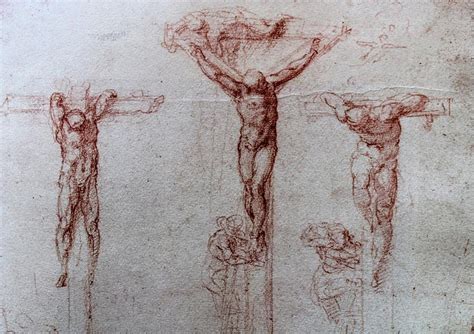
As I think about it, today’s Gospel reading plays with the same paradox since it’s the story of our king undergoing what, in Roman times, was regarded as the most humiliating and certainly the most unkingly of executions. The word “king” is first used sarcastically and then transformed into something holy:
When they came to the place that is called The Skull, they crucified Jesus there with the criminals, one on his right and one on his left. Then Jesus said, “Father, forgive them; for they do not know what they are doing.” And they cast lots to divide his clothing. The people stood by, watching Jesus on the cross; but the leaders scoffed at him, saying, “He saved others; let him save himself if he is the Messiah of God, his chosen one!” The soldiers also mocked him, coming up and offering him sour wine, and saying, “If you are the King of the Jews, save yourself!” There was also an inscription over him, “This is the King of the Jews.”
One of the criminals who were hanged there kept deriding him and saying, “Are you not the Messiah? Save yourself and us!” But the other rebuked him, saying, “Do you not fear God, since you are under the same sentence of condemnation? And we indeed have been condemned justly, for we are getting what we deserve for our deeds, but this man has done nothing wrong.” Then he said, “Jesus, remember me when you come into your kingdom.” He replied, “Truly I tell you, today you will be with me in Paradise.” (Luke 23:33-43)
Here’s Guite’s poem:
Christ the King Matthew 25-31-46
Our King is calling from the hungry furrows Whilst we are cruising through the aisles of plenty, Our hoardings screen us from the man of sorrows, Our soundtracks drown his murmur: ‘I am thirsty’. He stands in line to sign in as a stranger And seek a welcome from the world he made, We see him only as a threat, a danger, He asks for clothes, we strip-search him instead. And if he should fall sick then we take care That he does not infect our private health, We lock him in the prisons of our fear Lest he unlock the prison of our wealth. But still on Sunday we shall stand and sing The praises of our hidden Lord and King.
This “hidden Lord and King,” this “man of sorrows,” is not demanding pomp and ceremony, and he has nothing to do with prosperity theology, despite the contentions of certain megachurch pastors. The soldiers’ sarcasm is turned on its head, just as so much was turned on its head with Jesus’s death and resurrection.
In short, when you hear Christ described as king, don’t think of him as an elevated king. He’s down here in the trenches with us.
Note: If you wish to receive, via e-mail, (1) my weekly newsletter or (2) daily copies of these posts, write to me at rrbates1951@gmail.com. Comments may also be sent to this addss. I promise not to share your e-mail with anyone. To unsubscribe, write here as well.
Friday
This is the latest post in my on-going series on “My Life in Literature,” which appears every Friday. Because an informal autobiography written by my great grandmother Eliza Scott means so much to me—she discusses the novels that were important to her as she grew up in Victorian England—I figured I should do something similar for family members who come after me. Of course, the subject is also consistent with the mission of this blog, which is to explore the many ways that literature enhances and sometimes changes our lives.
In my last “Life in Literature” post I mentioned how, although many of my college literature essays felt like meaningless cerebral essays, occasionally I would write one where something seemed to be at stake. That was the case for an essay I wrote my senior year on D. H. Lawrence’s poetry. It was meaningful because it coincided with my blossoming love affair with Julia.
I had met Julia Ruth Miksch the year before. One of a handful of Carleton students with a farming background, Julia was touted by the Admissions Office as adding diversity to the student body. (“One of your classmates is a pig farmer’s daughter,” the admissions director informed us during first-year orientation.”) Julia had started a poetry reading group our junior year and, because she was a friend of my roommate, I wandered in. Apparently I impressed her by citing the first few lines of a Gerard Manley Hopkins poem—the very rhythmical “Leaden Echo”—but I didn’t join the group as the college newspaper was taking up all of my extra time.
We reconnected the following term, where over lunch we began a conversation that unexpectedly lasted for several hours. Conversing excitedly about ideas functioned as an aphrodisiac that led to the first real sex of my life, after which I was hooked. Over the summer Julia visited us in Sewanee after recovering from a severe case of mono contracted during her spring semester, and we decided we would get married after graduation. Senior year at Carleton proved a very rich time. Julia had to drop basketball because of the aftereffects of her sickness but found her time filled up with student teaching and preparing for comps. I, meanwhile, was editing the Carletonian while recovering from a broken leg and writing my senior thesis. Nevertheless, I would spend many nights in her room and (when the weather turned warm) out in the arboretum. Into these exhilarating days stepped Lawrence’s poetry.
Creative writing professor Keith Harrison was teaching a course on 20th century poetry, which introduced me to Lawrence. I sometimes think of D.H. as a young person’s author since his fascination with sex matches our own at that age. His collection Birds, Beasts, and Flowers, which contains pulsating poems about the natural world, was just the ticket. Take, for instance, these opening stanzas from “Tortoise Shout,” a poem about copulating turtles that, somewhat unbelievably, we had someone read at our wedding:
I thought he was dumb, I said he was dumb, Yet I’ve heard him cry.
First faint scream, Out of life’s unfathomable dawn, Far off, so far, like a madness, under the horizon’s dawning rim, Far, far off, far scream.
Tortoise in extremis.
Why were we crucified into sex? Why were we not left rounded off, and finished in ourselves, As we began, As he certainly began, so perfectly alone?
A far, was-it-audible scream, Or did it sound on the plasm direct?
An urge driven by nature’s seething plasm? Never underestimate the power of a young person’s sexual awakening.
Some background is useful here. Both sides of my family were sexually repressed, which I duly imbibed in a deep way. Few novels have understood me as well as John Fowles’s The French Lieutenant Woman, which I read as a sophomore and which features a young man who, while an intellectually adventurous Darwinist, is otherwise tightly wound. Everything changes for him when he meets a mysterious woman—just as, a year later, everything would change for me when I met Julia.
I say my family was repressed even though my father became somewhat famous (or infamous) for his fascination with erotica. It showed up in his groundbreaking Apollinaire scholarship, in his teaching, in his poetry, and in the “Erotic Film Series” he ran for years at the University of the South. In fact, the two of us once collaborated on an essay contending that “rosebud” in Citizen Kane was originally a vulva. (It’s my most cited article.) But one can reinscribe repression in rebelling against it, which I think my father did in attempting to break free from my grandparents’ Victorian views of sex. All of which is to say that I felt boxed in by my own feelings of guilt and timidity when it came to my sexuality.
Which is why Lawrence hit with such force. Even before I encountered his poetry, I had read The Man Who Died, a novella about Christ deciding to live a very different kind of life when he returns from the dead. The original title of the work was The Escaped Cock, with the sexual pun fully intentional, and we see Jesus rejecting self-denial for a life that includes sexual pleasure. By the end, he is sleeping with and impregnating an Egyptian priestess of Isis.
Characteristic of the novel is the following passage, which now strikes me as verging on parody but which was heady stuff for a 20-year-old with my background:
He crouched to her, and he felt the blaze of his manhood and his power rise up in his loins, magnificent.
“I am risen!”
Magnificent, blazing indomitable in the depths of his loins, his own sun dawned, and sent its fire running along his limbs, so that his face shone unconsciously.
Jesus as imagined by Lawrence has cared so much for others that he has neglected his own needs, which is what he must learn. As he tells Mary Magdalene, “The teacher and the savior are dead in me; now I can go about my business, into my own single life.” And she, whom Lawrence imagines to be a former prostitute who has given up the sensual life for the spiritual, is depicted as having gone too far the other way. Your lovers, he tells her, “were much to you, but you took more than you gave. Then you came to me for salvation from your own excess.” Elsewhere the author informs us, “Now the other doom was on her. She wanted to give without taking. And that, too, is hard, and cruel to the warm body.”
Lawrence is rebelling here, not only against sexual repression but against sacrificing oneself to a life of service to others. Given that “service” could have been my middle name, and Julia’s as well, reading Lawrence at the height of the sexual revolution gave us permission to explore our bodies.
But there’s another way that Lawrence was important to me, which I explored in my essay. Even as the author imagines losing himself in a grand passion, he is also fearful of losing his individuality. His poems reflect this tension, as does his essay on Walt Whitman, who in Song of Myself sometimes focuses on the Self apart, sometimes on merging with the cosmos. Here’s Lawrence doing a version of the same in “Hummingbird”:
Before anything had a soul, While life was a heave of matter, half inanimate, This little bit chipped off in brilliance And went whizzing through the slow, vast, succulent stems.
As I look back at the wedding ceremony I composed, I see that I used poetry to figure out how two people can hold on to their separate identities while still forming a more perfect union. Furthermore, I felt that I, as a non-believer, had to justify the very fact that I was getting married. Nor was that the only impediment since, to many of us at the time, marriage seemed an outdated institution (which is how Sartre saw it). Why have a ceremony at all? Since literature was my religion—it seemed to me a much richer symbol system—I turned to poetry to reconcile myself with exchanging vows before a minister.
The ceremony wasn’t a problem for Julia since she had been raised in a Moravian community and had been attending the local Moravian church in Northfield. That must have been why she gave me a free hand in writing the ceremony. In the following segment—which came after Keith Harrison reading Lawrence’s “Tortoise Shout”— I draw on an image from Archibald MacLeish’s “Ars Poetica” to capture separate-but-together and W.B. Yeats’s “A Prayer for My Daughter” to justify the ceremony. For good measure, I also throw in the Hegelian/Marxist dialectic, anticipating tension between my thesis and Julia’s antithesis but predicting a higher synthesis.
Before sharing it, let me set the scene. My sons, looking at photos, tell me that we had a hippy wedding. While I distanced myself from hippy drug culture, it’s true that I had long hair and wore blue jeans and sandals while Julia had a muslin wedding dress on which her mother and sister had embroidered mushrooms. The wedding, meanwhile was held outside and featured a classmate playing a lute, so you can tell me if my sons are right. Here’s the passage from the ceremony I’m referencing:
Minister: The marriage bond is a bond between two individuals. It does not entail a merging of one into the other, for in merging the individuality is lost. Congregation: There must be a tension of difference. Without the tension, there can be no growth. Minister: From the tension, this man and this woman will grow to new awarenesses and reach new syntheses. Marriage can be beautiful because it provides a unified form in which to search. Congregation: Marriage is like a sonnet. As a fixed form, it endows a heightened beauty on the infinite number of variations within. Minister: The bond is the attraction between two stars revolving around each other, caught in each other’s orbit but resisting an incorporation which would burn brightly but die quickly. Congregation: “Love is the leaning grasses and two lights above the sea.” Minister: If we are gathered together today, it is because through ritual we ascertain the symbolic nature of the bond. And only through symbolism can we touch upon the beauty and the innocence. Congregation: “How but in custom and in ceremony Are innocence and beauty born? Ceremony’s a name for the rich horn, And custom for the spreading laurel tree.”
Following the exchange of vows and a reception, Julia and I climbed into her Ford pickup and drove off into the great unknown. And here we are, still together, 53 years later.
Note: If you wish to receive, via e-mail, (1) my weekly newsletter or (2) daily copies of these posts, write to me at rrbates1951@gmail.com. Comments may also be sent to this addss. I promise not to share your e-mail with anyone. To unsubscribe, write here as well.
Thursday
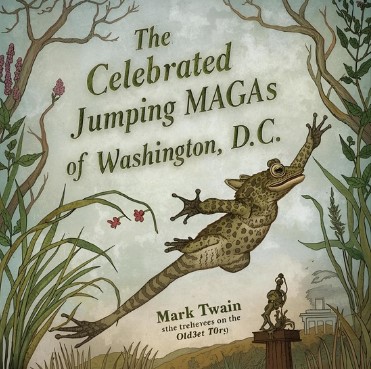
I’ve written numerous posts about the slavish devotion Donald Trump demands of his cabinet officials, but Digby’s Hullabaloo website has just given me another literary way of imagining it: “The Celebrated Jumping Magas of Washington, D.C.”
For extra measure, the post references King Lear, and it also gives me the opportunity to share a favorite image of mine from Gulliver’s Travels.
The title, as no doubt you know, references Mark Twain’s “The Celebrated Jumping Frog of Calaveras County.” Channeling Twain’s satiric tone, Digby notes that it took Pam Bondi a whole three hours and 37 minutes (!) to respond to Trump’s command to investigate Democrats associated with Jeffrey Epstein. Trump, of course, wants to deflect attention from his own association with Epstein, but no president since Richard Nixon has had the gall to sic the Justice Department on his enemies—and not even Nixon did it openly!
The need to maintain distance between the president and the attorney general has been so important that even casual encounters can create as stir, as Obama AG Loretta Lynch learned when she had a brief discussion with Hillary Clinton’s husband on an airport tarmac during the 2016 election. AG Merritt Garland, meanwhile, was scrupulous to a fault in maintaining distance from Joe Biden: when he saw that it was necessary to investigate Trump himself for instigating a coup attempt and stealing government documents, he appointed a special prosecutor.
Forget all that when it comes to Trump, who on Friday tweeted out,
Now that the Democrats are using the Epstein Hoax, involving Democrats, not Republicans, to try and deflect from their disastrous SHUTDOWN, and all of their other failures, I will be asking A.G. Pam Bondi, and the Department of Justice, together with our great patriots at the FBI, to investigate Jeffrey Epstein’s involvement and relationship with Bill Clinton, Larry Summers, Reid Hoffman, J.P. Morgan, Chase, and many other people and institutions, to determine what was going on with them, and him.
To which Bondi responded,
Thank you, Mr. President. SCNY U.S. Attorney Jay Clayton is one of the most capable and trusted prosecutors in the country, and I’ve asked him to lead. As with all matters, the Department will pursue this with urgency and integrity to deliver answers to the American people.
Noting the time lapse between when Trump tweeted out his “ask” and Bondi responded with her reassurance, Digby comments, “Surely you can do better, Pam. Usually, Trump’s people are pretty snappy about shouting, ‘Yes, sir! How high?’ whenever he says jump.”
Digby then suggests a contest between cabinet officials:
Why not a competition on the White House South Lawn? Let’s see who can jump faster and higher for their king. Consider it a trial run for the UFC the former reality TV star has planned there for the country’s 250-year anniversary. His entire boot-licking cabinet, plus Stephen Miller and OMB Director Russ Vought. Open the games with a solemn quote from King Lear: “Which of you shall we say doth love us most?“
For the record, here’s the response of Lear’s oldest daughter to that question:
Sir, I love you more than word can wield the matter, Dearer than eyesight, space, and liberty, Beyond what can be valued, rich or rare, No less than life, with grace, health, beauty, honor; As much as child e’er loved, or father found; A love that makes breath poor, and speech unable. Beyond all manner of so much I love you.
As apt as the Lear reference is, Swift goes it one better. In his visit to Lilliput, Gulliver witnesses two gymnastic exercises required of those seeking the emperor’s favor. The first involves a tightrope, a metaphor that every politician who has ever had to balance competing interests will appreciate. Flimnap in Swift’s allegory is Prime Minister Robert Walpole:
When a great office is vacant, either by death or disgrace (which often happens) five or six of those candidates petition the emperor to entertain his majesty and the court with a dance on the rope; and whoever jumps the highest, without falling, succeeds in the office. Very often the chief ministers themselves are commanded to show their skill, and to convince the emperor that they have not lost their faculty. Flimnap, the treasurer, is allowed to cut a caper on the straight rope, at least an inch higher than any other lord in the whole empire. I have seen him do the summerset several times together, upon a trencher fixed on a rope which is no thicker than a common packthread in England.
The other test involves either jumping over a stick or crawling under it (i.e., groveling). The threads awarded as prizes stand in for different orders of knighthood (the Order of the Garter, the Order of the Bath, and the Order of the Thistle):
There is likewise another diversion, which is only shown before the emperor and empress, and first minister, upon particular occasions. The emperor lays on the table three fine silken threads of six inches long; one is blue, the other red, and the third green. These threads are proposed as prizes for those persons whom the emperor has a mind to distinguish by a peculiar mark of his favor. The ceremony is performed in his majesty’s great chamber of state, where the candidates are to undergo a trial of dexterity very different from the former, and such as I have not observed the least resemblance of in any other country of the new or old world. The emperor holds a stick in his hands, both ends parallel to the horizon, while the candidates advancing, one by one, sometimes leap over the stick, sometimes creep under it, backward and forward, several times, according as the stick is advanced or depressed. Sometimes the emperor holds one end of the stick, and his first minister the other; sometimes the minister has it entirely to himself. Whoever performs his part with most agility, and holds out the longest in leaping and creeping, is rewarded with the blue-coloured silk; the red is given to the next, and the green to the third, which they all wear girt twice round about the middle; and you see few great persons about this court who are not adorned with one of these girdles.
In the case of walking the tightrope, everyone takes a fall sooner or later, but Flimnap/Walpole has special insurance:
These diversions are often attended with fatal accidents, whereof great numbers are on record. I myself have seen two or three candidates break a limb. But the danger is much greater, when the ministers themselves are commanded to show their dexterity; for, by contending to excel themselves and their fellows, they strain so far that there is hardly one of them who has not received a fall, and some of them two or three. I was assured that, a year or two before my arrival, Flimnap would infallibly have broke his neck, if one of the king’s cushions, that accidentally lay on the ground, had not weakened the force of his fall.
In Swift’s mind, the cushion is the Duchess of Kendal, mistress of the king and a Walpole supporter. When Walpole messed up, Kendal was there to smooth things over. In Trump’s case, the cushion is merely undying loyalty to Trump so that various screw-ups are allowed—mistakenly leaking battle plans (Defense Secretary Pete Hegseth), using a government jet to visit a mistress (FBI director Kash Patel)—if one is satisfactorily dancing, jumping, or crawling.
Gulliver and Lear actually fit Trump better than Twain’s jumping frog since a stranger rigs the contest. As the storyteller recounts it, “he got the frog out and prized his mouth open and took a teaspoon and filled him full of quail shot—filled him pretty near up to his chin.” It’s this stranger who bears the most resemblance to the current White House since Trump has been sabotaging his opponents his entire life. And as with this stranger, they have yet to “ketch” him.
But whether as jumping frogs, avaricious daughters, or gyrating Lilliputians, the heads of our most important governmental bodies are putting on quite a show.
Note: If you wish to receive, via e-mail, (1) my weekly newsletter or (2) daily copies of these posts, write to me at rrbates1951@gmail.com. Comments may also be sent to this addss. I promise not to share your e-mail with anyone. To unsubscribe, write here as well.
Wednesday
In a classic example of how bad people can twist a good book to their own ends, ICE is calling its Charlotte deportation efforts “Operation Charlotte’s Web.” Leader Gregory Bovino has even had the effrontery to quote from the novel: “Wherever the wind takes us. High, low. Near, far. East, west, North, south. We take to the breeze, we go as we please.” To which he adds, “This time, the breeze hit Charlotte like a storm.”
On Monday the Charlotte Observer reported that the storm involved masked ICE agents in green uniforms detaining 130 people in public places, supermarkets, busy roadways and an east Charlotte church.
The estate of E.B. White has hit back, with White’s granddaughter and literary executor saying that the operation is “antithetical” to the author’s values. Martha White has stated that her grandfather “certainly didn’t believe in masked men, in unmarked cars, raiding people’s homes and workplaces without IDs or summons. He didn’t condone fearmongering.”
In an interview with the Observer, White pointed out that the novel “is all about compassion. It’s all about taking responsibility for those who are vulnerable and putting yourself in another person’s shoes.” She added that White, in his White Flag collection of essays (1943-46), wrote that the United States is regarded by people everywhere “as a dream come true, a sort of world-state in miniature. Here dwell the world’s emigrants under one law, and the law is: Thou shalt not push thy neighbor around.”
Further on he stated,
By some curious divinity which in him lies, Man, in this experiment of mixed races and mixed creeds, has turned out more good than bad, more right than wrong, more kind than cruel, and more sinned against than sinning. This is the world’s hope and its chance.
It is in this spirit that Charlotte, in her final conversation with Wilbur, explains why she has expended her remaining energy to save his life. When he asks, “Why did you do all this for me? I don’t deserve it. I’ve never done anything for you,” the spider replies,
You have been my friend. That in itself is a tremendous thing. I wove my webs for you because I liked you. After all, what’s a life, anyway? We’re born, we live a little while, we die. A spider’s life can’t help being something of a mess, with all this trapping and eating flies. By helping you, perhaps I was trying to lift up my life a trifle. Heaven knows anyone’s life can stand a little of that.
Yes, antithetical to everything that ICE and Trump and Trump’s minions stand for.
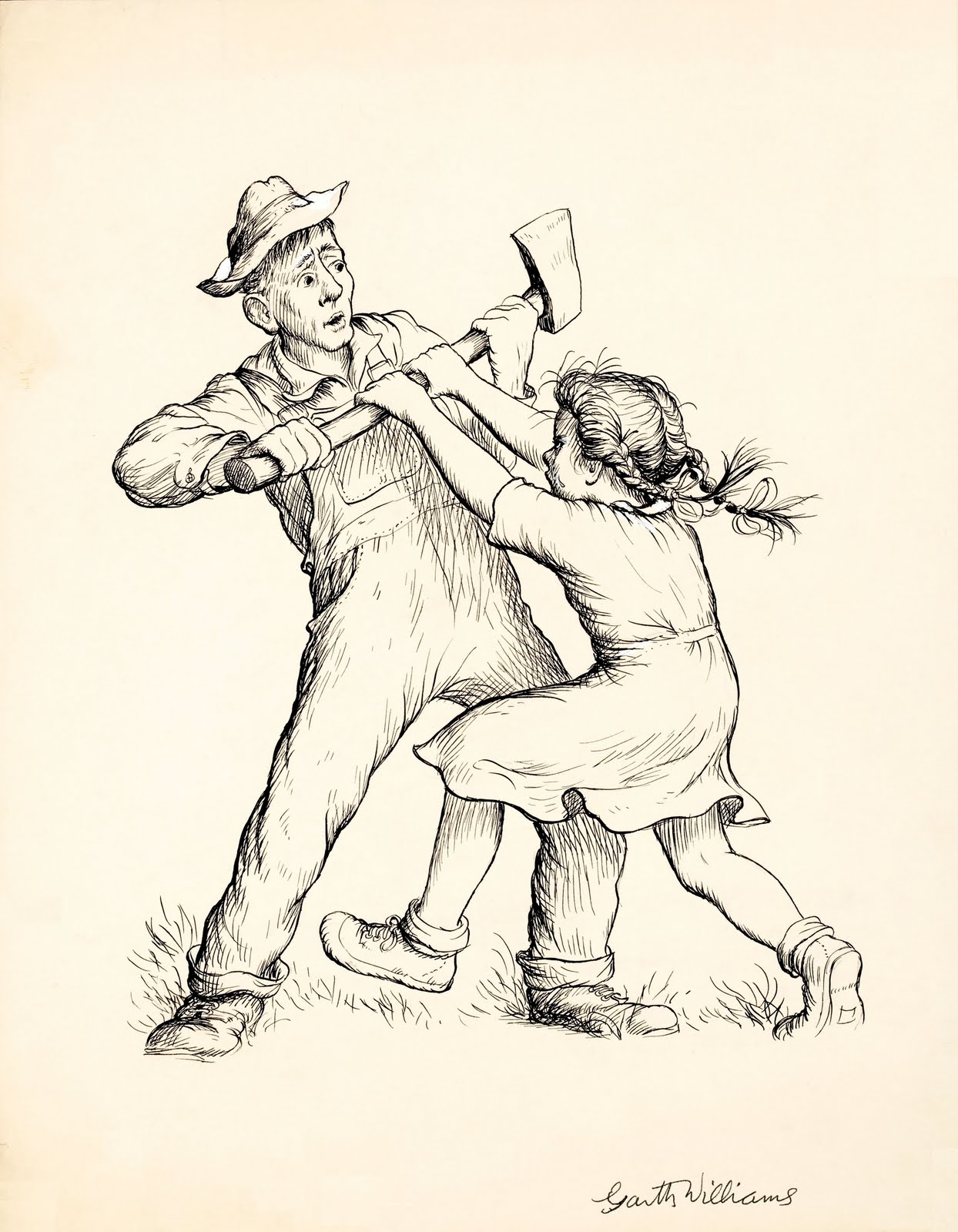
One Garth Williams illustration from Charlotte’s Web that was seared into my brain at six or so is Fern preventing her father from taking an axe to runt-of-the-litter Wilbur. Think of her as a Charlotte protester standing up against ICE. Of course, Mr. Arable is more justified than ICE in his rationale: farmers must kill animals to earn a living. This is the unwelcome news that the Old Sheep has for Wilbur: “Well, I don’t like to spread bad news but they’re fattening you up because they’re going to kill you…”
The only rationale that ICE has for going after most of those it is targeting is that they are people of color.
Bovino identifies ICE with the baby spiders who are about to be scattered to the wind. In actuality, there is nothing random about ICE, which is targeting blue cities. The passage he quotes more accurately describes our immigrants, who come down wherever circumstances allow. As the baby spiders put it, “We are aeronauts and we are going out into the world to make webs for ourselves.”
If Bovino wants to find a kindred soul in the novel, he should settle on Templeton the rat, who hoards rotten eggs and is described as having
no morals, no conscience, no scruples, no consideration, no decency, no milk of rodent kindness, no compunctions, no higher feeling, no friendliness, no anything. He would kill a gosling if he could get away with it – the goose knew that. Everybody knew it.
It is Templeton who, displaying a sadism characteristic of ICE, bursts Wilbur’s bubble at the fair, telling him, “I wouldn’t be surprised if Zuckerman changes his mind about you. Wait till he gets hankering for some fresh pork and smoked ham and crisp bacon! He’ll take the knife to you, my boy.”
Fortunately, Templeton doesn’t get the last word, and there’s a chance that Trumpism won’t either. The final message of Charlotte’s Web is one of renewal, which we all need at this moment. After Charlotte dies, breaking Wilbur’s heart, we are reminded that spring always follows winter:
The snows melted and ran away. The streams and ditches bubbled and chattered with rushing water. A sparrow with a streaky breast arrived and sang. The light strengthened, the mornings came sooner. Almost every morning there was another new lamb in the sheepfold. The goose was sitting on nine eggs. The sky seemed wider and a warm wind blew. The last remaining strands of Charlotte’s old web floated away and vanished.
A major reason why America has flourished is because immigrants, like baby spiders, have floated in, replenishing, rejuvenating and reinvigorating the nation. As E.B. White’s granddaughter notes, books like Charlotte’sWeb have been vital in opening our hearts and minds to the vulnerable. In the novel, Charlotte stands in for the author—Wilbur regards her as “a true friend and a good writer”—one who devotes her life to helping a fellow creature. The final result is a world in which we can live in harmony with a diverse population, “a sort of world state in miniature.” This vision even includes a place for rats:
Life in the barn was very good—night and day, winter and summer, spring and fall, dull days and bright days. It was the best place to be, thought Wilbur, this warm delicious cellar, with the garrulous geese, the changing seasons, the heat of the sun, the passage of swallows, the nearness of rats, the sameness of sheep, the love of spiders, the smell of manure, and the glory of everything.
Note: If you wish to receive, via e-mail, (1) my weekly newsletter or (2) daily copies of these posts, write to me at rrbates1951@gmail.com. Comments may also be sent to this addss. I promise not to share your e-mail with anyone. To unsubscribe, write here as well.
Tuesday
For five years I’ve been anxiously awaiting the publication of the final volume of Philip Pullman’s Book of Dust trilogy and would have stood in a midnight bookstore line like a Harry Potter fan to get it. I can now report that The Rose Field is as delicious as anticipated.
Before reading it, however, I reread the second book in the trilogy. In the process, I discovered that The Secret Commonwealth packs more of a punch now than it did five years ago. That’s because it captures what many Americans are experiencing daily under the Trump administration
The novel features scenes where agents from the Consistorial Court of Discipline (CCD) barge into previously off-limits Oxford University, carting away faculty and staff without any due process. The CCD is the enforcement arm of the Magisterium, which Pullman sets up as a cross between the Catholic Church of the Spanish Inquisition and the repressive Geneva church of John Calvin. The episode that got to me was two agents invading the home of an elderly professor and twisting her arm behind her back to get her to talk. Two other women, upon arriving, behave not unlike those brave protesters in L.A., Chicago, Charlotte and elsewhere when they see ICE grabbing people. Brenda is the more fearless of the two:
“Let her go at once,” Brenda demanded. “Take your hands off, stand back, move right away. Go on.” Topham’s reply was to twist even harder. Hannah couldn’t help a little gasp of pain.
At one point in the interchanges, the two women are shoved to the floor but come up wielding fire irons. Brenda says defiantly, “Now turn around, go outside, and leave. You’re not getting any further with this. I don’t know who you think you are or what you think you’re doing, but by God you’re not going to get away with it.”
Janet, once a timid secretary, also refuses to back down, earning a threat from the second CCD agent. “I remember you,” he says. “You can say goodbye to that job.”
Brenda and Janet are also upset about the arrest of housekeeper Alice Lonsdale, who (again like a number of American protesters) has been arrested for lipping off to the CCD. Neither woman backs down:
Janet was trembling with shock, but Brenda seemed to have no fear, confronting the two CCD men as if all the moral power in the situation belonged to her, which it did.
“You seem to be unaware that we have authority to carry out investigations”–Manton began, but Brenda’s voice overwhelmed his.
“No, you haven’t, you thief, you coward, you thug. No one has the authority to come into anyone’s house without a warrant—you know that, and I know that. Everyone knows it. Nor do you have the authority to arrest people without a cause. Why did you arrest Alice Lonsdale?”
“Nothing to do with—”
“It’s got everything to do with me. I’ve known that woman since she was a child. There’s not a criminal bone in her body, and she’s been a first-rate servant to Jordan College too. What did you do to the Master to make him give her up?”
“That’s got nothing—”
“You can’t give me a reason because there isn’t one, you wretch, you bully, you sneaking villain.”
The two agents ultimately decide to cut their losses and beat a tactical retreat, although not before Brenda berates them one final time. “We’ll find her,” she says, speaking of Alice. “We’ll have her out of your custody, you lawless vermin. The day’ll come when the bloody CCD is drummed right out of this country with your tails between your legs.”
To save face, one of the agents utters one final set of threats on his way out:
“We know you,” he said, looking at Janet, “and we’ll have you before long,” he went on, looking at Hannah, “and we’ll find out who you are easy enough, and you’ll be in real trouble,” he finished, looking at Brenda.
Just the coldness in his eyes was enough to frighten Janet, but she felt defiant too, having helped in a small way. It might be worth losing her job to feel like that for a minute or two.
When Janet goes into work the following day, she discovers that she has in fact been fired. The administrator who has capitulated to CCD, however, can’t look her in the face as he delivers the news. I thought of those universities and school systems that have capitulated to Trump’s extortion threats, as well as those who fired faculty and staff for posting disparaging comments about rightwing provocateur Charlie Kirk following his assassination:
“Janet, I’m sorry but I have some unfortunate news,” he said.
He was speaking quickly. He still didn’t look at her. She felt her stomach about to sink, and held her tongue.
“I—um—it’s been made clear to me that it would be difficult to—ah—continue your employment,” he said.
“Why?”
“It seems that you unfortunately made a, umm, well, a bad impression on the two officers who came here yesterday. I must say I saw nothing of that sort myself—always valued your complete professionalism—and it may be that their attitude was a little excessive—nevertheless, these are not easy times, and…”
Janet explains what the agents were doing in words that apply only too well to ICE’s behavior:
“They were stealing the property of an old lady and treating her brutally, and I happened to see it going on, and me and my friend stepped in and helped her. And that’s all, Mr. Stringer, that’s all that happened. Is this the kind of country we’re living in now, that people can be sacked from jobs they do well just because they inconvenience bullies and thugs from the CCD? Is that the kind of place this is?”
The Bursar put his head in his hands. Janet had never in her life spoken to an employer like that, and she stood with fast-beating heart while he sighed heavily and three times tried to say something.
“It’s very difficult,” he said. He looked up, but not at her. “There are things I can’t explain. Pressures and tensions that…umm…college staff, domestic staff are quite properly protected from. These are times unlike any…I have to protect the staff from…”
And at the end:
He was pretending he couldn’t hear her. His face was turned down; he sat perfectly still; he was pretending she wasn’t there, and that no one was asking him questions, and he seemed to think that if he sat still and didn’t look at her, what he pretended would come true.
There are craven Bursars all over the United States right now. Thankfully, there are also Brendas and Janets. Thanks to their courage and resolve, there’s a better chance that a day of reckoning will come for ICE bullies and their enablers.
Of course, we shouldn’t need brave souls having to step up. As Galileo says in Bertolt Brecht’s play about him, “Unhappy is the land that is in need of heroes.”
Note: If you wish to receive, via e-mail, (1) my weekly newsletter or (2) daily copies of these posts, write to me at rrbates1951@gmail.com. Comments may also be sent to this addss. I promise not to share your e-mail with anyone. To unsubscribe, write here as well.
Monday
Lacking the Justice Department’s files on Jeffrey Epstein—files in which Trump’s name reportedly appears hundreds of times—the public is left with files released by the Epstein estate. Of the thousands of pages available, one containing a Sherlock Holmes reference is drawing particular attention. In 2011 Epstein emailed confederate Ghislaine Maxwell, “i want you to realize that that dog that hasn’t barked is Trump. [named redacted] spent hours at my house with him,, he has never once been mentioned. police chief etc. im 75% there. ” To which Maxwell replied, “I have been thinking about that…”
The key tidbit here, of course, is that (according to Epstein) Trump spent hours with an underaged and trafficked girl. But what’s the significance of the Sherlock Holmes reference?
Let’s first look at the story. The non-barking dog appears in “The Adventure of Silver Blaze” (not The Hound of the Baskervilles), which is about horse trainer Straker attempting to hobble his own horse, who is a prohibitive favorite in an upcoming race. In desperate need of cash, Straker figures that if he subtly nicks one of Blaze’s tendons so that no one can see and then bets against him, he will replenish his coffers. He therefore drugs the stable boy, leads the horse outside, and attempts the deed. The horse, however, panics and kills him by kicking him in the head (although we don’t discover this until the end of the tale).
Holmes is puzzled that no one hears the dog barking when the horse is taken:
“Is there any point to which you would wish to draw my attention?” “To the curious incident of the dog in the night-time.” “The dog did nothing in the night-time.” “That was the curious incident,” remarked Sherlock Holmes.
He goes on to explain:
Before deciding that question I had grasped the significance of the silence of the dog, for one true inference invariably suggests others. The Simpson incident had shown me that a dog was kept in the stables, and yet, though some one had been in and had fetched out a horse, he had not barked enough to arouse the two lads in the loft. Obviously the midnight visitor was someone whom the dog knew well.
Demonstrating a Trump-like ability to distract us from the original crime, Arthur Conan Doyle presents us with a further plot complication: the horse disappears. It turns out that the manager of an adjoining estate, who is also betting against Silver Blaze, discovers him wandering on the heath, leads him to his own stables, and disguises him by painting over his silver blaze. At this point an innocent bookmaker (Simpson), who is in the area checking on the horses, is accused of having killed Straker. Holmes finds the horse and gets him to the racetrack on time, where he comes in first.
We could wish for such a happy ending in our own Epstein affair but let’s figure what the pedophile meant in his email:
First of all, the dog that didn’t bark has become a common enough expression that Epstein wasn’t necessarily referring directly to the story. Even if he wasn’t, however, let’s apply it to the situation. Trump would be Straker, the crooked horse trainer alone with his intended victim. That no one has barked out his name—not his victim, not the police—is what confuses Epstein and Maxwell. It’s as though they are in the early part of the mystery, possessing a significant clue but aren’t yet clear what it means. Or rather, the mystery for them is not a whodunit since they already know that Straker is guilty. They just can’t figure out why the police are failing to finger the culprit.
Of course, they are far from the only people that Trump has baffled with his ability to avoid accountability. Ultimately, it’s going to take more than Sherlock Holmes to solve that conundrum. Holmes can make connections that everyone else misses, but what does a literary detective do with someone who crimes in the open and even boasts about it? Where’s the intricate plot solving that is key to the genre?
Given how Trump, in the most blatant ways possible, is signaling he wants the Epstein files to be buried, we need to shift to a different literary detective. The one I have in mind is one whom Holmes expresses contempt for. When Watson in their early days together compares Holmes to Edgar Allan Poe’s Auguste Dupin, Holmes rises, lights his pipe, and replies,
No doubt you think that you are complimenting me in comparing me to Dupin. Now, in my opinion, Dupin was a very inferior fellow. That trick of his of breaking in on his friends’ thoughts with an apropos remark after a quarter of an hour’s silence is really very showy and superficial. He had some analytical genius, no doubt; but he was by no means such a phenomenon as Poe appeared to imagine.
In “The Purloined Letter,” however, Dupin is able to solve a mystery whose solution is hiding in plain sight. After the police fail to locate a blackmail letter despite conducting an extraordinarily meticulous search of minister G___’s apartment, Dupin saunters in and finds it in the letter rack where it lies only slightly disguised. “Perhaps the mystery is a little too plain,” Dupin observes to the police commissioner.
To invoke one final detective in this discussion, Erik Lönnrot in Jorge Luis Borges’s “Death and the Compass” is also befuddled by a mystery whose solution is staring him straight in the face. His criminal opponent, knowing how Lönnrot’s mind works, uses the detective’s preference for complex solutions to trap and kill him.
Before he dies, Lönnrot says, “I know of a Greek labyrinth which is a single straight line. Along this line so many philosophers have lost themselves that a mere detective might well do so too.” He is referring to Zeno’s paradox, but the straight line applies only too well to Donald Trump.
For decades there has been a straight line between Trump and Epstein, just as there has been a straight line between Trump and the January 6 coup attempt, a straight line between Trump and extortion, a straight line between Trump and money laundering, a straight line between Trump and bribery, a straight line between Trump and sexual assault, a straight line between Trump and countless other crimes. That single straight line has befuddled newspaper reporters and political opponents alike.
Understanding how Trump has evaded prison each and every time requires a different kind of mind than that possessed by Doyle’s famous detective.
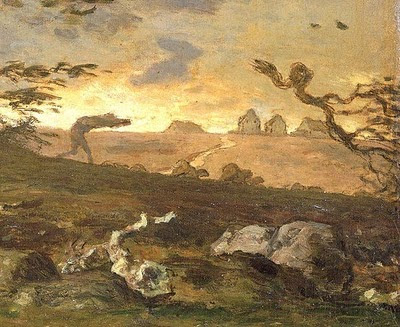
Jean-François Millet, detail from The Gust of Wind
Note: If you wish to receive, via e-mail, (1) my weekly newsletter or (2) daily copies of these posts, write to me at rrbates1951@gmail.com. Comments may also be sent to this addss. I promise not to share your e-mail with anyone. To unsubscribe, write here as well.
Sunday
aIn his ecstatic poem “Hurrahing the Harvest,” Gerard Manley Hopkins’s heart is lifted up by both the harvest season and by the prospect of meeting God face to face. Fall here is not a season for mourning, as it is in Hopkins’s “Spring and Fall,” but a time of ecstatic joy. As the old hymn has it, “we shall come rejoicing, bringing in the sheaves.”
The hymn, however, doesn’t entirely capture the fullness of Hopkins’s heart, which is lifted up as he sees the wild wind whipping around the grain dust and shredding the clouds. The immense joy he feels is God: in this harvest time he is “glean[ing] our Savior,” whose “rapturous love” greets us with realer and rounder replies than can the eyes, heart, looks, and lips of our fellow human beings. The hills he views in the distance, hung as though from the azurous blue sky, he imagines to be Christ’s “world-wielding shoulder.” They are like a mighty stallion although this stallion is sweet as well as strong.
This vision has been there all along, the speaker acknowledges in the last four lines, only he has been wanting in appreciation. Once we are awakened to the God’s grandeur (to borrow from another Hopkins poem)—once beholder and Savior meet—watch out! At that point the heart grows wings and hurls itself upwards, even as the earth hurls off below it:
Hurrahing the Harvest By Gerard Manley Hopkins
Summer ends now; now, barbarous in beauty, the stooks arise Around; up above, what wind-walks! what lovely behavior Of silk-sack clouds! has wilder, wilful-wavier Meal-drift moulded ever and melted across skies?
I walk, I lift up, I lift up heart, eyes, Down all that glory in the heavens to glean our Savior; And, eyes, heart, what looks, what lips yet gave you a Rapturous love’s greeting of realer, of rounder replies?
And the azurous hung hills are his world-wielding shoulder Majestic—as a stallion stalwart, very-violet-sweet!— These things, these things were here and but the beholder Wanting; which two when they once meet, The heart rears wings bold and bolder And hurls for him, O half hurls earth for him off under his feet.
The concluding bird image brings to mind maybe my favorite Hopkins poem, “The Windhover,” which opens with a similar soaring of the heart:
I caught this morning morning’s minion, king- dom of daylight’s dauphin, dapple-dawn-drawn Falcon, in his riding Of the rolling level underneath him steady air, and striding High there, how he rung upon the rein of a wimpling wing In his ecstasy! then off, off forth on swing, As a skate’s heel sweeps smooth on a bow-bend: the hurl and gliding Rebuffed the big wind. My heart in hiding Stirred for a bird, – the achieve of, the mastery of the thing!
When he became a Jesuit priest, Hopkins apparently stopped writing poetry out of fear that his poems were too sensual. Fortunately, his religious superiors encouraged him to return, and the result is a visceral experience of religious transcendence that reminds one of St. Teresa of Ávila, St. John of the Cross, Hildegard of Bingen and Meister Eckhart. The key to reading Hopkins is to give oneself over to the dazzling images and the explosive rhythms. Perhaps it was his attempt to contain these feelings over the period of silence that led to them to come bursting out as they do.
Note: If you wish to receive, via e-mail, (1) my weekly newsletter or (2) daily copies of these posts, write to me at rrbates1951@gmail.com. Comments may also be sent to this addss. I promise not to share your e-mail with anyone. To unsubscribe, write here as well.
Friday
This is the latest post in my on-going series on “My Life in Literature,” which appears every Friday. Because an informal autobiography written by my great grandmother Eliza Scott means so much to me—she discusses the novels that were important to her as she grew up in Victorian England—I figured I should do something similar for family members who come after me. Of course, the subject is also consistent with the mission of this blog, which is to explore the many ways that literature enhances and sometimes changes our lives.
I want to pause for a moment at this point in my life history to reflect on feelings of inauthenticity that have plagued me for much of my life—up until I was 50 or so. I don’t know if this topic will be of general interest, but I’d like to figure it out for myself. As I’m telling my life through my experiences with literature, I can report that many of the literature essays I’ve written in college and graduate school—as well as some scholarly articles I’ve published–have felt inauthentic. That I received A’s on many of them just makes them appear even more inauthentic, as though I was good as jumping through meaningless hoops.
Authenticity is a big deal with the existentialists, who introduced me to the concept. The authentic individual, they contend, lives in accordance with his or her true self rather than conforming to societal expectations. Sartre’s No Exit, which I read in high school, features a political activist, now dead, who spends the afterlife being haunted by the fact that he hasn’t lived up to the ideal of a political martyr. Whereas he likes to think of himself as a heroic pacifist who was executed for his beliefs, in fact he was a jerk and a coward, one who abused his wife and who was executed for desertion.
Throughout my years in college, I felt like a political coward. I obsessed over my fear that I wasn’t doing enough to stop the war, which I saw as demanding something dangerous and committed. The marches I attended, and even my arrest, didn’t seem to require enough of me, as though I were just cosplaying a resistor. To be real, however, would involve stepping out of my comfort zone (or so I thought), and like Sartre’s anti-hero I worried that I wouldn’t be up to the challenge.
In fact, this proved to be the case. I once tried campaigning for George McGovern in 1972 but was so nervous about knocking on the doors of strangers that I became sick and gave up. Seeking a model for true commitment, I once attended a conference of the Trotskyist Worker’s League, but the members’ fanaticism repelled me. (Looking back, I suspect some of them were cosplaying revolutionaries.) In short, I felt perpetually guilty for not doing enough, even though I wasn’t sure what doing more would look like.
As I look back, I think the source of my anxiety was the conflict between desiring to stay safely ensconced in a world of ideas and books and feeling that I should be out in the world making meaningful change. (Perhaps this a variant of desiring to remain a child while knowing that I had to grow up.) To my eyes, my father appeared the ideal model, and I desperately desired to be just like him. Here he was, establishing himself as a world-class authority on the French poet Guillaume Apollinaire while, at the same time, devoting himself to noble causes (the civil rights movement, the anti-war movement, the feminist movement, the gay rights movement). He could even point to some tangible results, such as the desegregation of Franklin County schools and the University of the South.
And yet not only could I not entirely follow in his footsteps—after all, one must find one’s own way—but I worried that there was something unreal about him. When he was caught up in his theories, he sometimes seemed untethered from earthly concerns. It was my mother who kept the family grounded: she took care of the finances, handled our illnesses, made community organizations work, and ultimately founded and ran for 17 years our town newspaper (which she typed up every Wednesday on mimeographed pages). While I found my father more stimulating and exciting, somehow it was my mother who appeared to engage more effectively with the real world.
My most meaningful college essays were ones dealing with this tension between wanting to remain in the world of books and feeling the need to break out. The Beowulf essay offered a way to bridge the conflict as it showed how a society could use a work of literature to negotiate the deep threats it faced. A satire I wrote for a “Utopian Literature” class showed how a dystopian society I called Notelarc (an anagram for Carleton) kept the population docile by burying them in books and essays. (In other words, I was worried about remaining in this safe realm and blamed college for enabling my desire.) My senior thesis argued that the works of Rousseau and Diderot had more of an impact on the French Revolution than did the “penny pamphlets” that activists wrote and hawked on the streets. In short, in these essays I was trying to find a place in the world for someone with my interests and passions.
By contrast, other essays I wrote felt inauthentic. To provide one example, I remember a paper I wrote in the early British Literature survey where I grappled with the question, “Why is Faustus unable to repent and turn back to God?” I systematically went through the text, came up with answers, weighed them against each other, settled on one, and received an A. The question, however, didn’t speak to anything deep within me. (It does now as I more fully appreciate self-destructive inner struggles.) The same was true for an essay on W.B. Yeats’s Cuchulain plays as I can’t even remember what I wrote. Nor can I remember which novel I chose to analyze in my “Contemporary French Novels” class.
Something similar would happen in graduate school. It seemed like choosing a meaningful topic was a matter of chance, which sometimes I stumbled upon and sometimes didn’t. I was out to please the professor or the academy but not to reflect upon my own soul. I mention this because, as I evolved as a teacher, I decided I wouldn’t let the same thing happen to my students. I determined they would always have something “at stake” in their literature essays, and I devised various means (all of them requiring considerable time and work on my part) for steering them to topics what would mean something to them. Likewise, in this blog I focus on works that help me see more deeply into matters that I consider urgent.
I mention in passing that my commitment to meaningful engagement shaped how I worked with my advisees as well. I listened to them closely, tried to hear what moved and motivated them, and then brainstormed with them about possible careers and people who could advise them further. Our goal, I would tell them, was to find out what excited them and then figure out how they could get paid for doing it. Or as Joseph Campbell puts it, how to follow their bliss.
I don’t know how clear I have been in this introspective romp. Perhaps what I’m saying is that, as long as I was trying to be my father, and as long as I was trying to please the academy so that I could become a professor like him, I wasn’t living in accordance with my true self. Only when I encountered a crisis in my teaching—when inauthentic student essays started draining the life out of me—did I face the issue head-on. As a result, I became a very different kind of teacher than he was.
For too long I believed Athena’s problematic observation to Telemachus in The Odyssey: “It is rare for sons to be like fathers: Only a few are better, most are worse.” Many of us must symbolically kill our fathers if we are to find ourselves. How I finally did so will be the subject of a future post.
Note: If you wish to receive, via e-mail, (1) my weekly newsletter or (2) daily copies of these posts, write to me at rrbates1951@gmail.com. Comments may also be sent to this address. I promise not to share your e-mail with anyone. To unsubscribe, write here as well.
Thursday
I still haven’t gotten over the gut punch many of us felt when the “Surrender Caucus”—seven Democrats and an Independent who caucuses with the Democrats—voted to end the Democratic filibuster, which was the only tool the party had to prevent health insurance premiums for 24 million Americans from doubling, tripling, or even quadrupling. Republicans refused to negotiate, using SNAP benefits and hungry Americans as hostage, and their hard line appears to have worked. We’re now back to business as usual, only with the GOP once again learning that the party that cares about governing will always fold when the going gets rough.
After spending months watching the Trump administration fearlessly violate norms, laws, the Constitution, and basic human decency, the resistance was finally feeling hopeful. First there were the October 18 No Kings marches, which drew close to seven million protesters. Then we saw a blue wave on election night as Democratic candidates swamped the opposition, a positive sign for next year’s midterm elections. With the filibuster, we believed that Senate Democrats were finally showing backbone after capitulating on the budget last May. All the momentum, however, came to a screeching halt with this Neville Chamberlain moment.
My sick feelings have taken me back to my least favorite episode in the Narnia chronicles, which I otherwise adore. The last battle in The Last Battle involves the forces of King Tirian, which include Jill, Eustace, Jewel the unicorn, Farsight the eagle, Poggin the dwarf, and others. The Narnians have squared off against Calormenes intent on seizing Narnia, and the battle is notable in part because Jill takes part, the first C.S. Lewis heroine we see shooting enemy soldiers. The Narnians notch a temporary victory but then realize that more Calormenes are on their way against their now depleted ranks. They have another card to play, however, as wild Narnian horses rush to the rescue. Think of them as Senate Democrats demonstrating unaccustomed fortitude. Thanks to Narnian mice, the horses have escaped Calormene captivity:
“Listen!” said Jewel: and then “Look!” said Farsight. A moment later there was no doubt what it was. With a thunder of hoofs, with tossing heads, widened nostrils, and waving manes, over a score of Talking Horses of Narnia came charging up the hill. The gnawer and nibblers had done their work.
Then comes the stab in the back. A group of dwarfs, who owe their freedom to the Narnians, now turn their arrows on them:
Poggin the Dwarf and the children opened their mouths to cheer but that cheer never came. Suddenly the air was full of the sound of twanging bowstrings and hissing arrows. It was the Dwarfs who were shooting and—for a moment Jill could hardly believe her eyes—they were shooting the Horses. Dwarfs are deadly archers. Horse after horse rolled over. Not one of those noble Beasts ever reached the King.
At least the Surrender Caucus is not jeering at its allies as the dwarfs do. “Thought we were on your side, did you?” the dwarfs shout. “No fear. We don’t want any Talking Horses. We don’t want you to win any more than the other gang. You can’t take us in. The dwarfs are for the Dwarfs.”
A little while later, the dwarfs begin directing their arrows against the Calormenes, as we can expect the Surrender Caucus to begin doing again against the GOP. The damage has been done, however, and, in the end, the dwarfs don’t fare any better than the Narnians. All are thrown into a stable, which functions as Lewis’s metaphor for death. “I feel in my bones,” says Poggin, “that we shall all, one by one, pass through that dark door before morning.” Better for the author to show Jill being dragged by the hair and thrust through the entrance than having her disemboweled by a sword.
In the novel the Calormenes presumably overrun Narnia, although we don’t see this since Lewis at this point introduces the Book of Revelation. Earthly setbacks ultimately don’t matter, we learn, since a final apocalypse renders irrelevant such trivial concerns. When the good guys all go to Narnia heaven and the bad guys to the other place, we cease to worry about old Narnia.
Labor activist Joe Hill mocked such consolation with “You’ll get pie in the sky by and by.” Those who oppose the authoritarian takeover of America don’t have that luxury. Their battles must be fought in what Aslan calls the Shadow-Lands, and we’ll be facing a desolate wasteland if the Calormenes win.