After two days of balmy 70-degree weather here in southern Tennessee, temperatures will be plummeting into the twenties, promising to wreak havoc on the blossoms that are bursting out all over. I’m not sure if this is a blackberry, dogwood, or redbud winter—maybe all three—but I always find myself reciting a stanza from Robert Burns ‘s “Highland Mary” at such moments.
To set up the stanza, the poem opens in the high Romantic style with fertility imagery running amuck:
Ye banks, and braes, and streams around The castle o’ Montgomery, Green be your woods, and fair your flowers, Your waters never drumlie! There Simmer first unfald her robes, And there the langest tarry: For there I took the last Fareweel O’ my sweet Highland Mary.
How sweetly bloom’d the gay, green birk, How rich the hawthorn’s blossom; As underneath their fragrant shade, I clasp’d her to my bosom! The golden Hours, on angel wings, Flew o’er me and my Dearie; For dear to me as light and life Was my sweet Highland Mary.
Then comes the stanza that I use to articulate the turn in the weather:
Wi’ mony a vow, and lock’d embrace, Our parting was fu’ tender; And pledging aft to meet again, We tore oursels asunder: But Oh! fell Death’s untimely frost, That nipt my Flower sae early! Now green’s the sod, and cauld’s the clay, That wraps my Highland Mary!
Burns couldn’t get blunter with “death’s untimely frost” and the image of Mary wrapped in cold clay. Nor do things get any better in the following stanza as the poet gets unnervingly specific:
O pale, pale now, those rosy lips, I aft hae kiss’d sae fondly! And clos’d for ay the sparkling glance, That dwalt on me sae kindly! And mouldering now in silent dust, That heart that lo’ed me dearly!
The poet tries to end on an upbeat note, although I am doubtful whether this graphic descent into the grave can be offset so easily. I am reminded of Charlotte’s critique of the poet in Jane Austen’s Sanditon. First the concluding couplet:
But still within my bosom’s core Shall live my Highland Mary.
And now for Charlotte’s assessment. She is responding to a rake, who is rhapsodizing about Burns in an attempt to seduce her:
“I have read several of Burns’s poems with great delight,” said Charlotte as soon as she had time to speak. “But I am not poetic enough to separate a man’s poetry entirely from his character; and poor Burns’s known irregularities greatly interrupt my enjoyment of his lines. I have difficulty in depending on the truth of his feelings as a lover. I have not faith in the sincerity of the affections of a man of his description. He felt and he wrote and he forgot.
So should all the dead blossoms that we will be witnessing by the end of the week feel consoled by my reassurance that they will continue to live in my bosom’s core? Hmm.
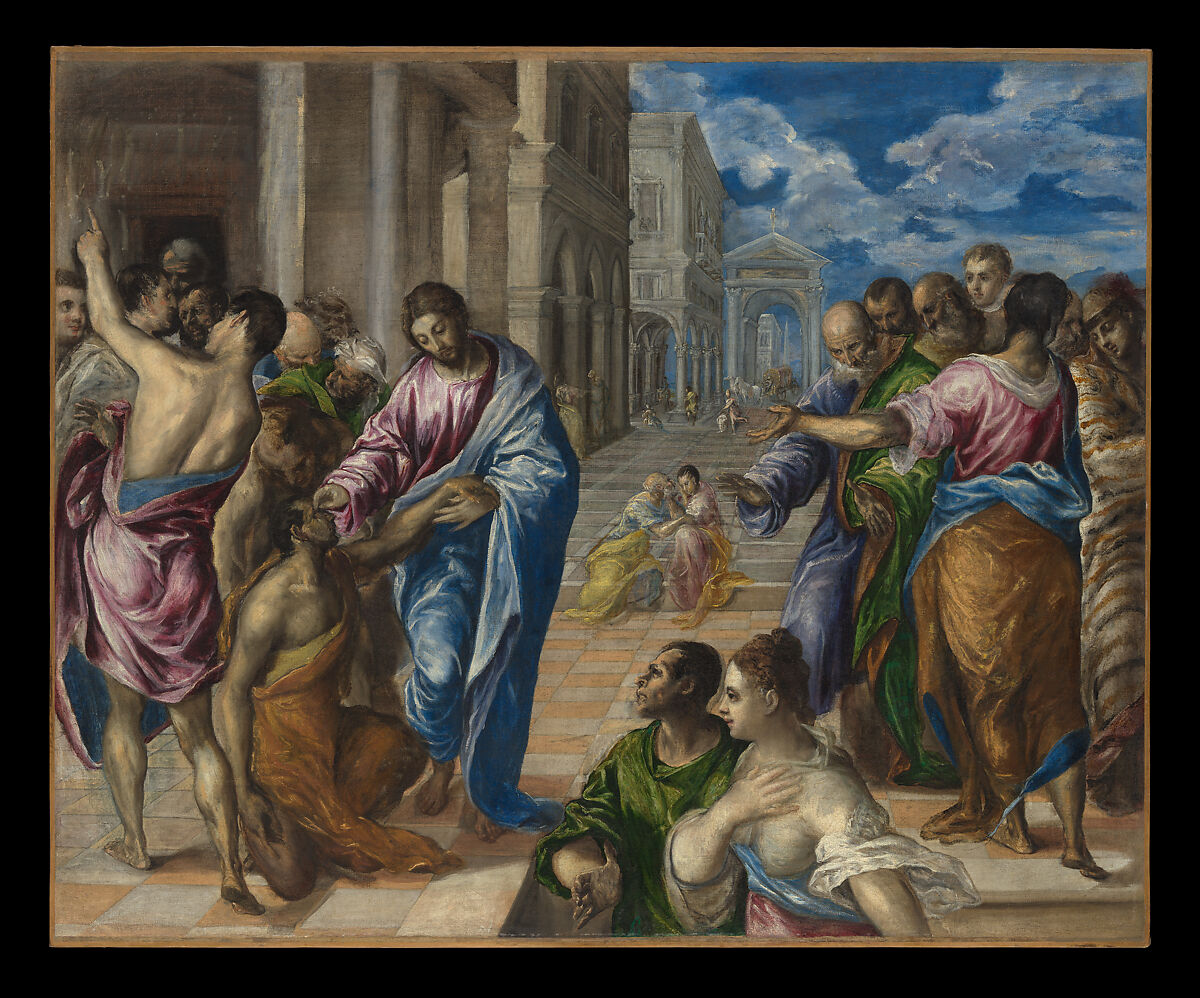
The indispensable blog Journey with Jesushas given me today’s poem, David Whyte’s “The Opening of Eyes.” Dan Clendenin has chosen it because seeing, both literal and metaphorical, is the subject of today’s Gospel reading, which is about Jesus healing the blind man. It concludes with Jesus chastising the pharisees, who have been berating the man for testifying about the miracle:
Jesus heard that they had driven him out, and when he found him, he said, “Do you believe in the Son of Man?” He answered, “And who is he, sir? Tell me, so that I may believe in him.” Jesus said to him, “You have seen him, and the one speaking with you is he.” He said, “Lord, I believe.” And he worshiped him. Jesus said, “I came into this world for judgment so that those who do not see may see, and those who do see may become blind.” Some of the Pharisees near him heard this and said to him, “Surely we are not blind, are we?” Jesus said to them, “If you were blind, you would not have sin. But now that you say, ‘We see,’ your sin remains.”
Here’s Whyte’s poem, in which the speaker realizes that the kingdom of God has always been here and now. If we pay attention, we will see that the bush is always burning and that God is always speaking to us. We think that God is elsewhere but, when we take off our shoes to enter heaven, we find that God is the ground on which we are already standing. We have but to open our eyes—truly open them–to understand this.
The Opening of Eyes By David Whyte
That day I saw beneath dark clouds the passing light over the water and I heard the voice of the world speak out, I knew then, as I had before life is no passing memory of what has been nor the remaining pages in a great book waiting to be read.
It is the opening of eyes long closed. It is the vision of far off things seen for the silence they hold. It is the heart after years of secret conversing speaking out loud in the clear air.
It is Moses in the desert fallen to his knees before the lit bush. It is the man throwing away his shoes as if to enter heaven and finding himself astonished, opened at last, fallen in love with solid ground.
I view the years between 1995 and 2000 as some Brits view the Edwardian golden age, which is to say, a period of idyllic quiet before all hell breaks loose and the world is inalterably changed. For them, the golden era was the period ranging from the death of Victoria in 1901 to the outbreak of World War I. In our case, it was the return from Slovenia in the fall of 1995 to the death of Justin on April 30, 2000.
If the age seemed golden for the Brits, it was partly out of nostalgia for pre-war England. But it’s also true that 1901-1914 was a rich period for literature, including many of the children’s classics I grew up with and loved. These included J.M. Barrie’s Peter Pan, Arthur Conan Doyle’s Lost World and many of his Sherlock Holmes stories, Kenneth Grahame’s Wind in the Willows, Rudyard Kipling’s Just So Stories (The Jungle Books were published in the previous decade), E. Nesbit’s Bastable Books and The Railway Children, Beatrix Potter’s animal books (beginning with Peter Rabbit), George Bernard Shaw’s Androcles and the Lion and Pygmalion, and P.G. Wodehouse’s Wooster and Jeeves. So the time was indeed golden.
For me, the final decade of the 20th century was also idyllic in fact, not just in retrospect, because I loved being the father of three teenage boys. All three were excellent athletes (Justin and Darien in soccer and baseball, Toby in soccer and lacrosse) so we were constantly attending sporting events where our boys shone. But I loved even more seeing them exploring ideas and stepping into their identities. We could talk about ideas at a whole new level.
I also got to see Justin and Darien star in Willie Wonka and the Chocolate Factory (Justin as the tuxedoed narrator who holds the show together, Darien as Charlie Bucket) and Toby captivate his school with a very entertaining feature film
The years were not without drama. Julia had been forced to drop out of her PhD program—she took on an overly ambitious dissertation topic—and then found that returning to public school teaching did not work out. The result was a sudden drop in income, which forced us to pull Justin out of Grinnell to attend St. Mary’s instead. It so happened that all three of our kids went to the college where I was teaching, and I was reassured that their education didn’t appear to suffer from their not having attended more nationally known schools. Still, it was a disappointment for Justin, and I was haunted for years that he might still be alive if he hadn’t returned to Maryland.
I realize I haven’t talked much about “my life in literature” in this post so I’ll mention one thing. In last Friday’s post I mentioned the epiphany I experienced about my new writing project, but I had a stumble before I got there. Returning from Slovenia, I tried out a very utilitarian approach to literature with a Senior Seminar class, directly asking them how literature could change their lives. It proved a failure as I received the lowest course evaluations in my life—2’s instead of my normal 4’s and 5’s—and my performance meant that my application for full professor was turned down, despite success in other classes, a series of significant publications, and non-stop service to the college. It was painful but ultimately instructive.
What I learned was that, when literature is subordinated to an agenda—even when the agenda is the students’ lives—something precious is lost. There has to be a side of literature that seems agenda-free, where delight rather than utility is the major focus. Or rather, there has to be a balance, as the Roman poet Horace, Sir Philip Sidney, and countless other thinkers have contended over the ages. A work that doesn’t instruct can seem frivolous but a work that does can appear tiresome and dull (“good for you”). I got the balance wrong in that class but came up with the necessary correction in subsequent classes.
And so we come to the terrible moment that I have written about in my book and in numerous blog posts. Before I leave this idyllic period, however, allow me to situate each of our family. Justin, who is 6’3” with a beautiful shock of blond hair, is a junior majoring in religious studies. He’s going through a fundamentalist phase—I know it would have just been a phase because he had too generous a spirit to stay judgmental for long but judgmental he certainly was at that time—and also singing in a mostly Black gospel choir and playing on the baseball team. Darien, meanwhile, has decided to skip his senior year of high school and has thrown himself into the St. Mary’s theater program. His advisor is Michael Ellis-Tolaydo, who when not at St. Mary’s is acting regularly in Washington, D.C. theater and knows how to get the best out of his students. Darien has also made the St. Mary’s soccer team.
Toby, meanwhile, is at the core of a remarkable group of high school boys. While not the straight A student his brothers have been—when he wants to be he can be stellar, as he is in English—but he doesn’t feel the need to excel in everything. He has a sense of humor that everyone who knows him falls in love with. (This continues to be true today, and as Tobias Wilson-Bates @phdhurtbrain on Bluesky he has a large following of people who appreciate his wit.) Having two older brothers who tended to suck up all the oxygen in the room, he has found his own identity.
Julia, meanwhile, has found a new job running a local community organization, while I have forward momentum on my book and am team-teaching a fascinating course on “Madness and Literature.”
James Northcote, The Murder of the Princes in the Tower
Thursday
A few weeks ago, when King Charles of Britain washed his hands of his brother and watched Andrew get carted off to prison for passing British trade secrets to Jeffrey Epstein, blogger Greg Olear was put in mind of Shakespeare’s Richard III. Olear was thinking of the opening scene where Richard watches as King Edward imprisons their brother Clarence for suspected treason.
To be sure, the parallel isn’t exact as Charles wasn’t imprisoning Andrew but only saying that the law should take its course. (He did, however, strip his brother of his titles.) But by mentioning the play, Olear is able to use its famous opening lines to express his joy that someone, finally, was being held accountable for their association with Epstein. He felt that the dark winter had passed, at least in this instance, and that summer had finally come:
Because here today in the United States, it really is the winter—literally and figuratively; our discontent is loud enough to be heard across the ocean; and the fall of our current “son of York,” Jeffrey Epstein’s buddy and Virginia Guiffre’s abuser, was glorious indeed, bringing a ray of sunshine to an otherwise bleak and dismal February day. There are plenty of clouds still louring upon our (White) House, to be sure. Nevertheless, I will take the “W.”
Olear admits that, just as Charles is no Edward, so the pedophile Andrew is no Clarence, a kindly man who is victimized by his evil brother’s machinations. (Richard has planted the bogus treason charge in Edward’s mind and later will make sure that Clarence is murdered.) But Olear loves the idea of the king’s brother being taken off by guards:
Richard: Brother, good day. What means this armèd guard That waits upon your Grace? Clarence: His Majesty, Tend’ring my person’s safety, hath appointed This conduct to convey me to the Tower.
Olear fantasizes about Andrew being conveyed to the Tower of London:
It is satisfying, is it not, to picture the scene: constables at the door of his well-appointed manse, Andrew sneering at the Thames Valley Police before slowly realizing he has no choice but to accompany them. He’s huffing and puffing, yowling and berating: indignant, insolent, making the officers wait as he barks instructions at some or other much-abused servant. And then the head officer says…
I beseech your Graces both to pardon me. His Majesty hath straitly given in charge That no man shall have private conference, Of what degree soever, with your brother.
Olear notes that Andrew being arrested on his birthday—February 19—is a Shakespearean touch.
At this point, however, there’s no more to be gained from a Clarence-Andrew comparison so Olear shifts to a Richard-Epstein parallel. After all, both abused children—or in Richard’s case, murdered. (The Richard in the play anyway. Who actually murdered the two princes in the tower has never been conclusively established, as mystery novelist Josephine Tey points out in Daughter of Time.) Citing the best known line in the play—“A horse! A horse! My kingdom for a horse!”–Olear writes,
One imagines Jeffrey Epstein expressing similar sentiments, as his life was strangled out of him. And I cling to the hope that, sooner rather than later, the gaggle of nihilistic amoral oligarchs now running the world will be similarly thrown from their proverbial saddles. Oh how I yearn for Elon Musk, for Peter Thiel, for Jared Kushner, for Donald Trump, to have their “My kingdom for a horse!” moments!
Having brought Trump into the conversation, Olear notes parallels there as well:
We have seen Trump at first hand harming children—whether kicking his disabled nephew off the family’s health insurance (a move Richard III would have admired for its creative savagery), or sanctioning a secret state police that kidnaps children and transports them far away from home, or cutting aid to impoverished nations and condemning their children to death by starvation, or giving succor to the butchers in Moscow and Tel Aviv who brutalize the children of Ukraine and Gaza—or, as alleged many times in the Epstein Files, personally raping and killing children just as young and just as innocent as the Princes in the Tower.
He also points out that one of Richard’s enablers, Lord Buckingham, draws the line at murdering the princes (he pays with his life) and wonders whether Congressional Republicans will draw the line at the increasing evidence that Trump assaulted underage girls?
As the political leader who stood by Richard thick and thin, Lord Buckingham represents the GOP House and Senate. Will the Republicans (who these days are all, ironically given the party’s name, monarchists) draw the line at the horrific abuse of children, as Buckingham did? If not that, what would it take for them to repudiate their grotesque and evil king? Will they ever come back to the light?
At this point I should mention a critique that my son Darien, whom I visited in Washington, D.C. last week, made about comparing Trump to various Shakespeare villains. When we do so, he said, do we not elevate rather than undermine Trump, making him appear more complex and interesting than he actually is? For instance, Lear, Richard, and Macbeth all undergo crises of conscience, which adds a tragic dimension to their characters, but we’ve seen no sign of remorse from Trump.
Olear fantasizes about Trump being visited by the ghost of Epstein, as Richard is visited by the ghosts of the murdered princes, and questioning himself:
O coward conscience, how dost thou afflict me! The lights burn blue; it is now dead midnight. Cold fearful drops stand on my trembling flesh. What do I fear? Myself? There’s none else by. Richard loves Richard, that is, I am I. Is there a murderer here? No. Yes, I am. Then fly! What, from myself? Great reason why: Lest I revenge. What, myself upon myself? Alack, I love myself. Wherefore? For any good That I myself have done unto myself? O, no. Alas, I rather hate myself For hateful deeds committed by myself. I am a villain. Yet I lie; I am not. Fool, of thyself speak well. Fool, do not flatter. My conscience hath a thousand several tongues, And every tongue brings in a several tale, And every tale condemns me for a villain. Perjury, perjury, in the highest degree; Murder, stern murder, in the direst degree; All several sins, all used in each degree, Throng to the bar, crying all “Guilty, guilty!” I shall despair. There is no creature loves me, And if I die no soul will pity me. And wherefore should they, since that I myself Find in myself no pity to myself?
But Olear is forced to admit that, unlike a Shakespearean protagonist, “Trump has no soul, no conscience, and no ability for introspection.” When we do make comparisons, in other words, we must also add in the contrasts—which in my defense I do every time I compare Trump to Lear, Macbeth, and Milton’s Satan. After all, Shakespeare and Milton understood narcissism in a deep way so we might as well apply their insights to our narcissist in chief.
There is certainly no problem in directing against Trump the words that Richard’s mother, appalled at his string of murders, directs against him:
While I don’t give Trump any credit for introspection, I do see him thrashing around in a deep unhappiness. He is aging quickly and panicking about it. Unfortunately, he’s making the world suffer for it.
Numerous outlets are reporting on plausible allegations that Donald Trump forced a thirteen-year-old to commit fellatio (and then hit her when she bit his penis), and that Trump’s Justice Department has been attempting to cover-up the FBI investigations into the matter. Given that the president appears in the Epstein files thousands of times and that he visited the dressing rooms of teenage beauty contestants—not to mention his rape of E. Jean Carroll—there’s every reason that Trump not only knew what Epstein was up to but participated in some of his abominations.
I find pedophilia so painful that I have long shied away from literature that deals with it. When I was enrolled in the Radcliffe Publishing Procedures Course in the summer of 1973, an editor gave us Robert Roper’s novel Royo County and asked us how we would respond if it came over our desk. I only remember a scene in which a man forces a girl to give him a blow job, which so appalled me that I called the book “filth,” thereby offending the editor. I failed to see that the novel is otherwise masterfully written.
When I look back at a revulsion verging on hysteria, I wonder if it has anything to do with a Frenchman running his hand up and down my leg when I was 13 and watching Gary Cooper’s The Unconquered with my brothers in a Paris theater. I didn’t know what was happening, just that I felt extremely uncomfortable. We got up and changed seats and fortunately nothing further transpired.
A casual treatment of pedophilia by Tom Robbins’s Fierce Invalids Home from Hot Climates caused me to turn against an author whose counterculture irreverence I had previously enjoyed (especially Jitterbug Perfume and Skinny Legs and All). In this novel, however, I concluded that Robbins had broken one taboo too many and found myself questioning my former attraction. It was like watching the rebellious sixties degenerate into the decadent seventies.
No work has caused me as much distress as Vladimir Nabokov’s Lolita. Because it enjoys such a high reputation, it was one of those novels I felt I should read, but time and again I fled after only a few chapters. Only when I team-taught a “Madness and Literature” course with a psychologist did I finally finish it.
Returning to it following the Epstein files leads me to wonder whether the pedophile used the novel as a training manual. Not only did Epstein name his plane The Lolita Express but it appears that he used the narrator’s tactics to keep his victims off balance, which is easier to do when one is dealing with children. In Humbert Humbert’s case, he retrieves Lolita/Dolores from her boarding school without informing her that her mother has died and then keeps her unsettled by moving around the country. He also finds ways to make her dependent, alternating gifts with threats. The rape occurs after the 12-year-old, feeling alone in the world, surrenders to her captor:
In the gay town of Lepingville I bought her four books of comics, a box of candy, a box of sanitary pads, two cokes, a manicure set, a travel clock with a luminous dial, a ring with a real topaz, a tennis racket, roller skates with white high shoes, field glasses, a portable radio set, chewing gum, a transparent raincoat, sunglasses, some more garments—swooners;, shorts, all kinds of summer frocks. At the hotel we had separate rooms, but in the middle of the night she came sobbing into mine, and we made it up very gently. You see, she had absolutely nowhere else to go.
Notice how he turns the tables on her in the following scene. The child, not the adult, is in the wrong:
Finally, let us see what happens if you, a minor, accused of having impaired the morals of an adult in a respectable inn, what happens if you complain to the police of my having kidnapped and raped you? Let us suppose they believe you. A minor female, who allows a person over twenty-one to know her carnally, involves her victim into statutory rape, or second-degree sodomy, depending on the technique, and the maximum penalty is ten years. So I go to jail. Okay I go to jail. But what happens to you, my orphan? Well, you are luckier. You become the ward of the Department of Public Welfare—which I am afraid sounds a little bleak. A nice grim matron of the Miss Phalen type, but more rigid and not a drinking woman, will take away your lipstick and fancy clothes. No more gadding about! I don’t know if you have ever heard of the laws relating to dependent, neglected, incorrigible and delinquent children. While I stand gripping the bars, you, happy neglected child, will be given a choice of various dwelling places, all more or less the same, the correctional school, the reformatory, the juvenile detention home, or one of those admirable girls’ protectories where you knit things, and sing hymns, and have rancid pancakes on Sundays. You will go there, Lolita—my Lolita, this Lolita, will leave her Catullus and go there, as the wayward girl you are. In plainer words, if we two are found out, you will be analyzed and institutionalized, my pet, c’est tout. You will dwell, my Lolita will dwell (come here, my brown flower) with thirty-nine other dopes in a dirty dormitory (no, allow me, please) under the supervision of hideous matrons. This is the situation, this is the choice. Don’t you think that under the circumstances Dolores Haze had better stick to her old men?
Humbert Humbert observes, “By rubbing all this in, I succeeded in terrorizing Lo.”
I’ve written about how, in Reading Lolita in Tehran, Azar Nafisi’s students identified with Dolores and saw Humbert Humbert as the mullahs who were ruling their lives. To put Trump and Epstein in that category sounds about right.
I’ve recently read one other book about a pedophile, a satisfactory mystery in that justice is dispensed at the end. In Linwood Barclay’s Find You First (major spoiler alert), the villain is a mixture of Epstein and Elon Musk. The Musk side is obsessed with what he sees as his genius DNA and the Epstein side with young girls and influence peddling, so it’s very satisfying to see a teenager and a young woman escape from the villain’s New York mansion and ruin his life.
I was amazed at how satisfying it was to see violence meted out to predatory men. It clued me into how angry I have been.
Last month a Literary Hub article, “On the So-Called Reading Crisis as Class Warfare,” caught my attention because it highlighted the distinction between pleasure reading and utilitarian reading. While I’m not always sure what author Eunsong Kim is getting at—at one points she confusingly contrasts “the technification and devaluation of public arts education” with “the rise of the growth of exclusive and luxury branded literary salons”—I think she’s saying that there’s a concerted effort by the moneyed classes to dumb down the proles and elevate the elite. Waldorf education for me, underfunded public education for thee.
I’m reminded of Jonathan Swift, in one of his less admirable moments, arguing that servants shouldn’t be taught how to read because it would make them dissatisfied with their position in life. In Gulliver’s Travels he describes the Lilliputian palace catching on fire because a servant falls asleep while reading a novel by candlelight. (The satire gets better when Gulliver saves the palace but offends the queen by urinating on the fire. This is an allegorical account of Swift’s brilliant but scatological satire Tale of a Tub so scandalizing Queen Anne that she quashed the author’s political ambitions. In other words, satirists sometimes have to be unpleasant and take risks to save society.)
According to Kim, Andrew Carnegie, though famous for the libraries he funded, thought like Swift about workers. She says she herself has traced the rise of U.S. philanthropy—particularly with regard to museums and libraries—to 19th-century labor-busting. She cites historian Paul Krause on how steel magnate Carnegie, famous for founding libraries, would break a town’s union and then “gift” the town with a library. Carnegie, however, believed that such a library
should only contain useful knowledge. In a speech given to workers in Braddock 1889, after breaking the town’s steel union, Carnegie states, “If you want to make labor what it should be, educate yourself in useful knowledge. This is the moral I would emphasize.”
Kim says that Carnegie disparaged an education that taught Greek and Latin, arguing that workers assigned to read Homer, Aeschylus or Shakespeare were being educated “for life upon some other planet than this. . . . What they have obtained has served to imbue them with false ideas and to give them a distaste for practical life.”
Carnegie, however, embraced “impractical knowledge” for himself as he attempted to write literature and befriended Mark Twain and other luminaries. Carnegie distinguished the knowledge the workers should have from his own.
I don’t know the extent to which Kim’s elitists are getting their way, but I do know about efforts to push back against their efforts. Idealistic language arts teachers around the country attempt to excite their students with quality literature, and this blog is my own contribution. Furthermore, I spent my career at a public liberal arts college (St. Mary’s College of Maryland), whose goal was to break down the very barriers that Kim sees the rich as erecting. We figured that, just because you were poor or were a first-generation college student–i.e., you had parents who hadn’t gone to college–didn’t mean you should be deprived of a premier education. Half the states have such schools, which belong to the Consortium of Public Liberal Art Colleges (COPLAC).
On the other hand, I know that the Republicans running my current state of residency (Tennessee) have been pushing very hard to shift educational resources to charter schools, even though public teacher salaries are so low that the Appalachian high school in the county next to mine (Grundy) can’t get anyone to teach Algebra II. (Interested students have to study the subject on-line.) Meanwhile, nationwide, what could be called the proletarianization of the professoriat is occurring at state universities, with English introductory classes being increasingly taught by adjunct faculty. Eusong Kim, in other words, is on to something.
Defending quality public education requires all our efforts, and we must do all we can to keep alive the vision of a literate electorate. While a good education can’t break down class divisions entirely, it can do a lot. At St. Mary’s I saw many of my first generation college students go on to use their “impractical” English classes in very practical ways, possessing as they did the ability to adapt to a changing world. In this regard, a narrow vocational education can come up short. Only when you dehumanize the working class do you fail to see how Homer, Aeschylus, and Shakespeare will indeed prepare them for life on this planet.
As we watch the macho posturing of Donald Trump and Defense Secretary Pete Hegseth following their insane attack on Iran, more than ever we need poets like Wilfred Owen. From the vantage point of the World War I trenches, Owen saw the ruinous effects of nationalistic jingoism. In “Dulce et Decorum Et” he talks of those who are “ardent for some desperate glory,” which pretty much sums up Hegseth. Here’s a recent instance of his rhetoric:
Death and destruction from the sky all day long. This was never meant to be a fair fight, and it is not a fair fight. We are punching them while they’re down, which is exactly how it should be.
In the preface to his posthumously published poems Owen wrote,
This book is not about heroes. English Poetry is not yet fit to speak of them. Nor is it about deeds or lands, nor anything about glory, honor, dominion or power, except War. Above all, this book is not concerned with Poetry. The subject of it is War, and the pity of War. The Poetry is in the pity.
In one poem Owen takes the story of Abraham and Isaac and, after changing the ending, applies it to Europe’s leaders. It fits our own leaders only too well.
The Parable of the Old Man and the Young By Wilfred Owen
So Abram rose, and clave the wood, and went, And took the fire with him, and a knife. And as they sojourned both of them together, Isaac the first-born spake and said, My Father, Behold the preparations, fire and iron, But where the lamb for this burnt-offering? Then Abram bound the youth with belts and straps, and builded parapets and trenches there, And stretchèd forth the knife to slay his son. When lo! an angel called him out of heaven, Saying, Lay not thy hand upon the lad, Neither do anything to him. Behold, A ram, caught in a thicket by its horns; Offer the Ram of Pride instead of him.
But the old man would not so, but slew his son, And half the seed of Europe, one by one.
Owen is spitting with anger in that concluding couplet.
When given a choice between sacrificing ego (“the Ram of Pride”) and sacrificing sons, the current leaders of Israel, America, and Iran will choose sons every time.
Today’s post is repurposed from one written on August 19, 2017
Military.com reported Friday that certain commanders are painting the current attacks on Iran as “rooted in Christian biblical prophecy”—which means it’s time to revisit what the Bible says about Satanic temptations. I turn also to Milton’s dramatic reenactment of Satan tempting Jesus in Paradise Regained.
First, here’s the report:
A complaint shared by an anonymous non-commissioned officer to the Military Religious Freedom Foundation (MRFF) claimed that non-commissioned officers were told that the Iran war is part of God’s plan and that President Donald Trump was “anointed by Jesus to light the signal fire in Iran to cause Armageddon and mark his return to Earth,” as originally reported by journalist Jonathan Larsen. Between Saturday and Tuesday afternoon, MRFF logged more than 200 similar complaints across 50 installations encompassing every branch of the military, its founder, Mikey Weinstein, told Military.com.
Matthew’s temptation story kicked off the season of Lent two Sundays ago:
Again, the devil took [Jesus] to a very high mountain and showed him all the kingdoms of the world and their splendor; and he said to him, “All these I will give you, if you will fall down and worship me.” Jesus said to him, “Away with you, Satan! for it is written,
‘Worship the Lord your God, and serve only him.’”
Then the devil left him, and suddenly angels came and waited on him. (Matthew 4:8-11)
In Milton’s version, Satanshows Jesus the capital of the Roman Empire, tempting him in ways that would appeal to Trump and to Christian nationalists like Defense Secretary Pete Hegseth:
The city which thou seest no other deem Than great and glorious Rome, Queen of the Earth So far renowned, and with the spoils enriched Of nations. There the Capitol thou seest, Above the rest lifting his stately head On the Tarpeian rock, her citadel Impregnable; and there Mount Palatine, The imperial palace, compass huge, and high The structure, skill of noblest architects, With gilded battlements, conspicuous far, Turrets, and terraces, and glittering spires.
He doesn’t mention White House ballrooms and triumphal arches but, if he were talking to Trump, he would have.
Then Satan contends that, by expelling a “monster from his throne”—think Ali Khamenei in the present case—Jesus can obtain absolute power:
This Emperor hath no son, and now is old, Old and lascivious, and from Rome retired To Capria, an island small but strong On the Campanian shore, with purpose there His horrid lusts in private to enjoy; Committing to a wicked favorite All public cares, and yet of him suspicious; Hated of all, and hating. With what ease, Endued with regal virtues as thou art, Appearing, and beginning noble deeds, Might’st thou expel this monster from his throne, Now made a sty, and, in his place ascending, A victor-people free from servile yoke! And with my help thou may’st; to me the power Is given, and by that right I give it thee. Aim, therefore, at no less than all the world; Aim at the highest; without the highest attained, Will be for thee no sitting, or not long, On David’s throne, be prophesied what will.”
Actually, this is not a bad description of Trump golfing at Mar-a-Lago, not to mention what we’re learning from Trump’s “horrid lusts in private,” which he’s ordering the Justice Department to redact from the Epstein files.
Jesus is not interested in such power, however, but with the Devil who drives such people (“what if I withal/ Expel a Devil who first made him such?”). When “my season comes to sit,” he informs Satan, it shall be “as a stone that shall to pieces dash/ All monarchies besides throughout the world”:
Know, therefore, when my season comes to sit On David’s throne, it shall be like a tree Spreading and overshadowing all the earth, Or as a stone that shall to pieces dash All monarchies besides throughout the world; And of my Kingdom there shall be no end.
So no, God hasn’t appointed Trump to unleash holy hell upon Tehran. And if Hegseth and his Armageddon commanders think otherwise, it’s because they have fallen for Satan’s temptation.
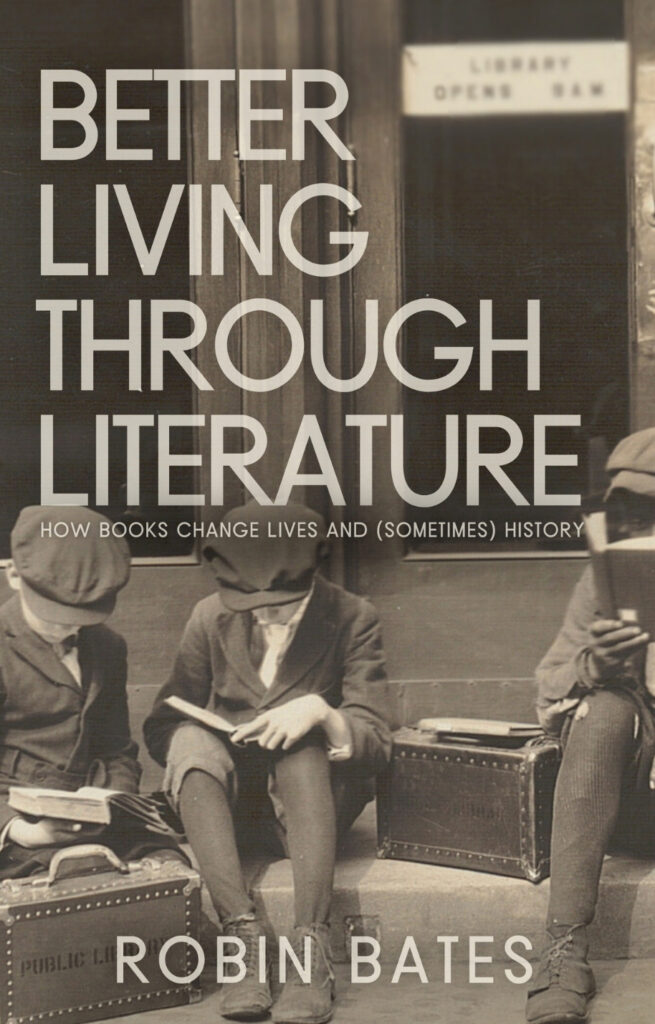
Somewhere in my mid-forties—I think the year was 1998—I had the epiphany that led to Better Living through Beowulf. While I can’t claim that I heard the voice of God, there were similarities with what happened to young Samuel in one of my favorite Biblical stories:
Samuel was lying down in the house of the Lord, where the ark of God was.Then the Lord called Samuel. Samuel answered, “Here I am.” (Samuel 3:3-4)
Two God calls later, Samuel answers, “Speak, for your servant is listening,” at which point he learns that he is to convey an important message.
By invoking the passage, I don’t mean to inflate the importance of this moment (although it wasimportant to me). I use itonly to capture how clear and momentous it felt. I awoke in the middle of the night, grabbed my notebook, and wrote steadily for two or three hours, something I never do. My life’s mission, I concluded that night, was to teach the general public (as opposed to other literary scholars) how literature can improve our lives. Starting with Beowulf, I would take major works from the British literary canon—my primary literary interest—and demonstrate how. My teaching, meanwhile, would be oriented similarly.
I’ve written about the only previous time that such a nighttime revelation came to me. While an undergraduate at Carleton and writing a Medieval history essay about Beowulf, at 3 in the morning I suddenly saw how the monsters in the tale represented the very real dangers threatening Anglo-Saxon society. As they listened to the tale, warriors were given powerful images of the troll violence that could well up in their companions (and in them as well) and of the dragon senility that could seize their kings. Literary fantasy, in other words, could provide people with invaluable tools for understanding and negotiating their challenges.
Although my nighttime vision in 1998 seemed clear, it took years for me to figure out what forms it was to take. Since self-help books were big in the 1990s (I suspect they still are), I initially envisioned writing about literary narrative as self-help. The book that emerged over the next ten years featured one big issue that each of my chosen works could address, along with accompanying exercises. This particular problem had a major problem, which I’ll touch on in a moment, but I start with sharing the table of contents and some sample exercises:
Better Living through Beowulf: How the Early British Classics Can Guide You beyond Terrorism Fears, Relationship Anxieties, Consumer Emptiness, Racial Tension, Political Cynicism, and Other Contemporary Challenges
Introduction: Harnessing the Power of Literature Chapter 1 – ANGER & FEAR: Using Beowulf to Subdue Your Inner Demons and Find a Lasting Peace Chapter 2 – DEATH: Using Sir Gawain and the Green Knight to Transform Your Fear of Dying into a Deep Joy Chapter 3 – MARRIAGE: Using Geoffrey Chaucer’s Wife of Bath to Save Your Relationship Chapter 4 – SOUL: Using Christopher Marlowe’s Doctor Faustus to Escape Your Private Hell Chapter 5 – GENDER: Using William Shakespeare’s Twelfth Night to Discover Alternate Selves Chapter 6 – RACE & CLASS: Using Aphra Behn’s Oroonoko to Negotiate Difficult Friendships Chapter 7 – INJUSTICE: Using Jonathan Swift’s Gulliver’s Travels and “Modest Proposal” to Keep Fighting the Good Fight Chapter 8 – BEAUTY: Using Alexander Pope’s Rape of the Lock to Reach beyond Star Worship and Touch the Star Within Chapter 9 – COURTSHIP: Using Jane Austen’s Pride and Prejudice to Find Your Soul Mate
As for exercises, for Sir Gawain and the Green Knight I suggested that each of the hunted animals represents a different way to approach death (and to approach life) and invited readers to think through their own responses. The Wife of Bath’s prologue and tale, I contended, can provide insight into why couples quarrel and how to work through differences. Rape of the Lock provided a workshop on dealing with sexual harassment while I approached Pride and Prejudice as a marriage manual (“Four Bad Reasons to Get Married”).
To write the book, I had to reprogram my mind and write as I once had for newspapers. I still remember how the first essay I wrote in graduate school, a three-page essay in which I had 17 (!) paragraphs, elicited the professor’s wry comment, “Did you used to be a journalist?” With such prodding, I learned to master compound complex sentences, nuanced and qualified assertion, scholarly jargon, and all the rest, and here I was having to revert to an earlier prose style. It was not easy to do.
I found an agent for the book and for a while had high hopes. After a year with no success, however, the agent dropped me, sending me to small presses. I finally found one and was all set to begin working with them when the world-wide 2008 crash occurred. My book was one of the (very minor) casualties.
In retrospect, I’m not sorry. There was always something not entirely right about using the language of self-help to talk about literature. At times I felt inauthentic in how I was discussing Chaucer, Shakespeare, and Austen. Further, I’m not sure that people actually use self-help books in the way I was imagining. How many go through proffered exercises to change their lives?
To be sure, America’s self-help tradition suggest that we should be able to do so. Think of Benjamin Franklin’s Poor Richard’s Almanack and of the “general resolves” of Jay Gatsby. The tradition may grow out of the Calvinist tradition, and dissenter Daniel Defoe created a character in Robinson Crusoe who is obsessed with self-improvement, with heaven and hell hanging in the balance. But Crusoe fails to achieve many of his general resolves and, like the rest of us, lives a life that takes many unexpected twists and turns. Literature doesn’t change that state of affairs.
Furthermore, literature is not a carpenter’s tool that can be directed to a single project but something more diffuse and wide-ranging. Whereas different people wielding a hammer will use it more or less the same, that’s not true of a novel, poem, or play. Sometimes readers will not even realize that the work has influenced their behavior until years later.
In any event, as I was feeling the disappointment of a 10-year project going up in flames, my son Darien, who was in marketing, informed me that I should establish a “platform.” Publishers would take me more seriously, he pointed out, if I could assure them that a ready audience existed for the book. He suggested that I start a blog and helped me set up a website.
I barely knew what a blog was but, once I began blogging, a new world opened to me. I was exhilarated by the instant contact with readers: no longer must I wait years for an article or a book to reach an audience. Furthermore, in its fragmentary form a blog was truer to the reading experience than my book had been: I wasn’t limited to a single theory about what a particular work means to readers but could just report on a range of responses, starting with my own. I could also share what the works meant to my students (always with their permission, of course), which meant that it became a pedagogical tool: they could see their work from an outside perspective, always useful. Meanwhile, I profited by regularly reflecting on my courses.
Of course, my unpublished book gave me a lot of ready material for the blog, and much of it has found its way into my daily posts. I also should note that, as blogs go, Better Living through Beowulf is neither the most scholarly nor the most casual. There are medieval experts who know far more about Beowulf than I will ever know and use their blogs to share their expertise. (While my own specialty is the British Restoration and 18th Century, I became a generalist by virtue of teaching at a small liberal arts college.) My blog is of limited value to them.
But my intense engagement with a wide variety of works has given me a different kind of expertise, which is useful for (1) general readers interested in literature (including those who may have had bad experiences in college literature classes) and (2) high school language arts teachers who are looking for ways to engage their students with the works. From the first, these were my intended readers, and they in fact make up the bulk of my audience.
I’ll recount in a later post how I came to write my recent book. I’ll just note that it emerged out of the blog in that, instead of focusing on a single way that literature changes lives, I have looked at what thinkers over the millennia have said about literary impact. They too diverge greatly, starting with Plato, who thought that Homer could lead young men astray, and Aristotle, who believed the great Greek tragedians provided valuable leadership advice. If one really wants to do justice to literature’s transformative potential, it’s best to share as many reading experiences as possible.