Friday – A Life Lived in Literature, 32nd Installment
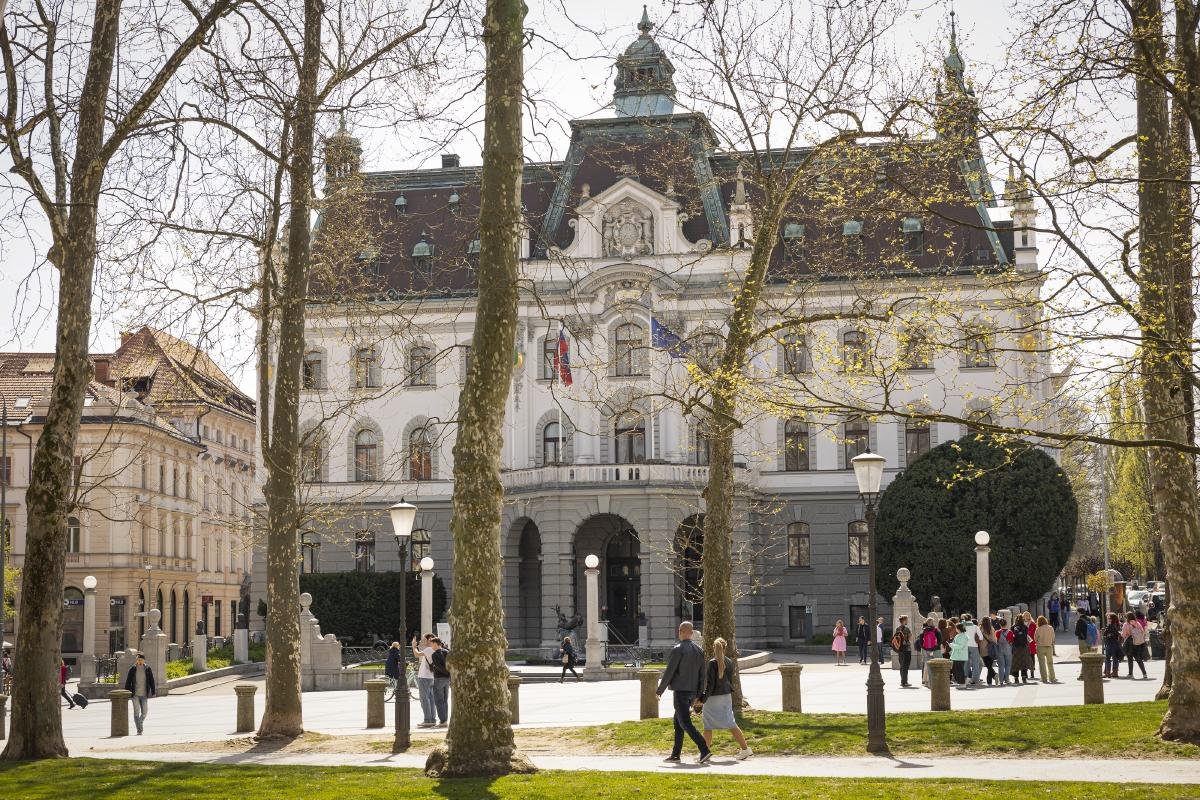
I’m writing this week’s memoir installment on the anniversary of Justin’s death—he drowned on April 30, 2000—so perhaps it’s fitting that I’m at the point where a scholarship we set up in his name went into effect. We established a student exchange with the University of Ljubljana, with Slovenian students living with us for a semester as they took classes. Meanwhile, students enrolled in the St. Mary’s teaching program traveled to Ljubljana to observe and participate in classes. To date, around 30 Slovenians have studied at St. Mary’s.
Our first student was Anamarija Šporčič, a brilliant woman who now teaches Victorian literature at Ljubljana while overseeing English students studying abroad. We wanted the students to have an immersion experience, and the program succeeded beyond our wildest dreams. As the top English students in Slovenia, these students thrived in their classes—many of our faculty fell in love with them—and they also participated in a wide range of extracurricular activities, such as plays, the literary magazine, the hiking club, intramural sports, and other options. Many report to having had “the best experience of their lives” and now see themselves members of our extended family. They call themselves “the Bates Bunch,” and we reconnect with them every time we return.
Justin’s death made this opportunity possible, an instance of something positive growing out of a dark moment. In return, Julia and I have received a gift that we didn’t expect: we see them having the future that Justin was denied as they have become teachers, translators, editors, film reviewers, tour guides, publicists, businesspeople, and entrepreneurs, as well as spouses and parents. While at St. Mary’s they stepped into their strengths, which they put to use when they returned to Slovenia. We learned that life doesn’t end with a death.
Julia and I have been returning to Ljubljana every two years or so, and teaching at the university continues to reaffirm my awareness of literature’s transformative potential. For the rest of today’s installment I share some of the essays that stick out, going back to the first student to live with us (this in the late 1980s, before the scholarship) and on up to a student from my last visit.
Nataša used her year with us to write a superb and very ambitious senior thesis on Toni Morrison’s novels. In it she noted how the Black protagonists must thread their way between the twin evils of assimilation into White society and the narrow isolation of Black separatism. At the time, it alerted me to an important dynamic in Morrison’s fiction that I had missed. Looking back at it now, I realize that it also spoke to a national drama that Nataša would have been facing. Slovenia was still part of Yugoslavia but also saw itself as an ethnicity apart. The question, then, was how could it hold on to its individual identity while still being part of a greater whole.
Versions of this drama continued even after Slovenia gained independence in 1991. Again, a student used the time spent with us to write her senior thesis, this time on the Laguna Pueblo novel Ceremony. The student had a Croatian father and Slovenian mother, and while that wasn’t a problem in the 1980s, in the mid-nineties she found herself facing some discrimination over her last name.
In Leslie Marmon Silko’s novel, Tayo explores how his Native American culture must adjust to white society if it is to survive, even as it seeks to hold on to ancient traditions. Tayo himself is mixed race—his mother was knocked up by a white man—and the theme of mixed blood runs through the book, from the hybrid cattle that he is raising to the mixed-race medicine man who heals his PTSD. Betonie, who lives on the border between white and Indian land so that he can overlook both worlds, uses a combination of Indian ceremony and white therapy with Tayo, and what emerges is a healing vision that addresses the illnesses of both besieged Indian and alienated white society.
When the student returned to Slovenia, she was asked to present her findings to the American literature class. The country as well as she herself needed this multicultural vision if it was to flourish as its own nation. As with most countries, there is a rightwing nationalist streak in Slovenia that demonizes “impure” Slovenians, along with immigrants and former fellow Yugoslavians. As we have seen in Hungary, such thinking impoverishes a nation.
Flash forward to 2024 and the Postcolonial Literature class that I taught in my last visit. Half the class were Slovenians, half students from European Union countries who were there thanks to the Erasmus program, designed to promote “transnational learning, mobility, and cooperation.” I had students from Germany, the Netherlands, Macedonia, and Belgium, all of whom were exploring their own dual identities (they were simultaneously citizens of their home countries and members of the EU). I focus here, however, on a Serbian-Slovenian student, whose Serbian surname was causing her problems.
She had chosen to write about Klara and the Sun, a science fiction work by the Anglo-Japanese author Kazuo Ishiguro. As I discussed her essay with her, I understood what drew her to the work.
The narrator is Klara, a sophisticated “care robot” that has been engineered for maximum empathy. A family has purchased her to be a friend to their seriously ill daughter, and the question arises whether she could actually replace the daughter should she die. In the end, Klara figures out what the sick girl needs to recover, a sacrifice on her part as she will be disposed of once she is no longer necessary. Nevertheless, she goes ahead with her insight.
Klara reflects back on the experience from a robot graveyard where she has been deposited as she waits for her solar batteries to die:
I did all I could to learn Josie and had it become necessary, I would have done my utmost. But I don’t think it would have worked out so well. Not because I wouldn’t have achieved accuracy. But however hard I tried, I believe now there would have remained something beyond my reach. The Mother, Rick, Melania Housekeeper, the Father. I’d never have reached what they felt for Josie in their hearts. I’m now sure of this…
My student was experiencing some anti-Serbian discrimination but a ready solution awaited her: she was engaged to a Slovenian man, which meant that she could change her name. The novel stepped into her life at the very moment that she was grappling with the issue.
In our conference, she told me that the novel had helped convince her to retain her maiden name, despite the problems it was causing. Perhaps she realized that she could never entirely become Josie—pure Slovenian—no matter how hard she tried and that it was time to step beyond being a constantly yielding robot. I suspect that, while she identified with Klara’s programmed desire to please, she found, in Klara’s reflections, the clarity she needed to stand in her own identity.
As an aside, I wonder if Ishiguro, transplanted to England at age 6, has a similar drama. In Remains of the Day, for instance, a butler is so anxious to be the perfect butler that he cannot challenge his Nazi-sympathizing master and sacrifices his heart in the process. Although a robot, Klara arrives at an acceptance of her separate self that the butler never does, and it was this self-acceptance that inspired my student.
Not every student I had wrestled with hybrid identity so I’ll end with two memorable responses I received from a high school English teacher who was taking a summer class in 1995. She was from the Bela Krajina or White Carniola region of Slovenia, named for its white birch trees. When we read about a young boy swinging on birches in the Robert Frost poem, she revealed that she too had been a “swinger of birches” as a young girl:
One by one he subdued his father’s trees
By riding them down over and over again
Until he took the stiffness out of them,
And not one but hung limp, not one was left
For him to conquer. He learned all there was
To learn about not launching out too soon
And so not carrying the tree away
Clear to the ground. He always kept his poise
To the top branches, climbing carefully
With the same pains you use to fill a cup
Up to the brim, and even above the brim.
Then he flung outward, feet first, with a swish,
Kicking his way down through the air to the ground.
What had once been just a colorful anecdote took on for me a new reality.
She shared a more tragic story when we discussed Frost’s “Mending Wall.” In the poem, the speaker mocks his neighbor’s rote insistence that “good fences make good neighbors,” even as he helps him repair the old stone wall between his apple trees and the neighbor’s pine trees. Yet my student revealed the wisdom of the saying with her story.
In her childhood, her father got into a dispute with a neighbor over property lines—perhaps involving no more than a meter or two as the farms were small—and the man killed her father with a shovel. Unable to maintain the farm on her own, the mother had to move the family to Ljubljana. I think now of how powerfully the final lines of the poem must have spoken to her lived experience:
I see him there
Bringing a stone grasped firmly by the top
In each hand, like an old-stone savage armed.
He moves in darkness as it seems to me,
Not of woods only and the shade of trees.
He will not go behind his father’s saying,
And he likes having thought of it so well
He says again, “Good fences make good neighbors.”
Although the old-stone savage may move in darkness, folk sayings can carry deep wisdom, arrived at (to borrow from Mary Oliver) “out of pain, and pain, and more pain.”
I suppose, in a way, this entire post has been about boundaries, both acknowledging them and transcending them. This teacher had to cross a boundary as a young girl, from a rural to a city upbringing. While boundaries offer seeming clarity and certainty, they can also work as traps. I think of what David Brooks wrote in the Atlantic article discussed on Wednesday. After discussing the attractions of tradition, he adds,
Traditionalists strike me as the kind of people who would score extremely low on the personality trait called “openness to experience.” They focus overwhelmingly on the secure base and seem to have no interest in daring adventures. They seem to want to lead stationary lives.
We took the kids to Yugoslavia/Slovenia because we wanted to open them up to experience, and they have grown into imaginative explorers with deep curiosity. We set up the Justin Bates Memorial Fellowship because we wanted to open others to the mind-expanding that occurs when one travels abroad. The Franciscan friar who counseled me following Justin’s death offered comfort as he described it as another boundary crossing, this the most challenging of them all. I think of the lines from Tennyson’s “Ulysses,” that
all experience is an arch wherethro’
Gleams that untravell’d world whose margin fades
Forever and forever when I move.
Past Installments of A Life Lived in Literature
A Life Lived in Literature: How It All Began (Sept. 5, 2025)
Early Reading Memories (Sept. 12, 2025)
Childhood Confusion: Reading to the Rescue (Sept. 19, 2025)
Confronting Segregation (Sept. 26, 2025)
School Reading vs. Real Reading (Oct. 10, 2025)
Childhood in Paris (Oct. 17, 2025)
My Time at Sewanee Military Academy (Oct. 24, 2025)
Existentialism for High School Seniors (Oct. 31, 2025)
Why I Majored in History, Not English (Nov. 7, 2025)
My College Search for Authenticity (Nov. 14, 2025)
On D. H. Lawrence and a Sexual Awakening (Nov. 21, 2025)
My Life as a Bildungsroman (Nov. 28, 2025)
Grad School: Literary Baptism by Fire (Dec. 5, 2025)
Early Scenes from a Marriage (Dec. 12, 2025)
Bringing Up Baby in Grad School (Dec. 19, 2025)
Grappling with Racism (Jan. 2, 2026)
Journal of a Young Teacher (Jan. 16, 2026)
Teaching and Reading in Yugoslavia (Jan. 23, 2026)
Life at 40: Barely Controlled Chaos (Jan 30, 2026)
From Secular Humanist to Christian Believer (Feb. 6 2025)
Looking Back at a Lifetime Together (Feb. 13, 2026)
To Ljubljana with Love (Feb. 20, 2026)
Forging a Separate Identity from My Father (Feb. 27, 2026)
“Better Living” Emerged from a Midnight Epiphany (March 6, 2026)
The Golden Years before Tragedy Struck (March 13, 2026)
Using Lit to Grapple with a Death (March 20, 2026)
Lit in the Year following Justin’s Death (March 27, 2026)
My Eldest Son, Named after a Keats Sonnet (April 3, 2026)
Sterne’s Uncle Toby and My Own Toby (April 10, 2026)
After the 2nd Death, a Book Project (April 17, 2026)
Making Lit Meaningful for Students (April 24, 2026)
Horizons Broadened (May 1, 2026)