My Son, Second Generation Lit Blogger

Tobias Wilson-Bates, English, Georgia Gwinnett College

Thursday

I invoke a father’s privilege today to tout the Substack blog authored by Tobias Wilson-Bates, my English professor son, who has begun posting short reflections on literary passages that tickle his fancy. As he states in his introductory post,  

Not sure if anyone will read this, but I want to be in the practice of reading poetry each day and finding a few lines to chew on. Would be delighted if others wanted to read a few words as well.

Toby has dazzled me for years with his penetrating literary observations. I still remember a response he had to Beowulf when he was in high school. He had asked me to give him something I assigned to my students, so I presented him with the Anglo-Saxon epic and then gaped in astonishment as he mapped out the power dynamics between the brash young Geat warrior and the revered Danish king Hrothgar. Toby rightly grasped that it’s somewhat humiliating for the king to have Beowulf bail him out, which is why Hrothgar attempts to restore the balance by pointing out that Beowulf is repaying a debt incurred by his father. 

I shouldn’t have been surprised, however, since Toby has always been psychologically acute. I recall once when my oldest son Justin was complaining about being bullied on the school bus, to which seven-year-old Toby commented, “Maybe he’s insecure.” Justin blinked, looked up in surprise, and said, “You’re right!”

This acuity makes Toby an amazing father since he’s able to grasp the different makeup of each of his four children and to respond appropriately. Combine this with his ready wit, which for years the Twitter and then the Bluesky communities have enjoyed (see below), and one can understand why he is a popular teacher.

He is on sabbatical this semester at Georgia Gwinnett College, finishing up a book on Victorian time machine literature. The project has him writing about (hang on for this) changing notions of time; a history of clocks; the relationship between universal time (necessitated by train schedules) and universal education; the origins of calculus (Toby, tongue in cheek but also seriously, insists one can’t really understand calculus unless one has read Paradise Lost); Victorian ghost stories (Toby notes that Scrooge’s time travel ghosts show up as though they are carrying pocket watches); Sir Walter Scott’s historical romances (which Toby regards as time machines); battles over the international date line; and I don’t know what else. 

But I wrote today’s post to alert you to his Substack blog, so here are a few samples to whet your appetite. About an Elizabeth Barrett Browning love poem (which at first glance appears sappy sentimental), he grapples with what young people refer to a “cringe,” which is “something that is embarrassing, awkward, or uncool, often causing discomfort or secondhand embarrassment” (Merriam-Webster). Toby says that Barrett Browning reminds us that “cringe” can actually be good. “Too many layers of irony, satire, or layers of self-protection,” he says, “are often the very dynamic that love poems seek to address.”

About John Milton’s Lycidas, written to mourn a friend who has drowned, Toby writes

I am particularly struck by the phrasing of “pastures new” (Milton’s classic Yoda-speak inversion) that carries the double meaning of both moving to pastures that are different than today’s for the sheep, but also that even if he returned to these same pastures they would be changed, and that is very much the feeling of the day after losing a loved one.

My favorite post so far has been his reflection on Christina Rossetti’s Goblin Market, a poem I remember reading to him when he was in grade school. (Toby says it’s his favorite 19th century poem and in contention for his favorite poem period.) I love the way that he compares Rossetti’s sensuous inventory of fruits to a similar inventory in Charles Dickens’s Christmas Carol. Here’s the passage he selects from Rossetti:

Morning and evening
Maids heard the goblins cry:
“Come buy our orchard fruits,
Come buy, come buy:
Apples and quinces,
Lemons and oranges,
Plump unpeck’d cherries,
Melons and raspberries,
Bloom-down-cheek’d peaches,
Swart-headed mulberries,
Wild free-born cranberries,
Crab-apples, dewberries,
Pine-apples, blackberries,
Apricots, strawberries;—
All ripe together
In summer weather,—
Morns that pass by,
Fair eves that fly;
Come buy, come buy:
Our grapes fresh from the vine,
Pomegranates full and fine,
Dates and sharp bullaces,
Rare pears and greengages,
Damsons and bilberries,
Taste them and try:
Currants and gooseberries,
Bright-fire-like barberries,
Figs to fill your mouth,
Citrons from the South,
Sweet to tongue and sound to eye;
Come buy, come buy.”

Toby says that the passage brings to mind the Ghost of Christmas Present, whose “warm flowing abundance” contrasts with Scrooge’s “pinching coldness”:

Heaped up on the floor, to form a kind of throne, were turkeys, geese, game, poultry, brawn, great joints of meat, sucking-pigs, long wreaths of sausages, mince-pies, plum-puddings, barrels of oysters, red-hot chestnuts, cherry-cheeked apples, juicy oranges, luscious pears, immense twelfth-cakes, and seething bowls of punch, that made the chamber dim with their delicious steam. In easy state upon this couch, there sat a jolly Giant, glorious to see; who bore a glowing torch, in shape not unlike Plenty’s horn, and held it up, high up, to shed its light on Scrooge, as he came peeping round the door.

Toby observes,

Rossetti, like Dickens here, seems to take such pleasure in the sensational immersion in desire and the ecstasy of visual consumption. And, also like Dickens, foregrounds that pleasure with ghastly circumstances (ghosts and goblins). The result, to me, is like when two unexpected flavors mix to produce something entirely unique or when two voices sing together in a way you have never heard before.

Toby then takes Victorian John Ruskin’s critique of the poem as an occasion to critique artificial intelligence. Ruskin considered the poem unpublishable for being “so full of quaintnesses and offenses” and wrote to Rossetti’s brother Daniel Gabriel that his sister “should exercise herself in the severest commonplace of meter until she can write as the public like.” To which Toby responds,

I think about these kinds of exchanges a lot these days as we are bombarded with machine-generated prose and content that emerges as aggregate syntheses of what has already been processed by ever-expanding data centers. If we write and read and watch only ever as optimized versions of what “the public like,” then do we eliminate the possibility of being spooked and dazzled by a luscious list of food we didn’t even know we could possibly experience?

Needless to say, I recommend that you visit the website and subscribe. (It’s free.) The link again is  https://substack.com/@tobiaswilsonbates.

Past Posts on Toby’s Comic Literary Tweets
A Comic Tweeter in Love with Lit (Jan. 13, 2022)
Comic Literary Twitter (continued) (Feb. 15, 2022)
Literary Tweeting (May 19, 2022)
Comic Twitter from a Master (Sept. 1, 2022)
Final Toby Literary Tweets (Sept. 24, 2023)

Posted in Uncategorized | Tagged , , , , , , , | Comments closed

Yeats’s Second Coming as Fascist Fantasy

Wednesday

I recently came across an interpretation of William Butler Yeats’s “The Second Coming” that is getting me to rethink the poem. While I’ve written about liberals who believe that the Trumpian rough beast slouching toward Bethlehem as a bad thing (for instance, here and here), I didn’t consider that Yeats might actually be welcoming it as a necessary corrective to populist movements. According to political commentator Noah Berlatsky, whose Everything Is Horrible blog I read regularly, Yeats was an authoritarian who disliked liberal democracy, and his poem “is a lot closer to fascist propaganda than to any sort of antifascist statement.”

For a refresher, here’s the poem:

The Second Coming

Turning and turning in the widening gyre
The falcon cannot hear the falconer;
Things fall apart; the centre cannot hold;
Mere anarchy is loosed upon the world,
The blood-dimmed tide is loosed, and everywhere
The ceremony of innocence is drowned;
The best lack all conviction, while the worst
Are full of passionate intensity.

Surely some revelation is at hand;
Surely the Second Coming is at hand.
The Second Coming! Hardly are those words out
When a vast image out of Spiritus Mundi
Troubles my sight: somewhere in sands of the desert
A shape with lion body and the head of a man,
A gaze blank and pitiless as the sun,
Is moving its slow thighs, while all about it
Reel shadows of the indignant desert birds.
The darkness drops again; but now I know
That twenty centuries of stony sleep
Were vexed to nightmare by a rocking cradle,
And what rough beast, its hour come round at last,
Slouches towards Bethlehem to be born?

Berlatsky says that Yeats here is channeling Christian apocalyptic thinking, which he has merged with “his own quasi-mystical notions about historical epochs or ‘gyres’—notions which he interpolated and bastardized from Nietzsche.” The spinning gyres that cannot (like the falcon) be called back are Christian and pagan (Celtic) morality. Looking back at the chaos of World War I, the influenza pandemic, and Irish civil unrest (he could also add the Bolshevik Revolution), Berlatsky says that Yeats “anticipates a reversal of the moral order—a shuffling off of the Christian status quo of mercy and love, and a birth of a harsher, more brutal status quo, ‘blank and pitiless as the sun.’”

Contrary to antifascist readings of the poem, Yeats thinks that “blank and pitiless” is necessary, as least as far as the unwashed masses are concerned. Put in our own terms, Yeats has more in common with those tech billionaires who fantasize about elite control rather than with Trump’s MAGA followers, who think that he cares about their material welfare. While a supporter of Irish nationalism, Yeats had an elitist nationalism in mind:

[A]s an Anglo-Irish intellectual, he feared the rise of a Catholic state, which he associated with what he saw as a debased and ignorant public linked to the “filthy modern tide” of capitalism and mass culture. In order to stem this danger, he embraced the fascist Irish Blueshirt movement, explaining that “I find myself constantly urging the despotic rule of the educated classes as the only end to our troubles.” He composed a marching song for the Blueshirts that included the line, “What’s equality? Muck in the yard!”

In another poem (“Under Ben Bulben”), Yeats uses the phrase, “base born products of base beds.” If he eventually broke with the Blueshirts, Berlatsky writes, it’s because they weren’t aristocratic and elitist enough:

When Yeats says “the best lack all intensity” he’s talking about people like himself—intellectuals, but also white men of elevated social standing, including the aristocracy and the wealthy. And “the worst” who are “full of passionate intensity” are the lower classes—those who should know their place, but have now slipped their hood and gone flying every which way.

Thus (and you hear this from some people who rationalize Trump’s crude brutality), what is needed is someone who will crack heads. Yeats, Berlatsky says, 

is imagining the (fascist) backlash to left uprising—a fascist backlash which is frightening and bleak, but which is also in its way exhilarating. The reason that the final lines of the poem are so indelible and so often quoted is because they encourage you to (at least ambivalently) identify with the force of apocalypse—to embrace the coming reversal of morals as a perhaps regrettable, but nonetheless necessary rebuke to the rabble, the communists, the anarchists, the Catholics. Fascism will restore order and grandeur. The price might be high, but Yeats made it clear in his writings that he was willing to see it paid. 

Berlatsky then turns to apocalyptic fantasies in general, which he notes often lean fascist as they generally involve “predictions of inevitable doom” from the point of view of one who knows. In that perspective there is an “implicit (or explicit) denigration of those who don’t.”

He therefore prefers antifascist apocalypse stories like N.K. Jemisin’s Broke Earth Trilogy (he could also have mentioned Octavia Butler and Margaret Atwood), which “insist on portraying the choices not of rulers, but of those targeted for violence, discrimination, and death.” Antifascism, he notes,

requires solidarity, which means you can’t pump yourself up by preening as you contemplate everyone else’s death. And, relatedly, it requires a commitment to, and an assertion of, agency—not for one poet or one king or one prophet, but for everyone.

Because “The Second Coming” makes our encounter with Trump feel mythic, liberals who cite the poem mistakenly believe it’s helpful in our battle. Bertlasky, however, points out that Trump isn’t a myth but rather “a boring, grimy truth.” Since granting him world-historical inevitability “is just another fascist lie,” we shouldn’t look to the poem for antifascist insight or inspiration.

While I myself have used “The Second Coming” in this way, I’ve never had illusions about Yeats’s politics. Not only him but a number of the leading writers of this period (Joseph Conrad, D. H. Lawrence, Ezra Pound, T.S. Eliot, James Joyce) were attracted to fascism. This does not mean that we should reject their works, however. I think of how Marxist Terry Eagleton values them for the insights they provide into their time. “In the absence of genuinely revolutionary art,” he writes, “only a radical conservatism, hostile like Marxism to the withered values of liberal bourgeois society, could produce the most significant literature.”

To take an example closer to our own time, while Trump-supporting playwright David Mamet has appalling political views, his play Glengarry Glen Ross is a brilliant depiction of the emptiness of dog-eat-dog capitalism. The man David Mamet celebrates the brutal bro culture that his play exposes.

If nothing else, then, “The Second Coming” helps us understand why so many on the right are willing to countenance the violence we are witnessing in our cities and why some Christian nationalists view Trump as a Christ-like figure: our president appeals to a fantasy that he is a rough beast who will sweep away all uncertainty—no lack of conviction there—and usher in a new age.

The question is whether Trump’s opponents can respond with powerful myths of their own. Or are they just hoping to take electoral advantage of the disillusion that will set in once people realize, as they eventually realized with Mussolini and Hitler, the pain that invariably accompanies fascistic second comings?

How deep does their commitment go? Fortunately the people of Minnesota, who have been embodying the ideals found in “the Declaration of Independence, “the Gettysburg Address,” Emma Lazarus’s poem on the Statue of Liberty, and Martin Luther King’s “I Have a Dream” speech, are showing them the way.

Posted in Uncategorized | Comments closed

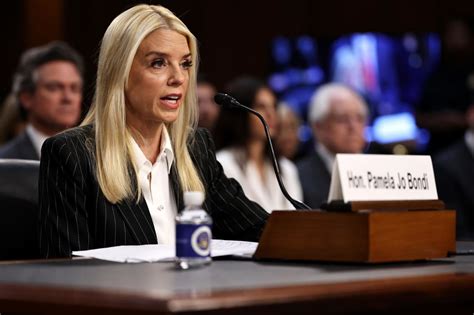
AG Bondi as Don Trump’s Consigliere

Pam Bondi testifying before the House Judiciary Committee

Tuesday

If there was ever any doubt that the Department of Justice is working as Donald Trump’s private law firm, with Attorney General Pam Bondi as his consigliere, that was put to rest with Bondi’s recent appearance before the House Judiciary Committee. 

Queried about unexplained redactions in the Epstein files, along with why millions of pages have still not been released, Bondi responded with evasions and name calling. At one point she said, “The Dow is over fifty thousand right now, the S. & P. at almost seven thousand, and the Nasdaq smashing records, Americans’ 401(k)s and retirement savings are booming. That’s what we should be talking about. The non-response triggered a storm of comic responses, my favorite being: “Landlord: “You’re a week late on rent.” Me: “The DOW just hit 50,000!” 

Bondi also attacked her interrogators, declaring to Democratic Congressman Jamie Raskin, “You don’t tell me anything, you washed-up loser lawyer. Not even a lawyer,” and accusing Republican Tom Massie of suffering from Trump Derangement Syndrome. At one point she said, “You all should be apologizing. You sit here, and you attack the President, and I am not going to have it.”

For his part, Raskin pointed out how slavishly she follows Trump’s wishes. “Trump orders up prosecutions like pizza and you deliver every time,” he observed. “Nothing in American history comes close to this complete corruption of the justice function and contamination of federal law enforcement.”

Thinking of Bondi as a consigliere invokes the image of Tom Hagen in Mario Puzo’s The Godfather, brilliantly played by Robert Duvall in Francis Ford Coppola’s movie. (Note: I see that Duvall just died at 95.) When discussing with a movie studio head about a role for the godfather’s godson Johnny Fontane, Hagen makes clear that there is only one man that he works for:

[The studio head] studied Hagen’s card. “I never heard of you,” he said. “I know most of the big lawyers in New York, but just who the hell are you?’

“I have one of those dignified corporate practices,” Hagen said dryly. “I just handle this one account.”

While she may resemble Hagen in fealty to her boss, however, Bondi would have done well to follow his negotiation strategies. When the studio head begins slinging insults, Hagen doesn’t pull a Bondi, choosing instead to remain calm:

The abuse itself bothered him not at all. Hagen had learned the art of negotiation from the Don himself. “Never get angry,” the Don had instructed. “Never make a threat. Reason with people.” The word “reason” sounded so much better in Italian, ragione, to rejoin. The art of this was to ignore all insults, all threats; to turn the other cheek.

Of course, it’s easy to remain calm when you know your next move will be beheading the man’s $600,000 horse. And then there’s death, the trump card that the Don always carries with him:

Hagen had seen the Don sit at a negotiating table for eight hours, swallowing insults, trying to persuade a notorious and megalomaniac strong-arm man to mend his ways. At the end of the eight hours Don Corleone had thrown up his hands in a helpless gesture and said to the other men at the table, “But no one can reason with this fellow,” and had stalked out of the meeting room. The strong-arm man had turned white with fear. Emissaries were sent to bring the Don back into the room. An agreement was reached but two months later the strong-arm was shot to death in his favorite barbershop.

Nor is the Godfather always so patient, as we see in a passage that gives us one of the most memorable lines from the novel. Michael recounts the story to girlfriend Kay:

“When Johnny was beginning to become popular, he had a problem with his boss, a bandleader. Johnny wanted to leave the band, but this man wouldn’t let him. So Johnny asked my father to help. My father went to see the bandleader and offered him $10,000 to let Johnny go. He said no. The next day my father went to see him with [strongman] Luca Brasi. One hour later, the bandleader let Johnny go. For $1,000.”

Kay looked confused. “How did he do that?”

“My father made him an offer he couldn’t refuse. Luca held a gun to his head and my father told him that if he didn’t agree to let Johnny go, Luca would blow his brains out.”

I suppose Bondi attempted a version of this hardball tactic when she told Minnesota Governor Tim Walz that the Trump administration would withdraw the ICE forces that were terrorizing his state if he turned over the state’s voter rolls. The rolls, of course, had nothing to do with the stated reasons for ICE being in the state.

Trump has been more successful in swaying Republican legislators. The man who sicced a violent mob on the Capitol and whose fans have issued death threats, attacked Nancy Pelosi’s husband in his home, murdered Democratic legislators, planted pipe bombs, and shot up houses of worship has reduced them to versions of the bandleader. Perhaps they should be calling him not Donald Trump but Don Trump.

My quarrel with Puzo’s book is that he glamorizes Don Corleone’s violence. It plays to a fantasy that is at the core of Trump’s psyche and that he has successfully sold for decades: that he can offer deals others can’t refuse. If Bondi has gone all in on consigliere loyalty, it’s because she feels he can deliver.

That’s why she was stunned when the people of Minnesota refused her deal. And baffled as to why members of the Judiciary Committee are not sold on her boss’s greatness. 

Posted in Uncategorized | Tagged , , , , | Comments closed

T.S. Eliot, Tolkien, Gaiman, and ICE

While this is a picture of a planned submersion, an old Minnesota tradition called Ice Out Day involved parking a clunker on the ice and placing bets on which day it would break through

Monday

I share today literary allusions associated with ICE’s apparent withdrawal from Minnesota following the courageous resistance of its citizens. The first two are courtesy of an interview that MS Now’s Chris Hayes had with Minneapolis mayor Jacob Frey.

The first one involved Frey saying, “We’ve got a saying among mayors, and that’s good mayors copy and great mayors steal. I have certainly taken great ideas from other mayors and utilized them in Minneapolis for the betterment of our community.”

The quote itself has been stolen from T.S. Eliot, who once wrote that ‘Immature poets imitate; mature poets steal.” It so happens that Eliot himself stole the quote from literary scholar W.H. Davenport Adams, who in defense of Alfred Lord Tennyson’s “thefts” wrote that “great poets imitate and improve, whereas small ones steal and spoil.” An instance of an Eliot theft in The Waste Land (one of dozens) is “But at my back in a cold blast I hear/ The rattle of the bones, and chuckle spread from ear to ear.” The allusion is to Andrew Marvell’s line (in “To His Coy Mistress”), “But always at my back I hear/ Time’s winged chariot hurrying near.”

Eliot argued that he wasn’t plagiarizing because readers would recognize the source and regard his “theft” as a riff and an homage. In any event, Eliot’s primary purpose is writing a good poem, just as Frey’s is enacting good policy. I don’t know whether the recently elected Freye will become a great mayor, but I know that he learned important lessons from watching ICE operate in Los Angeles and Chicago. Let us hope that other American mayors steal from Minneapolis’s example if ICE invades their cities.

Frey also made a powerful allusion to Lord of the Rings when he said,

I’ve heard from some, whether elected officials of business executives that, well, hey, if we just keep our head down, we don’t want to attract the eye of Sauron or whatever. I don’t know if you’re a Lord of the Rings fan. But that’s the wrong way of looking at it. You know, don’t bow your head in despair. Pick your head up. Kick your shoulders back.

Here’s the passage Freye has in mind:

But suddenly the Mirror went altogether dark, as dark as if a hole had opened in the world of sight, and Frodo looked into emptiness. In the black abyss there appeared a single Eye that slowly grew, until it filled nearly all the Mirror. So terrible was it that Frodo stood rooted, unable to cry out or to withdraw his gaze. The Eye was rimmed with fire, but was itself glazed, yellow as a cat’s, watchful and intent, and the black slit of its pupil opened on a pit, a window into nothing.

Then the Eye began to rove, searching this way and that; and Frodo knew with certainty and horror that among the many things that it sought he himself was one. But he also knew that it could not see him—not yet, not unless he willed it.

The hobbits initially think that they can live in blissful ignorance of what is transpiring in the rest of Middle Earth. That, however, is wish-fulfillment. The only way that Frodo and Sam defeat Sauron is by, well, picking their heads up, kicking their shoulders back, and walking directly into Mordor. It’s not unlike Minnesotans directly confronting ICE.

In the same Chris Hayes show, he shared an interview he had with one of these brave Minnesota citizens, who referenced a tradition I first learned about from Neil Gaiman’s American Gods. Here’s what Hayes was told:

We’re going to outlast them. We not going to get tired. They’re going to get tired and they’re going to leave. And the county is going to get tired of ice, of using people like this. There’s a saying around here, when does the ice go out? It’s when does the ice melt off the lakes? It’s called Ice Out Day. You know people will park old cars on a lake, or they used to, and make bets on when the car would sink. You know how to wait till ice out. And people around here, we’re going to outlast ice, and we’re going to be here when ice is out.

In Gaiman’s fantasy novel, a northern German sprite or kobold is economically protecting an idyllic town in exchange for a yearly sacrifice of one of its young people. He hides the sacrifices in old clunkers that sink to the bottom of the lake on Ice Out Day.

The town, which reminds one of Mayberry in the Andy Griffith Show, is what the right fantasizes about: it’s homogenous, white, and prosperous. All that is required is sacrificing its future.

When they figure out what is happening, the protagonist (Shadow) and the town’s police chief find the cost to be too high and defeat the kobold. The town will now experience all the aches and pains of modernity but also the multicultural excitement that has always been a deep part of what makes America America. Maybe Somali refugees take up residence there.

I have one more item tangentially related to the right wing’s antagonism toward Americans and immigrants of color. Last week I imagined the trees that walked onto Bad Bunny’s Super Bowl show as the Ents invading a tyrant’s domain. A reader wrote in to mention another invading forest. Macbeth thinks that he is home free when the witches tell him,

Macbeth shall never vanquish’d be until
Great Birnam wood to high Dunsinane hill
Shall come against him.

Little does he know that Malcolm, like the Puerto Rican singer, will use foliage to their own advantage:

Let every soldier hew him down a bough
And bear’t before him: thereby shall we shadow
The numbers of our host and make discovery
Err in report of us.

Which allows us to rephrase the witch’s prophecy:

Donald shall never vanquish’d be until
Bad Bunny to the Super Bowl 
Shall come against him,
Declaring love a greater force than hate
And unity the wished for goal of all.

Between Minnesotans caring for their neighbors and Bad Bunny invoking foundational American ideals to millions, there’s a glimmer of hope on our horizon.

Posted in Uncategorized | Tagged , , , , , , , , , | Comments closed

Great Trees, Apostles of the Living Light

Transfiguration Sunday

As today is Transfiguration Sunday, I have been revisiting John Gatta’s illuminating study The Transfiguration of Christ and Creation. As the Sewanee English professor sees it, the vision of Christ being transfigured so that “his face shone like the sun, and his clothes became dazzling white” is not just an account of how the disciples became aware that God was present in Jesus and within themselves. The story also makes clear that God is present within the unfolding process of all creation. In other words, God is not limited to human beings.

Before moving to this third area, however, let’s revisit Matthew’s account of the transfiguration and look at its implications for humanity. Here’s Matthew:

Six days later, Jesus took with him Peter and James and his brother John and led them up a high mountain, by themselves. And he was transfigured before them, and his face shone like the sun, and his clothes became dazzling white. Suddenly there appeared to them Moses and Elijah, talking with him. Then Peter said to Jesus, “Lord, it is good for us to be here; if you wish, I will make three dwellings here, one for you, one for Moses, and one for Elijah.” While he was still speaking, suddenly a bright cloud overshadowed them, and from the cloud a voice said, “This is my Son, the Beloved; with him I am well pleased; listen to him!” When the disciples heard this, they fell to the ground and were overcome by fear. But Jesus came and touched them, saying, “Get up and do not be afraid.” And when they looked up, they saw no one except Jesus himself alone. (Matthew 17:1-8)

Gatta writes that what we learn from this account is that

God wills to make us new, to enlarge our capacity for glory, without destroying the uniqueness of our old personality. Our original human nature is to be fulfilled, not annihilated, even though we know ourselves to be inherently flawed, sinful, and downright quirky creatures.

One of literature’s most powerful depictions of a transfigured human occurs in Dante’s Paradise:

While ascending from earth at noon of the vernal equinox, the pilgrim-narrator in the opening canto of Paradise undergoes an inward transformation when he gazes at his beloved Beatrice who, in turn, reflects the radiance of the sun. He finds himself momentarily elevated (Italian trasumanar) above his normal human nature. Then by the 23rd canto, when he reaches the eighth heaven of the fixed stars, he is able to behold the divine substance of Christ streaming forth its radiance amid the Church Triumphant, much as it had on the mount of Transfiguration. 

Gatta cites a passage from “The Transfiguration” by Scottish writer Edwin Muir that seeks to capture what the disciples experienced:

We would have thrown our clothes away for lightness,
But that even they, though sour and travel stained,
Seemed, like our flesh, made of immortal substance,
And the soiled flax and wool lay light upon us
Like friendly wonders, flower and flock entwined
As in a morning field. Was it a vision?
Or did we see that day the unseeable
One glory of the everlasting world
Perpetually at work, though never seen
Since Eden locked the gate that’s everywhere
And nowhere? 

Transfiguration of Christ and Creation, however, is most interested in how the process extends beyond the human realm: Christ is a cosmic symbol of how God is present in everything. Dante says as much when his pilgrim sees “not only the beauty of Beatrice transfigured beyond human telling, but also the universe itself, all substances and accidents, enfolded into one.”  

Gatta wants to move us past the tired debates over the Genesis creation story, which fundamentalists use to disavow Darwinian evolution. God didn’t just create the universe and then step back, Gatta counters. There is “a continuously evolving transformation of matter and energy, a dynamic immediacy, rather than a one-time leap from nothingness situated in the distant past.” He says that, by virtue of the Incarnation, “God became not only human but material, allied to the physical world.” God, in short, is in everything, including the evolutionary process.

Gatta turns to one of Wendell Berry’s Sabbath poems to capture this truth. The poem is an account of reforestation:

Slowly, slowly, they return
To the small woodland let alone:
Great trees, outspreading and upright,
Apostles of the living light.

Patient as stars, they build in air
Tier after tier a timbered choir,
Stout beams upholding weightless grace
Of song, a blessing on this place.

They stand in waiting all around,
Uprisings of their native ground,
Downcomings of the distant light;
They are the advent they await.

Receiving sun and giving shade,
Their life’s a benefaction made,
And is a benediction said
Over the living and the dead.

In fall their brightened leaves, released,
Fly down the wind, and we are pleased
To walk on radiance, amazed.
O light come down to earth, be praised!

Gatta writes that “great trees, despite their seemingingly inert solidity, support vital processes involving light and energy, microorgqnisms, motile fluids, and the exchange of atmospheric gasses.” The dynamics of “this physical synergism,” he contends, “corresponds to a divine economy of grace and transformation.”

The line “to walk on radiance, amazed,” Gatta notes, leads to the poem’s closing benediction: “O light come down to earth, be praised.” Thus, he concludes, “the multilayered metamorphosis enacted through and within these ‘great trees’ parallels the transformation of human awareness described through the course of Berry’s poem.”

To return to Matthew’s account, what we see by virtue of God entering Christ and being witnessed by the disciples is the emblematic story of how divinity works in the world. Through Jesus we learned that there is no ultimate separation between the world of spirit and the world of matter, that they are inextricably intertwined. When, gazing at great trees, we get a sense of the divine, we are connecting with the Godhead within all of us.

Posted in Uncategorized | Tagged , , , , , | Comments closed

Looking Back at a Lifetime Together

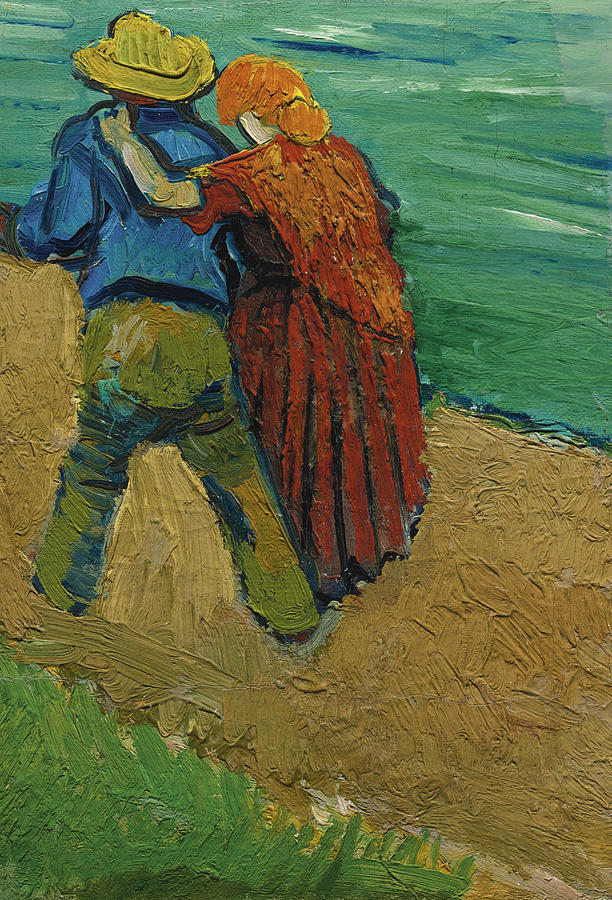
Vincent Van Gogh, Two Lovers

Friday

As tomorrow is Valentine’s Day, I devote today’s memoir installment to my marriage to Julia, now in its 53rd year. Like many such marriages, it has had its ups and its downs, during which time literature has often played a key role.

For this week’s poem in the Mountain Messenger, I shared W. S. Merwin’s poem “Here Together,” even though it pivots around a verb that I have long abhorred. That “cling” now seems the right word shows me how my marriage has evolved:

These days I can see us clinging to each other
as we are swept along by the current
I am clinging to you to keep you from
being swept away and you are clinging to me
we see the shores blurring past as we hold
each other in the rushing current
the daylight rushes unheard far above us
how long will we be swept along in the daylight
how long will we cling together in the night
and where will it carry us together

While we don’t normally see “clingy” as positive—it suggests an over-dependence and a reaction to fear rather than a positive affirmation—it now strikes me as a positive description of two people who have been through a lot for a long time and who are now propping each other up as they enter their final years. (Julia and I both turn 75 this year, which some say is transitioning from young old age to middle old age.)

I didn’t want to see ourselves in a clinging relationship when we started out, however. One can see this in a portion of our marriage ceremony, which was influenced by Karl Marx’s dialectic and D. H. Lawrence’s fixation (influenced by Walt Whitman) on the tension between wanting to be self-sufficient and wanting to be part of a greater whole. The stars image is taken from Archibald MacLeish’s “Ars Poetica”: 

Minister: The marriage bond is a bond between two individuals. It does not entail a merging of one into the other, for in merging the individuality is lost.
Congregation: There must be a tension of difference. Without the tension, there can be no growth.
Minister: From the tension, this man and this woman will grow to new awarenesses and reach new syntheses. Marriage can be beautiful because it provides a unified form in which to search.
Congregation: Marriage is like a sonnet. As a fixed form, it endows a heightened beauty on the infinite number of variations within.
Minister: The bond is the attraction between two stars revolving around each other, caught in each other’s orbit but resisting an incorporation which would burn brightly but die quickly.
Congregation: “Love is the leaning grasses and two lights above the sea.”

I also acknowledge that I wrote the wedding ceremony in part to rationalize marriage, which in 1973 seemed an outdated institution. So if you detect a slight undertone of defensiveness—or at least, of overexplaining—you’re not wrong.

But I knew I wanted a relationship with Julia, even though—and partly, because—we were so different. She had grown up on a small farm in southeast Iowa and felt that she was entering foreign terrain when she left the state to attend Carleton College. I, on the other hand, was swimming in the water that I had known my entire life. 

Often one is drawn to one’s partner because one wants to grow into the undeveloped parts of oneself that the other represents. This was certainly our case. To the extent that she aspired to the world of the intellect and wanted to marry a man comfortable with ideas who could recite poetry (I had reeled off the opening lines from Gerard Manley Hopkins’s “The Golden Echo and the Leaden Echo” in our first encounter), I was attractive to her. On the other hand, as an airy intellectual, I was drawn to how Julia was immersed in what struck me as a real life (milking cows, killing chickens, baling hay). She had a solidity and maturity to her that I felt that I lacked and that, in fact, made her much admired at Carleton. For instance, she was one of the few juniors chosen to be a resident assistant on her hall floor, and her teaching mentor (Harriet Sheridan) said she was one of the most mature students she had ever encountered.

Julia also was much more comfortable with physicality than I was. My family didn’t hug or even like to touch each other when I was growing up, and I will be forever grateful to Julia for helping me push past that taboo.

But of course, whatever draws one to the other person can also become a source of conflict. That’s because growing into the potential that the other person represents—and that a deep part of you knows is essential to your growth–is hard and sometimes painful. Better to fall back on what is familiar. It’s not just that Julia sometimes thought I should be more of the rugged man that her farmer father was (I didn’t know how to fix things) and I thought she should be more of the supportive faculty wife that my mother was, although that was part of it. It’s that she resented my success in the academic world, which she thought she wanted to join even though part of her found it a bit arid. I meanwhile didn’t fully appreciate her need to be grounded in social relationships, including a church community. I bring this up to understand those moments of tension that have arisen in our relationship.

To draw a literary parallel, Darcy needs Elizabeth’s liveliness and sense of humor if he is to escape the smug, self-satisfied, and suffocating world of Catherine de Bourg while she needs his steadiness and community commitment if she is not to grow into the detached satirist that her father is. But if their marriage is to live up to its potential, hard work and a departure from familiar patterns of behavior will be necessary. Darcy will need to learn “to laugh at himself,” as Elizabeth puts it, and she will need to take life more seriously. Her father’s philosophy—”For what do we live, but to make sport for our neighbors, and laugh at them in our turn?”—will not fully serve her when she is patroness of a village.

When tensions arose in our marriage, Julia would become outwardly angry while I would retreat into cold silence (fire and ice, to borrow from Robert Frost). Eventually we dealt with the issues by undergoing family therapy, where we learned that we both had anger suppression issues, which we were passing along to our kids. Although it’s embarrassing to admit, we were also aided by Lifespring, a cultish program that nevertheless featured powerful relationship and leadership exercises that I’ve found to be of use. Somehow we survived the bumps and the marriage grew stronger.

Having acknowledged the differences that led to our disputes, I add that we never stopped admiring and seeking to grow into the undeveloped side of ourselves that had led us into marriage in the first place. Our marriage was strong enough to raise three spectacular men and to survive the death of one of them. We also supported each other in our careers so that, in the end, we were both doing what we most wanted to do. To this day I admire tremendously Julia’s commitment to sustaining community, and Better Living through Beowulf owes much to her as I have sought to understand how literature can aid in this effort. For her part, she came to appreciate my academic work. We sometimes marvel at how calm our lives have become now that we no longer trigger each other.

I was in high school when I first encountered and admired Ezra Pound’s “The Merchant’s Wife: A Letter,” little knowing that it would prove predictive. The difference is that it takes the speaker only a year to overcome feelings of separateness and fully bond with her husband while it has taken Julia and me a lifetime to reach something comparable:

At fourteen I married My Lord you.
I never laughed, being bashful.
Lowering my head, I looked at the wall.
Called to, a thousand times, I never looked back.

At fifteen I stopped scowling,
I desired my dust to be mingled with yours
Forever and forever, and forever.

In the poem, the couple hate to be separated, and while they are technically teenagers while we are septuagenarians, I experience something similar when Julia and I are apart:

At sixteen you departed
You went into far Ku-tō-en, by the river of swirling eddies,
And you have been gone five months.
The monkeys make sorrowful noise overhead.

You dragged your feet when you went out.
By the gate now, the moss is grown, the different mosses,
Too deep to clear them away!

The vision of marriage that I had on our wedding day—“two stars revolving around each other, caught in each other’s orbit but resisting an incorporation which would burn brightly but die quickly”—appears to have come about. We balance our individual interests (tennis and writing for me, community service and various writing, memory, and sewing projects for her) with collective interests (church, politics, travel). And yes, as we face various medical challenges, we cling to each other to keep from being swept away. “In sickness and in health, til death us do part” has taken on special resonance.

I find strangely comforting the vision of our dust being mingled forever and forever and forever.  

Past Installments of A Life Lived in Literature
A Life Lived in Literature: How It All Began (Sept. 5, 2025)
Early Reading Memories (Sept. 12, 2025)
Childhood Confusion: Reading to the Rescue (Sept. 19, 2025)
Confronting Segregation (Sept. 26, 2025)
School Reading vs. Real Reading (Oct. 10, 2025)
Childhood in Paris (Oct. 17, 2025)
My Time at Sewanee Military Academy (Oct. 24, 2025)
Existentialism for High School Seniors (Oct. 31, 2025)
Why I Majored in History, Not English (Nov. 7, 2025)
My College Search for Authenticity (Nov. 14, 2025)
On D. H. Lawrence and a Sexual Awakening (Nov. 21, 2025)
My Life as a Bildungsroman (Nov. 28, 2025)
Grad School: Literary Baptism by Fire (Dec. 5, 2025)
Early Scenes from a Marriage (Dec. 12, 2025)
Bringing Up Baby in Grad School (Dec. 19, 2025)
Grappling with Racism (Jan. 2, 2026)
Journal of a Young Teacher (Jan. 16, 2026)
Teaching and Reading in Yugoslavia (Jan. 23, 2026)
Life at 40: Barely Controlled Chaos (Jan 30, 2026)
From Secular Humanist to Christian Believer (Feb. 6 2025)
Looking Back at a Lifetime Together (Feb. 13, 2026)

Posted in Uncategorized | Tagged , , , , | Comments closed

Race Passing and Pretti’s Killers

Alex Pretti moments before he is shot

Thursday

Since we learned that the two Border Patrol agents who killed Alex Pretti were Latino—which is to say, members of one of the communities that Border Patrol and ICE have been targeting—it’s worth revisiting once again how race operates in America. Three novels about race passing provide some insight.

First, some thoughts on the matter. Ever since reading Isabel Wilkerson’s Caste and watching the biopic based on the book (Origins), I have a much clearer sense of the dynamics of race. Essentially, ever since slave times America has been signaling to the world that we have a caste system in which people of color, especially African Americans but occasionally other groups, are at the bottom of the system. Thus every immigrant group has seen it as advantageous to be identified as white. This has been easier for certain groups than others. (Noel Ignatiev’s study of How the Irish Became White tells how one formerly discriminated-against group pulled it off.)

One way to see Donald Trump’s success with Latino voters in the last election is that many were convinced that they had become white and would therefore be safe from his deportation crackdowns. Cuban Americans have long felt this way, but it appeared that other Hispanic populations were coming to believe it also. In some ways, Obama and Biden’s promotion of diversity and the success of DEI programs created a false sense of security. It has been one reason why Democrats’ optimism that the browning of America would favor them electorally has not panned out as they hoped.

Or not panned out until white Christian nationalists began aggressively asserting themselves. It has come as a shock to Hispanic, Islamic, East Asian, South Asian, and Jewish Trump voters that white supremacists will never accept them. As the supremacists see it, you can’t be American if your skin color or religious practices deviate at all.

Nevertheless, certain members of the targeted communities have believed that, if they aggressively embrace the racist stances of the extreme white, they will be accepted. One sees this in such figures as Jewish Stephen Miller, Indian American Dinesh D’Souza, and African American Candace Owens, as well as the murderers of Alex Pretti.  The most fanatical advocates for racism are often members of targeted minorities. 

Which is why race passing novels help us understand what is going on. Race passing is when people with characteristics that would cause society to put them in one racial category pass for members of a different category. William Faulkner’s Light in August, Philip Roth’s The Human Stain, and Nella Larsen’s Passing all feature African American characters who successfully pass as white (although Joe Christmas’s racial mixture is never entirely clear). Each character pays a price for success but, more to my point, we see just how flimsy the distinctions are. Perhaps it is because they are paper thin, however, that whites spend an inordinate amount of energy in maintaining them.

Christmas is an orphan who is raised white but comes to believe he is of mixed ancestry. He feels so torn about this internal bifurcation that he shifts between racial identities, getting into fights with both Blacks and whites. At one stage in his life he attempts to flee from his whiteness:

Sometimes he would remember how he had once tricked or teased white men into calling him a negro in order to fight them, to beat them or be beaten; now he fought the negro who called him white. He was in the north now, in Chicago and then Detroit. He lived with negroes, shunning white people. He ate with them, slept with them, belligerent, unpredictable, uncommunicative. He now lived as man and wife with a woman who resembled an ebony carving. At night he would lie in bed beside her, sleepless, beginning to breathe deep and hard. He would do it deliberately, feeling, even watching, his white chest arch deeper and deeper within his ribcage, trying to breathe into himself the dark odor, the dark and inscrutable thinking and being of negroes, with each suspiration trying to expel from himself the white blood and the white thinking and being. And all the while his nostrils at the odor which he was trying to make his own would whiten and tauten, his whole being writhe and strain with physical outrage and spiritual denial.

When we first encounter him, however, his community thinks he is white, although it turns on him when it determines that he is Black, killing him in a grisly execution that includes castration. His killers react with extreme violence because the ambiguity of his identity threatens to expose the entire system.

In Human Stain, Coleman Silk is a light-skinned Black man who, when he passes himself off as white, is disowned by his family. He goes on to have a successful university career but then is accused of racism by two of his Black students. Although the controversy would probably die down on its own, Silk handles it badly because of his own vulnerability. The secret that he hides has left him in an identity limbo, which in turn leads him to resigning from the university.

In this novel about bottled up rage one finds this remarkable passage:

But the danger with hatred is, once you start in on it, you get a hundred times more than you bargained for. Once you start, you can’t stop. I don’t know anything harder to control than hating. Easier to kick drinking than to master hate. And that is saying something.

Claire in Larsen’s Passing has an internal struggle similar to those of Christmas and Silk. Passing for white, she marries a rich racist and is rejected by her childhood friends. She learns, however, that a life of luxury cannot compensate for the emptiness she feels, and she seeks out these friends and the Black community, even though she risks exposure. And in fact, her husband eventually finds out:

“So you’re a nigger, a damned dirty nigger!” His voice was a snarl and a moan, an expression of rage and of pain.

I can’t think of any stories featuring people of color brutalizing members of their own race, but the internal conflicts that tear apart the characters in Faulkner, Roth and Larsen’s novels give us an idea as to why such people might be prone to violence. Getting a ticket to whiteness is so enticing, and yet requires such internal sacrifice, that rage is a logical outcome. Indeed, the rage might burn particularly hot against whites like Pretti, who are defending the very people that his murderers should be defending. In their eyes, he is a race traitor, spurning the privilege that they have sold their souls to achieve.

In their guilt and anger, they unload their guns into his body.

Posted in Uncategorized | Tagged , , , , , , , | Comments closed

Bad Bunny’s Trees, Olympic Athletes

Wednesday

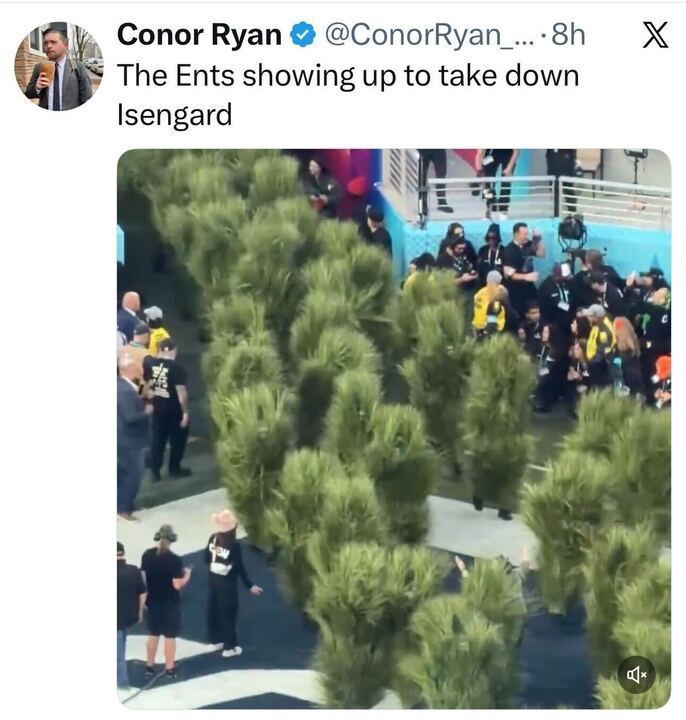
Today’s post has been inspired by a couple of Blue Sky posts involving sports. Actor Conor Ryan, upon seeing the shrubbery walk in for Bad Bunny’s Super Bowl halftime show, tweeted, “The Ents showing up to take down Isengaard.” Given that I have upon occasion found parallels between Saruman and Trump (for instance, here and here), I applauded the reference.

While most of the 143 million+ who watched the performance thrilled to Bad Bunny’s exuberant celebration of Latino culture and his message that love is more powerful than hate—only the current administration would see this as a political statement—Trump predictably threw a temper tantrum. Sounding like a cranky old geezer, he tweeted,

The Super Bowl Halftime Show is absolutely terrible, one of the worst, EVER! It makes no sense, is an affront to the Greatness of America, and doesn’t represent our standards of Success, Creativity, or Excellence. Nobody understands a word this guy is saying, and the dancing is disgusting, especially for young children that are watching from throughout the U.S.A., and all over the World.”

One of my favorite counter-responses was satirist Andy Borowitz, who after imagining Trump as having won “the gold medal in the downhill presidency” (“Trump set a new speed record for driving the world’s strongest economy into a ditch”), concluded, “Despite his victory, he remained bitter about the Super Bowl halftime show, telling reporters that ‘Bad Bunny took a job away from an American bunny.’”

We could use the Ents in America right now. When King Theoden and his warriors, along with Aragorn, Gimli and Legolas, appear about to succumb to the waves of Saruman’s orcs, the walking and talking trees show up, panicking the invaders. Just as the Super Bowl playing field suddenly became a forest of trees, so do the plains beyond Helm’s Deep, the site of the battle:

The land had changed. Where before the green dale had lain, its grassy slopes lapping the ever-mounting hills, there now a forest loomed. Great trees, bare and silent, stood, rank on rank, with tangled bough and hoary head; their twisted roots were buried in the long green grass. Darkness was under them. Between the Dike and the eaves of that nameless wood only two open furlongs lay. There now cowered the proud hosts of Saruman, in terror of the king and in terror of the trees. 

It makes sense that Trump, one of our most openly anti-environmental presidents ever, would cower before Bad Bunny’s trees. Merry and Pippin give us a report on how they move:

‘There is a great power in them, and they seem able to wrap themselves in shadow: it is difficult to see them moving. But they do. They can move very quickly, if they are angry. You stand still looking at the weather, maybe, or listening to the rustling of the wind, and then suddenly you find that you are in the middle of a wood with great groping trees all around you. 

Next thing you know, Trump’s cultural hegemony is reeling from the onslaught.

The other sports item I owe to my son, who tweeted on Bluesky,

Every Olympic broadcast should be assigned one (1) statistician and one (1) poet to give us different ways to understand the mind-boggling displays of athleticism.

To make clear what he had in mind, he employed a short Oscar Wilde lyric:

Statistician: oof! Tough crash there; skiers go up to 50 mph on the giant slalom 

Poet: Never regret thy fall, 
O Icarus of the fearless flight 
For the greatest tragedy of them all 
Is never to feel the burning light.

Enjoy the Olympics.

Posted in Uncategorized | Tagged , , , , , , | Comments closed

An Ego the Size of the Universe

Rockwell as Zaphod Beeblebrox in Hitchhiker’s Guide to the Galaxy

Tuesday

Reprinted from March 13, 2017 with changes

If you’ve ever read Douglas Adams’s Hitchhiker’s Guide to the Galaxy, perhaps you will know what episode came to mind when I heard about Donald Trump boasting of his large ego at last week’s national prayer breakfast. As you read through his comments, let me know if you can detect any sign of spiritual searching or if you can explain why various church leaders would have laughed and applauded as Trump delivered them:

They rigged the second election. I had to win it. I had to win it. I needed it for my own ego. I would’ve had a bad ego for the rest of my life. Now I really have a big ego. Beating these lunatics was incredible … the first time they said I didn’t win the popular vote. I did.

So who has the bigger ego, Donald Trump or Zaphod Beeblebrox?

Beeblebrox is the irritating cousin of protagonist Ford Prefect in Hitchhiker’s Guide. In the scene I have in mind, Beeblebrox has been captured by the fiendish Gargravarr, a Frogstar prison warden whose mind and body are undergoing “a trial separation likely to end in divorce.” Beeblebrox appears to have unlimited self-confidence, but “unlimited” only goes so far as a descriptor when one is subjected to Gargravaar’s “Total Perspective Vortex.”

Adams describes how the Vortex works. It all has to do with a sense of proportion:

The Total Perspective Vortex derives its picture of the whole Universe on the principle of extrapolated matter analyses. To explain — since every piece of matter in the Universe is in some way affected by every other piece of matter in the Universe, it is in theory possible to extrapolate the whole of creation — every sun, every planet, their orbits, their composition and their economic and social history from, say, one small piece of fairy cake. The man who invented the Total Perspective Vortex did so basically in order to annoy his wife.

Trin Tragula — for that was his name — was a dreamer, a thinker, a speculative philosopher or, as his wife would have it, an idiot. And she would nag him incessantly about the utterly inordinate amount of time he spent staring out into space, or mulling over the mechanics of safety pins, or doing spectrographic analyses of pieces of fairy cake.

“Have some sense of proportion!” she would say, sometimes as often as thirty-eight times in a single day. And so he built the Total Perspective Vortex — just to show her.

And into one end he plugged the whole of reality as extrapolated from a piece of fairy cake, and into the other end he plugged his wife: so that when he turned it on she saw in one instant the whole infinity of creation and herself in relation to it.

We have here the classic death-of-God existential horror show. If humans are merely a random biochemical event that occurred on an infinitesimally tiny pebble hurtling through the vast reaches of interstellar space, then our lives are meaningless. Some existentialists cushion themselves against this demoralizing truth by counseling us to live as though our lives have meaning, even if they don’t. This, however, can be seen as no more than a cowardly coping mechanism. The Total Perspective Vortex is designed to cut through such rationalizations and show us how small and insignificant we truly are.

This is in fact how the Vortex works with Mrs. Trin Tragula:

To Trin Tragula’s horror, the shock completely annihilated her brain; but to his satisfaction he realized that he had proved conclusively that if life is going to exist in a Universe of this size, then the one thing it cannot afford to have is a “sense of proportion.”

Mrs. Tragula would have survived, however, had she an ego the size of Beeblebrox’s. Think about it this way: if we see ourselves as more or less on a par with our immediate surroundings, then we feel neither too big nor too small. It is a perspective we are familiar with. If, on the other hand, we were suddenly shown the entire universe, the only way we could hold on to a sense of proportion and stay sane would be (drumroll!) if we had an ego as big as the universe!

This proves to be the case with Zaphod Beeblebrox. Gargravarr is stunned to see what emerges from the Total Perspective Vortex:

He waited for him to flop forward out of the box, as they all did.

Instead, he stepped out.

“Hi!” he said.

“Beeblebrox…” gasped Gargravarr’s mind in amazement.

“Could I have a drink please?” said Zaphod.

“You…you…have been in the Vortex?” stammered Gargravarr.

“You saw me, kid.”

“And it was working?”

“Sure was.”

“And you saw the whole infinity of creation?”

“Sure. Really neat place, you know that?”

Gargravarr’s mind was reeling in astonishment. Had his body been with him it would have sat down heavily with its mouth hanging open.

“And you saw yourself,” said Gargravarr, “in relation to it all?”

“Oh, yeah yeah.”

“But…what did you experience?”

Zaphod shrugged smugly.

“It just told me what I knew all the time. I’m a really terrific and great guy. Didn’t I tell you, baby. I’m Zaphod Beeblebrox!”

While Trump’s ego may not be as large as the universe, it is big enough for him to deny that millions voted against him in 2016 and again in 2020. He thinks he is “a really terrific and great guy,” and his wounded ego led him to sic his followers onto the nation’s Capitol building and all that has followed. 

In short, he would give Zaphod Beeblebrox some stiff competition.

Posted in Uncategorized | Tagged , , , | Comments closed

  • Sign up for my weekly newsletter