Brother Fire Unleased upon Tehran

Tehran bombed

Monday

I’m traveling at the moment so, in response to America’s preemptive (and therefore illegal) war against Iran, I’m reposting an essay on Louis MacNeice’s poem “Brother Fire,” which I wrote in March of 2011 when anticipating that Barack Obama would bomb Libya, which he in fact did a little over a week later. I’ve also included a short poem by David Krieger which, while about the 1945 atom bomb, also captures how our president has fallen in love with unleashing devastation upon populations. Iran’s high civilian death toll, including over a hundred Iranian children so far, he never acknowledges.

Here’s Krieger’s poem:

When the Bomb became our God
We loved it far too much,
Worshipping no other gods before it.
When the bomb became our god
We lived in a constant state of war
That we called peace.

Now for the post anticipating the bombing of Libya, reposted from March 10, 2011:

As I watch Muammar Qaddafi turn his air force against his own people, I am trying to imagine conditions on the ground. I asked my father for literature describing the experience, he having once undergone a bombing himself. It occurred in 1944, a month or two after the D Day invasion of Normandy, when the Germans sent an aerial counterattack against Avranches in the battle of the Falaise Gap.  My father and other American troops were stationed in a hotel, and although everyone else went down to the cellar, he remembers curling up in an upstairs room. He didn’t want to be buried in the rubble if there were to be a direct hit. (The Germans were trying to bomb a bridge a mile away but, bombsights being notoriously bad in those days, anyone could have been hit.)

My father reminded me of a poem by Irish poet Louis MacNeice, who witnessed firsthand the German bombing of London in which over 40,000 civilians were killed. In my father’s eyes, “Brother Fire” is one of the great antiwar poems, in part because it captures the bombing so vividly, in part because it makes the point that we and our enemy are not that different. “Oh enemy and image of ourselves,” MacNiece says to the flames as they “slaver and crunch away/ The beams of human life, the tops of topless towers.”

One other note: MacNiece describes an almost anarchistic joy as he watches the fire swarm up “city blocks and spire.” Apparently he was not alone. Other Londoners reported being caught up in an excited camaraderie as together they watched their city burn.  This may have occurred as well during the 1944 Allied bombing of Germany, which some feel actually lengthened the war by stiffening the resolve of the German people.

Here’s the poem:

Brother Fire
By Louis MacNeice

When our brother fire was having his dog’s day
Jumping the London streets with millions of tin cans
Clanking at this tail, we heard some shadow say,
“Give the dog a bone”–and so we gave him ours;
Night after night we watched him slaver and crunch away
The beams of human life, the tops of topless towers. 

Which gluttony of his for us was Lenten fare
Who Mother-naked, suckled with sparks, were chill
Though dandled on a grill of sizzling air
Striped like a convict–black, yellow and red;
Thus were we weaned to knowledge of the Will
That wills the natural world but wills us dead. 

O delicate walker, babbler, dialectician Fire,
O enemy and image of ourselves,
Did we not on those mornings after the All Clear,
When you were looting shops in elemental joy
And singing as you swarmed up city blocks and spire,
Echo your thought in ours? Destroy! Destroy! 

In his note on “Brother Fire” in his Poems of War Resistance from 2300 to the Present (Grossman 1969), my father notes the London blitzkrieg was in part a response to England’s own strategic bombing of Germany in May of 1940. This is not to say that the bombing of London was in any way justified, any more than the revenge bombing of Dresden (which Kurt Vonnegut experienced as a prisoner of war) was justified. The fire described by MacNiece is a “dialectician” because, when the dogs of war are unleashed (to quote Julius Caesar), an infernal dialectic is set into motion. We are initiated into–weaned into–knowledge of some inexorable Will that seeks our death and yet still manages to enroll us in its urge to “Destroy! Destroy!”

“Topless towers,” incidentally, is a reference to the most well-known passage from Christopher Marlowe’s Doctor Faustus, a play about the dream of unfettered power. “Was this the face that launched a thousand ships, and burned the topless towers of Ilium,” Faustus asks in wonder upon seeing the ghost of Helen of Troy.

As an Irishman, MacNeice had seen a dark side of England.  Although he bucked certain Irish revolutionaries when he embraced the English cause during World War II, he didn’t believe in England’s moral superiority.

And this is why I believe that we must not enter Libya’s war, even though part of us wants to protect those being slaughtered—just as people wanted to protect the Iraqi people from Sadaam Hussein. I remember reading in 2003 a wise piece by Chilean Ariel Dorfman urging the U.S. not to invade Iraq, even as he spoke of the horrors of Hussein from the vantage point of one who had suffered under Chile’s fascist dictatorship. Such an invasion, he predicted, could result in far more devastation than that which it was designed to alleviate.  He proved to be remarkably prescient.

Indeed, both the Iraqi people and the U.S. (and its allies) have paid a high price for the Iraqi War.  In addition to all the loss of life and money, the U.S. has lost moral authority.  As Washington Post columnist Annie Applebaum points out, the Middle Eastern revolutionaries are not clamoring for U.S. assistance (some neoconservatives argue otherwise) because they fear a repeat of Iraq.  Furthermore, the American tolerance for torture and indefinite detention has eroded our credibility even more.

War is never a neutral tool that can be wielded dispassionately.  Every time we engage in bloodshed, we are in peril of losing our moral compass. O enemy and image of ourselves.  The U.S. should, by all means, marshal all the non-military resources it has against Qaddafi.  Sending planes or troops into the conflict, however, could once again pull us into the elemental joy of brother fire.

What has occurred in the 15 years since: Rather than answering the hopes of the Arab Spring, the 2011 intervention failed to establish democratic rule. Instead, Libya has witnessed the rise of jihadism so that it finds itself in perpetual civil war. The concluding lines from William Blake’s “The Grey Monk” come to mind:

The hand of Vengeance found the bed
To which the Purple Tyrant fled;
The iron hand crush’d the Tyrant’s head
And became a Tyrant in his stead.

Posted in Uncategorized | Comments closed

Scientific Wonder and the Longing for God

Sunday

I have been reading through Arnold Benz’s Astronomical Psalms for a Vast Universe (Crossroad, 2025), a series of poetic reflections by an astrophysicist expressing his wonder at the diverse features of the universe. As Benz says in his introduction, “Aristotle considered wonder to be the origins of science and a motive behind all great questions,” and then notes how, through his amazement, he participates “in the cosmic performance.”

The book reminds me of one of my favorite passages from the Prayers of the People, Eucharistic Prayer C, where someone from the congregation will read, “At your command all things came to be: the vast expanse of interstellar space, galaxies, suns, the planets in their courses, and this fragile earth, our island home.” 

To this the congregation responds, “By your will they were created and have their being.”

In this spirit Benz writes that, “while God’s presence is not susceptible to scientific demonstration, my personal perception of reality does hint at something or someone beyond what can be scientifically observed.” His verses, he says, echo “the ancient literary genre of the Psalms.” As such, they “aim to link the present-day universe story told by science with a faith-grounded response.”

In one of his poems he writes,

A quintillion is a million trillions.
A trillion is a million millions.
I can calculate these numbers,
I can write them,
but I can’t imagine them.
Space where galaxies dwell,
and where physical laws apply
is unimaginably vast.
Is there a Presence in it or behind?
It must be unimaginably larger.
Is this God?

One of my favorite of his poems is “Energy,” which gives you a sense of the whole:

The universe is unfathomably lavish with energy.

Consider the solar atmosphere:
Swirling hot gas,
sets magnetic fields in tension
like spiral springs.
When the tension becomes too great,
energy bundles explode.
Within minutes, a magnetic eruption
releases a hundred million times more energy
than the largest atomic bomb,
ten thousand times more energy
than all power plants on earth can produce in a year.

Or: Massive stars explode
as supernovae,
hurling energy into space
every second somewhere in the universe
billions of times that of a solar eruption.

Or: Two black holes merge
with a hundred times more energy than a supernova;
space-time shakes throughout the whole universe:
A gravitational wave.

We humans, insatiable in our hunger for energy,
have access to only the tiniest share
of the cosmic abundance,
like a nutshell full of water
compared with all that’s in the sea.

We need energy to live.
Are we entitled to energy?
No,
it is given to us freely
from an unfathomably prodigious source.

For this we give you thanks, gracious God!

The book is a powerful response to those who see science and religion at odds. It addresses in a deep way how we can be at the same time infinitesimally small and yet somehow connected with divinity.

Posted in Uncategorized | Tagged , , , | Comments closed

Forging a Separate Identity from My Father

My father and me during a Fulbright year in France (1952)

Friday

I’ve mentioned my father frequently in these Friday recollections but thought I’d write today about when I finally started to slip out of  his orbit, which didn’t happen until my forties. Previously I had worshipped him, which meant to finding separation was difficult. I think of the observation that Athena, in the guise of Mentor, makes to Telemachus in The Odyssey:

Telemachus, you will be brave and thoughtful
if your own father’s forcefulness runs through you.
How capable he was, in word and deed!
Your journey will succeed, if you are his.
If you’re not his son by Penelope,
I doubt you can achieve what you desire.
And it is rare for sons to be like fathers:
Only a few are better, most are worse.

Perhaps Tennyson had this passage in mind when he wrote “Ulysses,” in which the Greek hero regards his son as an unimaginative bureaucrat rather than a wild and exciting adventurer:

       This is my son, mine own Telemachus, 
To whom I leave the scepter and the isle,— 
Well-loved of me, discerning to fulfil 
This labor, by slow prudence to make mild 
A rugged people, and thro’ soft degrees 
Subdue them to the useful and the good. 
Most blameless is he, centered in the sphere 
Of common duties, decent not to fail 
In offices of tenderness, and pay 
Meet adoration to my household gods, 
When I am gone. He works his work, I mine.

The truth is that my father was a remarkable man. A translator during World War II, he ended up in Munich in 1945, where he conducted Germans on required tours of Dachau. When he returned to the United States, he finished up his education at Carleton College, earned his Ph.D at the University of Wisconsin, and had a stellar academic career as a world-class scholar, specializing in the poetry of French modernist poet Guillaume Apollinaire. He also gained a reputation as an accomplished poet of light verse; created eye-catching paintings that involved nails, hinges, and other forms of hardware; and played his own small role here in Sewanee in the Civil Rights, feminist, and LGBTQ+ movements. He was a major mover in a landmark civil rights case, funded by the NAACP, in which four Black families and four white sued our county school board for failing to comply with the 1954 Brown v. Board of Education ruling. We won the suit—I was one of the plaintiffs—and for years afterwards the NACCP advertised the case as one of its signature accomplishments.

When I say “world class scholar,” incidentally, I’m not exaggerating. During his life, he was offered multiple positions, including at Indiana University, one of the premier public universities for foreign language study. He also once set Apollinaire world on its head with his original research into some of the poet’s more obscure poems.  How was I to compete with all that?

As a child, I realized early on that I would never draw as well as he did—I got C’s in first grade penmanship—and I stopped writing poetry (except for occasional doggerel) after my efforts were mocked by fellow poets in high school. (I wrote a poem inspired by the fairy world in Midsummer Night’s Dream, which they saw as evidence that I was a fairy.) But I aspired to be the kind of literary scholar that he was.

Only I never succeeded. For one thing, I never fell in love with library research the way that he did. In some ways, this form of academic scholarship jumped a generation as my son Toby, also a literature professor, is far more accomplished than I am. For years, I felt an academic failure.

Where I differed from my father is that, where he loved to pontificate, I preferred to listen. I was far more attuned to my students’ concerns than he could ever be. Although we were both successful teachers, both winning teacher-of-the-year awards at our respective colleges, we taught in different ways, with him more of a lecturer, me as more of a counselor. This became clear to me when we co-authored an article on Citizen Kane, which was his favorite movie. 

As we were exchanging ideas, I fell in love with the following account of why the movie meant so much to him:

When I first saw Citizen Kane with my college friends in 1941, it was in an America undergoing the powerful pressures of a coming war, full of populist excitement and revolutionary foreboding. But cynical Depression kids that we were, we had little hope for salvation through armed uprising. Nor did we believe any longer in America’s self-proclaimed values. Nevertheless, those values were still part of us, and it was America’s blind self-destruction that we instinctively recognized in the shattering experience of watching a little wooden sled go up in flames. From the moment the huge lips opened and said “Rosebud,” to the sled’s final immolation in the furnace of our desires, we were both thrilled and terror-stricken. It was the flaming consummation of sex and politics that we had been looking for in movie theatres all our young lives. We somehow knew that we had experienced our own flaming love-death and that it had taken place in the tragic heart of our country. Welles and Mankiewicz had revealed, in two short hours of perception, how energetically Miss America had been raped of her dream, of her promise, of her rose; and then how she had dutifully prostituted us, her own bastard children. We no longer had a place we could call home. Pessimistically, and yet with the hope of finding some sort of transcendence through great eschatological events, we let ourselves get drafted into the army…

He followed up these observations with some fantastic research: looking through the Welles collection at the Indiana University library, he came across Welles’s previous undiscovered adolescent diaries. You will recall that the reporter in the film is searching for the meaning of “rosebud,” Kane’s last word, and my father discovered that the diaries are filled with references to roses. Then I discovered that roses were also big in the life of publisher William Randolph Hearst, upon whom Kane is based. We figured we could add some insight into the meaning of the symbol.

My father generously told me I could frame the article however I wanted. As I started to write it, however, I started running up against some generational differences. Essentially my father was a modernist for whom the desecrated rose—blasted innocence—was central to his identity whereas I was more of a post-modernist, seeing the rose as a metaphor that Welles was manipulating. (Welles himself described rosebud as “dollar book Freud.”) As much as I tried, I couldn’t get our two interpretations to jell.

My solution, finally, was to explore why the film meant so much to him and people like him (since he wasn’t the only viewer in 1941 and 1942 to be blown away by the film). With this approach, I could both honor him and acknowledge that I myself had a different perspective and different set of concerns. Our college president and English professor Ted Lewis thought that I had used the article to gently kill my father—my Oedipal moment—and perhaps there was some of that. It felt more, however, as though I was forging my own distinctive identity.

It took me this long to stop using his career as my measuring stick. Only in my forties did I realize that the kind of teaching and scholarship he did didn’t interest me that much, in large part both seemed too detached from life. I was much more of a utilitarian in my approach to literature (even though I hated Jeremy Bentham when I encountered him in college). In this way, I was more my mother’s son, who kept our family grounded as my father went off on his intellectual flights. 

I was learning that it was okay to be the Telemachus in Tennyson’s poem.

Yet I don’t want to deny that, in many ways, I am also my father’s son. It could be said of Scott Bates what poet Lucille Clifton once said of me when we were colleagues: “as if words only matter in the world they know.” Although this was truer of my father than it was of me, there are ways I too get lost in abstractions. I think of what Mentor/Athena says to Telemachus in a follow-up comment to the one above:

But you will be no coward and no fool.
You do possess your father’s cunning mind,
So there is hope you will do all these things.

I’m proud that I possess my father’s cunning mind and am grateful for the gifts that he gave me. He worked his work, I mine.

When I began blogging in 2009, I was able to express my gratitude by regularly sharing his poems, some of which are really fine. He, meanwhile, became my #1 fan and told everyone he knew about the blog. Up until 89—he died at 90—he held on to his keen intellect and held forth at dinner gatherings and with friends. When we gathered to honor his memory with poems and stories, Sewanee’s Convocation Hall was packed.

Posted in Uncategorized | Tagged , , , , , | Comments closed

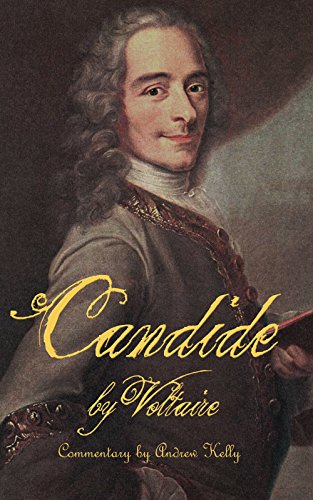
Milton, Voltaire, and Trump’s Address

Thursday

My heart leaped when I saw a political pundit referencing both Samuel Johnson and John Milton to describe Donald Trump’s State of the Union address. For the record, my graduate school field was Restoration and 18th century British Literature, which is to say, from when Milton wrote Paradise Lost to when Jane Austen composed the first draft of Pride and Prejudice. Then another commentator mentioned Voltaire and my joy was complete.

First, here’s the Bulwark’s Bill Kristol:  

My reaction to Trump’s speech mirrored Samuel Johnson’s famous (but probably unfair?) judgment of Milton’s Paradise Lost: “None ever wished it longer than it is. Its perusal is a duty rather than a pleasure.”

My students, when assigned Paradise Lost, have sometimes understood Johnson to be saying that Milton’s epic is too damn long, which, while true of Trump’s speech, isn’t exactly what Johnson was saying. In fact, Johnson was a fan of the poem and would routinely quote passages from it. But where Paradise Lost does run on—I’m thinking of the second half of Book XI and the first half of Book XII—it bears some resemblance to Trump’s  “American carnage” emphasis.

God has sent the archangel Michael down to inform Adam and Eve that they will (1) soon be leaving the Garden of Eden and (2) eventually die. He also delivers a history lesson about what will happen over the next several thousand years, most of it bad. First there’s all the evil leading up to Noah’s flood, then all the evil necessitating Christ having to intervene, and then all the ways in which the church founded by Christ’s followers will become corrupted. The account competes with Trump’s version of America when the Democrats are in charge.

But the archangel hasn’t come down only to deliver bad news. Just as Trump in his speech predicted that “soon you will see numbers that few people would think it possible to achieve just a short time ago” and that American will be back “bigger, better, richer, and stronger than ever before,” so Michael assures Adam that Jesus will come a second time to make everything right:

                      Thy Saviour and thy Lord,
Last in the clouds from heav’n [will] be revealed
In glory of the Father, to dissolve
Satan with his perverted World, then raise
From the conflagrant mass, purged and refined,
New heavens, new earth, ages of endless date
Founded in righteousness and peace and love
To bring forth fruits joy and eternal bliss.

In Adam’s eyes, this makes all the suffering worth it:

O goodness infinite, goodness immense!
That all this good of evil shall produce, 
And evil turn to good; more wonderful
Then that which by creation first brought forth
Light out of darkness! 

Now, I know there are white nationalist Christians who see Trump in apocalyptic terms—I wrote recently how some applaud him as a rough beast slouching toward Bethlehem—so perhaps they appreciated his mixture of doom speak and boasting. If so, however, they might note that Trump is conspicuously deficient in the behaviors that Michael demands of Adam, starting with good deeds:

                                [O]nly add
Deeds to thy knowledge answerable, add Faith,
Add virtue, patience, temperance, add love,
By name to come called charity, the soul
Of all the rest: then wilt thou not be loath 
To leave this Paradise, but shalt possess
Paradise within thee, happier far. 

Unfortunately, Trump more resembles those kings described by the archangel who succeeded David and Solomon, which is to say kings who led a great nation into depravity so that it was eventually conquered by the Babylonians. Michael talks of how their 

       foul idolatries, and other faults
Heaped to the popular sum, will so incense
God, as to leave them, and expose their land,
Their city, his temple, and his holy ark
With all his sacred things, a scorn and prey
To that proud city [Babylon], whose high Walls thou saw’st
Left in confusion…

Think of our holy ark as the Constitution. Other nations may not have the power to drag us off to Babylon, but why bother when Trump & Co. are locking up innocent people here at home.

The other 18th century reference I encountered was to Voltaire’s Candide, or Optimism and to Candide’s tutor Pangloss, a satiric caricature of the great German philosopher and mathematician Leibniz. Even as everything around him is going to hell, Pangloss stubbornly contends that “we live in the best of all possible worlds.” Observing that Trump’s default setting is triumphalism, the New Yorker’s Susan Glasser noted his “Panglossian conviction that a country with him as its leader must be doing pretty damn great.”

At one stretch in Candide, the world challenges Pangloss’s optimism. He is first condemned to be burned at the stake, then (because it’s raining) imperfectly hanged, then partially cut open by a doctor before coming back to life, and then condemned to life as a galley slave, where he is repeatedly whipped, before Candide rescues him. Arguing with Pangloss that we may not live in the best of all possible worlds, however, is like arguing with fervent Trump supporters that their idol may not be the perfect blend of Christ, George Washington, and Abraham Lincoln:

Well, my dear Pangloss,” said Candide to him, “when you had been hanged, dissected, whipped, and were tugging at the oar, did you always think that everything happens for the best?”

“I am still of my first opinion,” answered Pangloss, “for I am a philosopher and I cannot retract, especially as Leibnitz could never be wrong; and besides, the pre-established harmony is the finest thing in the world…

Epstein and Trump may have been molesting young girls, but, hey, the Dow is over 50,000!

Posted in Uncategorized | Tagged , , , , , , , | Comments closed

Misuse of Language Induces Evil in the Soul

John Keats

Wednesday

I recently stumbled across Ursula K. Le Guin’s “A Few Words to a Young Writer.” As it turns it, it’s only two paragraphs—nothing as extensive as Rilke’s “Letters to a Young Poet,” which may have inspired it—but still well worth revisiting at this time of non-stop political lying and the looming threat of essays composed by Artificial Intelligence. Here it is in its entirety: 

Socrates said, “The misuse of language induces evil in the soul.” He wasn’t talking about grammar. To misuse language is to use it the way politicians and advertisers do, for profit, without taking responsibility for what the words mean. Language used as a means to get power or make money goes wrong: it lies. Language used as an end in itself, to sing a poem or tell a story, goes right, goes towards the truth.

A writer is a person who cares what words mean, what they say, how they say it. Writers know words are their way towards truth and freedom, and so they use them with care, with thought, with fear, with delight. By using words well they strengthen their souls. Storytellers and poets spend their lives learning that skill and art of using words well. And their words make the souls of their readers stronger, brighter, deeper.

One reason why I don’t fear for the future of literature—even as enrollments in college literature classes decline and young people are absorbed by video games and social media—is that something deep within human beings craves literary truth. As I note in my book, author Salman Rushdie responded to the torrent of lies emanating from the Donald Trump White House in 2019 by pointing out that the classics will always remain relevant because of their commitment to authenticity. Seeing literature as essentially a “no bullshit” zone, Rushdie wrote that the job of contemporary writers was “rebuilding our readers’ belief in reality.” Le Guin tells us one does this by using words “with care, with thought, with fear, with delight.”

I think of how processed cheese, polyester clothing, and formica counter tops were once considered the future, only for people to revert back to real food, natural fabrics, and wood surfaces in their longing for something genuine. These are inexact analogies but you see my point. The inauthenticity of AI-generated prose will not “make the souls of their readers stronger, brighter, deeper.”

I like Le Guin’s point that misusing words is failing to take responsibility “for what the words mean.” Slowly but surely, abusing language hollows people out, as we see in too many politicians and their press secretaries. They think they have discovered a magic get out of jail card—all they have to do is lie and deflect to escape accountability—but instead they turn into T.S. Eliot’s hollow men:

We are the hollow men  
We are the stuffed men  
Leaning together 
Headpiece filled with straw. Alas! 
Our dried voices, when  
We whisper together  
Are quiet and meaningless 
As wind in dry grass  
Or rats’ feet over broken glass 
In our dry cellar

Contrast these what those who seek the truth as described by poet William Cowper in Book V of The Task:

The only amaranthine flower on earth
Is virtue; the only lasting treasure, truth.

Or with those who arrive at Keats’s ringing conclusion to “Ode on a Grecian Urn”:

“Beauty is truth, truth beauty,—that is all
                Ye know on earth, and all ye need to know.”

The abuse of language that we witnessed in last night’s State of the Union address was as far from truth and beauty as it’s possible to get.

Posted in Uncategorized | Tagged , , , , | Comments closed

Jesse Jackson’s Uplifting Message

Jesse Jackson, 1941-2026 (R.I.P.)

Tuesday

Over the weekend, as I was listening to Clock It–MS Now’s new and very entertaining podcast hosted by Symone Townsend-Sanders and Eugene Robinson—I was reminded of the late Jesse Jackson’s immense contributions to Black advancement in the United States. Without Jackson, Townsend-Sanders noted, we wouldn’t have had Barack Obama, Kamala Harris, Al Sharpton, or the many African American figures that have become an integral part of American political life (including Townsend-Sanders and Robinson themselves).

One of my most vivid memories of Jackson was seeing him in tears in Chicago’s Grant Park as Obama addressed the crowd after hearing he had won the 2008 election. I wondered whether Jackson ever thought he would live to see this day.

Jackson was one of Martin Luther King’s youngest advisors although he would later split with the Southern Leadership Conference. Eventually, as the organizer of the Rainbow Coalition and Operation Push, he worked tirelessly on behalf of the marginalized. He was an early advocate for LGBTQ+ rights, and in his speech before the 1984 Democratic National Convention he compared America to a quilt:

America is not like a blanket — one piece of unbroken cloth, the same color, the same texture, the same size. America is more like a quilt: many patches, many pieces, many colors, many sizes, all woven and held together by a common thread. The white, the Hispanic, the black, the Arab, the Jew, the woman, the native American, the small farmer, the businessperson, the environmentalist, the peace activist, the young, the old, the lesbian, the gay, and the disabled make up the American quilt.

Jackson went on to observe that, while we “have proven that we can survive without each other,… we have not proven that we can win and make progress without each other. We must come together.” It’s a message we desperately need today.

I love what Jackson used to do with Black children, turning his poem “I am Somebody” into a call and response affair. He would say, “I am,” and they would enthusiastically complete the sentence: 

I am Somebody!
I am Somebody!
I may be poor,
But I am Somebody.
I may be young,
But I am Somebody.
I may be on welfare,
But I am Somebody.
I may be small,
But I am Somebody.
I may have made mistakes,
But I am Somebody.
My clothes are different,
My face is different,
My hair is different,
But I am Somebody.
I am black,
Brown, or white.
I speak a different language
But I must be respected,
Protected,
Never rejected.
I am God’s child!

Revisiting that outreach, I am reminded of how, years before, Lucille Clifton made the same theme central to her poetry. Clifton eschews capitalization in her verse, a strategy that can capture feelings of smallness, which she then turns into defiant self proclamations. In “homage to my hips,” the speaker refuses to be defensive about her large hips, reporting, 

i have known them
to put a spell on a man and
spin him like a top!

In “what the mirror said,” meanwhile, a large-bodied woman—one whom others see as “a noplace anonymous girl”–looks at her reflection and gives her own version of “I am Somebody”:

what the mirror said
By Lucille Clifton

listen,
you a wonder.
you a city
of a woman.
you got a geography
of your own.
listen,
somebody need a map
to understand you.
somebody need directions
to move around you.
listen,
woman,
you not a noplace
anonymous
girl;
mister with his hands on you
he got his hands on
some
damn
body!

To be clear about the body aesthetic that has led to the woman’s low esteem, here’s Clifton’s “my dream about being white”:

hey music and
me
only white,
hair a flutter of
fall leaves
circling my perfect
line of a nose,
no lips,
no behind, hey
white me
and i’m wearing
white history
but there’s no future
in those clothes
so i take them off and
wake up
dancing

Much of Clifton’s power lies in the confidence of her declarations. The same was true of Jackson.

Posted in Uncategorized | Tagged , , , , , , | Comments closed

Hans Brinker’s Successors Bring Home the Gold

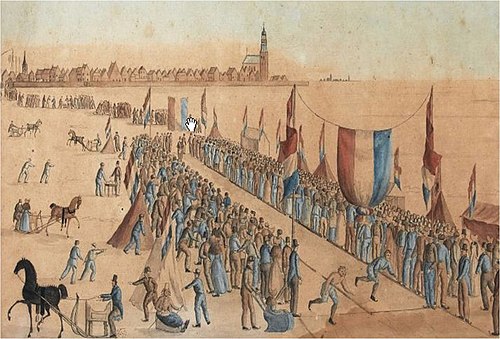
1828 skating race on the Zuiderzee

Monday

Note: If you wish to receive Better Living through Beowulf daily, send me a request at rrbates1951@gmail.com. I promise not to share your email with anyone. Or you can choose to receive the weekly newsletter, which has links to the previous week’s posts. There is no cost to either. Let me know.

Among the many glorious memories that people carry away from the 2026 Winter Olympics, one in particular has a literary connection. Thanks to their prowess in speed skating, the Dutch tied with Italy for third in gold medals. With seven silver and three bronze, the Netherlands earned 20 medals overall for their most successful Winter Olympics ever. In Olympic history, the Dutch have won 146 speed skating medals, 70 more than the second place United States. 

Which brings me Mary Mapes Dodge’s 1865 novel Hans Brinker, or The Silver Skates,  a book that I enjoyed as a child but haven’t thought about since. 

The story focuses on the Brinker family, which has fallen on hard times after the father falls from a dike and experiences a brain injury. Spurned by the community for their bad luck, Hans and sister Gretel dream of winning a mile-long skating race and, with it, a pair of silver skates. It’s a heart-warming story that NBC would be sure to play up if the two were racing in the Olympics.

The story features multiple instances of heroic self-sacrifice. Hans works to buy a good pair of skates for his sister—the two wouldn’t stand a chance on their homemade wooden skates—and then gives up the dream of buying his own skates in order to pay a cranky doctor to perform brain surgery on his father. When the doctor, softened by Hans’s sacrifice, performs the surgery for free, Hans then performs a second sacrifice, donating a shoe string to his good friend Peter, who has experienced an equipment failure at a critical moment. Gretel and Peter go on to win their respective races.

Just as we saw family and friends rejoicing as skaters flashed across the line, so do we see the same excitement in the novel. Feel free to revisit your favorite Olympics moments as you read the accounts. First, here’s Gretel:

They are winged Mercuries. Who is first? Not Rychie, Katrinka, Annie, nor Hilda, nor the girl in yellow, but Gretel—Gretel, the fleetest sprite of a girl that ever skated. She was but playing in the earlier races, NOW she is in earnest, or rather, something within her has determined to win. That lithe little form makes no effort, but it cannot stop—not until the goal is passed!

In vain the crier lifts his voice. He cannot be heard. He has no news to tell—it is already ringing through the crowd. GRETEL HAS WON THE SILVER SKATES!

Like a bird she has flown over the ice, like a bird she looks about her in a timid, startled way. She longs to dart to the sheltered nook where her father and mother stand. But Hans is beside her—the girls are crowding round. Hilda’s kind, joyous voice breathes in her ear. From that hour, none will despise her. Goose girl or not, Gretel stands acknowledged queen of the skaters!

And now for Peter:

They are winged Mercuries, every one of them. What mad errand are they on? Ah, I know. They are hunting Peter van Holp. He is some fleet-footed runaway from Olympus. Mercury and his troop of winged cousins are in full chase. They will catch him! Now Carl is the runaway. The pursuit grows furious–Ben is foremost!

The chase turns in a cloud of mist. It is coming this way. Who is hunted now? Mercury himself. It is Peter, Peter van Holp; fly, Peter–Hans is watching you. He is sending all his fleetness, all his strength into your feet. Your mother and sister are pale with eagerness. Hilda is trembling and dares not look up. Fly, Peter! The crowd has not gone deranged, it is only cheering. The pursuers are close upon you! Touch the white column! It beckons–it is reeling before you–it–

“Huzza! Huzza! Peter has won the silver skates!”

“Peter van Holp!” shouted the crier. But who heard him? “Peter van Holp!” shouted a hundred voices, for he was the favorite boy of the place. “Huzza! Huzza!”

We witnessed many such moments over the past two weeks. Huzza! Huzza!

Posted in Uncategorized | Tagged , , , | Comments closed

How Did This Dust Learn to Sing?

Sunday

The season of Lent began this past Wednesday with Ash Wednesday, a day of repentance in which Christian worshippers are often marked on their foreheads with an ashen cross as the priest says, “Remember that you are dust, and to dust you shall return.”

In 2015, perhaps thinking of the climate change that is causing out-of-control wildfires and of the deliberate burning of large sections of the Amazonian rain forests, Malcolm Guite composed the following sonnet. As he explained at the time,

As I set about the traditional task of burning the remnants of last Palm Sunday’s palm crosses in order to make the ash which would bless and sign our repentance on Ash Wednesday, I was suddenly struck by the way both the fire and the ash were signs not only of our personal mortality and our need for repentance and renewal but also signs of the wider destruction our sinfulness inflicts upon God’s world and on our fellow creatures, on the whole web of life into which God has woven us and for which He also cares. 

Here’s his poem:

Ash Wednesday
By Malcolm Guite

Receive this cross of ash upon your brow,
Brought from the burning of Palm Sunday’s cross.
The forests of the world are burning now
And you make late repentance for the loss.
But all the trees of God would clap their hands
The very stones themselves would shout and sing
If you could covenant to love these lands
And recognize in Christ their Lord and king.

He sees the slow destruction of those trees,
He weeps to see the ancient places burn,
And still you make what purchases you please,
And still to dust and ashes you return.
But Hope could rise from ashes even now
Beginning with this sign upon your brow.

Guite moves from trees to stones, the latter referred to in the account of Palm Sunday. When Jesus was rebuked for his followers singing his praises as he entered Jerusalem, he replied, “I tell you, if they keep quiet, the stones will cry out.”

The image of trees rejoicing also appears in a moving poem written by Julia Bates, my wife. After the ashes were applied and the words spoken in this past Wednesday service, Julia said she suddenly found herself—in an “instantaneous gestalt”–identifying with the dust motes that danced in the air around her–which in turn prompted her to wonder at the miracle of creation. How, she asks, did this dust

Learn to speak
To have a heartbeat
To think a verse of a
Song?

The thinking process continued on, Julia reports. Did dust then create a god in order 

To teach us how to
Gather ourselves
To stand close enough
To touch

After reflecting whether this dust also creates a god to regulate its destructive urges, the poem asks again what it takes to keep us, like dust motes, from simply blowing away. Are we bound together by heavenly chords/ “cords of love.” And from there she wonders whether we follow the example of trees,  which learned the anchor of roots long before us.

Whether trees or humans, the sap rises within. Does the wind come at their bidding, she asks, as they/we “pound out the heartbeat of bird song”? 

Daughter of Ashes
By Julia Bates

Daughter, you come from dust
And to dust you shall return
The priest, a woman in white
With black stole
Thumbs a circle on my forehead
And then a cross

Suddenly I am a column of dust
And around me all are transformed
Into dervishes of sparkling motes
Fragile, whimsical, barely separate
One from another

And how, I ask in wonder,
Did this dust
Learn to speak
To have a heartbeat
To think a verse of a
Song

Did we create a god
To teach us how to
Gather ourselves
To stand close enough
To touch

And the fear that if we
Mistake the law
Murder one another
The wrath will descend

Perhaps that anger is
Our anger
That destruction
The might in our own
Right hand

Can we go back to harmony
Can we listen for chords
To make cords of love
To hold us here
Floating
When we might just
Blow away

The option
To hug
To put down roots
Like the trees who
Learned that anchor long before
Us
Do trees pray
How do they learn the rules
Of mutual survival

As the spring sun
Launches urges of sap
Ever upwards
How can those trunks
Keep from dancing

Or is that how the wind comes
At their bidding
To toss their branches
Like the long hair
Of young women
And young men
As they pound
Out the heartbeat
Of bird song

Posted in Uncategorized | Tagged , , , , , | Comments closed

To Ljubljana, with Love

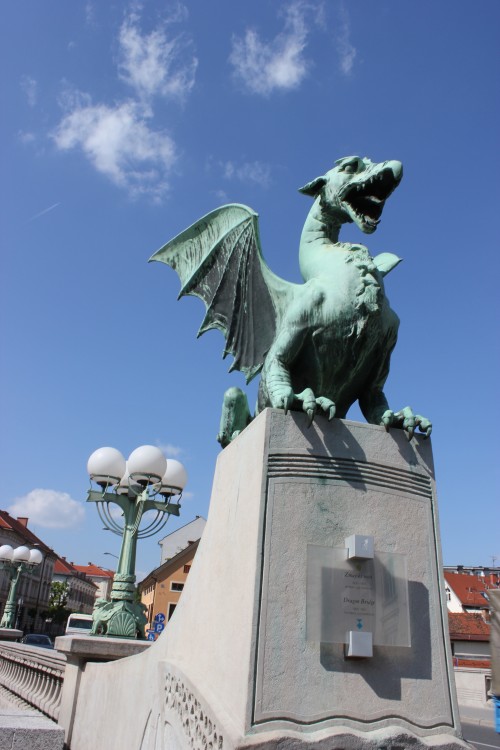
One of Ljubljana’s dragons

Friday

Years ago I read a memoir written by Eliza Scott, my great grandmother, which included accounts of the novels that had been important to her when she was growing up in Barton, England. It has meant so much to me that I have been writing my own A Life Lived in Literature. The latest installment appears every Friday.

nIn 1995 I experienced my 15 minutes of fame when I was invited to participate in Slovenia’s 50th anniversary of Victory in Europe Day. This time Julia and I had both received grants to visit the country—a Fulbright for me, an international studies grant for Julia to study Slovenia’s high school graduation exams—and we were able to reconnect with former colleagues and friends.

As far as the year went, Slovenia following its break with Yugoslavia was not dramatically different from what it had been seven years before: while there were fewer regulations and more freedom of movement across borders, it remained the beautiful country it had been in 1987-88. The boys attended international programs that were embedded within the Slovenian school system, with Justin attending Gimnazija Bežigrad for high school and Darien and Toby Danila Kumar for elementary. The education was excellent and the fees reasonable and, to offset some of Justin’s tuition, I taught a senior poetry class to four international students at Bežigrad. 

At the University of Ljubljana I met some extraordinary students and colleagues and gained new literary insights. Uroš Mozetič, who taught the British Modernists, alerted me the gender challenges of translating English into Slovenian. (When Auden writes, “Lay your sleeping head, my love/ Faithful on my faithless arm,” a Slovenian translator must indicate the gender of the loved one—for Auden, it would have been a man—while in English it can remain ambiguous.) I had the talented Cvetka Sokolov in a literary theory class—Cvetka has become a noted author of children’s and young adult fiction—and also Nada Grošelj, today one of Slovenia’s premier translators. (Nada taught herself English at a young age so that she could read Lord of the Rings.) Igor Maver opened my eyes to the dynamics of Slovenian-Australian immigrant fiction (which are also to be found in American immigrant fiction). I could go on and on.

Meanwhile, I was still reading to the boys at home, and because we had to rely on whatever was available at a local library, some of the readings were eclectic. For instance, we read Zane Grey’s Riders of the Purple Sage and, for years afterward, it became family practice to dramatically pronounce, at the most unexpected moments, the protagonist’s name, which inspires awe and dread in his enemies:

“Who are you? We are seven here.”

The rider dropped his sombrero and made a rapid movement, singular in that it left him somewhat crouched, arms bent and stiff, with the big black gun-sheaths swung round to the fore.

Lassiter!

It was Venters’s wondering, thrilling cry that bridged the fateful connection between the rider’s singular position and the dreaded name. 

Here’s another line that has stayed with us, although this one involves a movie. We took a special trip to Paris and, on the bus, watched a videotape of Orca: The Killer Whale, Moby Dick imitation and Jaws wannabe that is so awful as to be memorable. Among the dreadful lines is one that has become legendary in the Bates household. Umilak, the stereotypical wise old native guide, dismisses the whale expert who is counseling the Ahab-like sea captain with, “She knows it from university, I know it from my ancestors.” Almost as bad, and again delivered in oracular fashion, is, “He is not gone, he hides and waits in a sea cave.” 

Along with Zane Grey, I remember reading to the boys E. Nesbit’s The Phoenix and the Carpet. We also tried out, but rejected as boring, Kenneth Grahame’s The Golden Age.

The boys made friends with their schoolmates, who were from all over the world (it helped that English was the lingua franca). I especially remember students from Poland and Kenya. Justin also became the ace pitcher on Ljubljana’s top youth baseball team, which did wonders for his confidence.

William Boyd, the African American student who had joined us in 1987 and sung in Yugoslavia’s major concert halls, again flew over (this time the government was less suspicious) and used the year to decide whether he would go into the ministry like his father. (By the end of the year, he decided in the affirmative, and he would succeed his father at Baltimore’s New Elizabeth Baptist Church.) Once again he was a singing sensation, performing at one point in the Christmas Eve service in the cathedral on Ljubljana’s central square. His reputation was such that a Slovenian playwright wrote him into an avant garde play, having him descend as an extraterrestrial being singing in a strange language. Unfortunately, the incense that accompanied the scene messed with Williams’s breathing so that he had to dial things down.

But the highlight of the year for me was reading Walt Whitman’s “Oh Captain, My Captain” to a national television audience to cap off Slovenia’s 50th year celebration of Victory in Europe Day (May 8, 1945). I was one of six readers from allied nations. We wore handmade suits that had been specially tailored for us and stood on a platform 20 feet in the air with the word “ZMAGA”—”Victory”—in large letters behind us.

It was an elaborate affair, held on the square in front of the National Assembly Building. Prior to our reading, we had watched as Slovenian concentration camp survivors paraded around the square, followed by the country’s famous Lipizzaner horses (dating back to when Slovenia had been part of the Austro-Hungarian Empire). Alpinist climbers scaled the surrounding buildings, the Slovenian national orchestra performed on the front steps, parachutists descended from airplanes, and beauty pageant winners holding ceremonial horns looked down from the rooftops. Although the Slovenes were ostensibly celebrating the day when Germany declared unconditional surrender in 1945, the affair was even more about celebrating Slovenia’s independence from Yugoslavia four years before.

What impressed me most, however, was that the Slovenes chose to cap the event with poetry. The readings were from Russia (Vladimir Mayakovsky), France (“Liberté by Paul Eluard), the United Kingdom (Shakespeare’s Henry V speech “Once more into the breach, dear friends”), a poem by Spain’s Garcia Lorca (killed by the fascists), Whitman, and a Slovenian poem read by a teenager representing the future. 

The Shakespeare was actually read by a Scot, who expressed some ambivalence about the speech given how Scots are caricatured in the play. The Eluard was read by a French Canadian who didn’t know why she had been chosen. (I figured that, since Canada was also an ally, it was two for the price of one.)  

For my part, I was at first unsure why a tragic poem like “Oh Captain,” which mourns the death of Lincoln, would be the choice to celebrate a victory, unless it was to commemorate the 28,000 Slovenians that died fighting the fascists (who built a fence enclosing Ljubljana during the war). The organizers then explained that Jimmy Carter had given the poem to Yugoslavia following the death of its president Josip Tito, a wonderful use for a great poem. I belted out the words (or lip synced them, having previously been recorded) as the Slovenian air force flew overhead and the Slovenian television audience sat riveted. Or not.

To capture this wonderful year, allow me to reference a film. In After Life, by the Japanese director Hirokazu Koreeda, people who have died end up in a netherworld until they can settle on a memory from their lives in which to spend eternity.  Some people’s suggestions are rejected (say, a ride on a Disney roller coaster) and some people can’t make up their minds (in which case they remain in this limbo until they can). Then the scene is staged and the person passes on. The film prompts one to think of one’s own best moment, and my moment comes from this year in Slovenia.

We had a large king-sized bed in our apartment and sometimes, on a Sunday morning, the five of us would gather in it as I read aloud. I remember thinking at the time it was a perfect moment. So yes, if I had to choose, this is how I would spend eternity. 

Past Installments of A Life Lived in Literature
A Life Lived in Literature: How It All Began (Sept. 5, 2025)
Early Reading Memories (Sept. 12, 2025)
Childhood Confusion: Reading to the Rescue (Sept. 19, 2025)
Confronting Segregation (Sept. 26, 2025)
School Reading vs. Real Reading (Oct. 10, 2025)
Childhood in Paris (Oct. 17, 2025)
My Time at Sewanee Military Academy (Oct. 24, 2025)
Existentialism for High School Seniors (Oct. 31, 2025)
Why I Majored in History, Not English (Nov. 7, 2025)
My College Search for Authenticity (Nov. 14, 2025)
On D. H. Lawrence and a Sexual Awakening (Nov. 21, 2025)
My Life as a Bildungsroman (Nov. 28, 2025)
Grad School: Literary Baptism by Fire (Dec. 5, 2025)
Early Scenes from a Marriage (Dec. 12, 2025)
Bringing Up Baby in Grad School (Dec. 19, 2025)
Grappling with Racism (Jan. 2, 2026)
Journal of a Young Teacher (Jan. 16, 2026)
Teaching and Reading in Yugoslavia (Jan. 23, 2026)
Life at 40: Barely Controlled Chaos (Jan 30, 2026)
From Secular Humanist to Christian Believer (Feb. 6 2025)
Looking Back at a Lifetime Together (Feb. 13, 2026)

Posted in Uncategorized | Tagged , , , , | Comments closed

  • Sign up for my weekly newsletter